

Who Owns Maritime Emissions Data? A Website and Governance Checklist

Maritime emissions data passes through crew, technical operations, procurement, finance, software providers, verifiers and regulators. If each team owns only its spreadsheet, nobody owns the reported result.
Data ownership means accountability for definition, source, quality, change, access and retention. It should be explicit in internal governance and accurately reflected on the website.
Who should own the data?
The maritime operator should assign one accountable owner for the report, then named owners for activity, fuel, emission factors, claims, calculations, systems and verification. Data suppliers may process or transfer records, but responsibility for the submitted result remains with the operator. Each handoff needs a source, control and approval.
The GOV.UK maritime ETS compliance guide states that operators must monitor, prepare a verified annual report and submit it through METS. It also allows data providers to support XML or API transfer, which makes clear governance important.
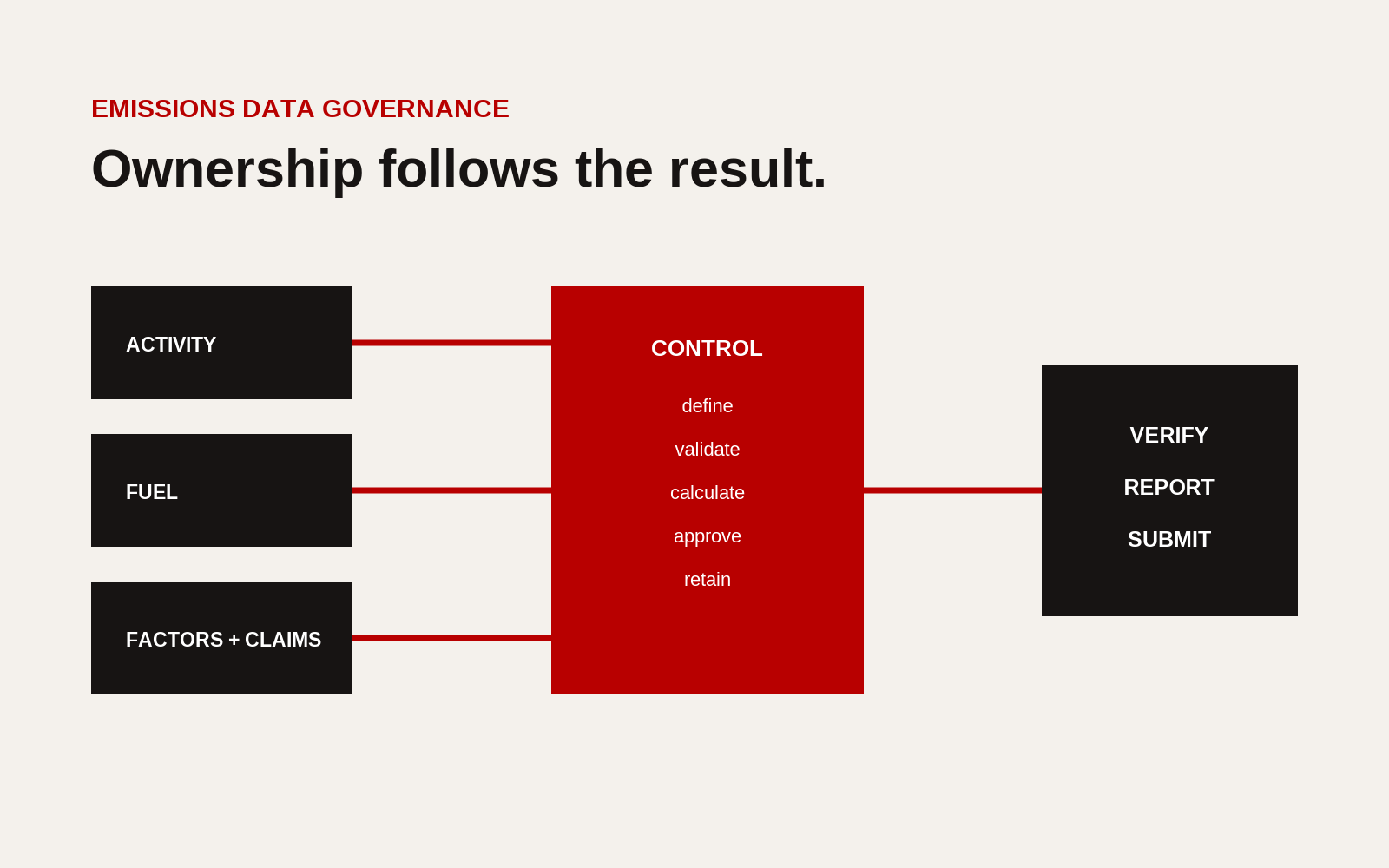
Maritime emissions data ownership map from vessel sources through controls, verification and public claims.
Create a data responsibility table
| Data object | Producer | Control owner | Accountable owner | Evidence |
|---|---|---|---|---|
| Voyage and port call | Vessel or voyage system | Fleet operations | ETS lead | Source log and classification |
| Fuel quantity | Vessel and suppliers | Technical operations | ETS lead | BDN, measurement and reconciliation |
| Factor and conversion | Controlled reference | Sustainability or compliance | ETS lead | Version and approval |
| Eligible-fuel claim | Procurement and supplier | Compliance and finance | Maritime operator | Purchase, certificate and delivery |
| Submitted report | Reporting team | Management and verifier | Maritime operator | Approved dataset and verification |
Add deputies, system locations and retention periods in the internal version.
Define data before connecting systems
Agree what each field means, its unit, time zone, source and permitted transformation. “Fuel consumed” can refer to purchased, transferred, measured or calculated quantities. A system connection does not resolve that ambiguity.
Create a data dictionary for vessel identifier, voyage boundary, port call, fuel type, consumption, factor, greenhouse gas, claim and correction. Link every derived field to its calculation and source version.
Then design the workflow. Automation can reduce copying, but it can also move an error faster.
Control corrections and missing data
Define who can change a source, calculation and final report. Preserve the original value, reason, evidence, approver and date.
Review missing data monthly. Group causes such as equipment failure, late supplier document, classification uncertainty or integration error. Assign corrective action to the cause, not just the blank cell.
The first UK maritime ETS reporting cycle guide provides deadline gates for putting these controls into operation.
Govern suppliers and platforms
For each data provider, define:
- data and ships covered;
- source and calculation responsibility;
- quality checks and exception handling;
- access roles and security;
- export format and portability;
- change notification;
- retention and exit process;
- support during verification.
Do not let a dashboard become the only place the operator can see its record. Ensure data and audit history can be exported in a usable form.
What should the website say?
The public site can state the service boundary, governance approach, methods supported and evidence available. It should not expose vessel routes, fuel purchases, account access or security details.
If the company provides reporting software or advisory work, say whether it collects, calculates, reviews, verifies or submits. “Compliance platform” is too broad when legal responsibility stays with the operator and independent verification has a separate role.
Publish a simple process: source, validate, calculate, review, verify and submit. Name the outputs and buyer responsibilities. Add a dated link to the relevant official guidance.
Test traceability in both directions
Select one reported emissions value and trace it back through calculation, factor, fuel record and activity source. Then choose one source record and trace how it appears in the report. Both directions matter.
Record every manual step and judgement. A spreadsheet can be controlled when access, formulas, versions and approvals are clear. An automated platform can be weak when no one understands a transformation.
Ask the verifier what sample and evidence format will be useful, while preserving independence. The operator should not wait until March to learn that a provider's export lacks source identifiers or change history.
Define retention and exit
Keep records for the period required by the applicable scheme and approved procedures. Align vendor contracts and internal storage with that obligation.
Before adopting a platform, test a full export of raw, transformed and audit data. Document formats, identifiers and dependencies. If the supplier relationship ends, the operator still needs to explain past reports.
Rehearse the exit with a sample ship and period. A contract promise about portability is less useful than an export the team has opened and traced.
Governance checklist
- Legal operator and fleet responsibility are confirmed.
- Each data object has a producer, controller and accountable owner.
- Definitions, units and time rules are documented.
- Calculations and factors are version-controlled.
- Corrections preserve reason, evidence and approval.
- Provider contracts cover access, export and exit.
- Verification evidence can be traced to source.
- Public claims match the actual service boundary.
- Sensitive operational data stays off the public site.
Review after a ship transfer, system change, provider change, fuel change or monitoring-plan variation.
Creatif Work designs marine websites that explain technical and governance roles accurately. Our custom software service can help map data ownership and replace fragile manual handoffs where the operating process justifies it.