

A Shipyard Supplier Page Built Around Integration Points

A shipyard buyer can usually find a supplier's product description. The harder question is how the package connects to the vessel, other suppliers and the yard programme.
A capability page built around integration points makes that question visible before detailed engineering begins.
What should an integration page contain?
Show the package boundary, incoming and outgoing physical connections, utilities, electrical supply, controls, alarms, data, safety functions, structural needs, test points, documents and responsibility. State which items are fixed, configurable or confirmed during project engineering.
France's maritime transition involves shipowners, yards, ports, energy providers and technology suppliers across one value chain. The Ministry's decarbonisation paper makes the value of integration clear even where the exact technology differs.
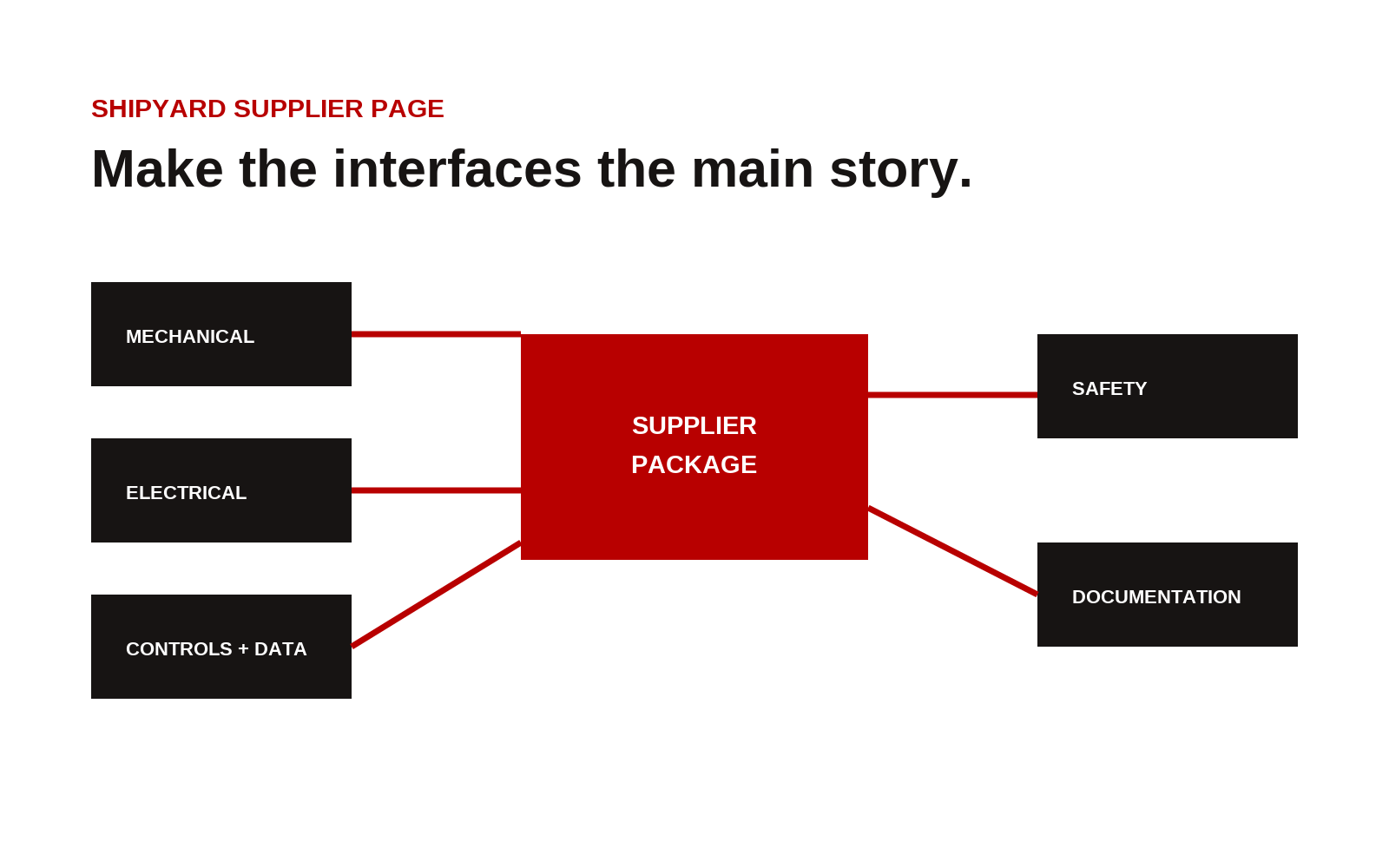
Shipyard integration map showing mechanical, electrical, controls, safety and documentation interfaces.
Use five interface groups
| Interface group | Information to publish | Detail to control privately |
|---|---|---|
| Mechanical | Connections, loads, clearances and service access | Project dimensions and calculations |
| Electrical | Supply range, load, protection and earthing concept | Single-line and cable schedules |
| Controls and data | Protocols, signals, alarms and remote access | Network design and security settings |
| Safety | Detection, shutdown, ventilation and fallback | Hazard study and cause-effect detail |
| Documentation | Drawings, manuals, certificates and as-built record | Project register and approvals |
The public page or diagram should orient the buyer. It should not publish security-sensitive or proprietary design information.
Define responsibility beside every interface
An interface list without ownership still leaves project risk. Use a representative responsibility matrix with these roles: supplier, yard, designer, owner, class and third-party package provider.
For each interface, identify who provides data, who reviews it, who approves the design, who installs it, who tests it and who retains the final record. State that the project matrix controls where it differs from the example.
This helps the buyer see that the supplier has an integration method, not merely experience.
Explain configuration control
Ship projects change. A connection size, protocol, foundation or alarm can move after another package develops. Explain how the supplier manages interface data:
- issue a dated interface document;
- record assumptions and open points;
- review changes with affected parties;
- approve and release the revised configuration;
- update test procedures and records;
- preserve the as-built state.
Name the platform only if it matters to the buyer. The control is more important than the software brand.
Link interfaces to tests
Every important interface should have a verification method. Visual inspection may suit one item, while measurement, functional test, simulation or integrated harbour test suits another.
Publish the test stages and acceptance ownership. For example, factory tests can prove internal package logic but not every vessel connection. Harbour and sea trials may close different evidence.
If the supplier uses a test rig, explain what it represents and what it does not. Do not imply full-vessel validation from a component test.
Use a project example with one difficult interface
Choose a case study where integration shaped the outcome. Explain the vessel context, package, difficult interface, parties involved, decision, test and accepted result.
Remove client-sensitive details but keep enough technical context to be credible. “Successful collaboration” is not the result. A closed compatibility issue, accepted test, reduced installation rework or controlled commissioning sequence is more useful.
Our overview of France's maritime decarbonisation chain helps suppliers decide where this integration offer fits commercially.
Build a qualified enquiry
Ask for vessel type, project stage, package, expected interface scope, location and required date. Offer a controlled technical workshop after initial fit is confirmed.
Do not accept sensitive vessel drawings through a basic contact form. Tell the buyer how confidential material will be exchanged and who leads the review.
Make the page usable during a bid
A technical manager may return to the page several times while building a bidder list. Keep the URL stable, show the update date and allow direct links to the interface, testing and documentation sections.
Offer a concise capability statement for internal circulation, but keep the core facts on the page. Downloads become detached from updates and are easily forwarded without context.
If the page covers several product families, let the user filter or navigate without hiding the full content from search and accessibility tools. Each family should still have a clear boundary and responsible contact.
Audit one live project against the page
Select a recent project and compare the public interface list with the actual interface register. Note missing groups, responsibility ambiguity and tests that were more important than expected.
Update the public method without copying sensitive detail. Repeat after a major package or vessel type changes. This keeps marketing tied to delivery experience and reveals where the stated process does not match practice.
Ask the yard or integrator which interface evidence reduced review time. That feedback can improve the next public page and controlled bid pack.
Publication checklist
- Package boundary is explicit.
- Five interface groups are covered where relevant.
- Responsibility is separated from capability.
- Fixed and configurable items are labelled.
- Change control and test stages are described.
- Examples have approved limits.
- Sensitive drawings stay controlled.
- Technical enquiry reaches an integration owner.
Creatif Work designs marine websites for yard, owner and procurement audiences. Our website service can turn existing interface and test material into an accurate public capability page that supports the next technical exchange.