

Website Content Audit: 25 Questions Before a Redesign

A redesign can make weak content look newer without making it more useful. Before wireframes, decide which pages support a real buyer decision, which claims have evidence and which material should not move to the new site.
These 25 questions create a working audit, not a cosmetic inventory.
What should a content audit decide?
It should decide the purpose, audience, evidence, status and owner of every important page. The result should mark content to keep, rewrite, merge, create or retire, plus required redirects and missing evidence. Do this before detailed design so the new layout is based on real content and responsibilities.
Google's people-first content guidance asks whether content serves an intended audience and provides first-hand expertise. Use that standard alongside business and technical review.
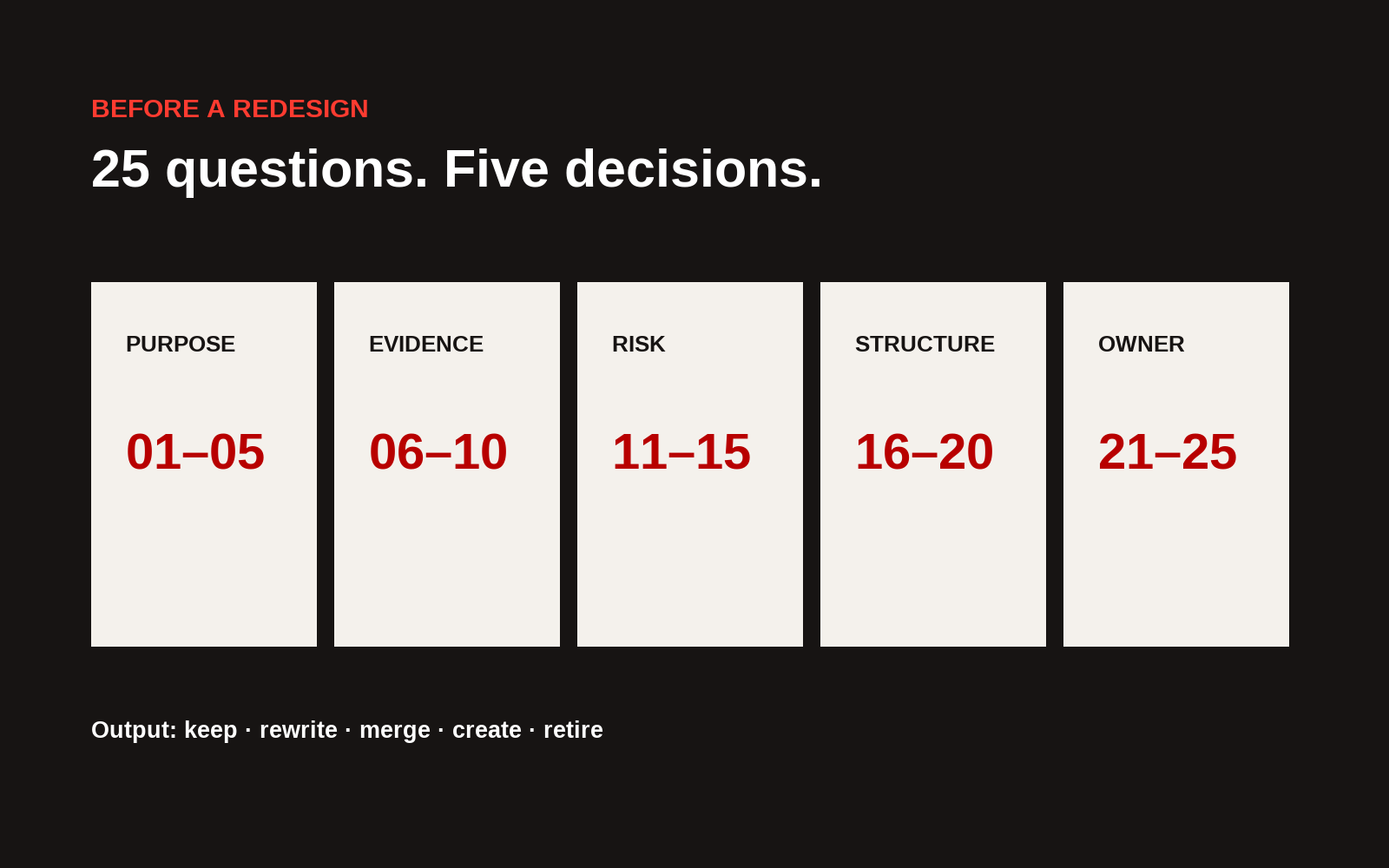
Website content audit board grouping 25 questions across purpose, evidence, structure, search and ownership.
Purpose and audience: questions 1 to 5
- What business decision does this page support?
- Who is the primary reader and what do they already know?
- What question should the page answer first?
- What should the reader do or understand next?
- Is another page trying to do the same job?
If a page has no decision, audience or next step, do not migrate it by default.
Scope and evidence: questions 6 to 10
- Is the service, product or capability still offered?
- Are scope, geography and exclusions accurate?
- Which claims need technical, legal or leadership approval?
- What original project, process or data evidence supports the page?
- Are results labelled as measured, calculated, specified or estimated?
Create an evidence gap list. Do not ask the writer to invent confidence where the business has not approved proof.
Accuracy and risk: questions 11 to 15
- Are prices, dates, standards and regulations current?
- Are certificates, partners and staff roles still valid?
- Do downloads match the visible page?
- Does the page expose confidential, personal or security-sensitive information?
- Could a reasonable buyer misunderstand responsibility or outcome?
Assign each risky fact an owner and review trigger. A launch date alone is not enough for changing information.
Structure and findability: questions 16 to 20
- Can a reader understand the page from its title and headings?
- Is the main answer available as text, not only an image or animation?
- Which service, product, project and contact pages should link to it?
- Does it compete with another URL for the same decision?
- What redirect is needed if the URL changes or retires?
Google's Search Essentials emphasise crawlable links and useful content. A visual redesign should preserve that basic access.
Ownership and maintenance: questions 21 to 25
- Who owns the facts after launch?
- What event should trigger an update?
- Which team approves changes?
- Can the content system represent the page without manual workarounds?
- How will success be measured beyond page views?
An owner should be a role or named person with authority to verify the content. “Marketing” is too broad when engineering controls the fact.
Turn answers into a migration register
Create one row per current URL with:
| Field | Purpose |
|---|---|
| Current and future URL | Track migration and redirect |
| Decision and audience | Preserve the page's job |
| Action | Keep, rewrite, merge, create or retire |
| Evidence gap | Name what must be supplied |
| Owner and approver | Control factual accuracy |
| Priority and due date | Sequence work before build |
Add analytics and link data as evidence, not as the decision by itself. A low-traffic compliance page may still be essential to a small procurement audience.
Audit before designing components
Designers need representative real content for tables, diagrams, downloads, project evidence, forms and long technical headings. If design begins with placeholder copy, teams discover late that the components cannot hold the material.
Select the hardest examples early: the deepest product page, the most complex case study, the largest comparison and the most conditional claim. Design for those, then simpler pages will fit.
Our 90-day content review provides the lighter operating cycle to use after launch.
Do not migrate these problems unchanged
- duplicate pages aimed at the same decision;
- unsupported superlatives;
- expired staff, partner or certificate information;
- PDFs that duplicate weak page copy;
- project galleries without scope or outcome;
- generic contact forms with no routing owner;
- old campaign pages still indexable without purpose.
Record why content was removed and where any useful material moved. This prevents the same page returning during stakeholder review.
Validate the audit with real tasks
Give representative users three tasks, such as finding a suitable service, checking a technical claim and contacting the correct team. Observe which current pages they use, where they hesitate and which evidence they seek.
Compare this behaviour with the planned structure. Stakeholder preferences may not match buyer needs. A director may value a long company history while procurement needs scope, certificates and project evidence first.
Use the tasks again on the proposed sitemap and early content. This tests whether the audit decisions improve the journey before visual design is complete.
Agree the launch content freeze
Set a date when facts, URLs and approved copy enter final quality control. New requests after that point should be assessed for launch necessity and migration risk.
Keep a post-launch backlog for useful additions that do not block release. This protects testing from endless copy movement while keeping stakeholder requests visible.
Creatif Work starts website projects with the buyer journey, real evidence and content ownership. We can audit the current site, build the migration register and design the new system around approved material rather than placeholders.