

Engineering Document Portals: Revisions, Approvals and Customer Access

An engineering document portal should tell the authorised customer which revision they can use, who released it and what changed. File storage alone cannot answer those questions. Specify document identity, lifecycle states, approval authority and customer visibility before choosing screens or technology.
A project folder contains drawing files called final, final-updated and final-approved. A customer opens a link from an older message. The latest upload has not completed technical review. The portal can display every file while leaving the customer uncertain which one was actually released for their task.
This guide focuses on controlled document lifecycle, beyond the broader public/private website architecture. It covers metadata, numbering, review, approval, release, customer access, superseded records and export. Microsoft SharePoint documentation provides platform examples, not a universal implementation recipe. No portal described here is claimed to meet an engineering standard or provide certification.
All drawing identities and records are fictional teaching examples. Generated photographs illustrate review work and do not depict real customer drawings or approvals. Use the document workflow workbook or editable CSV registers. Both are ungated. The five public tables provide equivalent planning questions without exposing protected records.
Give the document a stable identity
A document identity should survive filename changes, uploads and interface redesigns. Record the document number, project or equipment context, title and owner. Then record each revision separately. A file's storage URL and a document's business identity are related but different. Confusing them can make history difficult to reconstruct.
Choose the numbering rule with the business. It may include project, discipline and sequence, or another existing convention. Do not impose a new format simply because the portal can generate one. Inspect actual records and exceptions. If imported material has inconsistent numbering, decide how it will be reconciled without losing the identity customers already use.
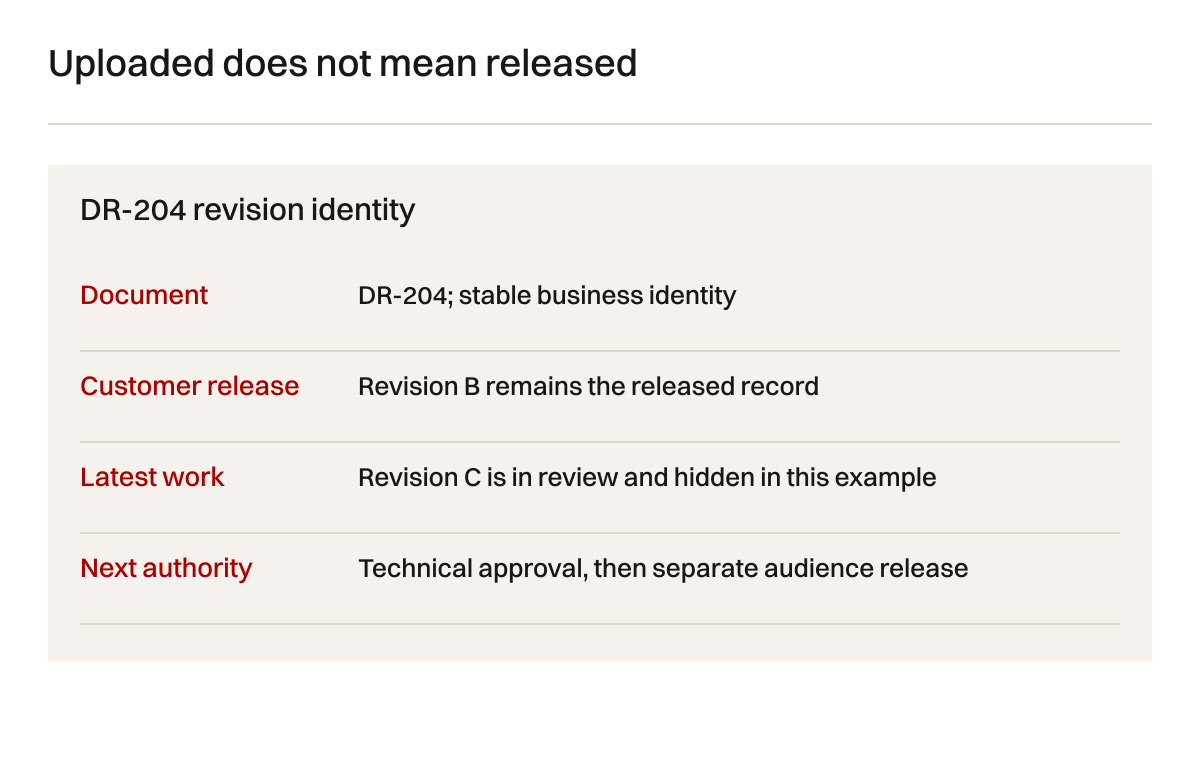
The fictional document DR-204 has revisions A, B and C. Revision B was released to a particular customer group. Revision C is undergoing review. The current storage timestamp belongs to C, but the current authorised customer document remains B until the release decision changes. A “latest uploaded” sort cannot settle that distinction.
Keep author, reviewer and releaser identities appropriate to the operating record. A role may change hands over time, but a historical approval should remain understandable. The portal needs to explain who acted with which authority. It should not rewrite old approvals to the name of the person who currently holds the role.
Table 1: document metadata and its purpose. The identifiers are fictional. Actual fields and conventions need business approval.
| Field | Why it matters | Source owner | Acceptance question |
|---|---|---|---|
| Document number | Stable business identity | Document controller | Can users distinguish similarly named files? |
| Revision | Identifies the technical iteration | Technical owner | Does it agree with the released file? |
| Title and context | Explains applicability | Project or equipment owner | Is the intended task clear? |
| Lifecycle state | Distinguishes draft and release | Workflow owner | Can a customer mistake a draft for released material? |
| Approval record | Explains authorised technical decision | Named approver | Which revision was actually approved? |
| Release record | Defines audience and issue event | Authorised releaser | Who could access what, and when? |
Separate technical revision from storage version. A platform may create several saved versions while an engineer prepares one revision. Conversely, a released revision may include several files. Decide how these concepts map. Do not expose a storage counter as an engineering revision without a reviewed rule.
Define lifecycle states in terms of actions
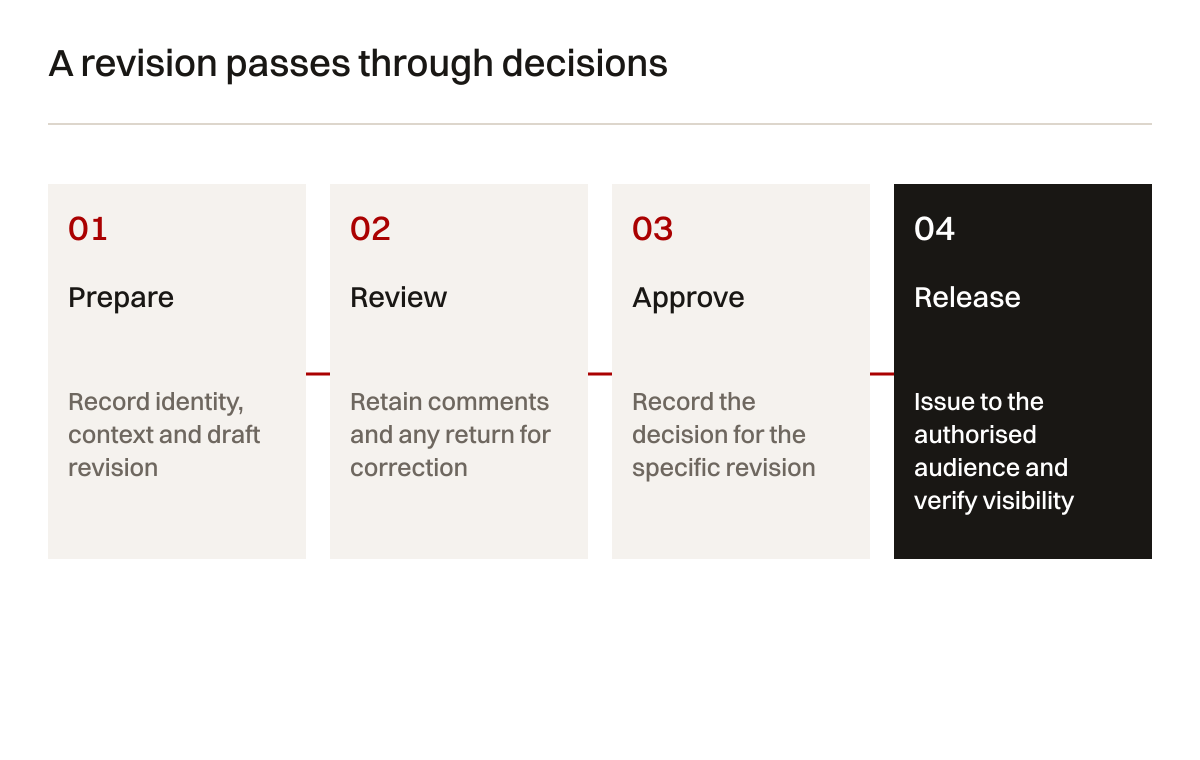
State names should explain what can happen next. Draft means preparation is incomplete. Review means a named decision is being requested. Approved means the specified decision was recorded. Released means an authorised audience can access the identified material under the agreed conditions. Superseded and withdrawn need their own consequences.
Table 2: proposed lifecycle states. These are requirements for the fictional workflow, not a claim about every platform's default behaviour.
| State | Meaning | Permitted next action | Customer visibility |
|---|---|---|---|
| Draft | Work in preparation | Edit or request review | Hidden in this example |
| In review | Named review outstanding | Comment, approve or return | Hidden in this example |
| Approved | Specified revision accepted | Authorised release decision | Not automatically visible |
| Released | Material issued to approved audience | Access, acknowledge or supersede | Visible to intended customers |
| Superseded | New release replaces current use | Historical access if approved | Clearly labelled if retained |
| Withdrawn | Use or access revoked under a decision | Clarification or replacement route | Controlled by withdrawal policy |
Allow a revision to return from review with comments. Do not delete the review event to make the record look clean. The engineer needs to know why it returned and which requested changes remain. A later approval should identify the reviewed revision rather than ambiguously approve the document family forever.
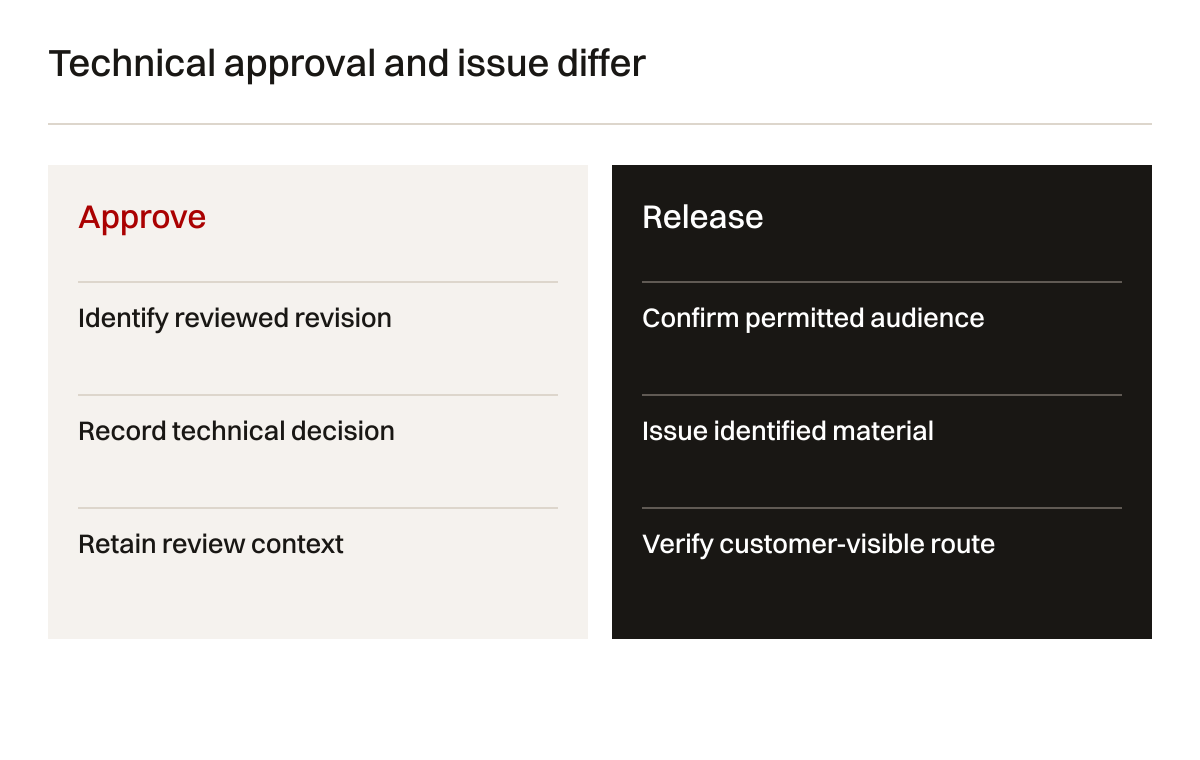
Approval and release can be held by different people. An engineer may approve technical content. A document controller may issue it to the customer. A commercial or project owner may limit the audience. The portal should preserve that division when it exists rather than combine all authority into a convenient upload button.
Microsoft's content approval guidance describes approval settings and visibility conditions. Inspect the actual library configuration. Turning on an approval requirement is not proof that drafts are hidden correctly from every user. Existing material and permission settings need particular attention.
Make the released revision obvious to the customer
The customer's ordinary task should start with a clear released record, not a folder of competing files. Show the document identity, revision, release status and applicable context. If a newer revision is in review, decide whether the customer should see any notice. Do not imply that the unreleased file is usable merely because its date is later.
Use descriptive download labels. A button can name the document and revision without exposing unnecessary internal metadata. Keep relevant instructions readable as text. A customer using a phone should not need to zoom into a screenshot to discover that a drawing is superseded. Accessibility and task clarity belong in the acceptance criteria.
If the portal preserves historical revisions, make their status explicit. A customer may need to understand what was issued at a previous project stage. That historical task is different from finding today's permitted material. Provide a deliberate path rather than mix archive records into the default current view without labels.
Check direct links as well as the portal listing. A user may open a bookmark or an old email. The destination should enforce the agreed access and revision policy. Removing a file from the current list does not necessarily prevent access through a retained storage URL. The implementation must test both paths.
Do not claim acknowledgement means correct technical use. A download event may show that an authenticated user accessed a file under the system's definition. It does not prove they read every page or applied the drawing correctly. If acknowledgement is required, define what the user affirms and preserve the appropriate record.
Use permissions based on the actual roles
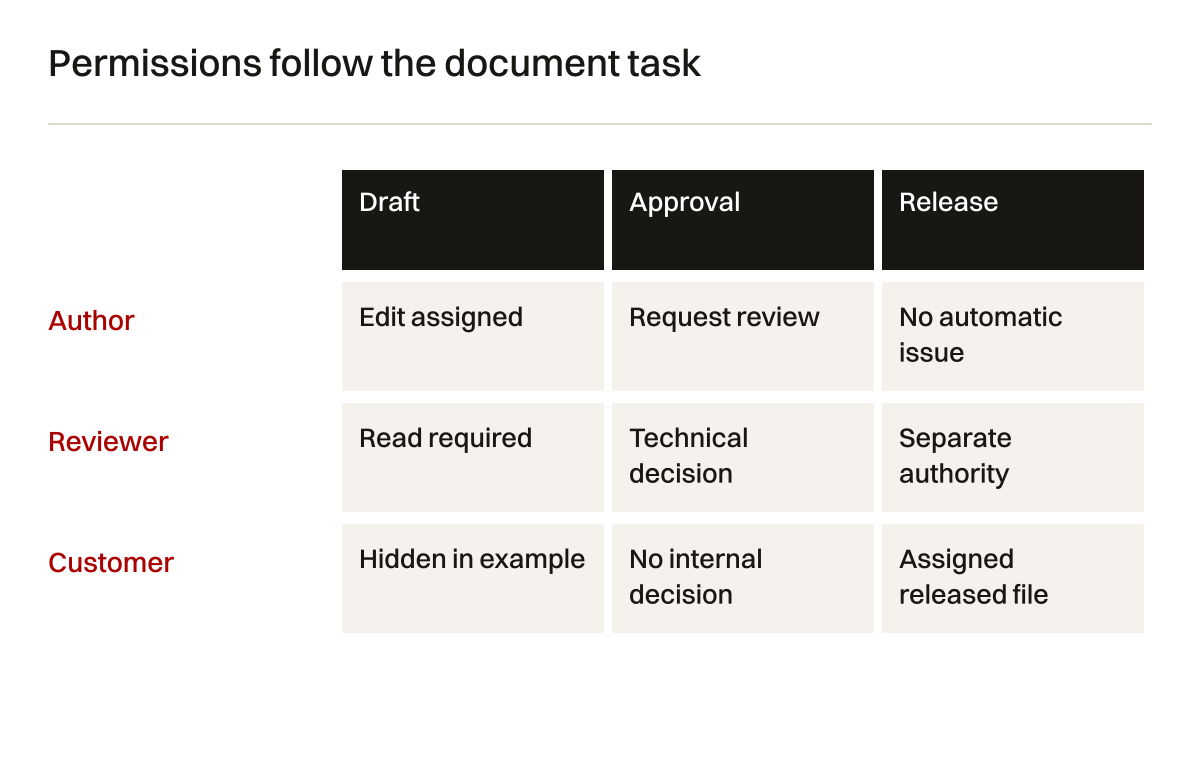
Write the task permissions before building the screen. Who can upload a draft? Who can review it? Who can approve technical content? Who can release it externally? Who can withdraw a record? Who can view a historical revision? A single “administrator” label often hides several business decisions.
Table 3: role and document permissions. The example distinguishes editing, technical approval and external issue. One person may hold several authorised roles.
| Role | Draft access | Review or approval | Release authority |
|---|---|---|---|
| Document author | Edit assigned material | Request review and address comments | No automatic external release |
| Technical reviewer | Read required drafts | Record technical decision | Only if separately authorised |
| Document controller | Manage identity and records | Check completeness | Issue approved material under policy |
| Project owner | Inspect permitted context | Approve audience or project decision | Defined scope only |
| Customer | Access released assigned records | Clarify or acknowledge if required | No internal approval authority |
| System administrator | Maintain technical operation | No inferred technical approval | No inferred business release authority |
Microsoft's permission-level documentation explains inheritance and available roles. Inspect actual site, library and item permissions. Sharing an individual record can change the access pattern. A role matrix in the requirements document does not prove the configured platform implements it.
Test with separate representative identities. An administrator seeing a file is not evidence of customer visibility. A customer from organisation A should not see organisation B's protected records. A departed user's access should follow the approved removal procedure. Use controlled fictional documents for acceptance tests before real material is exposed.
Inspect external sharing at every relevant level
SharePoint's external sharing overview explains available sharing arrangements and ways to stop access. The organisation sharing settings guidance describes controls at organisation and site levels. A portal design needs to respect the actual configuration rather than assume one invitation setting governs everything.
Choose the sharing mode according to the protected task. An unauthenticated link is different from an invited customer account. If the business requires user-specific access and accountability, inspect whether the chosen route can support that requirement. Do not describe an anyone-link as customer authentication because it is difficult to guess.
Document invitation and removal tasks. Who confirms the customer's organisation? Who approves additional users? What happens when the customer's contact leaves? A portal can keep an account active indefinitely unless the operating workflow supplies a removal trigger. Customer permissions need business ownership after launch.
Understand revocation limits. Removing access from the portal does not recall copies already downloaded or forwarded outside it. If the business needs a controlled document-use arrangement, the system requirements and operating terms need separate review. Technology can enforce a route without guaranteeing control over every external copy.
Keep public search separate. Approved capability pages and generic product information can serve public discovery. Protected customer drawings and project records need the agreed access boundary. A noindex directive is not a substitute for authentication. The earlier public and private engineering guide explains the wider architecture.

Generated illustrative photograph. The drawings are fictional and do not represent an actual review, release or engineering approval.
Preserve history without confusing it with backup
Microsoft's version-history overview describes viewing, restoring and tracking previous versions. This can support document work. Decide the actual retention and version settings for the library. The presence of a history feature is not proof that every required revision remains available under the chosen configuration.
The restore instructions describe returning to previous material. Restoration changes the current platform record under that behaviour. In a controlled engineering workflow, ask whether the restored content needs renewed review and release. Do not equate restoring an old file with issuing a currently approved engineering revision.
Keep history and recovery decisions separate. Version history helps inspect changes to a document. A broader recovery requirement concerns the system, records, metadata, permissions and dependencies. If the portal must be recovered after an account or platform problem, define and test that task under the actual environment. A version menu cannot settle it alone.
Record exports in terms of the intended use. A folder of PDFs can preserve visible files while losing revision relationships, approval events and release audiences. An export requirement should say which records and identifiers must remain understandable outside the portal. Test the receiving person's ability to reconstruct the approved release from that export.
Decide whether checkout serves the workflow
Microsoft's checkout and check-in guidance describes how files can be reserved for editing and returned with change comments. Whether that control is appropriate depends on how the team works. It is not an engineering approval decision.
A team editing one controlled drawing file may need to prevent simultaneous edits. A team collaborating on a draft report may have different requirements. Inspect the platform and file type. Do not enable every available control simply to make the portal sound more governed. Each control should answer a real task or failure condition.
Define the unavailable-author exception. A file can remain checked out while its editor is absent. The administrator may have a permitted override route, but the business should decide when it can be used and how the action is recorded. An override should not silently imply technical review of the content being recovered.
Keep change comments meaningful. “Updated” tells the next reviewer little. A comment that identifies the revised dimension reference, corrected title or returned review issue gives context. The comment still needs to agree with the actual file and should avoid private customer information in places visible to a broader audience.
Plan withdrawal and supersession as real tasks
Supersession means a later release replaces the permitted current use under the agreed rule. Withdrawal can mean access or use is revoked because of a decision or discovered issue. Those states may require different notifications, access changes and archive treatment. Define them separately rather than apply a generic “inactive” label.
For fictional DR-204, revision C is approved and released to the authorised customer group. Revision B becomes superseded. Its historical record remains identifiable, but the ordinary current task now points to C. Old direct links follow the approved policy and do not silently appear current. Customers have a clear clarification route if the context is uncertain.
If C is later withdrawn, the business must decide what the customer can access and what should replace it. A portal should not automatically restore B as approved current use unless that decision has been made. The file history may make B available technically, but availability and permission to use it are different facts.
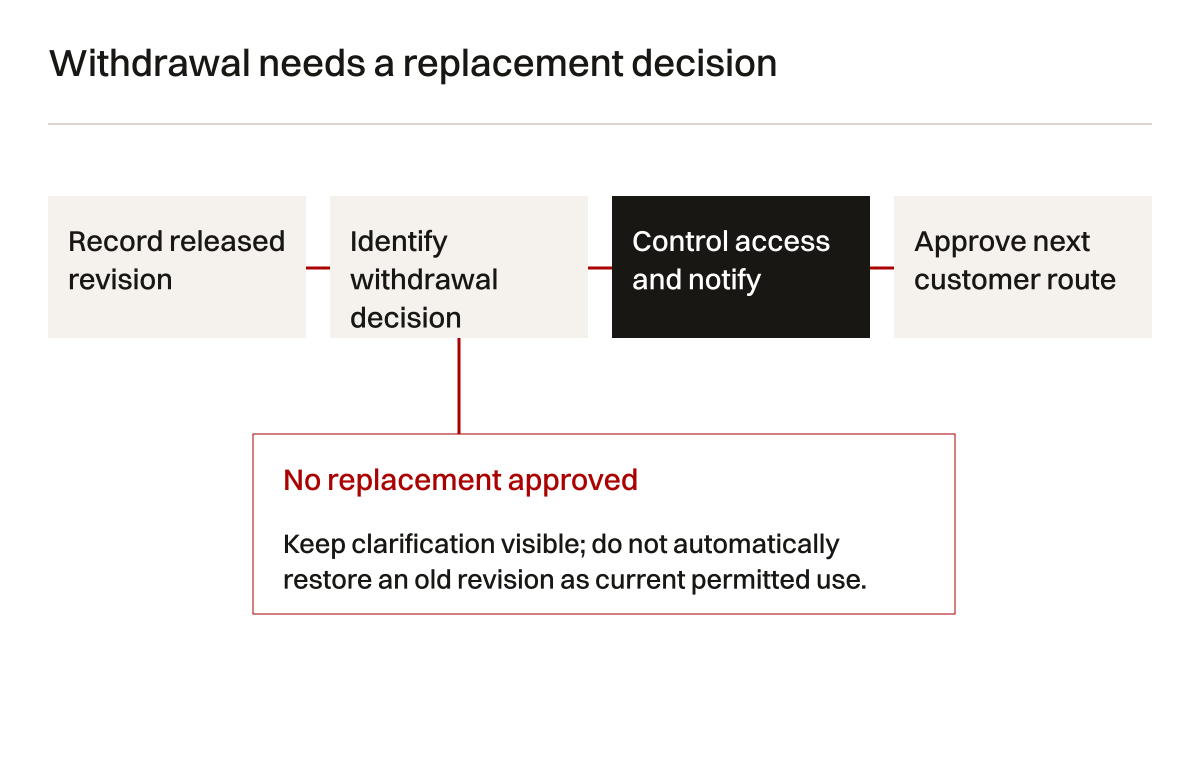
Notification acceptance needs its own evidence. A change recorded in the database is not proof that the customer was informed. A sent email is not proof of reading. Define the appropriate required action and retain the actual event. Do not guarantee complete control of downstream copies or customer behaviour.
Test tasks rather than admire the document list
Choose scenarios that expose the boundary. A customer finds the current release. An author submits a revision. A reviewer returns it. A controller issues the approved file. Another customer tries an unauthorised direct link. A withdrawn revision cannot be mistaken for current material. Those tasks tell you more than a screenshot of a tidy folder.
Table 4: portal acceptance tests. Inputs are controlled fictional files and identities. Record actual conditions and remaining limits.
| Task | Scenario | Required evidence | Limit |
|---|---|---|---|
| Find current release | B released while C is in review | Customer identifies and opens B | No technical-use competence implied |
| Review revision | Reviewer returns C with comment | State and comment retained | Approval remains outstanding |
| Controlled release | C approved for one audience | Correct file becomes visible to that audience | Other audiences tested separately |
| Reject unauthorised access | Different customer uses direct link | Access boundary enforced | Downloaded outside copies are not recalled |
| Supersede or withdraw | Current revision changes status | Listing and direct route follow policy | Customer understanding needs its own process |
| Export history | Receive selected document records | Revision and release context remain understandable | Full system recovery is separate |
Use a small declared inventory to explain reporting. A fictional review contains six documents: three released, two in review and one withdrawn. Three of six are released, or 50%. That number is not a quality score. A project may correctly keep most documents in review, or one withdrawn document may require urgent customer clarification. The counts cannot decide the next action by themselves.
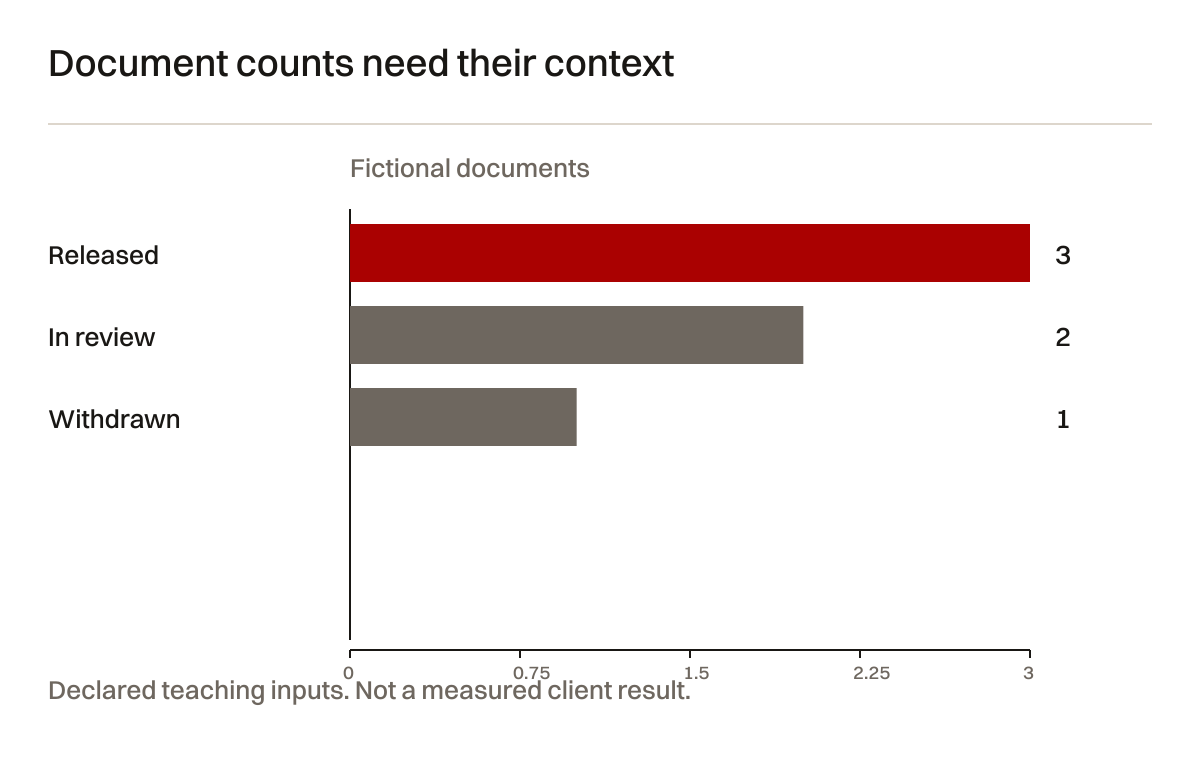
Measure useful operational questions instead. Can a customer identify the correct revision? Are reviews waiting on a named decision? Are required metadata fields missing? Has a withdrawn release reached its notification task? Define the measure and its limits before building a dashboard. Counts and elapsed times do not establish engineering correctness.
Keep standards and certification claims precise
A document portal may support a company's procedures. It does not automatically make the company certified or the workflow conformant with a particular engineering standard. The responsible quality or technical owner needs to identify applicable requirements, edition and actual evidence. Do not use a generic software feature list as a conformity assessment.
The official ISO 9001 page illustrates why edition and status checks matter: the referenced 2015 edition is labelled withdrawn at the time of research and points users to a newer edition. This public summary is not the full standard. It cannot establish that the fictional workflow satisfies detailed requirements or the company's transition arrangements.
If a client asks for a standards claim, obtain the actual approved basis and appropriate specialist review. The system requirements can then identify the operating records and tests needed to support that specific procedure. Until that evidence exists, describe the portal's actual behaviour without adding certification language to the public page.
Hand over the document workflow
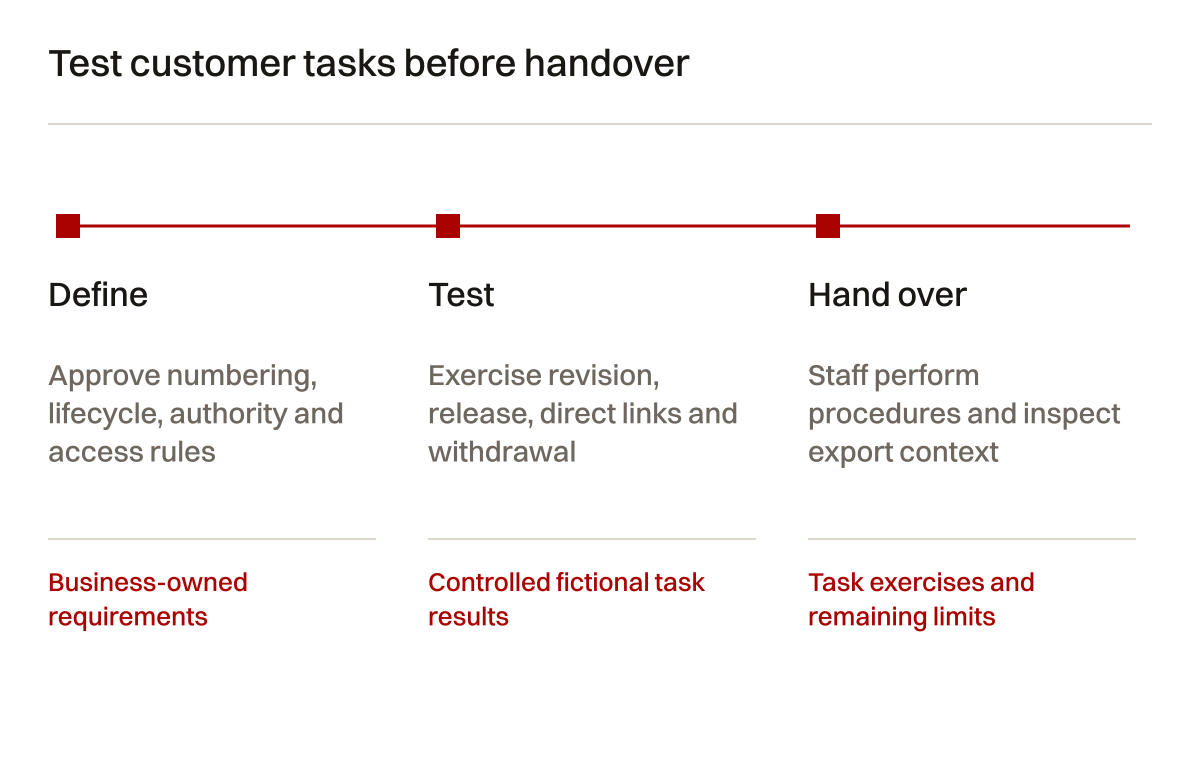
The receiving team needs more than account access. Give it the metadata rules, lifecycle definitions, permission model, customer invitation route, release procedure and exception runbook. Include examples of a returned review, superseded revision and withdrawn release. These are the cases staff are likely to misunderstand when the original builder is absent.
Table 5: operating handover and owners. Assign actual names privately and retain the business's approval authority.
| Material or task | Business owner | Working role | Handover exercise |
|---|---|---|---|
| Metadata convention | Document-control lead | Author and controller | Identify a model document and revision |
| Technical review | Technical lead | Authorised reviewer | Return and approve a fictional revision |
| External release | Project or commercial owner | Document controller | Issue to correct customer audience |
| Customer access | Account authority | Portal administrator | Invite and remove a controlled user |
| Withdrawal | Authorised technical decision maker | Controller and administrator | Revoke and clarify a fictional release |
| Export and support | System business owner | Maintainer | Reconstruct a record and handle an exception |
Ask staff to perform the task with the instructions. If they need the developer to interpret every status, revise the instructions or interface. Attendance at training does not prove independent operation. Retain the questions raised because they often reveal unclear business rules rather than purely technical faults.

Generated illustrative photograph. It does not show protected customer records or establish a deployed portal.
Run DR-204 through a complete lifecycle
The author prepares fictional revision C while B remains the released record. The portal stores C with its identity and draft status. The reviewer returns it with a specific comment. The author resolves that issue and requests review again. The approval event identifies C and the authorised reviewer rather than only the document number.
The controller checks completeness and the intended audience. A separate release event exposes C to the approved customer group. B becomes superseded under the defined policy. A customer opening the normal current view sees C. A customer opening an old link sees the appropriate historical status or controlled route. Another organisation cannot access either protected record.
The business then exercises withdrawal using a safe fictional condition. The controller records the authorised decision. Current access and notifications follow the policy. The system does not automatically substitute an old revision as approved current use. The quality or technical owner decides the replacement or clarification route.
Finally, the team exports the selected record history. The receiving person can identify which revision was approved, released, superseded and withdrawn. Any missing metadata is logged. This exercise establishes a tested task sequence, not certification, universal security or complete control over files previously downloaded by customers.
Questions about engineering document portals
Exercise the imported archive before adding current work
Imported records deserve a separate acceptance sample. Select two revisions of the same fictional document, one released record and one file with missing metadata. Ask the importer to preserve the stable identity and flag the incomplete record. Do not let a filename parser declare technical approval because the word “approved” appears in a name. The business needs to approve how historical labels map to lifecycle states.
Check what happens when the source contains the same revision twice. They may be identical copies, different file formats or conflicting content. Those cases require different decisions. The importer can identify the condition and route it to the controller. It should not pick the newest storage timestamp and erase the other record without an approved rule.
Then perform the customer task using the imported sample. Can the user identify the released revision and distinguish the historical copy? Does the direct link enforce the same audience boundary as the list? Does a missing title produce an understandable review task instead of a misleading public placeholder? These questions test the actual import consequence, not just whether the upload completed.
Keep a mapping report with source identity, destination identity, revision, state and exception. The report should allow the controller to reconcile each accepted sample without exposing real protected files broadly. A total imported-file count is useful as one observation, but cannot establish correct revision relationships or permissions.
Check the meaning of restore and reissue
Use another fictional exercise in which a user restores an earlier platform version. Inspect what the system now treats as current storage content. Ask whether the business revision field changed and whether any approval or release record still points to the right file. If the content changed while the released revision label stayed the same, the workflow needs an explicit decision before customers use it.
A correction may need a new technical review even if its aim is to return to earlier content. The responsible owner should determine that rule. The portal can enforce the required path once it is defined. It cannot decide independently that a historically approved file is suitable for every current project context.
Finally, exercise staff absence. The normal reviewer is unavailable and a customer needs clarification. The system should expose the named fallback or escalation route without quietly granting an administrator technical authority. The controller can prepare the record, but the approval belongs to a person authorised under the actual procedure. This makes the exception workable when the ordinary sequence cannot proceed.
Retain the findings as requirements or operating notes. If a task cannot be tested because the policy is unknown, record the missing business decision. Do not disguise that uncertainty as a software defect or resolve it by widening access. The right implementation follows an approved rule that the business and customer-facing team can explain.
Is the newest uploaded file the current approved drawing?
Not necessarily. A newer upload can remain in review while an earlier revision is the released record. Define technical revision, approval and release separately. The customer-facing view should answer the permitted-use task rather than rely on a storage timestamp.
Does version history replace an approval process?
No. History can show changes and support restoration under the platform's configuration. Approval records identify a business or technical decision. Release records identify audience and issue. Keep those concepts distinct and test the workflow that connects them.
Can revoking a link recall every downloaded copy?
No. Portal access controls affect the routes they govern. Copies already downloaded or forwarded need separate operating and contractual consideration. Define withdrawal and notification requirements without promising universal external-file control.
Does this workflow meet ISO requirements?
This guide does not make that claim. The responsible owner must identify the applicable current requirements and appropriate evidence. Official summaries and software features are not a full conformity assessment. Describe actual portal behaviour until a specific claim has an approved basis.
Should protected documents be indexed for SEO?
Public discovery belongs to approved capability and product information. Protected customer drawings need the agreed access boundary. Indexing directives do not replace authentication. Keep the public website and private document tasks separately scoped.
What demonstrates a successful handover?
Representative staff can find the correct revision, conduct a review, release to the proper audience and handle an exception using the supplied material. The evidence should identify tested conditions and remaining limits. A meeting attendance list or password delivery alone cannot establish those tasks.
Bring the revision customers struggle to identify
Start with a safe representative document, its current numbering convention and the decision that makes it usable by a customer. Creatif Work's web-app work and custom software work can specify the lifecycle and exceptions before implementation. Website work serves the approved public side.
Keep search work tied to public capability information. The protected document workflow needs its own operating acceptance. Start with the problem.
Sources checked for this guide
Official documents checked on 4 October 2026. Platform settings and product editions need inspection in the actual environment. The ISO summary is cited only for status and scope limits.