

SEO for Industrial Product Catalogues: Specifications, PDFs and Filters

Industrial catalogue SEO starts with reliable product records and useful public pages. Give each family and model a clear place, preserve identifiers and units, identify current documents, and decide which filtered views deserve search discovery. A larger URL inventory does not necessarily make a catalogue easier to find or use.
A buyer knows the part number but finds three nearly identical pages. One has an old specification PDF. Another omits the operating conditions. A third appears only after several filter selections. The website can display the catalogue while still making it difficult to identify the correct product or submit a useful enquiry.
This guide focuses on catalogue implementation. It covers architecture, part numbers, specifications, documents, filters, discontinued products and enquiry routing. It does not provide engineering selection approval or promise rankings. All product records and numerical examples are fictional teaching material. Generated photographs illustrate catalogue work rather than actual equipment testing or client projects.
Use the product catalogue workbook and editable CSV pack. Both are ungated. The five public tables provide a web-readable equivalent. Replace the example records with approved data and keep protected customer specifications in a private system.
Define the buyer tasks before choosing page templates
Industrial buyers arrive with different amounts of information. Some know a manufacturer and exact model. Others know a required function, a material or a connection type. A procurement buyer may need the approved distributor and availability route. A technical reviewer may need a drawing revision. One generic catalogue page cannot serve all those tasks equally well.
Write the tasks using actual enquiry language. “Find model VX-20 and its current dimensional drawing” is specific enough to test. “Improve product visibility” is not. Identify what the buyer must recognise, compare or provide before the next step. Then decide whether a family page, model page, document index or search function best supports that task.
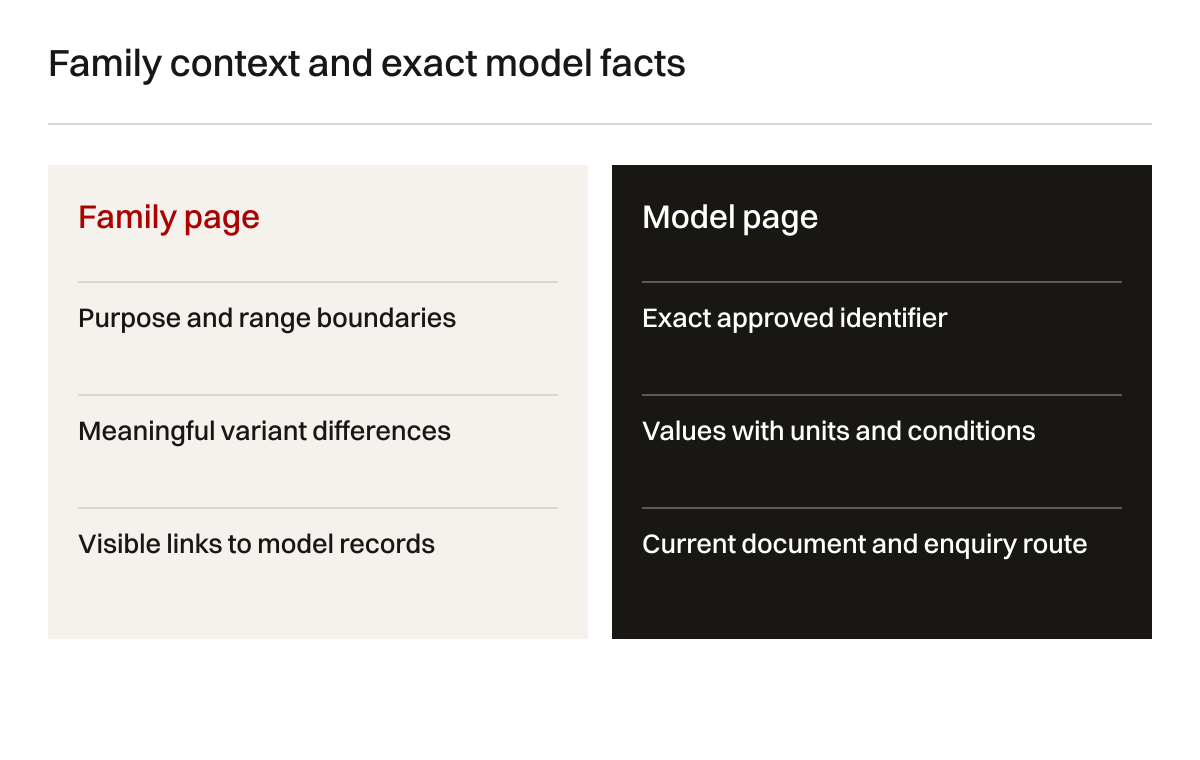
A fictional valve supplier illustrates the structure. The family page explains the product purpose and approved variation boundaries. A model page identifies the exact code and current specification. A document link names the drawing revision. The enquiry form preserves the model reference so a sales coordinator does not have to infer it from a visitor's free text.
Internal catalogue search and external search are different mechanisms. A good on-site search can help a buyer who already reached the website. A crawlable public hierarchy helps search systems discover useful addresses. Do not assume a product available through a JavaScript filter also has an independently discoverable, stable public page.
Keep private records separate. Customer-specific drawings, quoted prices, negotiated stock allocations and protected test certificates may belong behind appropriate access controls. Those records should not become public SEO pages merely because the portal can display them. Public product information needs its own approval and document policy.
Build a product record that survives presentation changes
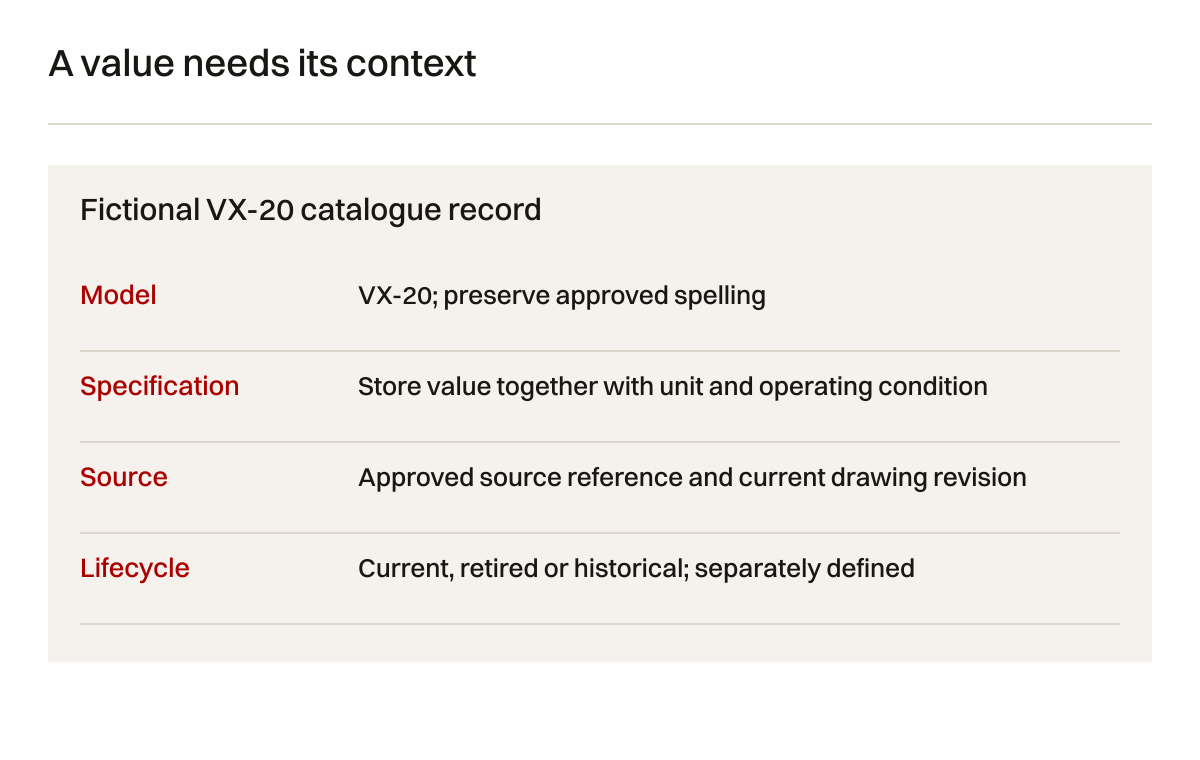
The content model should exist independently of the page layout. Store a stable internal identifier, public model code, manufacturer identity where approved, family membership and lifecycle status. Keep technical values with their units and operating conditions. A spreadsheet cell containing “20” does not tell an editor whether the value is diameter, pressure or temperature.
Choose one authoritative source for each field. The manufacturer may own the specification. The distributor may own local availability and enquiry routing. The engineering team may approve an application explanation. Treat those as different sources rather than copy everything from whichever PDF is easiest to find.
Table 1: product information and source ownership. The values described here are field requirements, not specifications for real products.
| Information | Required context | Source owner | Acceptance check |
|---|---|---|---|
| Model or part number | Exact spelling and approved variants | Product owner | Search and page preserve the identifier |
| Technical value | Unit, condition and applicability | Technical source owner | Page matches approved source |
| Product family | Real relationship and useful description | Catalogue owner | Buyer can navigate family to model |
| Current document | Title, revision and release status | Document controller | Link opens the intended revision |
| Availability | Region and confirmation conditions | Commercial owner | No unsupported stock guarantee |
| Enquiry route | Model context and required details | Sales operations | Received request retains reference |
Do not merge similar identifiers without approval. A hyphen, suffix or material code can distinguish products that look alike. Normalising spelling for search may help retrieval, but the displayed approved identifier should remain correct. Keep synonyms as controlled search aids rather than quietly rename a product to match a popular query.
Plan imports with validation. A model needs a family reference that exists. A specification needs a unit. A document needs a usable address and revision status. Missing information should create a review queue, not silently fill with defaults. The site can publish a limited accurate record while the technical owner resolves a field, if the resulting page still serves a useful approved purpose.
Make category and model pages do different jobs
A family page helps someone understand the range and select a narrower path. It should explain shared purpose, meaningful differences and the information needed for selection. A model page gives the exact record. Avoid repeating the same long paragraph on every model while burying the distinguishing fields at the bottom.
Use visible links through the hierarchy. A buyer should reach model pages from the family and return without reconstructing filter selections. Important product content should not exist only in an internal search result. Stable model addresses also support manufacturer references, quotations and documents that link back to the website.
Write titles that distinguish the model and its role. A title consisting only of “Product” is difficult to assess. A title packed with unrelated keyword variations is also unhelpful. Preserve the model code and explain the product type with approved terminology. The opening text should clarify what the record covers and when technical confirmation is required.
Related products need a valid relationship. Alternatives can differ in dimensions, material or approvals. An editor should not label another item as a direct replacement because it is commercially convenient. Ask the technical owner whether the relationship is a compatible substitute, a newer family, a comparison candidate or simply a related product.
Google's product structured-data introduction describes supported search features and their requirements. Choose a format based on the actual page and offer. A quotation-only industrial record is not automatically eligible for every merchant feature. Valid markup does not guarantee a rich result or replace accurate visible content.
For genuine variants, review Google's variant documentation. The implementation needs to match the real relationships and supported properties. Do not invent offers, customer reviews or stock data to satisfy a testing tool. Keep structured fields reconciled with the approved product record.
Keep specifications readable and technically bounded
Put the essential approved information in readable HTML where it helps the buyer. A specification table can make model differences easier to compare. A PDF can carry detailed drawings or documentation that has its own revision controls. Neither format removes the need to explain the source and applicable conditions.
Suppose the fictional VX-20 record includes a nominal diameter, connection type and operating limit. The limit must retain its unit and the condition under which it applies. Do not separate the number from the source's qualification. A shorter web table that changes technical meaning is not an acceptable adaptation.
If the source distinguishes nominal and actual dimensions, preserve that distinction. If values vary by material or configuration, show the relevant scope. An editor translating a brochure should ask about unfamiliar units and abbreviations rather than make a confident guess. A page that requires technical review can remain unpublished until those questions are answered.
Make mobile tables usable. Keep real headers, readable units and captions. A horizontal table can scroll within its region when necessary, but it should not make the whole page overflow. Critical warnings should also appear in ordinary text. A figure or screenshot is not the only place a buyer should find an important operating condition.

Generated illustrative photograph. It does not establish a product dimension, inspection result or engineering approval.
Connect PDFs to the product and its revision
A PDF can be discoverable. Google's indexable file-types documentation includes PDF among supported formats. That does not mean every file will be indexed or that a PDF alone gives buyers the best route through a catalogue. Decide the role of the document and its relationship to the page.
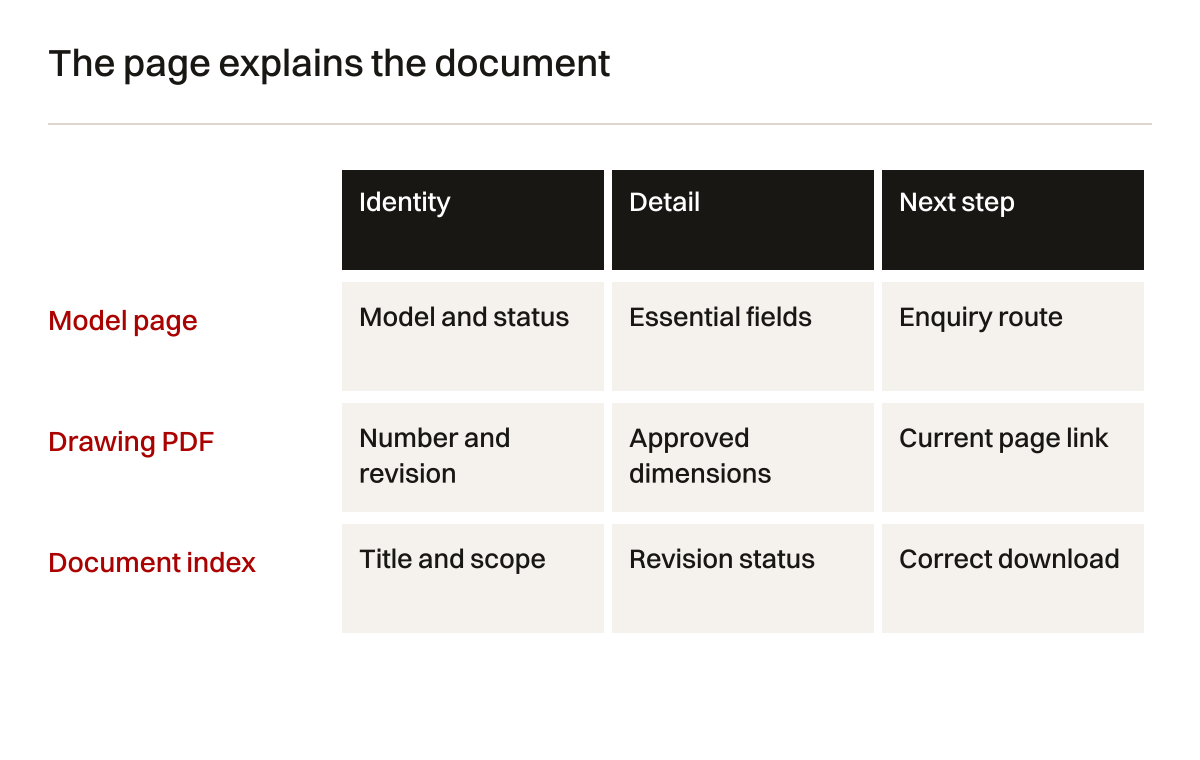
Give each link a descriptive name. “Dimensional drawing, revision C” is more useful than several identical “Download” links. Identify language, date or model applicability where those details change the decision. The product page should make the current approved file easy to identify without requiring the visitor to compare filenames.
Table 2: page and document responsibilities. Decide who can release each public file and how the website points to it.
| Item | Public purpose | Required identity | Owner check |
|---|---|---|---|
| Family page | Explain range and distinctions | Approved family name | Links reach relevant models |
| Model page | Present exact product record | Stable code and status | Values match approved source |
| Specification PDF | Preserve detailed approved data | Title, revision and applicability | Current file opens correctly |
| Drawing | Show permitted technical detail | Drawing number and revision | Public release is authorised |
| Certificate reference | Explain available evidence | Actual scope and validity | No unsupported certification claim |
| Archived document | Preserve necessary historical context | Superseded status | Cannot be mistaken for current instruction |
A document change should propagate to every reference. The same PDF may appear on a product page, family page and document library. Keep a dependency register. If an old file remains public for a valid historical reason, label its status clearly and connect readers to current information. Do not quietly overwrite a file while retaining misleading revision text.
If a PDF should not appear independently in search, choose an appropriate indexing policy and implement it for that resource. Google's robots metadata and header guidance explains mechanisms including HTTP headers for non-HTML material. Indexing controls do not protect confidential information. Protected documents need proper access controls.
Decide which filtered views deserve public discovery
Filters help a buyer narrow a catalogue. They can also create many URL combinations containing essentially the same records. Google’s faceted-navigation guidance explains crawl-resource consequences and different approaches according to whether filtered URLs need indexing. The correct decision depends on the catalogue and buyer task.
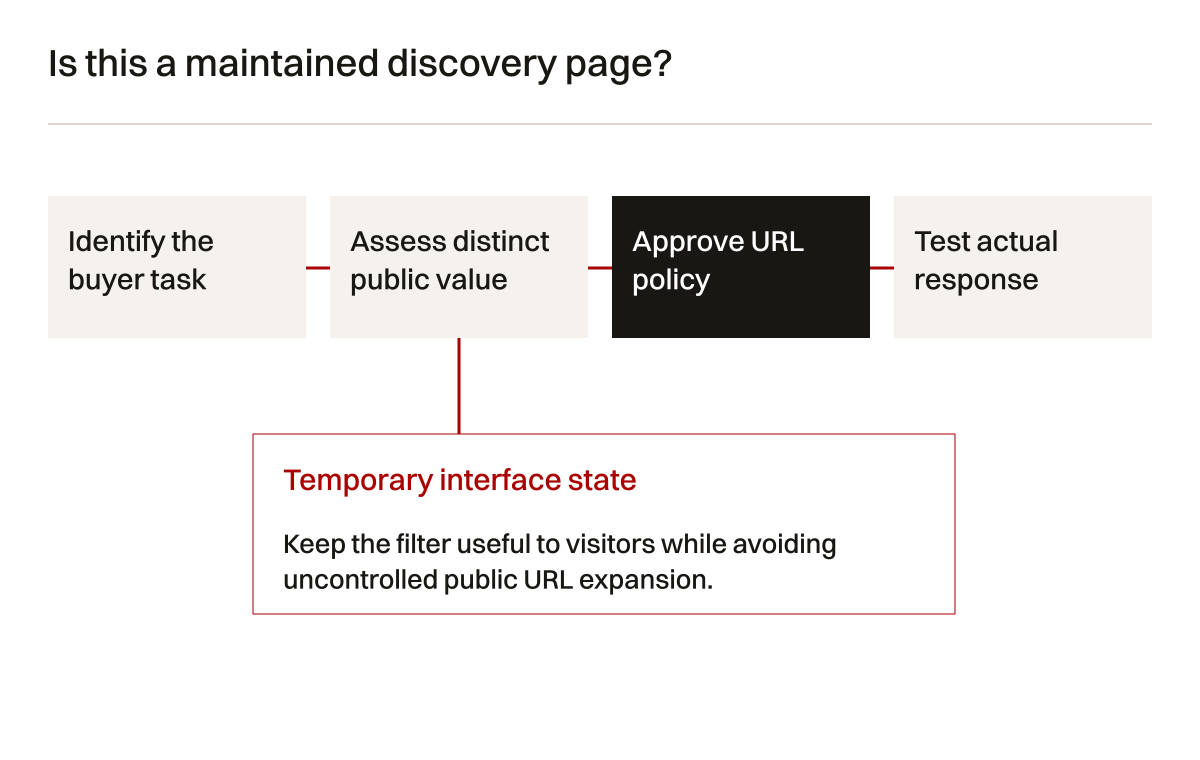
Separate useful destinations from transient interface states. A durable category for a recognised product type may deserve a maintained public page. A temporary combination of sort order, page size and several optional values may serve only the on-site interface. Do not publish every possible state as a search landing page merely because the application can generate it.
Use a declared example to understand the scale. A fictional catalogue has four selectable materials, five connection types and six sizes. If each dimension takes exactly one selected value, their cross-product contains 4 × 5 × 6 = 120 combinations. Adding three sort orders produces 360 states. This excludes multi-select filters, pagination and other options.
These are synthetic inputs, not measurements of a client website. Real valid combinations may be far fewer. Some combinations can contain no products. The arithmetic does not establish crawl volume or server load. It demonstrates why URL policy should be decided before the team assumes every state needs an independently maintained page.
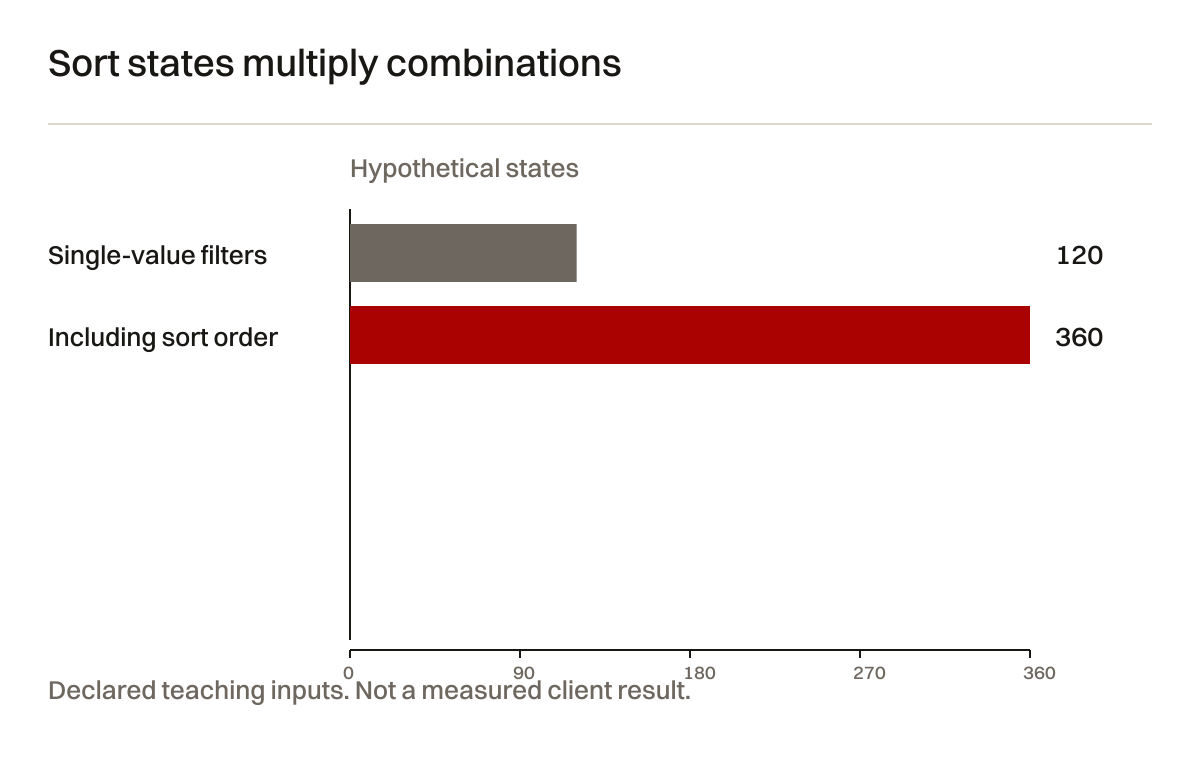
Table 3: filter choices and review questions. Select an implementation after examining actual URLs, content and visitor tasks.
| View | Buyer purpose | Search decision question | Acceptance test |
|---|---|---|---|
| Maintained product family | Understand a recognised range | Does it provide distinct approved information? | Stable page and visible model links |
| One useful product attribute | Find a meaningful subset | Is the subset worth ongoing editorial ownership? | Useful content and consistent URL policy |
| Sort order | Reorder the same records | Does this add a discoverable answer? | Avoid unnecessary duplicate destinations |
| Multi-filter state | Narrow an individual search | Is it a temporary interface state? | Filter works without uncontrolled URL expansion |
| Empty combination | Show no matching products | How should the application respond? | Honest empty result and suitable response |
| Pagination | Reach additional records | Can buyers and crawlers reach products? | Valid pages and no endless invalid sequence |
Canonical signals express a preferred representative for duplicate or similar pages. Google's canonical documentation describes methods and limits. A canonical tag is not a guaranteed instruction to remove arbitrary filter URLs from crawling. It also does not make materially different content equivalent.
Do not combine controls casually. Blocking crawling can prevent a search system from seeing page-level indexing instructions. A noindex directive is not a crawl-budget strategy by itself. The developer should document the intended behaviour for each URL class and test representative actual addresses. The business should approve which subsets are useful enough to maintain as public content.
Preserve identifiers when products change
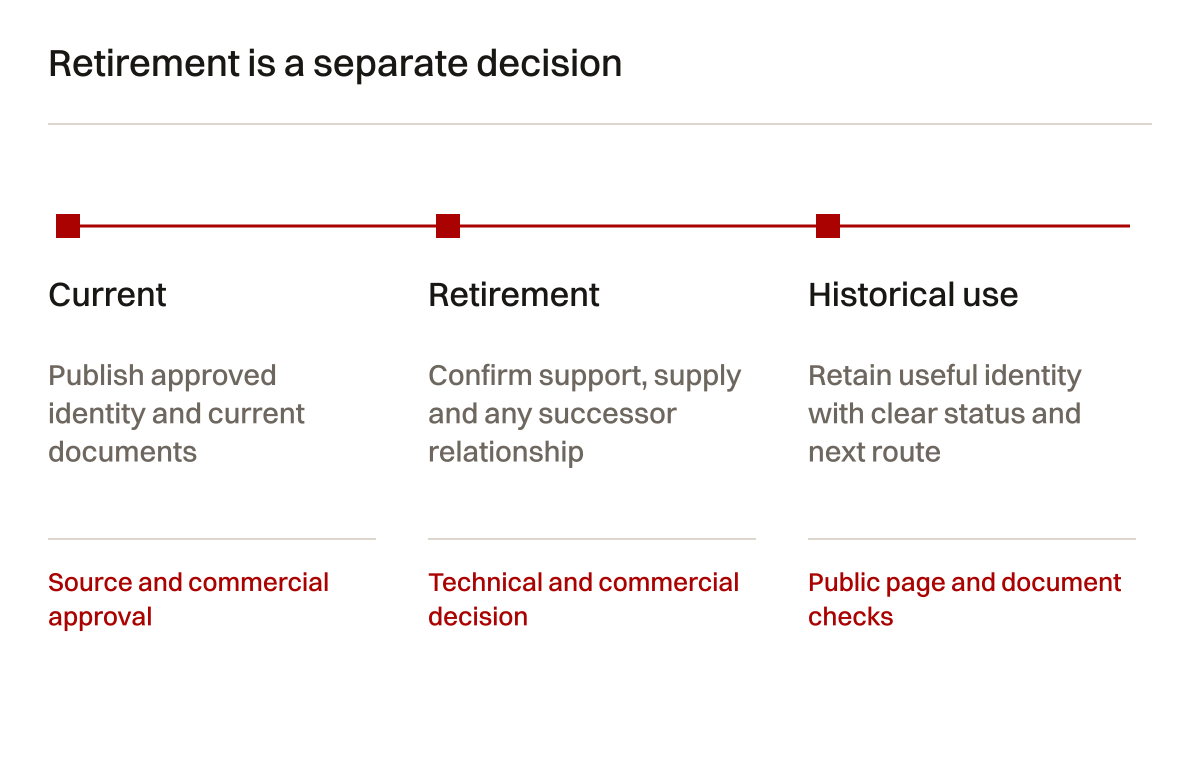
Discontinued products create a practical buyer problem. Existing equipment, old quotations and manufacturer references may still mention the code. Removing every retired model can lose useful context. Keeping an apparently current page can mislead someone about availability. Choose the response based on what the business can truthfully explain.
If a retired model has a verified successor, describe the relationship with technical approval. Link to the successor while keeping meaningful differences visible. If replacement requires an assessment, say so. If no substitute is known, provide the appropriate enquiry route without implying the sales team can supply it.
Table 4: discontinuation actions. These decisions require real product and commercial approval; the examples are not universal redirect rules.
| Situation | Useful public treatment | Evidence needed | Avoid |
|---|---|---|---|
| Retired model with approved successor | Clear retired status and successor link | Verified relationship | Claiming interchangeability without approval |
| Installed product still supported | Historical identity and support scope | Current support policy | Presenting it as generally available |
| No suitable replacement | Honest status and clarification route | Commercial confirmation | Redirecting to an unrelated popular item |
| Duplicate model record | Consolidate to the accurate record | Identifier and equivalence review | Losing meaningful variant differences |
| Removed incorrect page | Suitable unavailable response | Approved correction decision | Leaving a misleading live record |
| Changed public address | Relevant destination where appropriate | URL map and current page | Breaking supplier references silently |
Response behaviour matters to both buyers and search systems. Google's HTTP status documentation explains crawler treatment of responses. Match the implementation to the actual state. An error message shown with a successful response can create confusing signals. A blanket redirect to the homepage does not answer a specific retired-model request.
Keep the revision and lifecycle decision separate. A product may remain current while its drawing changes. A product may be discontinued while a historical document remains relevant. Your content model should express both without overwriting one field with the other. This separation also supports later exports and provider handovers.
Carry catalogue context into the enquiry
The form should preserve the model or family that prompted the request. A buyer should not need to copy a long URL manually. The received record should contain the same identifier shown on the page. Verify that the form does not send an old hidden model value after a visitor selects a different item.
Ask for information needed to route the enquiry. A model reference, requested quantity and task description may be useful. Sensitive project files should follow an approved private route. Explain the limits of initial assessment. A public form submission is not technical approval, a stock reservation or a confirmed quotation.
Test failures as well as the ordinary path. What happens if the buyer requests an unavailable model? If a PDF link fails? If an attachment is too large? If the record arrives without a unit? The form should present understandable feedback and the receiving team should have an exception route. Otherwise the catalogue can create requests nobody can process confidently.
For multilingual enquiries, retain the approved product identifier across language variants. Translate explanations with technical review. Do not translate a model code unless the manufacturer has an approved local identifier. Units and decimal conventions need attention because a literal text translation can change how a specification is read.

Generated illustrative photograph. Product records and stock shown in the scene are not evidence of an actual supplier's catalogue or inventory.
Verify a representative set before release
Select records that expose meaningful variation. Include an ordinary current model, a variant, a discontinued item, a revised document and an empty filter state. Add a product with an unusual identifier or unit if the catalogue contains one. A homepage review cannot establish that these paths work.
Table 5: catalogue acceptance tests. Adjust the sample to the actual content model and platform. Record remaining limits rather than announce complete verification from a small sample.
| Test | Input | Expected evidence | Responsible owner |
|---|---|---|---|
| Identifier retrieval | Approved model code and synonym | Correct record found without changing code | Catalogue owner |
| Source comparison | Model and technical source | Values, units and conditions agree | Technical approver |
| Document revision | Current and superseded files | Status and link are unambiguous | Document controller |
| URL policy | Representative filter addresses | Declared crawl and index behaviour | Developer and search owner |
| Lifecycle path | Retired model enquiry | Honest status and relevant next step | Commercial and technical leads |
| Enquiry receipt | Controlled product request | Correct context reaches named owner | Website and sales operations |
Use a sitemap for intended useful public destinations. Google's sitemap guidance explains supported construction and submission. A sitemap is a discovery aid, not an indexing guarantee. It should agree with your intended public URL inventory rather than list every sort state indiscriminately.
Check the visitor output and response behaviour independently of the CMS record. Open the actual file, inspect the rendered unit and test mobile navigation. A correct database field can still render incorrectly. A download saved successfully in the editor can still be linked to an older file. Retain dates and exact addresses for each check.
Run an example record through the whole system
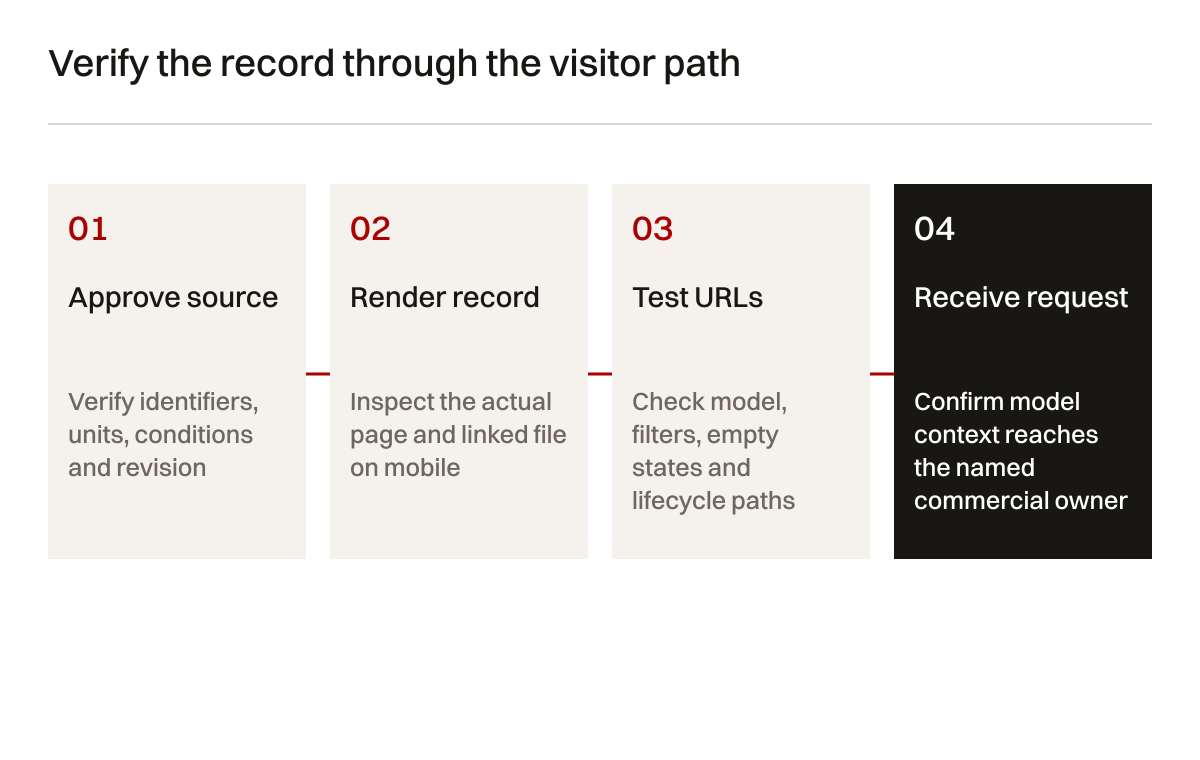
The fictional VX-20 page begins with an approved source record. The technical owner supplies the correct identifier, family, values and current drawing revision. The commercial owner supplies the enquiry conditions. The editor prepares a model page with a descriptive heading and readable specification fields. No customer-specific technical approval is implied.
The developer connects it to the family page and the catalogue search. Filter states follow the documented policy. The current drawing opens from the product page, and its revision label agrees with the file. A historical drawing remains available only where the business has approved that purpose and the status is explicit.
A controlled request then tests the handoff. The buyer sample selects VX-20, enters a fictional quantity and asks a permitted question. The received record retains the identifier and reaches the appropriate coordinator. An unavailable configuration takes the clarification route. The team records actual results rather than infer them from a success message.
Later the technical owner releases a new drawing. The dependency register identifies the model page, family download and document index. Each reference is updated and inspected. The old drawing is handled according to the agreed archival rule. The change is complete only when the approved surfaces and their acceptance checks have evidence.
This exercise does not establish broad indexing or commercial performance. It establishes that one declared catalogue workflow works under the test conditions. Search observations and qualified enquiry review can follow separately. If the catalogue contains thousands of records, the business also needs import validation and risk-based sampling appropriate to that scale.
Questions about industrial catalogue SEO
A practical import review before the first full upload
Take a deliberately varied sample from the intended source rather than the first convenient rows. Include a record with a missing unit, an identifier with a suffix, a drawing with a newer revision and a retired model. Ask the import process to validate each. The expected result for a missing unit is an explicit review decision, not a guessed value copied from a nearby product.
Check how a corrected record is updated. If the source owner changes the drawing revision, the importer should identify the existing product through its stable key. Creating a second product whenever the public name changes will leave conflicting pages. Deleting and recreating a record can also break relationships, historical references and enquiry context. Confirm the update behaviour before operating on the full catalogue.
Review whitespace and character handling. A product code copied from a PDF may contain a different hyphen character or an invisible space. Decide which forms the internal search can recognise, while retaining the approved displayed identifier. This is a data-cleaning decision with a recorded rule, not permission to simplify every technical code indiscriminately.
Inspect failed rows privately. The review file should name the field, source row and reason so the correct owner can respond. It should not include secrets or protected customer documents. Assign unresolved technical fields to the technical approver and missing commercial availability to the commercial owner. A developer cannot settle those business facts by changing validation rules.
Finally, test an export of the accepted sample. The exported records should retain the identifiers, lifecycle states, source references and document relationships needed for handover. A website that can import but cannot explain or export its content model can become difficult to maintain when the original builder leaves. This check connects catalogue accuracy with operating ownership.
Keep the sample result and remaining limits in the acceptance record. Passing ten representative records does not prove every source row is valid. It establishes the declared import behaviour under those conditions. Broader validation should then follow the catalogue's scale and the consequences of an incorrect public record.
Can we keep specifications only in PDFs?
PDFs can be useful and may be indexable. However, a public model page can provide identity, current status, document context and an enquiry route more directly. Decide what belongs in each format from the buyer task. Preserve technical meaning rather than duplicate every page of a source document into HTML without review.
Does every filter combination need an indexable page?
No. Many combinations are transient interface states or repeat the same records. Maintain public pages where they answer distinct useful questions and have editorial ownership. Define controls for the remaining URL classes with the developer. Avoid assuming a canonical tag alone solves every crawl or duplicate-content issue.
Should discontinued items redirect to a new product?
Only when the destination is appropriate and the relationship is verified. Buyers may still need the old code and support information. A retained page with clear retired status can be useful. An unrelated redirect can conceal the distinction. Technical approval is required before presenting a successor as interchangeable.
Will product structured data guarantee richer search results?
No. Supported features have eligibility and content requirements, and appearance is not guaranteed. Use accurate properties that match the visible page. A quotation-only catalogue should not invent offers or stock claims to resemble an online store. Test implementation and retain the platform's actual limits.
Who approves units and technical translations?
The named technical source owner should approve values, conditions and terminology. The editor owns presentation but should not infer engineering meaning from a spreadsheet. Keep translation review and source revision references. A correct product identifier can still be attached to an incorrectly translated specification.
How do we measure whether the catalogue is helping?
Review defined search observations, visitor tasks and received enquiry quality. Search clicks do not establish correct product selection. Form submissions do not establish suitable requests. Commercial colleagues should review whether records contain the information needed to respond. Keep those measures distinct and recognise attribution limits.
Start with the uncertain record
Bring a representative product family, current specifications, document rules and an enquiry example that can be reviewed privately. The first problem may be inconsistent units, retired records or uncontrolled filters. The architecture and implementation should follow that diagnosis rather than a promise to publish more pages.
Creatif Work's website work can connect catalogue records with public pages and visitor tasks. SEO work investigates discoverability and technical implementation with appropriate evidence. Private customer files need their own access and workflow scope. Start with the problem.
Sources checked for this guide
Official documentation checked on 4 October 2026. Catalogue examples, record identifiers and filter arithmetic are original synthetic teaching material.