

Multilingual Industrial SEO Without Duplicating Every Page

An industrial company does not need to translate every page into every language on day one. That approach often creates hundreds of pages with old product data, inconsistent terminology and no owner.
A better model starts with buyer decisions and maintains a smaller set of complete, useful language routes.
How can industrial SEO work across languages?
Create a shared product and evidence core, then localise the pages needed for each market's search language, compliance questions, service coverage and contact route. Use separate URLs, accurate language versions and hreflang. Do not auto-redirect by location or publish thin machine translations that nobody reviews.
Google's localized version guidance recommends telling Search about language and regional variants with hreflang. Each version should reference itself and the alternates. Google also advises using one implementation method consistently.
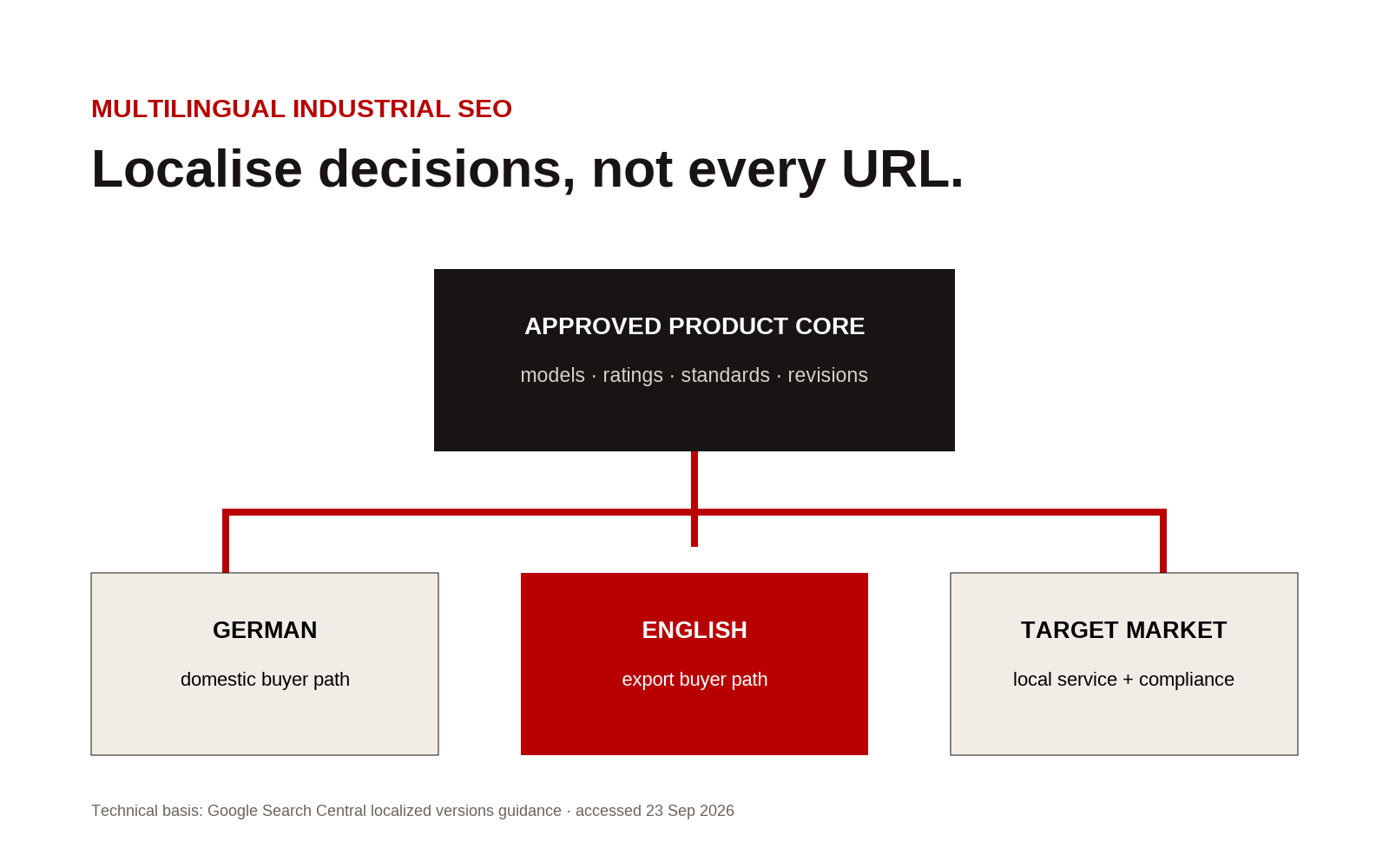
Multilingual industrial website model with one product core and selective market-specific pages.
Decide what deserves localisation
| Page type | Translate fully? | Localise further when |
|---|---|---|
| Core product | Usually | Units, standards, options or buyer terminology differ |
| Technical evidence | Selectively | Market approval or application differs |
| Service coverage | Yes for active markets | Local partner, hours or spares differ |
| Project case study | When relevant | Buyer needs a comparable market or sector example |
| News and studio content | Only when useful | It supports a local decision or campaign |
| Legal and privacy | Obtain proper review | Obligations and audience differ |
Do not measure success by translated URL count. Measure whether target buyers can complete the important research path in their language.
Use one source of approved product facts
Create a structured source for model names, ratings, conditions, standards, document revisions and status. Language pages should draw from the same approved facts even when the explanation changes.
Assign terminology owners. Decide how technical nouns, units and option names appear in each language. Maintain a glossary for translators and reviewers.
When a product changes, trigger review of every affected language route. Do not rely on a marketer noticing a new PDF.
Localise the decision, not just the sentence
A German and English page may need different order and detail. An overseas buyer may look first for export support, conformity, installation and English documentation. A domestic buyer may use different industry terms and assume a different service model.
Keep the same facts but answer the market's first questions. Add local contacts, time zones, service coverage, document languages and relevant projects. Remove claims that do not apply.
Our guide to what overseas buyers need from German machine builders provides a useful international page checklist.
Implement language signals cleanly
Give each language version a unique, crawlable URL. Use visible navigation so users can switch. Keep a visitor on the equivalent page where one exists and offer a sensible language home when it does not.
Add reciprocal hreflang annotations and, where helpful, an x-default route. Use canonical tags carefully. Google's canonical guidance says regional variants in the same language can use canonicalisation with hreflang, but a translated page should not simply canonicalise to another language and disappear from consideration.
Avoid automatic location redirects that block users or crawlers from choosing another version. A language suggestion is safer than forcing a route.
Review quality before indexing
For each language page, check:
- product facts and units match the approved source;
- headings use real buyer terminology;
- technical warnings and limitations are preserved;
- downloads are available in the promised language;
- contact and service coverage are accurate;
- internal links stay within the intended language where possible;
hreflang, canonical and sitemap signals agree;- a competent reviewer approved publication.
If a complete version is not ready, it can be better to keep one strong international page than publish an incomplete translation.
Maintain by market priority
Group markets into active, developing and reference-only. Active markets receive complete product, evidence, service and contact routes. Developing markets receive the minimum viable buyer path. Reference-only markets can use a clear international page until the business commits resources.
Review search terms, enquiries and service demand by language. Expand where buyers need more evidence, not simply where translation is easy.
Handle pages that do not have an equivalent
Not every article or project needs an immediate translation. If no equivalent exists, the language switcher can offer the language homepage or explain that the specific page is available in another language. Do not silently send the user to an unrelated page.
Keep navigation honest. A language label should not lead to a mostly untranslated site. Mark document languages clearly so buyers know what they will open.
For regional versions in the same language, add a separate URL only when content such as product availability, regulation, service or contact genuinely changes. Small spelling differences rarely justify another maintained page.
Measure a complete journey
Track whether visitors in each target market can move from search entry to product evidence, service coverage and contact. A translated landing page with no local next step may collect impressions without supporting sales.
Review enquiries for terminology buyers use. Feed useful terms into the glossary and core page, but do not create a new page for every query variant.
Creatif Work combines engineering website design with SEO and AI visibility work. We can build a multilingual structure that keeps product facts controlled while giving each active market the language, proof and enquiry route it needs.