

Write Specification Pages That Search Engines and Engineers Can Parse

A specification page should work for an engineer reading carefully and a search system extracting meaning. Use stable product identity, visible text, consistent fields, real HTML tables, clear units, scoped evidence and descriptive links. Do not hide the core data inside an image or PDF.
Machine-readable markup can support the page, but it cannot repair incomplete visible information.
How should an industrial specification page be written?
Give one clear product or controlled family per page, with exact name and model, plain description, intended application, technical data table, operating conditions, variants, interfaces, compliance scope, current documents, revision and contextual enquiry.
| Page area | Human need | Parsing need |
|---|---|---|
| Title | Identify the exact item | Stable entity name |
| Summary | Understand function and fit | Plain visible description |
| Specification | Compare values and units | Consistent labelled fields |
| Conditions | Know where values apply | Context beside each value |
| Variants | Select the right model | Distinct identity and relationships |
| Compliance | Verify scope | Named standard, issuer and dates |
| Documents | Obtain controlled detail | Descriptive links and revisions |
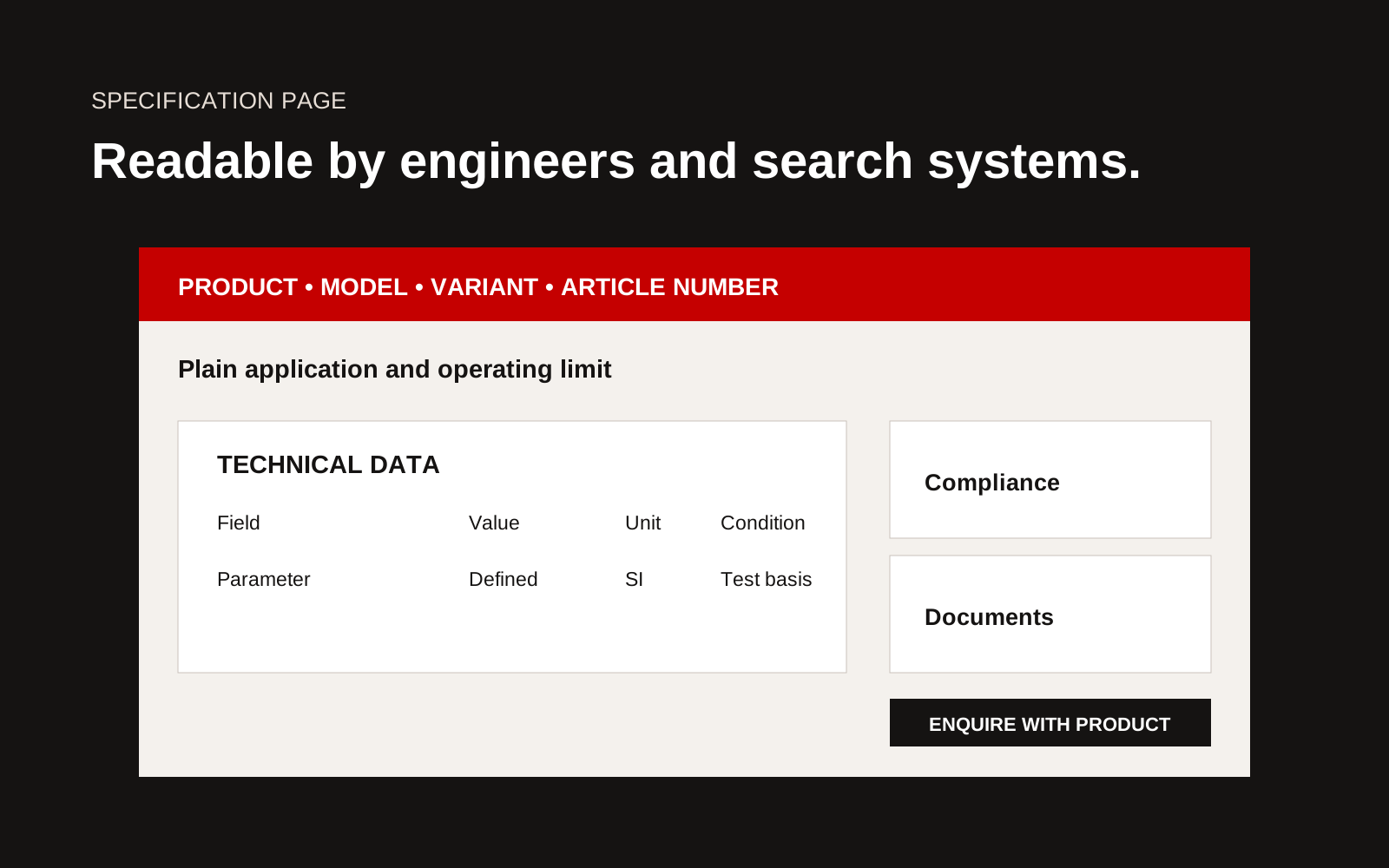
Annotated industrial specification page with product identity, application, structured data table, compliance, documents and enquiry.
Use one stable identity
Place manufacturer, product name, model, variant and article number in visible text. Keep the same identity across metadata, headings, documents, images and structured data.
Do not create several URLs for the same item solely to target synonyms. Put alternative names and old references on the canonical page where useful.
Write a plain description
The first paragraph should state what the product is, what it does, who selects it and the main limit. Avoid opening with brand claims.
A search system and a buyer both benefit from explicit nouns: product type, process, application, material and operating context.
Use structured tables
Create rows for field, value, unit, condition and method where relevant. Keep field names consistent across a product family. Use true text and table markup rather than a screenshot.
Do not combine values into an unreadable cell. A pressure value, temperature condition and test method should remain distinguishable.
Put conditions beside values
State whether a value is nominal, minimum, maximum, typical or tolerance. Include media, temperature, frequency, configuration or other condition that changes the meaning.
If performance depends on final engineering, say so and give the selection route.
Scope compliance claims
Name the standard, version, report or certificate reference, body, product scope, issue date and validity. Link to the current document when publication is permitted.
Do not list standards that merely influenced design as if they were product certification.
Make documents readable and controlled
Use link text such as "Download model X installation manual, revision 4" rather than "click here". Show language, file type and revision. Keep core selection data on the page.
Google's Product structured data documentation explains how visible product information can be represented for search. Use only supported properties that accurately match the page.
Add useful internal relationships
Link the product to its family, application, compatible accessories, relevant project and service support. Avoid a dense list of unrelated products.
The enquiry form should carry the product and variant. Ask for operating parameters needed to confirm selection.
Maintain source and revision
Define the product-data owner and review trigger. A certificate renewal, material change, firmware release or end-of-sale decision should update the page and documents together.
Design filters from governed fields
If the website includes a product finder, use only fields that are complete and meaningful for selection. State how missing data behaves. A blank should not silently exclude a suitable product or imply that a requirement is not supported.
Let users see which criteria matched and compare a small number of products. Keep the underlying product page as the canonical source for each result.
Avoid keyword-driven duplication
One strong specification page can explain synonyms, applications and old model references. Do not create near-identical pages for every phrase engineers may use. Search engines and users benefit from a stable source that accumulates links and revisions.
Where market or language versions differ, use the same product identity and control translations. State local compliance and availability only on the relevant version.
Test with a selection task
Give an engineer a real operating requirement and ask them to identify the product, verify limits, locate the current drawing and submit an enquiry. Watch where they need the PDF or call for basic clarification. Those gaps belong in the page structure.
Specification-page checklist
- One stable product identity used everywhere
- Plain description states function and limit
- Technical data is visible text
- Fields and units consistent across the range
- Conditions and methods sit beside values
- Variants and options are unambiguous
- Compliance claims show scope and date
- Downloads show document and revision
- Structured data matches visible content
- Enquiry carries product context
Run a selection and parsing test
Give an engineer a real application and ask them to select a variant using only the page. Record any field they must infer or retrieve from a PDF. Then inspect the page without styling. The product name, description, table headings, values, conditions, revision and related documents should still form a logical sequence.
Check the rendered HTML to confirm that important specifications are text rather than pixels, labels are associated with values and structured data matches visible content. Search the page for an old model number and confirm the current replacement or status is clear. Finally, submit an enquiry and verify that the product and variant travel with it. Fix the source model when several pages share the same ambiguity. A clean template cannot compensate for inconsistent units, uncontrolled option names or compliance claims that lack a defined scope.
Our guide to turning a spec sheet into a web page provides a deeper content model. Creatif Work builds engineering websites and product-focused website systems where specifications remain readable, searchable and maintainable.