

German Industrial Website Design for International Buyers
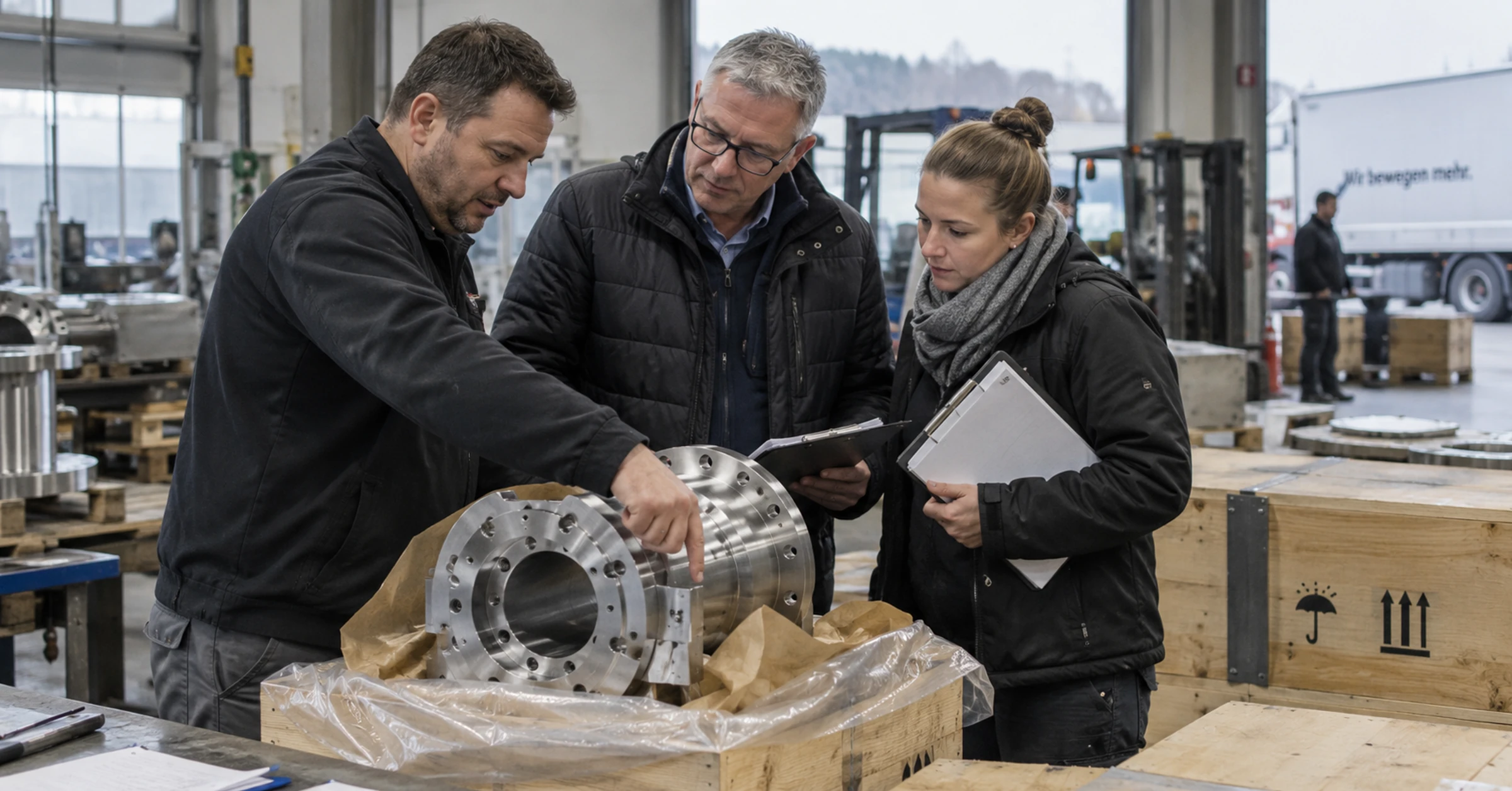
An international industrial website should not be a translated corporate brochure. It should help a buyer identify the right product, verify technical and market fit, understand delivery and support, then contact a responsible person.
The design challenge is to present depth without forcing every visitor through a document archive.
What does international industrial website design require?
It requires product-family pages with structured data, market-specific compliance and service information, clear interfaces, controlled downloads, relevant project evidence, useful language routes and a qualified enquiry. The site should separate current facts from future capability and public material from controlled procurement documents.
Germany Trade & Invest describes German machinery as a highly export-oriented sector and identifies service and maintenance as important parts of the value chain. Its machinery profile supports a website model that follows the buyer beyond initial product selection.
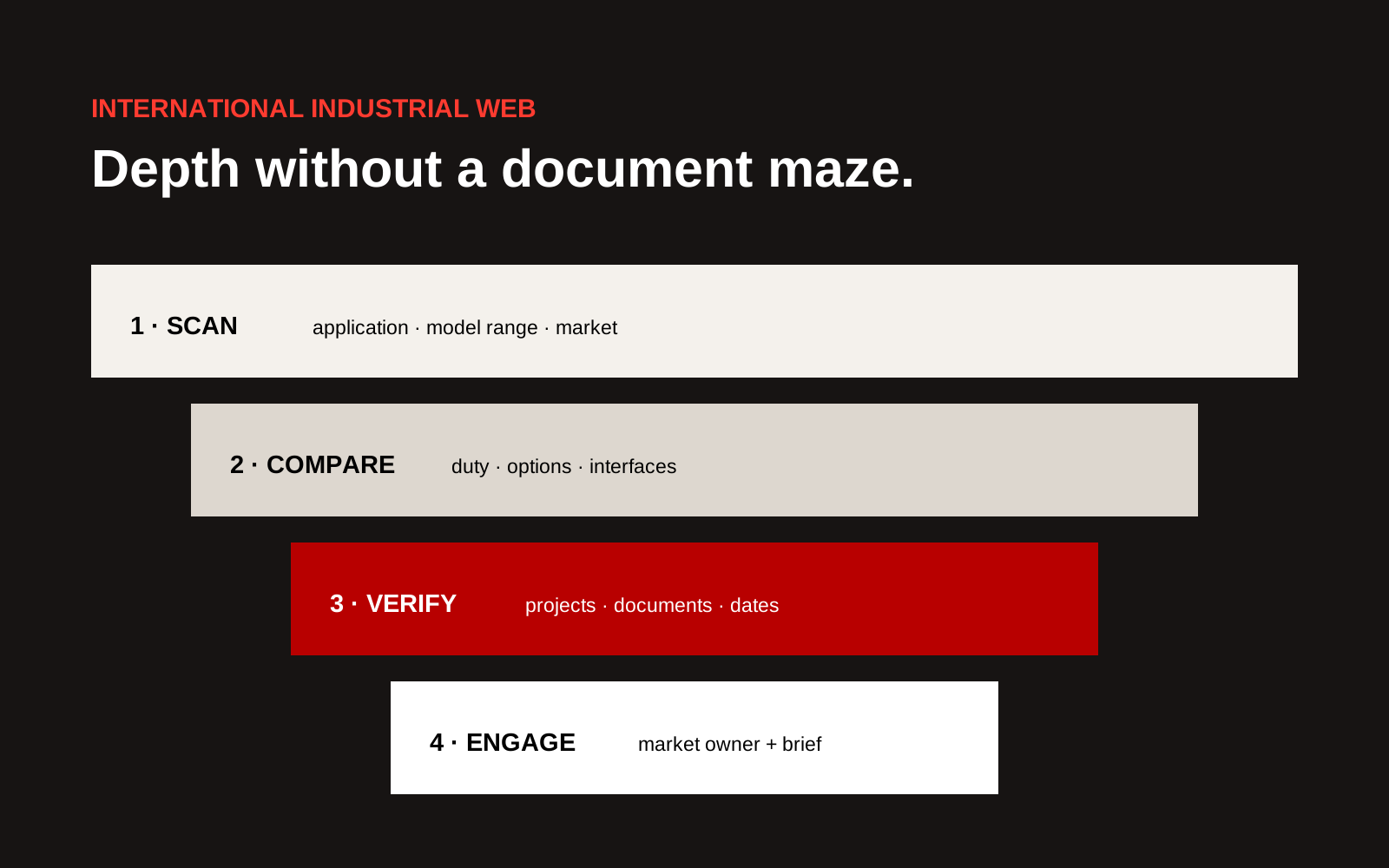
International industrial website architecture connecting product, compliance, project and service evidence.
Design for four reading depths
| Depth | Reader need | Page treatment |
|---|---|---|
| Scan | Is this relevant? | Clear title, application, model range and market |
| Compare | Does it fit? | Structured duty, options, standards and interfaces |
| Verify | Can we trust it? | Project evidence, downloads, dates and responsibility |
| Engage | What happens next? | Market contact and qualification route |
Do not make every reader open a PDF for basic facts. Do not force every detail into the first screen either.
Build a repeatable product system
Use the same fields across machine families: application, material, capacity, accuracy, utilities, footprint, options, controls, compliance, documents and support. Consistency helps buyers compare and helps internal owners spot missing data.
Add conditions beside performance figures. Identify test methods, product versions and revision dates. If a model is configured to order, explain the fixed platform and the variables confirmed during engineering.
Create one controlled source for core facts so regional teams do not publish conflicting numbers.
Give international buyers a market layer
The product may be global, but compliance, language, installation and service are not. Add a market layer that answers:
- whether the product is offered in the country;
- which conformity or local approval route applies;
- available documentation and interface languages;
- sales, partner and service responsibility;
- typical delivery and commissioning model;
- spares and remote-support conditions.
The European Commission's machinery information is a reminder that legal and conformity requirements evolve. Date compliance copy and route it through competent review.
Use projects to show operating context
An international buyer wants proof in a comparable plant, material, climate or production environment. A project page should state the application, configuration, customer constraint, supplier responsibility, acceptance method and outcome.
Where the client cannot be named, describe enough context to remain useful. Do not publish production figures, plant layouts or client identities without approval.
Link the project back to the exact product and service pages. This forms an evidence path instead of a separate inspiration gallery.
Plan language versions around demand
Start with the languages needed to complete a serious buyer journey. A product page in English with a German-only download and contact confirmation is not a complete English route.
Use stable language URLs and accurate alternate signals. Our multilingual industrial SEO guide covers hreflang, selective localisation and maintenance.
Translate technical terminology through a glossary and reviewer, not a disconnected page-by-page process.
Make contact specific
Ask for machine family, application, material, duty, location, required date and preferred language. Explain that detailed drawings move to a controlled exchange.
Route the enquiry by product and market. Confirm the responsible office or partner. A generic form that reaches headquarters and waits for forwarding creates doubt before the project begins.
Design for a long technical sales cycle
An international machine purchase may involve operations, engineering, safety, finance, procurement and service. Give each role a path without duplicating the product story.
Operations needs application and performance. Engineering needs interfaces and documents. Procurement needs delivery, commercial scope and supplier identity. Service teams need maintainability, spares and support. Use anchors, consistent tabs or clear page sections so they can share one dependable URL.
Allow useful documents to be linked directly, but preserve the product-page context. A PDF alone may not show whether the model remains current or whether market-specific conditions apply.
Check the route from another country
Test language selection, consent, forms, downloads, phone numbers and time zones from the perspective of a target market. Confirm that regional privacy and legal text received proper review.
Send test enquiries for two products and two markets. Verify routing, acknowledgement language and responsible follow-up. Document who maintains the rules when teams or distributors change.
Repeat the test after a distributor, product line or CRM rule changes. International routes often fail at the handoff rather than on the visible page.
Give the route an owner and a dated review record.
A launch review
- Product families and model status are current.
- Data has units, conditions and revision dates.
- Compliance statements name the market and boundary.
- Language paths include downloads and contact.
- Service coverage is operational, not a decorative map.
- Projects link to relevant products and decisions.
- Search and navigation work on mobile and keyboard.
- Enquiries reach the correct market owner.
Creatif Work designs engineering websites for complex international buying journeys. Our website service can turn product, compliance, service and project evidence into a clear system that regional teams can maintain.