

What Overseas Buyers Need From a German Machine Builder Online

“Made in Germany” may open an overseas buyer's attention, but it does not answer whether a machine fits the plant, market and support model. International buyers need specific technical and commercial information before they can justify contact.
The website should shorten that first screening without replacing engineering review or a formal offer.
What should an overseas buyer find online?
An overseas buyer should find machine scope, duty and options, applicable compliance, utilities and interfaces, layout and installation needs, delivery process, documentation languages, local service coverage and comparable project evidence. Each claim needs a product boundary, date and route to deeper technical information.
Germany Trade & Invest reports that the German machinery and equipment sector had an 81% export share in 2023 and describes service, maintenance, repair and overhaul as important value-chain opportunities. Its industry profile shows why the buyer journey extends beyond the machine sale.
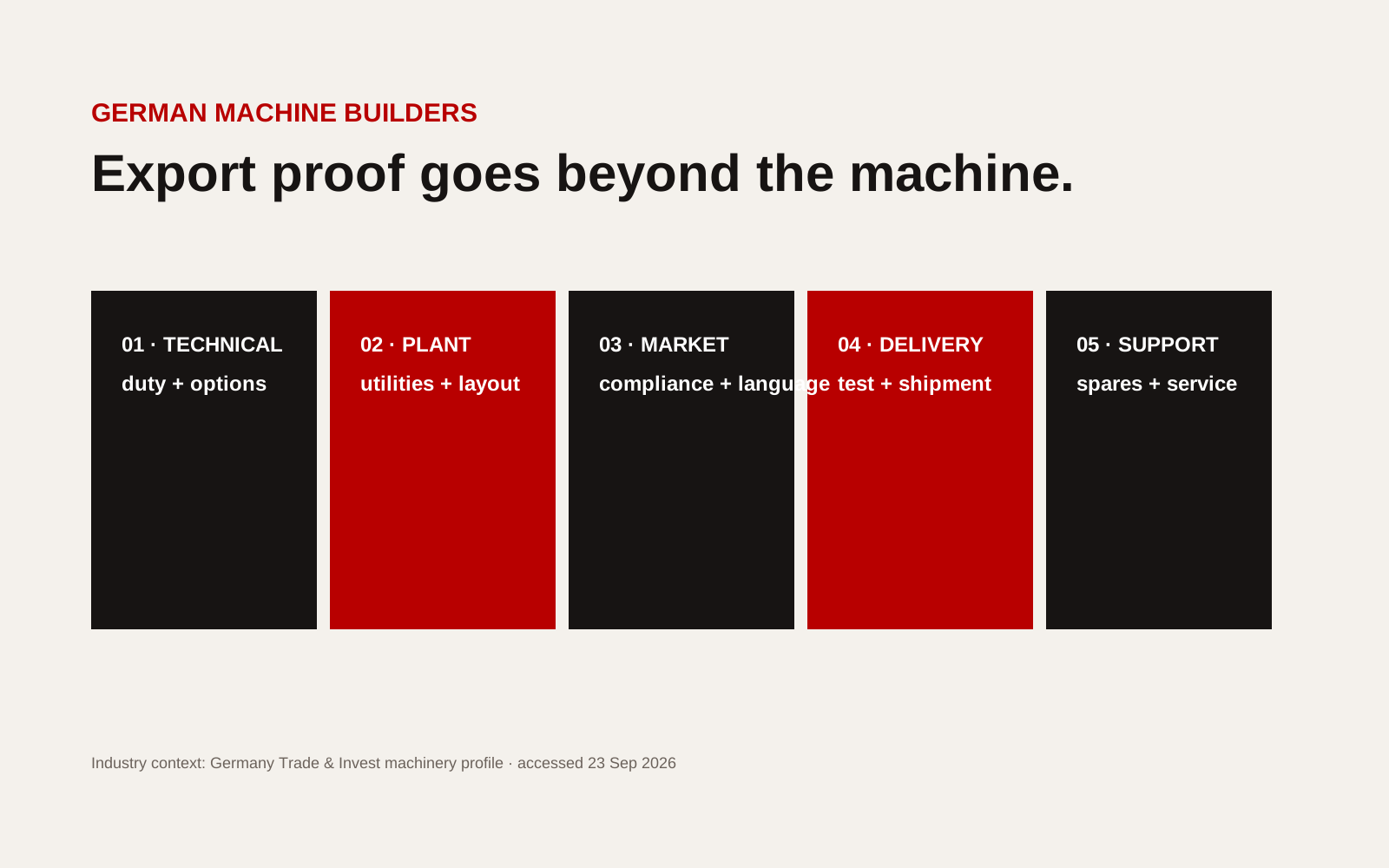
Overseas buyer information path through machine scope, compliance, integration, delivery and service.
Build the page around five decisions
| Buyer decision | Information | Useful evidence |
|---|---|---|
| Technical fit | Duty, material, throughput, tolerances and options | Data sheet and selection inputs |
| Plant fit | Footprint, utilities, controls, access and interfaces | Layout and interface summary |
| Market fit | Applicable rules, declarations and language | Compliance route and document list |
| Delivery fit | Engineering, approval, test, shipment and installation | Project timeline and hold points |
| Support fit | Commissioning, training, spares and service locations | Coverage map and escalation route |
Do not hide these items in one general brochure. Give each machine family a stable page and consistent fields.
Explain compliance without using the CE mark as decoration
The European Commission states that CE marking follows the prescribed conformity-assessment process for machinery covered by EU rules. Its machinery guidance also notes that the new Machinery Regulation applies mandatorily from 20 January 2027.
State which product and market the declaration covers. An overseas buyer may need a different local approval, importer arrangement or modification review. Do not imply that EU conformity automatically clears every destination.
Publish document types and the process for confirming requirements. Keep controlled declarations, test reports and project-specific files in the appropriate exchange.
Make integration visible
List electrical supply, compressed air, extraction, water, network, safety circuit and material-flow interfaces where relevant. Add required tolerances, loads, access and upstream or downstream dependencies.
Use an annotated layout with three boundaries: supplied by machine builder, supplied by customer, and confirmed during project engineering. This reduces vague enquiries and reveals missing scope before the order.
For software-connected machinery, explain protocols, remote-access conditions, data ownership and support. Avoid an “Industry 4.0 ready” badge with no interface detail.
Treat documentation and language as deliverables
Name available interface, manual, training and service languages. State when translated documentation becomes available and who approves it.
Our guide to multilingual industrial SEO explains how to create useful language versions without copying every page mechanically.
Translation should preserve units, warnings, product identifiers and revision control. A marketing translation cannot substitute for controlled technical documentation.
Show international service honestly
A global map needs operating detail. Identify company offices, authorised partners, remote support, normal coverage, parts location and escalation. If travel and visa conditions affect response, address them in the proposal.
Describe the path from issue to competent diagnosis and closure. A 24-hour hotline may acknowledge a problem quickly but still depend on a specialist in another time zone.
Explain delivery and acceptance
Show the stages from requirement review to final acceptance. A typical sequence may include selection, quotation, specification freeze, design approval, factory acceptance test, packing, export, installation, commissioning and site acceptance.
For each stage, identify the buyer input and the hold point. State when the delivery commitment becomes firm and which configuration changes can move it. This prevents a headline lead time from being read as shipment from the first email.
Name the acceptance documents provided at each stage. Overseas buyers may need inspection plans, test records, packing information, origin documents, manuals and training evidence for several internal teams.
Give the buyer a useful enquiry form
Ask for country, application, material, duty, utilities, production target, required date and preferred language. Let the buyer select a product family or request help with selection.
Explain that detailed plant drawings and controlled specifications will move to an approved exchange after fit is confirmed. Route the enquiry to a product and market owner, not a general mailbox.
Test the route from different languages and regions. A strong machine page loses value when the confirmation or response arrives only in German.
Ask one distributor and one end user to test the route. They will often notice different gaps in terminology, documents and support ownership.
Record their task, market and assumptions. A comment from one user should improve the right route, not trigger a universal redesign.
A machine-page checklist
- Exact model or family and intended application.
- Selection inputs and operating conditions.
- Performance data with test basis.
- Utilities, interfaces and footprint.
- Compliance route and document types.
- Engineering, test and delivery stages.
- Installation, training and acceptance boundary.
- Spares, service and escalation coverage.
- Current downloads with revision dates.
- Procurement contact for the target market.
Creatif Work designs engineering websites for international technical buyers. Our website service can structure German product depth for overseas screening, then lead serious enquiries into a controlled engineering and commercial process.