

Data Centre Engineering Website Design: What Procurement Teams Need

A data centre engineering website has to serve a reader who is comparing technical fit and delivery risk. Large photography and broad claims may create interest, but procurement still needs product scope, standards, lead time, interfaces and support.
The right design makes those facts easy to reach without turning the public site into a document room.
What should the website contain?
A data centre engineering supplier website should contain package-specific pages, structured product data, operating conditions, standards, integration points, capacity and lead-time method, local service coverage, relevant project evidence and a procurement enquiry route. Sensitive drawings and live commercial data should move into a controlled exchange.
MIDA's 2026 data centre ecosystem statement frames local supply-chain value and sustainable operations as part of Malaysia's next stage. The website should therefore show how the supplier delivers, not merely that it wants the market.
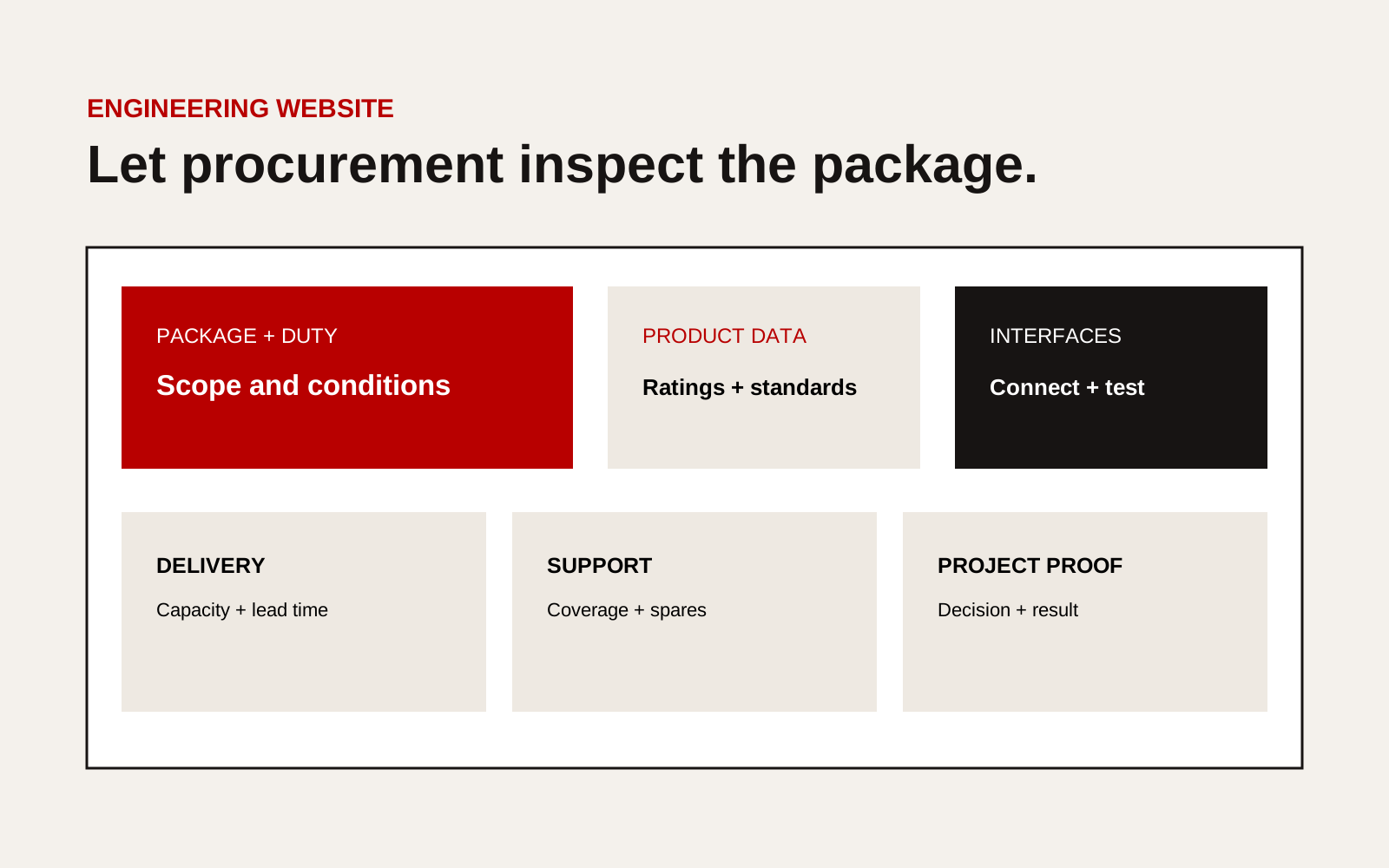
Annotated data centre engineering supplier website with scope, product data, interfaces and service coverage.
Use a procurement-led information architecture
| Page | Buyer decision | Required content |
|---|---|---|
| Capability | Is this supplier relevant? | Package, stage, location and boundary |
| Product or system | Does it meet the duty? | Ratings, conditions, options, standards and downloads |
| Integration | Will it connect and commission? | Interfaces, controls, tests and responsibility |
| Delivery | Can it meet programme? | Capacity method, lead-time stages and hold points |
| Support | Can it operate after handover? | Coverage, spares, escalation and maintenance |
| Project | Has it worked in a comparable setting? | Context, responsibility, decision and result |
Do not place every product in one long page. Give each meaningful product family a stable URL and consistent data fields so a buyer can compare.
Present product data in context
A specification table should include the conditions that make a number meaningful. Cooling capacity without temperature and flow conditions is incomplete. Electrical efficiency without load and test conditions is difficult to compare.
Add a short “selection inputs” block that tells the buyer what to provide: duty, redundancy, ambient condition, supply characteristics, control protocol, footprint, access and certification needs. This improves enquiry quality and shows engineering discipline.
Put revision dates on technical downloads. Remove superseded files or identify them clearly. Search results can continue sending buyers to an old PDF after the main page changes.
Show interface ownership visually
Use a simple interface diagram for each package. Mark incoming services, outputs, controls, alarms, physical connections and required third-party work. Then label the supplier, consultant, contractor and operator responsibilities at a representative level.
The diagram should help a buyer prepare a technical question. It is not a construction drawing. Keep project dimensions, network details and site-sensitive information out of the public version.
Our guide to capacity, lead time and service coverage provides the fields needed for the delivery section.
Build case studies around decisions
Data centre project pages can become a gallery of plant rooms. Instead, explain the design or delivery constraint, the supplier's package, the interface decision, the evidence produced and the accepted result.
State whether the project name and metrics are approved for publication. Where confidentiality prevents identification, use a bounded description such as facility type, country, project stage and package scale. Do not invent anonymity by making the description so vague that it proves nothing.
Design a useful procurement enquiry
Ask for organisation, package, location, project stage, duty range and required date. Allow the buyer to request a controlled technical exchange, but do not invite sensitive uploads through a basic form.
Route the enquiry to an owner who can qualify both technical and commercial fit. The confirmation should tell the buyer what happens next and what information may be requested.
Test the form quarterly. Staff changes and CRM rules can break a route while the website still appears correct.
A pre-launch check
- Product families and service boundaries are clear.
- Every important figure has a condition and date.
- Current standards and certifications are identified accurately.
- Interface diagrams label responsibility.
- Lead time is shown as a process, not an unsupported promise.
- Support coverage names people, places and escalation.
- Two or more relevant project examples are findable.
- Procurement enquiries reach a named owner.
Maintain the site as technical information
Assign an owner to every product family and capability page. Set review triggers for a product revision, certification change, new service partner, lead-time shift or withdrawal. A calendar review alone may be too slow when a discontinued model still appears in search.
Keep a change record for important fields. Note what changed, who approved it and when the page was republished. The public site does not need to expose this log, but the business should be able to explain where a published specification came from.
Check analytics alongside sales feedback. Search terms can reveal missing product language, while enquiries can reveal whether readers understand the service boundary. Do not add pages for every phrase. Improve the main page when the buyer is making the same decision.
Once a quarter, ask a technical person who did not write the page to verify a sample of figures against the current approved source. That small control catches copy errors before they become procurement confusion.
Keep the review independent of campaign deadlines. Two people reading the same source can still catch a unit, condition or model mismatch.
Creatif Work designs engineering websites for technical buying journeys. Our website service can organise complex product and delivery evidence into a clean public structure, with the right handoff into private procurement material.