

Capacity, Lead Time and Service Coverage for Data Centre Buyers

Capacity, lead time and service coverage are often reduced to three sales claims: available, fast and local. A data centre buyer needs the assumptions behind each one.
The supplier's task is to make those assumptions visible early, then provide controlled evidence during procurement.
What should a supplier publish?
Publish a qualified capacity range, the stages that make up lead time, and a service map showing people, locations, hours, spares and escalation. State the date, product scope and conditions. Do not publish a universal delivery promise when engineering approval, component availability or site readiness can change it.
Malaysia's sustainable data centre guideline links sector growth to energy, water and resource performance. MIDA's 2026 Data Centre Nexus release also highlights local supply-chain participation. Buyers will therefore look for delivery capability as well as product specification.
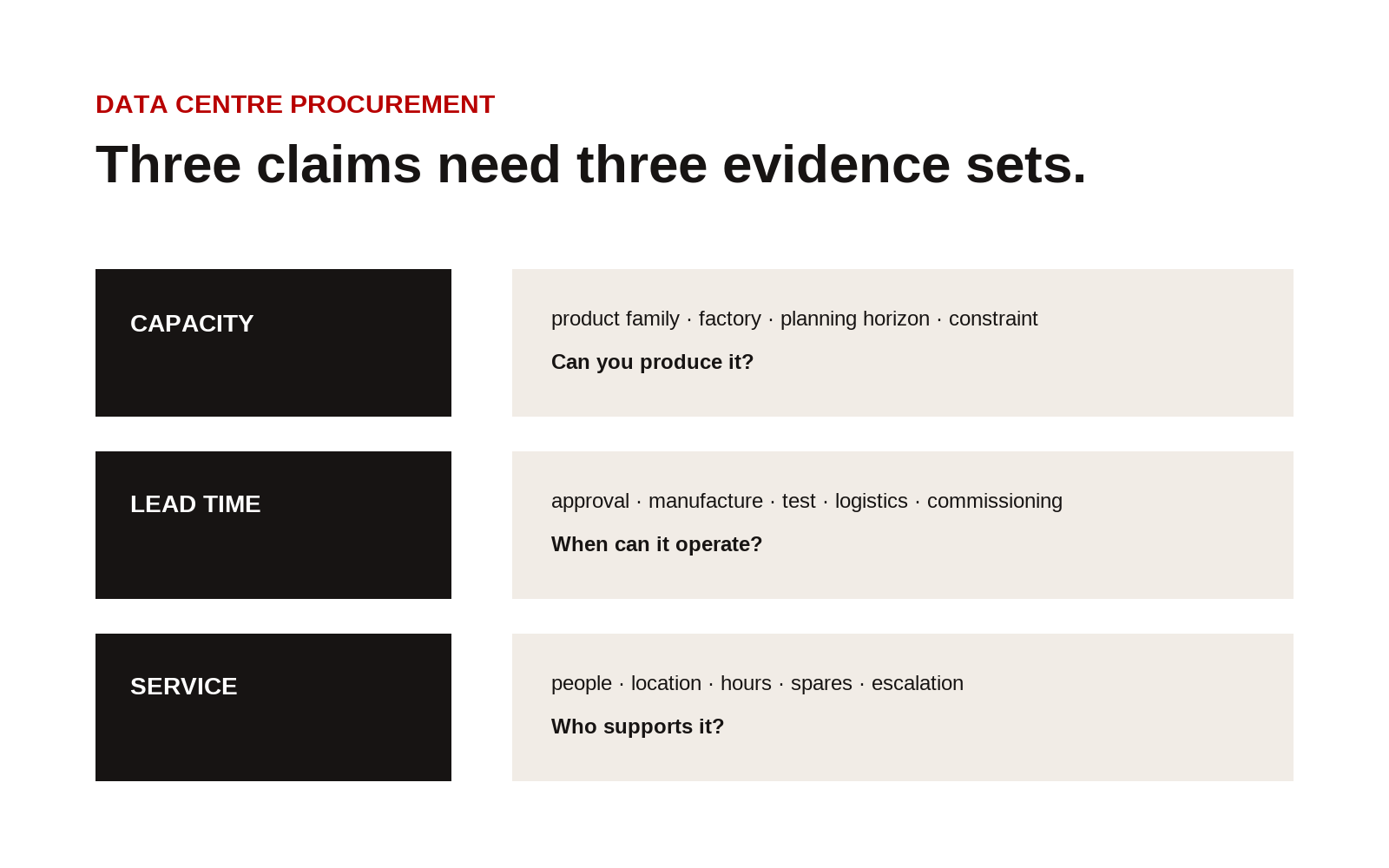
Data centre procurement matrix connecting capacity, lead time and local service evidence.
Separate three questions that are often mixed
| Buyer question | Evidence | Qualification |
|---|---|---|
| Can you produce it? | Monthly or project capacity by product family | Approved configuration, materials and factory loading |
| When can it arrive and operate? | Stage-by-stage programme | Approval, testing, logistics and site readiness |
| Who supports it after handover? | Coverage map and service process | Location, hours, competence, spares and exclusions |
One factory capacity number does not answer all three. Neither does a map with a pin marked “Malaysia”.
Define capacity in units the buyer can use
Capacity should match the purchase. Units, panels, skids, megawatts or projects per month may each be valid depending on the package. Explain whether the figure covers manufacturing, assembly, testing or installation.
Add these fields:
- product family and configuration range;
- site or factory included;
- normal planning horizon;
- current data date and review frequency;
- constraints that reduce output;
- reserved and uncommitted capacity treatment;
- process for confirming a project slot.
Avoid publishing client-confidential utilisation. The aim is to show how capacity is established, not disclose an order book.
Turn lead time into a controllable sequence
Use a timeline rather than one headline number:
- enquiry definition;
- technical selection and quotation;
- design approval and release;
- procurement and manufacturing;
- factory acceptance test;
- shipping and customs;
- site acceptance, integration and commissioning.
For each stage, name the required buyer input and the point at which the date becomes committed. Show which changes reset the sequence. A revised duty, enclosure, control protocol or certification requirement can be material.
This also protects the supplier. A public “six-week delivery” claim is misleading if six weeks starts only after approved drawings and excludes shipment.
Show service coverage as an operating system
A coverage page should answer who responds, from where, with what parts and under what conditions.
Include local and regional service locations, support hours, escalation path, remote-access conditions, typical competence categories and critical-spares approach. If a partner provides coverage, state the partner's role and the supplier's accountability.
Do not list a hotline as proof of field capacity. Buyers may need to know how incidents are triaged, how site access is arranged, which records are produced and what happens when the first responder cannot close the issue.
Our article on Malaysia's data centre opening for M&E suppliers places this operating evidence in the wider value chain.
Keep public and controlled evidence separate
The website can publish method, scope and representative capability. Controlled procurement material can hold current load, client references, detailed factory data, staffing, response commitments and contract terms.
Use a clear handoff:
- public page establishes fit;
- enquiry captures package, location and programme;
- commercial owner confirms the evidence set;
- sensitive documents move into the approved exchange;
- agreed figures enter the proposal and contract.
This prevents sales copy from becoming an unintended contractual promise.
Run a monthly evidence review
Assign owners for capacity, lead time and service data. Each month, confirm the current date, major constraint changes, service-contact accuracy and whether published examples remain representative.
If the business cannot maintain a number, publish the decision process instead. “Lead time confirmed after approved technical scope and factory review” is more useful than an attractive number that is usually withdrawn later.
Handle exceptions without hiding them
Procurement teams know that supply chains change. Confidence comes from seeing how the supplier responds when the normal plan fails.
Describe the exception process at a useful level: identify the constraint, assess technical alternatives, obtain approval, update the programme and preserve traceability. If a substitute component changes a certification, duty or warranty condition, make that visible before acceptance.
Keep an internal log of quoted and achieved milestones by product family. Review the difference and the cause. This evidence helps commercial teams improve future ranges and gives management a clearer view than an average lead-time claim.
For service coverage, record first response, competent attendance, diagnosis and closure separately. A fast acknowledgement is not the same as restoring operation. Use contract-specific commitments in the proposal, while the public website explains the measurement method.
Questions a buyer can use
- When does the lead-time clock start?
- Which approvals or changes can reset it?
- What capacity is uncommitted and how is it reserved?
- Who attends in Malaysia and who supports remotely?
- Which critical parts are stocked locally?
- How are exceptions approved and recorded?
Creatif Work structures engineering websites around the information technical buyers compare. Our website design service can build a capacity and support section that moves from public qualification to a controlled procurement conversation without blurring the two.