

The Local Supplier Page a Multinational Procurement Team Needs

A multinational procurement team needs to understand what the supplier actually does in Malaysia, which entity it will contract, what capacity is local and which evidence supports the claim. A page full of flags and global language does not answer those questions.
Build the page around the package and qualification route.
What should a local supplier page include?
Include the Malaysian legal entity, ownership, facilities, work performed locally, products or services, capacity and lead-time basis, quality and inspection capability, applicable certifications, relevant projects, supply-chain role and a qualification contact.
| Buyer question | Page evidence |
|---|---|
| Who will contract? | Legal name, number, ownership and address |
| What is local? | People, process, equipment and value performed in Malaysia |
| What can be supplied? | Exact products, services, specifications and limits |
| Can demand be met? | Dated capacity, shifts, lead-time process and constraints |
| How is quality controlled? | Inspection, traceability, calibration and non-conformance |
| Has this been done before? | Comparable customers or approved project evidence |
| How do we qualify? | Named contact and controlled document route |
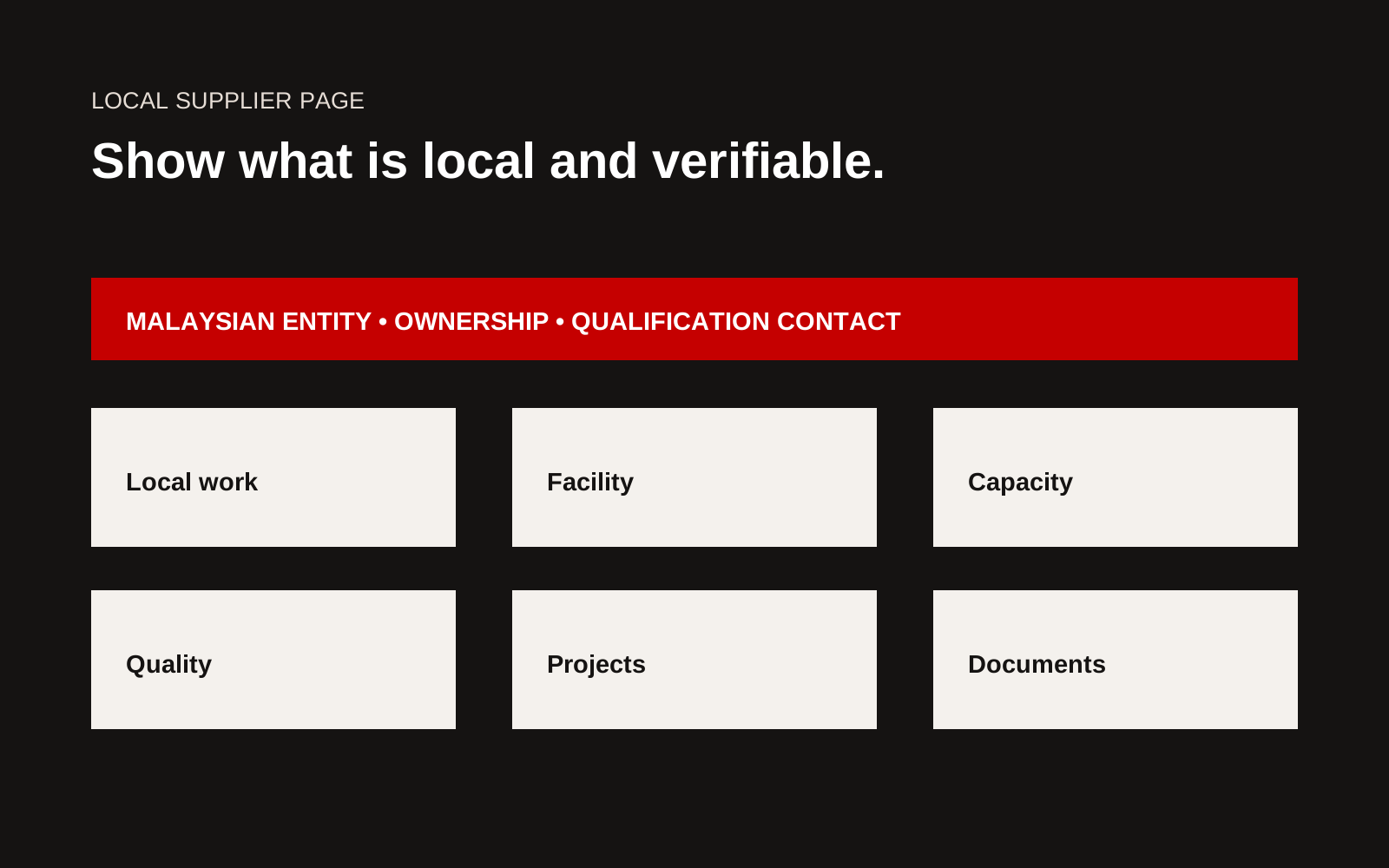
Local supplier page anatomy with Malaysian entity, facilities, products, capacity, quality, projects and qualification contact.
State the entity and local scope
Explain group and shareholder relationships without making the reader decode an organisation chart. State which entity employs people, owns or operates the facility and signs the supply contract.
If design comes from an overseas group company while manufacturing is local, show that interface and responsibility.
Show the facility as operating evidence
Publish location, floor area if approved, principal processes, equipment, inspection capability, shifts and supported product families. Use dated photography and captions.
Do not display a machine list without explaining what can be produced and which processes are subcontracted.
Define local value accurately
Separate local design, engineering, sourcing, manufacturing, assembly, testing, service and support. Avoid a broad "made in Malaysia" claim when material or key processes come from elsewhere.
If a buyer has a specific local-content definition, answer it in the controlled qualification response.
Present capacity with a boundary
State date, product or process family, unit, shift basis and assumptions. Explain the process for confirming current availability.
Capacity on a website is not a reservation. Use it to demonstrate scale, then route forecasts and firm orders through the responsible team.
Make quality evidence specific
Show certification entity, standard, scope, issuer and validity. Explain incoming inspection, process control, final inspection, traceability, calibration and non-conformance at a high level.
For sensitive customer or product records, state what can be reviewed under NDA or qualification.
Connect to current vendor programmes
MIDA's official site provides current information about investment and supplier-development initiatives such as InvestLokal. Link to the official programme rather than presenting participation as buyer approval unless the company has that documented status.
Use relevant proof
Project or customer evidence should state supplied item or service, industry, period, volume or constraint where approved, and the supplier's role. A logo grid is not enough.
Show continuity and risk controls
Procurement teams may need to understand backup equipment, critical spares, alternative suppliers, maintenance, utilities and business continuity. Publish a high-level explanation and keep sensitive facility details in the controlled review.
State how quality and delivery issues are escalated. Give role contacts for normal orders, technical questions and urgent disruption. Avoid personal details that become stale when staff change.
Make the page usable across borders
Use SI units consistently, explain Malaysian registration terms and provide a reviewed English version where multinational teams work in English. State time zone, working hours and response route.
Do not translate technical terms mechanically. Product names, standards and legal entities must remain consistent across languages.
Connect products to enquiry data
Each product or service link should carry its reference into the enquiry. Ask for drawing, specification, quantity, target date and destination only when needed. This lets the procurement team send a useful request without first navigating a generic sales conversation.
Review common enquiries quarterly. Missing fields and repeated clarification reveal where the public page or controlled pack needs improvement.
Local supplier page checklist
- Malaysian contracting entity identified
- Group and operational roles explained
- Local processes separated from imported inputs
- Product and service limits clear
- Facility and equipment tied to deliverables
- Capacity states unit, date and assumptions
- Quality system and traceability explained
- Certifications show scope and validity
- Projects prove comparable supply
- Qualification route has a responsible contact
Add a local-content claim register
For every statement about local production, staffing, sourcing or capability, record the exact definition, measurement period, source and approving owner. Distinguish work performed by the Malaysian entity from imported components, group capability and subcontracted processes. Avoid turning a complex supply chain into an unsupported percentage.
Review the register with operations and finance before a campaign or buyer visit. Check whether facility photos, machine lists and headcount figures still represent current capacity. When a process is not performed locally, say where responsibility sits and how quality is controlled. Give procurement a contact who can provide controlled records under the appropriate agreement. This makes the public page useful without forcing every detail into it. It also prevents sales teams from creating different versions of the same local-content story for separate buyers, a pattern that becomes difficult to reconcile during audit or onboarding.
Test the page in the buyer's working language and on a phone. A clear record should survive translation, smaller screens and forwarding between procurement, engineering and quality reviewers without losing the identity or scope of the supplier.
Creatif Work builds engineering websites for Malaysian suppliers selling into regional and multinational procurement. Through our website service, facilities, specifications and buyer evidence can be maintained as structured records instead of scattered company-profile slides. Our guide to Malaysian supplier websites before a buyer visit provides a wider readiness review.