

InvestLokal: How Malaysian Engineering SMEs Can Prepare for Vendor Programmes

Vendor programmes can give Malaysian engineering SMEs a route into multinational supply chains, but registration is not the same as qualification or awarded work. Firms should prepare evidence around a specific package, buyer requirement and capability gap.
The useful goal is to become easier to assess, develop and onboard.
How should an engineering SME prepare for InvestLokal or a vendor programme?
Choose target buyers and work packages, map mandatory requirements, assemble current company and technical evidence, identify capacity and capability gaps, define a development plan and prepare for audits, pilots or sample qualification.
MIDA describes InvestLokal as part of efforts to strengthen domestic supply chains and link Malaysian companies with multinational and large local companies. Firms should use the current MIDA programme notice, participating-company requirements and official application route.
| Readiness area | Evidence | Development question |
|---|---|---|
| Entity | Registration, ownership and locations | Is the intended supplier entity clear? |
| Package fit | Product or service and limits | Which buyer need is addressed? |
| Quality | System, inspection and traceability | What approval gap remains? |
| Capacity | People, equipment and lead time | Can demand be met consistently? |
| Technical | Drawings, processes and test evidence | What must be qualified? |
| Commercial | Quote basis, terms and continuity | Is supply sustainable? |
| ESG and HSE | Applicable process and data | Which buyer requirements apply? |
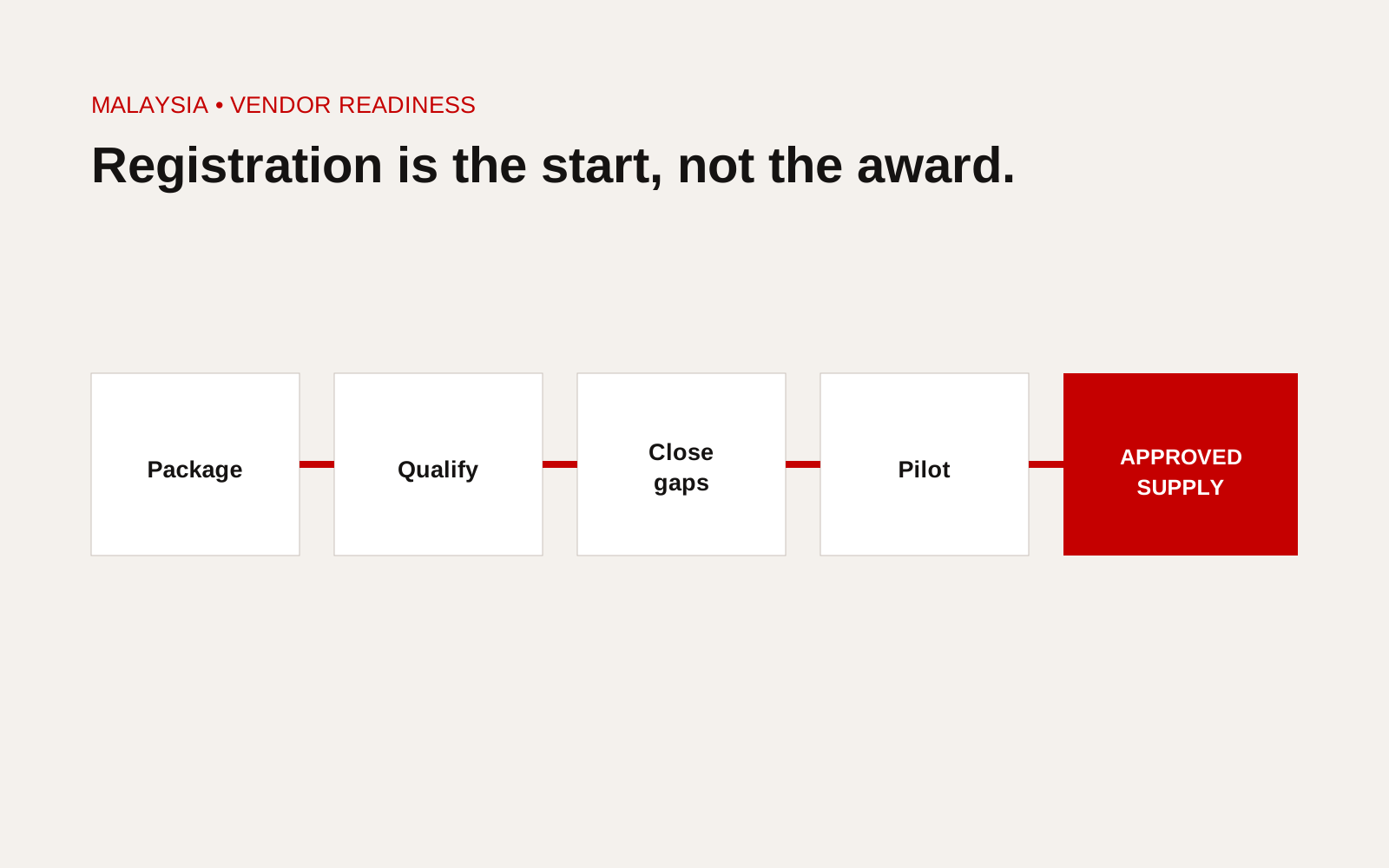
Malaysian SME vendor programme readiness path from buyer need through qualification, capability gap, pilot and approved supply.
Select a package, not a whole industry
Do not apply as a general engineering company. Identify components, processes, maintenance packages, design services or other deliverables that match the buyer's supply chain.
For each target, record specifications, volumes, approval steps, current sourcing, lead times and critical risks. This makes the development conversation practical.
Build a qualification index
Create one controlled index of:
- legal entity and company profile
- ownership and local operations
- products and services
- facilities and principal equipment
- workforce and critical competencies
- quality, safety and environmental systems
- certifications with scope and validity
- process and inspection capability
- project or customer evidence
- financial and continuity information
- contact and document owner
Do not upload expired certificates simply to complete a portal field.
Compare current capability with the buyer requirement
Use a gap matrix:
| Requirement | Current evidence | Gap | Action | Owner/date |
|---|---|---|---|---|
| Product tolerance | Inspection records | Gauge capability | Equipment and method review | Named owner |
| Traceability | Batch record | Supplier input missing | Extend record | Named owner |
| Capacity | Current shift output | Peak not proven | Controlled run | Named owner |
| Approval | Comparable sector | Buyer-specific test | Sample qualification | Named owner |
Do not hide the gap. A credible development plan is more useful than an unsupported "fully capable" claim.
Prepare for an audit or site visit
The visitor should see the same process described in the documents. Verify housekeeping, material identification, calibration, work instructions, non-conformance, training, maintenance, inspection and records.
Trace one completed job from purchase order through material, production, inspection and delivery. Close missing links before the visit.
Plan a pilot or sample qualification
Agree product or service scope, inputs, specifications, quantity, tests, acceptance, intellectual property, cost responsibility and what decision follows. Record deviations and corrective action.
A successful sample does not prove production capacity. A capacity run does not prove every product family. Label the evidence stage.
Prepare the commercial operating model
A buyer also needs continuity. Explain quotation lead time, order acknowledgement, change control, packaging, delivery, warranty, after-sales support and escalation. Identify imported inputs, single-source components and long lead items.
Do not hide minimum viable volumes or investment needed for scale. A vendor-development programme works better when both sides understand the commercial conditions required to sustain supply.
Protect intellectual property and buyer information
Define ownership and permitted use for drawings, samples, tooling, software, process data and test results before qualification work starts. Control buyer documents and access by role.
The public website should show capability, not upload customer drawings or photographs of restricted production. Prepare a controlled data room or qualification pack for evidence that needs confidentiality.
Track the programme as a gated project
Use stages for initial match, document review, site audit, gap closure, sample, pilot order and approved supply. Record the evidence and decision needed at each gate. This prevents a long registration process from being mistaken for commercial progress.
Make the company easy to research
Buyers may review the website before contacting the SME. Publish exact services, facilities, certifications, specifications and relevant projects. Keep client-sensitive evidence controlled.
Vendor-programme checklist
- Target buyer and package identified
- Current official programme route checked
- Legal entity and local operation clear
- Certifications show scope and validity
- Technical process and inspection evidence ready
- Capacity has a dated boundary
- Gaps have actions, owners and dates
- Site audit can trace a real job
- Pilot has acceptance and next decision
- Public and controlled evidence separated
Prepare a 12-week readiness sprint
Weeks one and two should confirm the target buyer, package, official programme route and mandatory conditions. Weeks three and four should map products, processes and facilities to those requirements. Weeks five and six should close high-risk evidence gaps, not rewrite the whole company profile.
Use weeks seven and eight for a mock document review and site walk. A reviewer should be able to trace one order from quotation through material, production, inspection and delivery. Weeks nine and ten can prepare a tightly scoped pilot with acceptance criteria, commercial assumptions and responsible people. Use the final two weeks to correct findings, approve public claims and assemble controlled evidence. The schedule is only a planning device, since programme timing and buyer requirements vary. Its value is that it turns a broad ambition into gates with owners and proof. If a mandatory gap cannot be closed honestly, record it and defer the application rather than hiding it in presentation language.
Creatif Work helps engineering SMEs organise the proof multinational buyers need. Our website service turns approved capability into useful pages, while custom software can support controlled qualification and evidence records when portals and spreadsheets begin to conflict.