

A Malaysian Supplier Website Before the First Multinational Buyer Visit
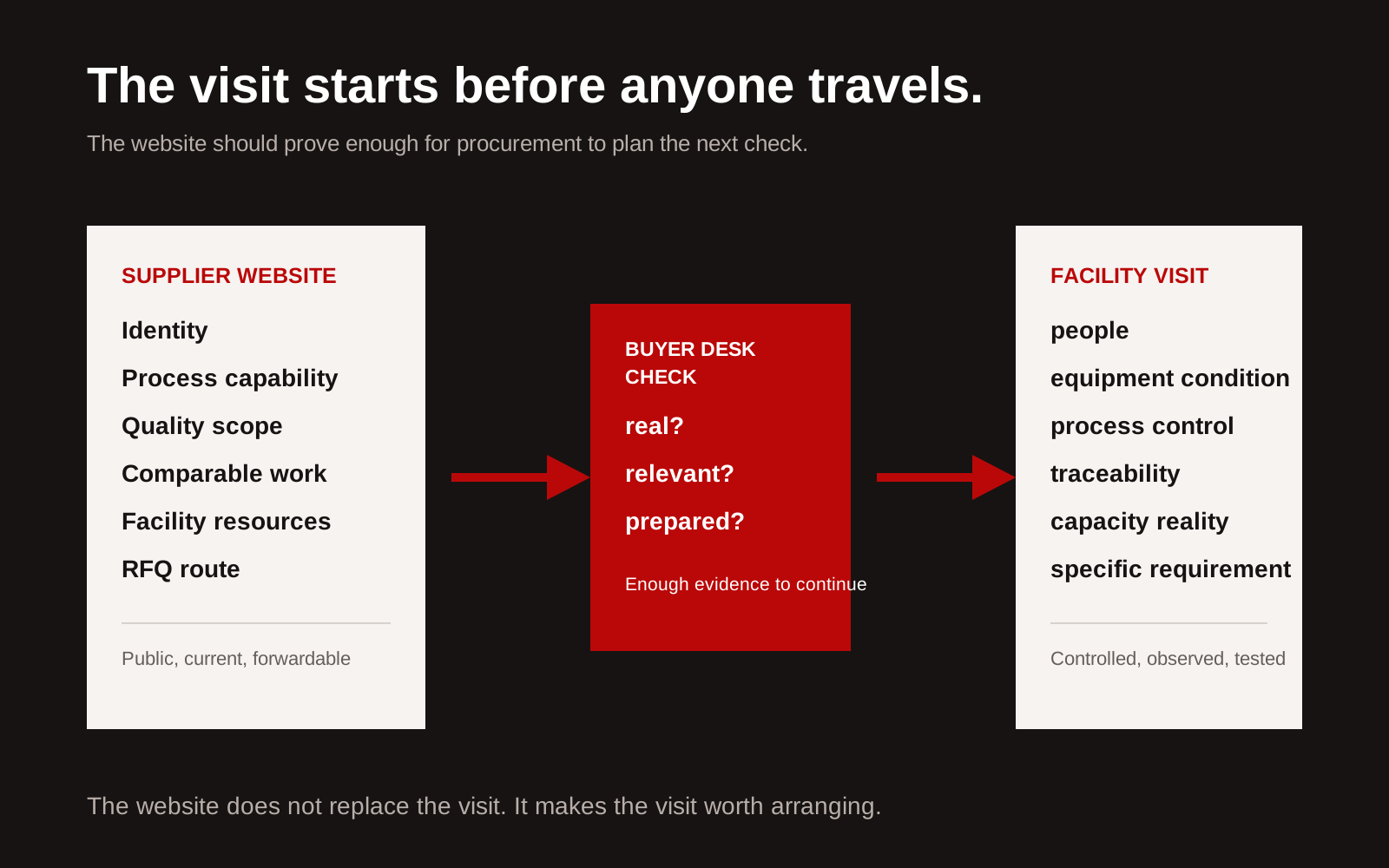
A multinational buyer usually visits a Malaysian supplier after a desk check, not before one. The website is part of that check. It helps procurement confirm the legal business, lets engineering assess a possible technical fit and gives quality or operations a reason to spend time on the visit.
The site does not need to answer the full supplier audit. It needs to prove that a visit is worth arranging and help the buyer plan what to inspect.
What should the website prove before a buyer visits?
It should prove that the company is real, relevant and prepared. Publish the legal entity and operating location, exact process capability, quality scope, comparable work, facility resources, export or multinational experience and a secure route for drawings and RFQs before the buyer decides to visit.
Malaysia's SME Corporation describes its Glocal Linkages SME Programme as a route for MSMEs to connect with larger companies and enter domestic and international value chains. Visibility can create the introduction. Qualification decides whether it becomes a site visit.
Build the page in the buyer's checking order
| Buyer question | Public website evidence | Hold for NDA or visit |
|---|---|---|
| Is this the correct company? | Registered or trading name, full address, contact and operating locations | Corporate records not needed for first screening |
| Can it perform the process? | Equipment type, working range, materials, capacity and limits | Detailed parameters tied to confidential drawings |
| Is the quality system relevant? | Standard, certified scope, issuer and validity | Audit reports, non-conformance records and customer files |
| Has it done comparable work? | Project role, sector, scale, constraint and result | Client-owned drawings, prices and restricted names |
| Can the facility support the job? | Workshop functions, inspection resources, shifts and service coverage | Layout detail, security-sensitive access and proprietary methods |
| Can the team handle our enquiry? | Named response role, RFQ inputs, file route and response process | Commercial negotiation and customer-specific terms |
This separation reduces two common mistakes. The first is publishing too little, forcing the buyer to ask basic questions before deciding whether to visit. The second is uploading sensitive information that should only be shared after qualification and an appropriate confidentiality agreement.
Show the facility as an operating system
A gallery of machines proves that equipment exists. It does not show how work moves through the facility.
Explain the sequence relevant to the buyer:
- quotation and technical review;
- material receipt and traceability;
- planning and process control;
- production or service delivery;
- inspection and release;
- packing, documentation and dispatch; and
- non-conformance or change handling.
Name the functions performed in-house and those handled by approved external providers. If heat treatment, coating, specialist testing or transport is outsourced, do not present it as an internal process. State how the supplier controls the handoff.
ISO and IAF's guidance on external providers explains that organisations need controls for externally provided products, processes and services. A buyer will ask about those controls even when the subcontractor never appears on the public site.
Replace broad claims with operating facts
“High precision”, “fast turnaround” and “international quality” are not useful before a visit. Replace them with information that shapes the visit agenda.
Depending on the business, publish:
- equipment model and working envelope;
- normal material and product families;
- tolerance range with relevant conditions;
- inspection equipment and calibration approach;
- batch, project or monthly capacity with a clear unit;
- shift pattern and surge arrangement;
- design, build, installation and commissioning boundaries;
- sectors and operating environments served; and
- languages and time zones supported by the commercial team.
State limits. A company that explains what it will not quote appears more credible than one that claims every material, process and industry.
Make certificates understandable
Do not upload a row of certificate images without explanation. For each certification, publish:
- standard and edition;
- certified entity and site;
- scope of certification;
- certificate issuer and accreditation where applicable;
- certificate number and expiry date; and
- a link or document for verification, when appropriate.
Our guide to SIRIM and ISO evidence for Malaysian engineering firms explains the difference between a standard, certification and accreditation. That distinction matters when a multinational quality team checks whether the scope covers the facility and process under consideration.
Assign an owner to review the page before every certificate expires. An old certificate can create more doubt than publishing none and explaining the current status directly.
Give the buyer three useful project records
Choose examples that resemble the intended work. A project page should state:
- customer sector and location, even if the name is confidential;
- the requirement or failure that triggered the work;
- the supplier's exact role;
- material, system or scale relevant to the buyer;
- quality or programme constraint;
- inspection or acceptance route; and
- the outcome and its limit.
Do not publish ten images with a one-line caption. One annotated process photograph, one inspection record excerpt cleared for publication and one result table can carry more evidence.
If the work was performed for a multinational through a main contractor, state the contractual route. Direct-client experience and subcontracted experience are both valid, but they prove different commercial responsibilities.
Make the visit easy to plan
The buyer may be coordinating procurement, engineering and quality staff across countries. Publish practical information:
- complete facility address and map link;
- nearest airport, port or industrial area where useful;
- visitor contact and normal appointment hours;
- personal protective equipment or access expectations;
- photography and device restrictions;
- languages available for the technical discussion; and
- whether a virtual capability review is available before travel.
Do not publish access-control procedures or sensitive layout information. Give enough for planning, then confirm the controlled details directly.
Test the RFQ route before inviting the visit
A useful enquiry route asks for the fields needed to assign the opportunity:
- process or service required;
- material or system;
- quantity, scale or operating condition;
- required date and delivery location;
- applicable standard or inspection requirement;
- drawing or specification upload; and
- consent to handle the submitted information.
State the supported file types and size limit. Route the enquiry to a monitored group, not one employee's unattended mailbox. Send an acknowledgement that confirms receipt without promising a technical answer before review.
Test the route from outside the company network. Upload a drawing, receive the acknowledgement, check the internal notification and confirm who owns the next step. A form that appears to work but loses the attachment is worse than a published email address.
A seven-day pre-visit website review
Day 1: verify company names, addresses and contacts.
Day 2: review capability ranges and remove unsupported claims.
Day 3: check certificates, scope and expiry dates.
Day 4: publish or repair three comparable project records.
Day 5: check facility information, photographs and permissions.
Day 6: test the RFQ and file-handling route.
Day 7: ask someone outside sales to plan a visit using only the public site. Record every missing fact.
The aim is not to polish the site before guests arrive. It is to make the visit more productive. When the buyer already understands the basic capability, on-site time can focus on controls, people, equipment condition and the specific requirement.
Creatif Work builds engineering websites for the desk check that happens before a supplier visit. Our website service turns facility, process, certification and project records into a route a multinational team can verify and forward internally. If every visit still begins with facts that should have been clear online, start with the problem.