

Malaysia Data Centre Suppliers: Power, Water and Green Compliance Evidence
A data centre buyer does not need another supplier page saying “sustainable”. The buyer needs operating data, measurement boundaries and documents that can survive technical review. In Malaysia, that now includes clearer expectations around power use, water use, carbon and resource planning.
The practical task for a supplier is to connect each claim to a record. A cooling vendor should be able to explain what it measures. A switchgear company should show the load and test conditions behind an efficiency figure. A water-treatment contractor should state which flows it can meter and report.
What evidence do Malaysian data centre buyers need?
Suppliers should prepare design assumptions, test methods, metering points, operating limits, efficiency results and document revision dates. The pack should distinguish predicted performance from factory tests, commissioning results and live operational data. It should also show who owns each measurement after handover.
Malaysia's Guideline for Sustainable Development of Data Centre provides the clearest public reference. It applies to Digital Ecosystem Acceleration Scheme applications through 31 December 2027. The guideline covers power usage effectiveness, water usage effectiveness, carbon usage effectiveness, renewable energy and local resource conditions.
It recommends a design water usage effectiveness, or WUE, of no more than 2.2 cubic metres per megawatt-hour, with improvement towards 2.0 over ten years. It also calls for continuous monitoring and annual disclosure of actual WUE. Suppliers should not present those figures as universal project acceptance criteria. They should use them to understand the kind of evidence an operator may request.
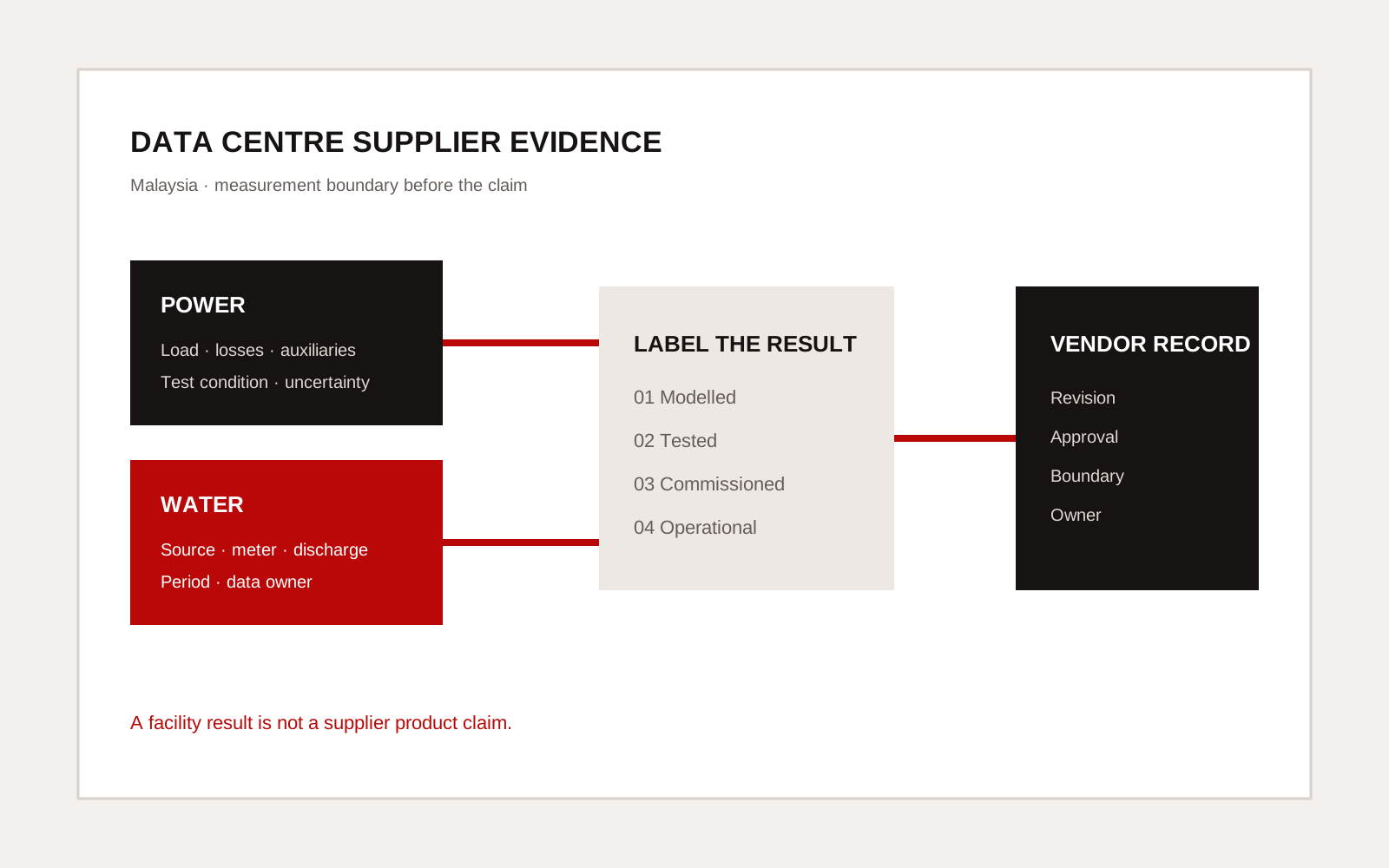
Evidence map linking Malaysian data centre power, water and environmental requirements to supplier records.
Build the pack around the measurement chain
The strongest supplier pack follows the measurement from equipment to project report.
| Evidence area | Supplier record | Question it answers |
|---|---|---|
| Design basis | Duty point, ambient condition, redundancy mode and load profile | What conditions produced the stated result? |
| Product performance | Test standard, curve, tolerance and certificate | Is the equipment result comparable? |
| Metering | Meter type, location, frequency and data owner | Can the result be checked after handover? |
| Commissioning | Test script, witness, exceptions and closure record | Was the installed system shown to work? |
| Operations | Setpoints, maintenance needs and drift indicators | What keeps performance within range? |
| Disclosure | Unit, period, boundary and approval status | Can this number be used in a report? |
Do not collapse these records into one percentage. A factory efficiency test is not a site PUE result. A design model is not measured consumption. The pack should keep each boundary visible.
Power evidence needs context
For electrical and mechanical equipment, publish the operating range rather than one best-case value. Include partial-load behaviour where it affects the result. State whether auxiliaries, controls and standby equipment are included.
Useful fields include:
- rated and tested load;
- input and output measurement points;
- voltage, frequency and power factor assumptions;
- cooling or ambient conditions;
- measurement uncertainty;
- applicable test standard;
- control mode and setpoints; and
- the revision date of the performance data.
If the equipment contributes to a wider efficiency calculation, show where its data enters that calculation. The operator owns the facility result. The supplier owns the accuracy of its input.
Water evidence must show the boundary
The MIDA guideline defines WUE as water consumption divided by IT equipment energy. A system vendor may only see one part of that numerator. Cooling tower make-up, blowdown, humidification and treatment losses may sit in different packages.
A water or cooling supplier should map:
- incoming water sources;
- treatment stages;
- make-up and process flows;
- discharge and reuse streams;
- each meter and data owner; and
- the calculation period.
The guideline also advises avoiding Peninsular Malaysia areas with a Water Stress Index of 0.8 or higher. Site selection remains an owner decision. A supplier can still explain how its design changes consumption under different water conditions and which assumptions must be checked locally.
Green claims need an evidence label
“Low carbon” is not a technical field. State whether a claim refers to embodied material, electricity consumption, refrigerant, renewable energy or an operational calculation. Then name the source.
Use four labels throughout the pack:
- modelled: produced by a calculation before operation;
- tested: measured under a stated test method;
- commissioned: observed during project acceptance; and
- operational: recorded in service over a stated period.
This prevents a tender team from reusing a modelled figure as a measured case result. It also makes later updates easier.
What belongs on the website?
The public page should act as an index, not a document dump. Publish the systems supported, the data available, the standards used, a sample evidence table and a contact route for controlled records. Keep project schematics, security-sensitive metering layouts and client data behind an approved process.
Our guide to engineering website evidence explains how buyers review capability before an enquiry. The engineering sector page also shows how technical proof can be structured without exposing confidential files.
Before release, ask one technical manager to trace every public number back to its source. Ask one commercial manager to confirm that the wording does not extend beyond the contract role.
Creatif Work can turn an existing data pack into a useful public structure through our website work. If the documents exist but procurement teams cannot find the right version, start with the problem.