

Malaysia's AI and Data Centre Growth: Openings for M&E Suppliers
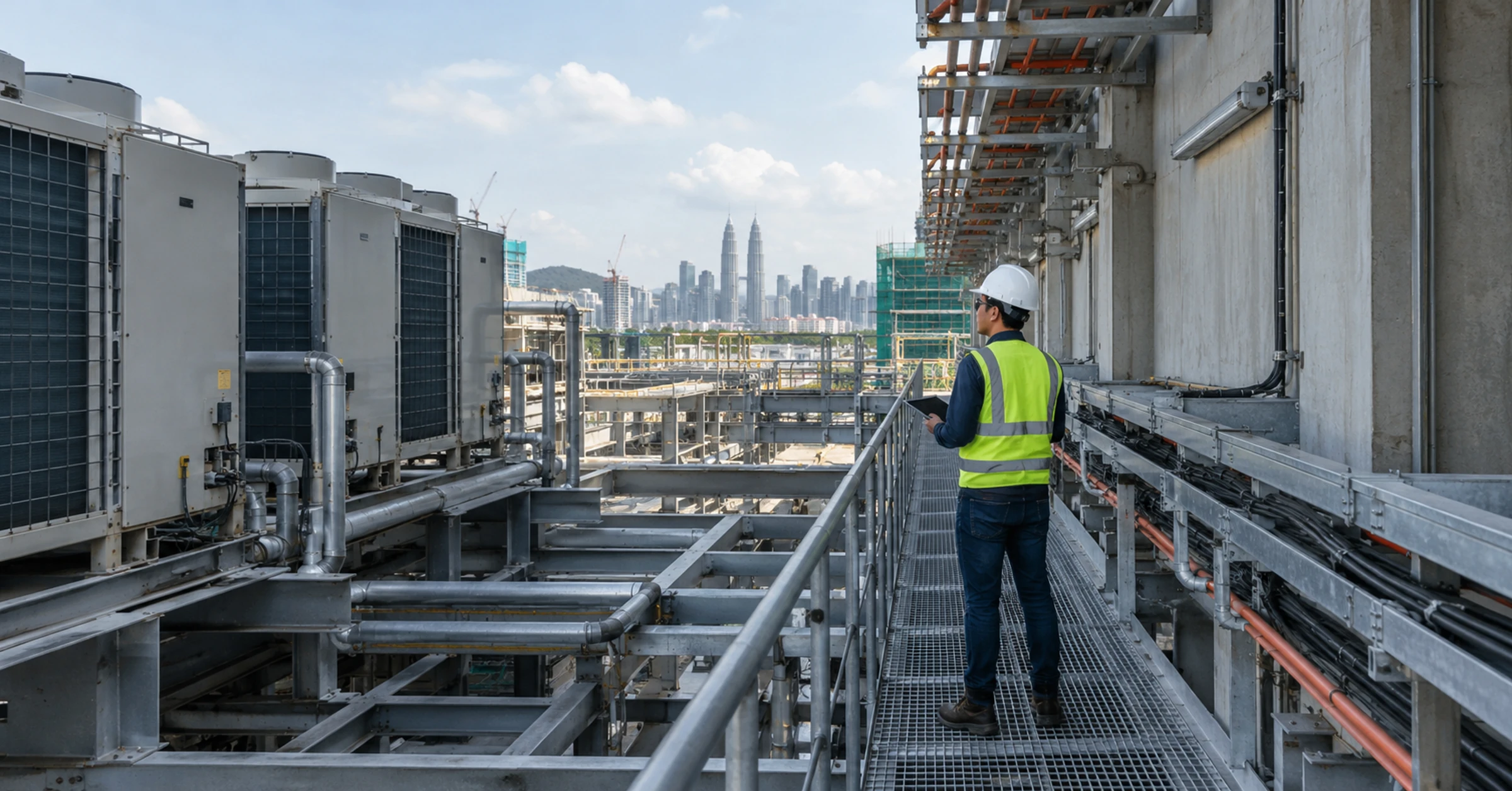
Malaysia's data centre growth creates work for more than developers and operators. Mechanical and electrical suppliers can contribute to power, cooling, controls, water, fire protection, commissioning and long-term maintenance.
The opportunity is real, but a supplier still has to prove capacity, technical fit and service coverage. A page that says “data centre solutions” without those facts is unlikely to survive technical screening.
Where can M&E suppliers enter the value chain?
M&E suppliers can enter through design support, equipment supply, package integration, installation, testing, commissioning, monitoring and maintenance. The strongest opening is not the broadest claim. It is a defined package with documented capacity, environmental conditions, interfaces, lead time, quality controls and Malaysian service coverage.
MIDA's September 2026 Data Centre Nexus statement described a shift from attracting investment toward building local value for SMEs and Malaysians. The official programme brought operators, technology companies, government agencies, finance providers and supply-chain companies together around AI-driven digital infrastructure and sustainable operations.
That does not mean every supplier should rebrand as an AI infrastructure company. It means more buyers will need credible local delivery and support around demanding facilities.
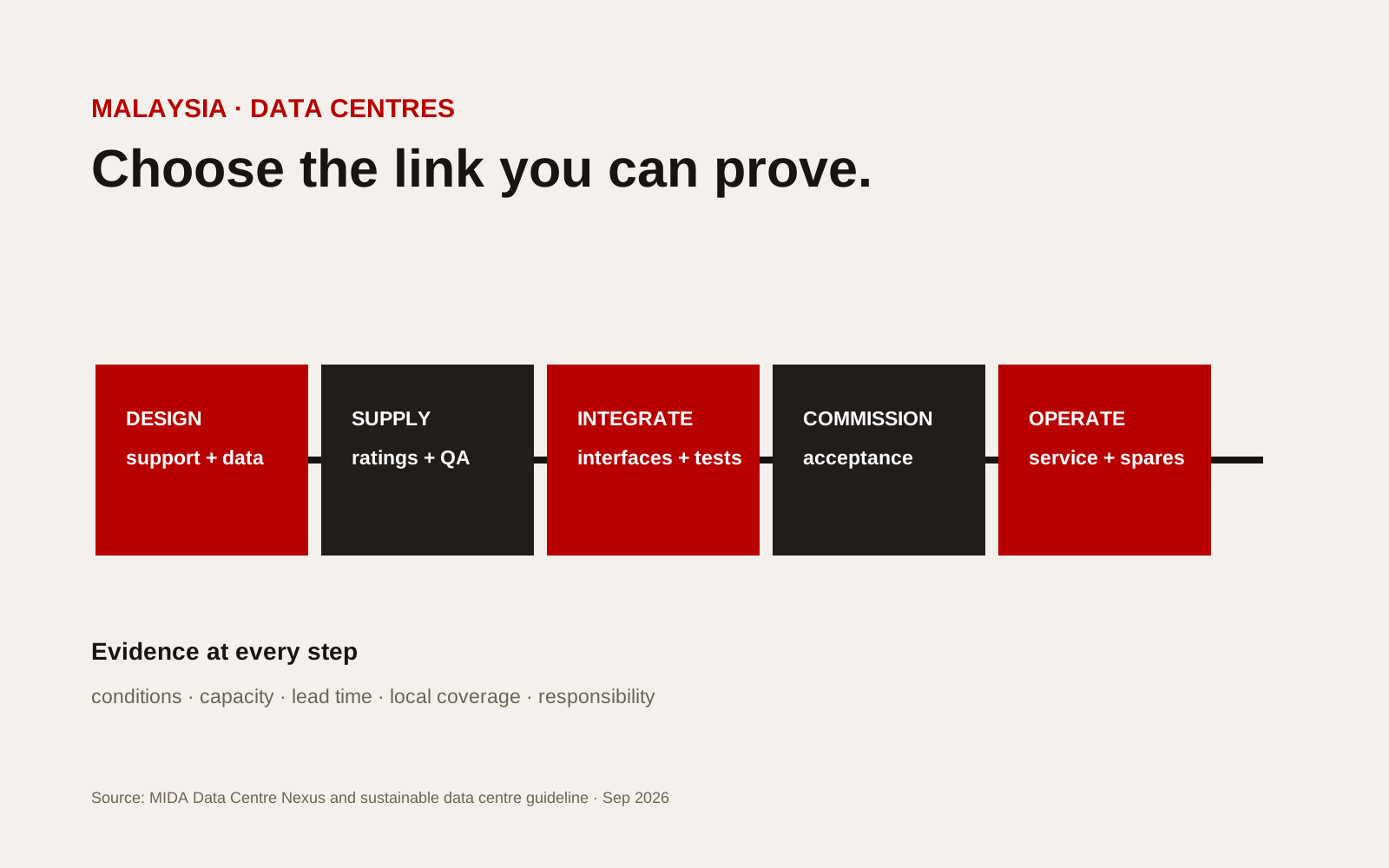
Malaysia data centre value chain showing M&E supplier opportunities from design support to maintenance.
Choose a specific position
| Value-chain stage | Supplier contribution | Evidence a buyer will ask for |
|---|---|---|
| Design support | Selection data, load assumptions, controls and interface input | Design conditions, calculation basis and responsible engineer |
| Supply | Equipment or assembled package | Ratings, standards, origin, QA and lead time |
| Integration | Mechanical, electrical and controls coordination | Interface matrix, drawings, protocol and test plan |
| Commissioning | Functional and integrated testing | Procedures, acceptance criteria and records |
| Operations | Monitoring, spares and maintenance | Coverage, response route, stock and escalation |
Pick the rows the company can own. If it supplies equipment but relies on a partner for commissioning, name that boundary.
Sustainability changes the supplier conversation
Malaysia's Guideline for Sustainable Development of Data Centre places energy and water performance, resource efficiency and responsible development inside the sector's growth plan. An M&E supplier should therefore connect product claims to operating conditions.
Do not publish an efficiency figure without the duty point, standard, test condition and control mode. For cooling equipment, buyers may need performance across ambient conditions and part load. For power equipment, they may need losses, harmonics, redundancy and maintenance constraints. For water-related systems, state the boundary between equipment performance and whole-site consumption.
If a result belongs to a completed project, label it as measured, calculated or specified. Do not imply that one product determines the facility's overall performance.
Lead time is part of technical risk
Data centre programmes can be exposed by long-lead equipment, but a single number is rarely enough. Break lead time into quotation validity, design approval, manufacturing, factory test, shipping, site readiness and commissioning.
Publish ranges only when the business can maintain them. Otherwise explain the process and the information required for confirmation. A useful capacity statement includes:
- manufacturing or assembly location;
- normal and constrained lead-time drivers;
- approval and hold points;
- critical imported components;
- local stock or spares policy;
- site and commissioning coverage;
- escalation route for programme change.
Our guide to capacity and lead time for data centre buyers shows how to present that information without making a promise the operation cannot keep.
Prove integration, not just product quality
The equipment may be excellent and still create project risk at the interface. Buyers need to know how the package connects to power distribution, controls, fire strategy, water systems, structural supports and the commissioning sequence.
Use one annotated interface diagram. Mark inputs, outputs, protocols, limits and responsible parties. Add the tests used to prove each interface. Keep project-sensitive drawings in the controlled exchange, but show the method publicly.
This is also valuable for local partners. A clear interface model helps a manufacturer, distributor, installer and service team agree who owns design queries and failures.
A supplier readiness checklist
Before targeting a data centre buyer, confirm:
- the exact equipment or package and duty range;
- applicable standards and certification scope;
- product data under Malaysian operating conditions;
- capacity, lead-time assumptions and hold points;
- quality and test records available;
- local installation, commissioning and service boundary;
- spares, warranty and escalation route;
- one relevant project or test example with an approved boundary.
Decide whether the opportunity fits the business
Do not treat market growth as a reason to accept every enquiry. Score the opportunity against technical fit, delivery capacity, required investment, payment exposure, certification gap, partner dependence and after-sales obligation.
A simple go or no-go review should involve operations, engineering, service and finance, not only business development. Ask what must be true for the first project to succeed and which capabilities will still be useful if the order does not proceed.
If a new factory line, stock position or service team is required, separate committed investment from assumptions based on forecast demand. MIDA's ecosystem focus may create routes for local participation, but each supplier remains responsible for its own commercial case.
Publish only capabilities that are ready. Future plans can be discussed as plans, with dates and dependencies, rather than written as current capacity.
The commercial opening begins with credible evidence. Creatif Work designs engineering websites that help procurement teams find product scope, interfaces and service coverage quickly. Our website service can turn approved data into a focused data centre capability section instead of another generic market page.