

Malaysia's Semiconductor Growth: Opportunities for Precision Engineering Firms

Malaysia's semiconductor investment is moving into more front-end equipment, advanced materials, automation and packaging. Precision engineering firms can benefit, but broad claims about serving the semiconductor industry will not pass supplier qualification.
The opportunity sits in a defined process, part, tolerance, material and capacity range. That is what the website and vendor pack should prove.
Where can precision engineering firms fit?
Firms can support equipment parts, precision modules, jigs and fixtures, automation, inspection, clean-compatible fabrication, spares and repair. The credible entry point is a narrow capability backed by measurement, traceability, controlled change and delivery capacity, not a general claim to serve semiconductor customers.
MIDA reported RM218.5 billion in approved investments in the first half of 2026. Its release highlighted movement from back-end activity towards front-end design and equipment. It cited UWC Technology's expansion in complex machinery, modules and parts for front-end semiconductor equipment.
Approved investment is not guaranteed demand for an individual supplier. It is a signal to prepare evidence for the segments receiving capacity.
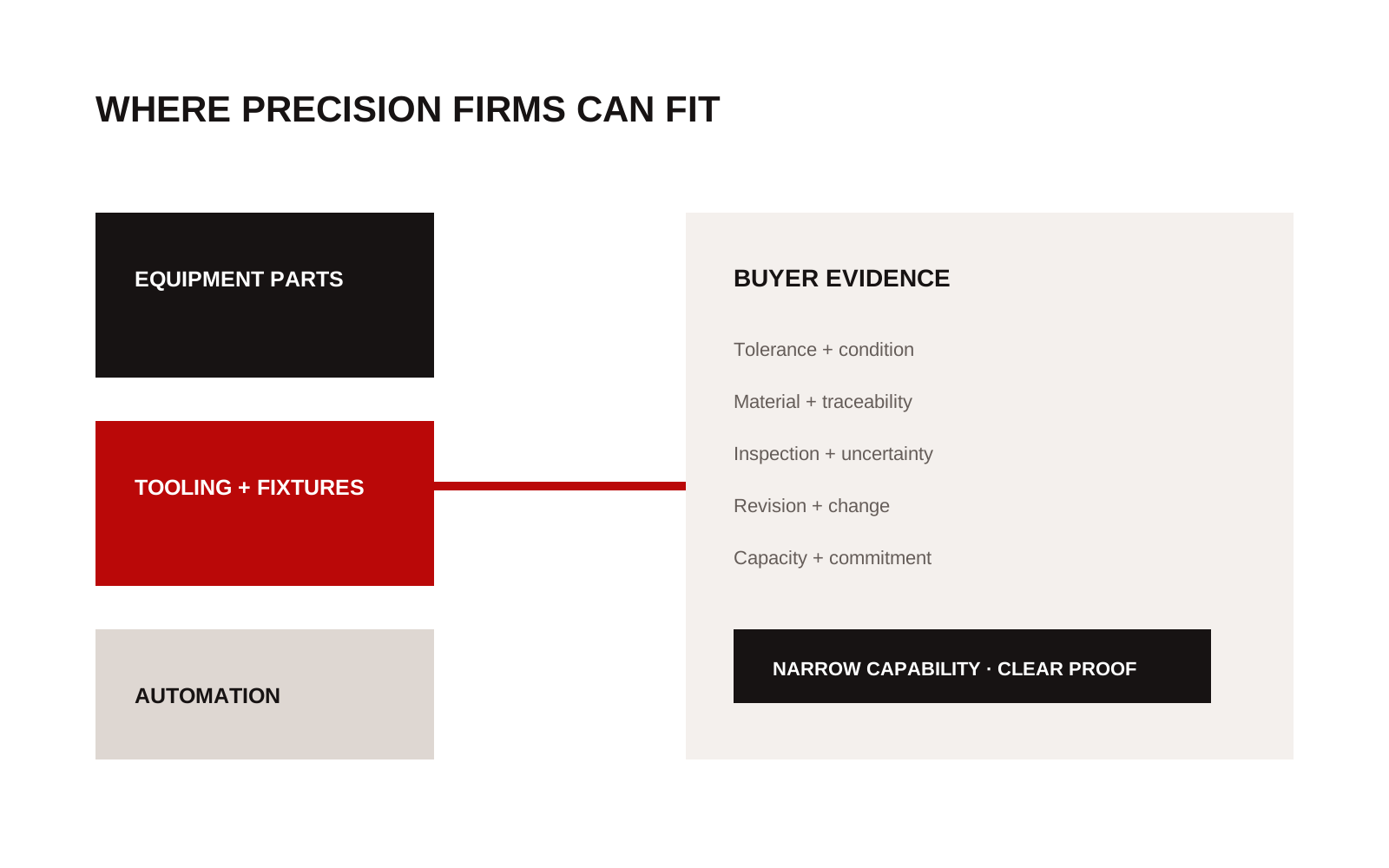
Malaysia semiconductor value chain showing precision engineering opportunities in equipment, modules, tooling and inspection.
Map capability to the value chain
| Buyer area | Possible precision scope | Evidence needed |
|---|---|---|
| Wafer and process equipment | Machined parts, frames and modules | Tolerance, material, cleanliness and inspection |
| Automation | Fixtures, handling and integration parts | Repeatability, cycle and interface evidence |
| Packaging | Tooling, nests and precision assemblies | Dimensional control and changeover capability |
| Test | Sockets, fixtures and mechanical interfaces | Measurement method and revision control |
| Facilities support | Skids, specialist parts and repair | Material, pressure or service qualification |
| Maintenance | Replacement and reverse-engineered parts | Drawing control and equivalence approval |
Do not imply that every capability is cleanroom-ready. State cleaning, packaging and environment controls only where they are implemented and verified.
Build a buyer-ready capability record
For each process, document:
- part size and weight range;
- achievable tolerance under stated conditions;
- materials and specialist treatments;
- equipment and control method;
- inspection equipment and uncertainty;
- batch or serial traceability;
- drawing and revision control;
- nonconformance and change process;
- monthly or shift capacity basis; and
- subcontracted steps.
Buyers need to see where responsibility leaves the facility. If heat treatment, coating or calibration is subcontracted, state how those suppliers are approved and traced.
Follow the investment signals carefully
MIDA's first-quarter 2026 release named projects in wafer-level packaging, silicon carbide wafering, automation modules and compound-semiconductor deposition equipment. Its electrical and electronic components page reported RM16.9 billion in approved 2025 investment across 59 projects.
These figures describe the ecosystem, not an addressable market forecast for one company. A precision firm should interview existing customers and equipment partners before buying a machine for a presumed demand wave.
Use an investment gate:
- named target process and part family;
- confirmed buyer requirement;
- qualification route and expected duration;
- gap between current and required control;
- capacity and utilisation case;
- inspection and talent requirement; and
- alternative work if the target programme changes.
Show capacity without overpromising
Machine count alone is not capacity. Publish a sensible range or explain the planning method. Account for setup, inspection, maintenance, yield, shift pattern and other committed work.
A useful statement might explain that capacity is confirmed after drawing review and process planning. Do not publish a guaranteed lead time that sales cannot support across part complexity.
Prepare for technical search
Buyers may search by process, material, tolerance, part type, inspection method or location. Create pages only for real capability combinations. Include tables that use consistent units and state exceptions.
Our guide to precision engineering capability pages provides the field structure. The engineering sector page shows how project and supplier evidence fit around it.
Creatif Work turns approved capability data into engineering websites that buyers can compare and maintain. If the investment case depends on a customer finding the firm, but the public evidence stops at a machine list, start with the problem.
Prepare for a supplier-development conversation
Before approaching a multinational or equipment company, prepare one capability sheet around the target part family. Include the current process, material, inspection route, controlled outside processes, traceability and realistic volume. Add a gap table showing what must change for the target requirement.
Do not ask the buyer to design the investment case. Bring specific questions about tolerances, cleanliness, documentation, qualification lots, change notification and forecast pattern. Record which requirements are mandatory and which are preferences.
Use a staged decision:
- desktop capability review;
- sample or process trial;
- quality-system gap closure;
- qualification batch;
- controlled production release; and
- capacity expansion after evidence.
The stages vary by buyer, but the principle prevents large capital commitments based only on an introductory meeting. Track the people, equipment, inspection and documentation needed at each gate. Publish only the capability currently available or formally committed. Keep customer-specific qualification detail controlled until permission is clear.
Set a review date for the target account and market assumption. Compare actual enquiries, qualification progress and utilisation with the investment case. If the target part family does not advance, decide whether the equipment supports another approved market before adding capacity. This keeps the growth plan tied to buyer evidence rather than a national investment headline.
Document the decision even when the answer is not to invest. A recorded assumption and review trigger are more useful than an optimistic equipment list with no qualified demand behind it.