

Precision Engineering Capability Pages: Tolerance, Inspection and Capacity

“High precision” gives a buyer nothing to qualify. A capability page should state what is made, in which material and size range, under what controlled process, and how the result is inspected.
Tolerance, inspection and capacity belong together. A number without measurement or production context can mislead.
What should a precision engineering capability page show?
Show process, part range, material, dimensional capability, surface requirement, inspection method, traceability, controlled subcontracting and capacity basis. State that final feasibility follows drawing review. Do not publish the tightest tolerance ever achieved as a routine promise across every material and geometry.
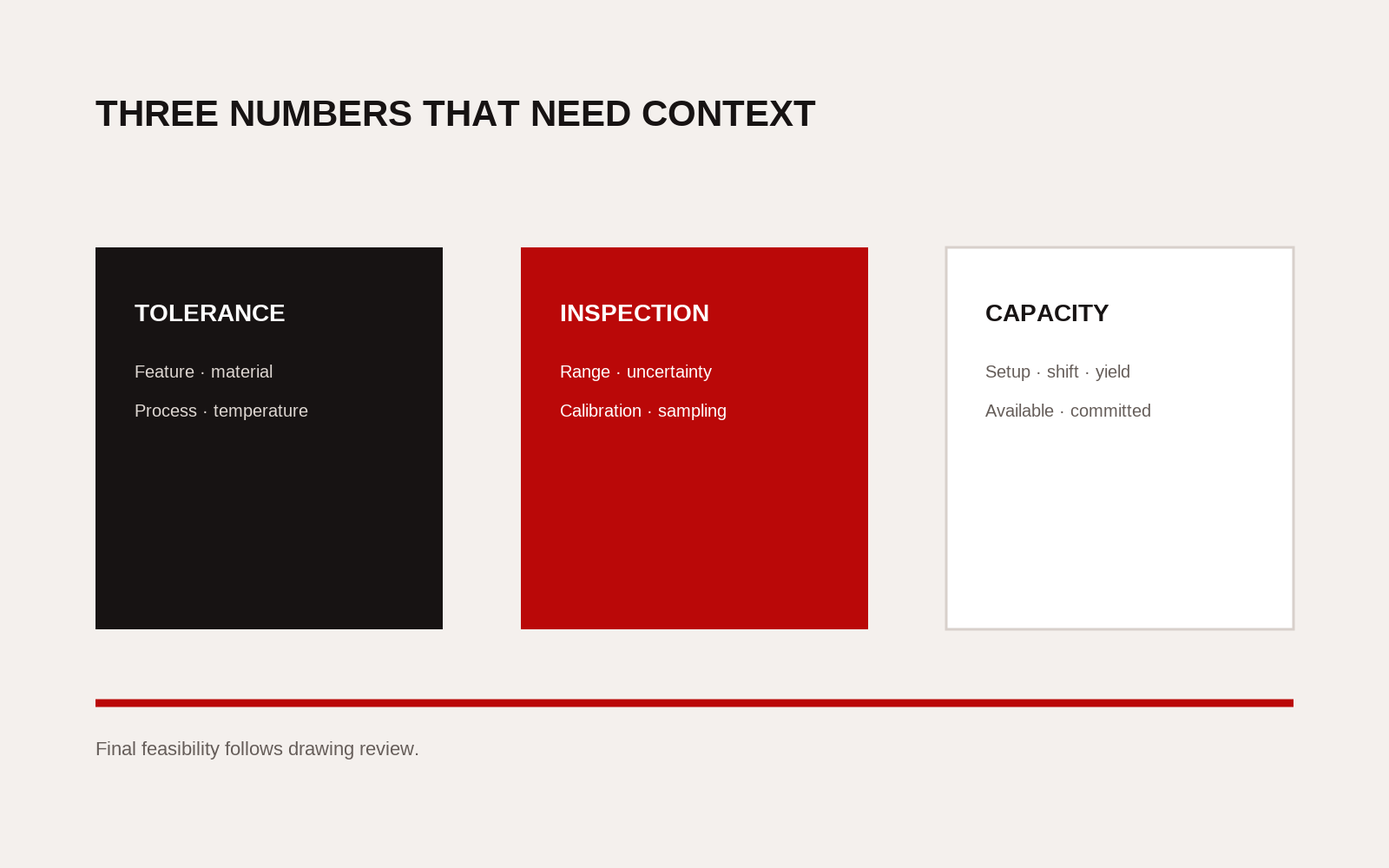
Precision engineering capability page matrix linking tolerance, material, inspection and capacity evidence.
Use a process capability table
| Field | What the buyer needs | Boundary to state |
|---|---|---|
| Process | Turning, milling, grinding, EDM or other | Machine and setup class |
| Part range | Diameter, envelope, weight or feature | Fixture and access limits |
| Material | Approved grades and forms | Hardness or condition |
| Tolerance | Typical controllable range | Feature, size and process conditions |
| Surface | Roughness or treatment | Measurement and sampling method |
| Inspection | Equipment and capability | Range, uncertainty and calibration |
| Volume | Prototype, batch or repeat production | Shift and setup assumptions |
Add notes where fields are not directly comparable. Use consistent units and define whether figures are typical, demonstrated or contractual.
Explain tolerance as a system
Tolerance depends on geometry, material, temperature, process stability, tool condition, setup and measurement. A capability page should not present one figure as a property of the company.
Use wording such as “features within this range are subject to drawing, material and inspection review”. Then show one anonymised example with the feature, process and verification method.
Connect inspection to the claim
Name the equipment only if the page also explains what it measures. Useful fields include:
- measurement type and range;
- resolution and relevant uncertainty;
- calibration status and traceability;
- environmental control;
- sampling plan;
- report format; and
- handling of out-of-tolerance results.
A photograph of a coordinate measuring machine is not inspection evidence. An anonymised report excerpt or annotated measurement route is stronger.
Define capacity honestly
Buyers ask about capacity because they need delivery confidence. Machine quantity is one input. A useful capacity explanation covers operating hours, setup, typical batch, inspection bottleneck, maintenance, yield and other commitments.
| Capacity term | Meaning |
|---|---|
| Nameplate | Theoretical equipment output |
| Available | Time remaining after planned work and maintenance |
| Demonstrated | Output shown under a stated product and period |
| Committed | Capacity already allocated to orders |
| Quoted | Capacity offered after part and schedule review |
Do not publish customer-specific utilisation. Give buyers a clear route for a current capacity check.
Show control of outside processes
Heat treatment, coating, specialist cleaning and testing may be outsourced. State which processes are external and how they are specified, approved, received and traced. Do not let the page imply they occur in-house.
For each outside process, maintain the supplier status, applicable specification, purchase requirement, incoming evidence and nonconformance route.
Build pages around real buyer searches
Separate pages can be useful for materially different processes or markets. They become spam when the same paragraph is copied across locations, materials and industries.
A good page has unique evidence:
- process and range;
- material experience;
- inspection method;
- example part or feature;
- quality and traceability route;
- lead or capacity decision; and
- technical enquiry fields.
Google's Search Essentials provide the crawlability and quality baseline. Pages should help a buyer, not only target a phrase.
Add a drawing-review enquiry
Ask for the minimum information needed to assess feasibility: drawing or model, material, quantity, critical features, finish, required certificates, delivery need and confidentiality requirements. Provide a secure route for controlled files. Do not require a prospect to upload sensitive drawings through an ordinary public form without appropriate controls.
Our article on Malaysia's semiconductor growth explains where this proof supports current investment areas. The engineering sector page connects technical capability with broader buyer evidence.
Creatif Work builds engineering websites from controlled capability records, not adjectives. If the technical team answers the same tolerance and capacity questions in every first call, start with the problem.
Validate the page against an actual drawing
Choose three previously quoted parts: one routine, one borderline and one declined. Ask an estimator and quality engineer to use the public page before opening internal records. Note which fields help them classify the request and which statements could create a false expectation.
For the routine part, confirm that the page does not understate normal capability. For the borderline part, confirm that conditions and drawing review are visible. For the declined part, check that the page does not imply feasibility.
Record the difference between marketing range, demonstrated process capability and contractual acceptance. These may be related, but they are not interchangeable. Update the field definitions and approval route if reviewers interpret them differently.
Repeat the exercise after a new machine, inspection method or outside process is introduced. A capability page is a controlled operational interface. Its value depends on technical ownership, consistent units and a clear route from public statement to quotation decision.
Keep the test parts anonymous where customer permission is absent. The internal review needs real evidence, but the public page can use a controlled range and a generic feature description.