

German Industrial Energy Efficiency: What Retrofit Buyers Need to Compare

An industrial energy retrofit should not be selected from a promised saving percentage alone. A useful comparison keeps the production output, energy boundary, measurement period, operating constraints and verification method consistent across every proposal.
That matters in Germany because federal efficiency support asks applicants to describe a savings concept, while plant teams still have to manage shutdowns, product quality and output. The best technical offer is therefore not automatically the proposal with the largest headline number. It is the one whose assumptions can be tested before approval and checked after commissioning.
What should an industrial retrofit buyer compare?
Compare the existing baseline, proposed operating point, annual energy saved, production effect, implementation risk, measurement plan and full scope of work. Ask every bidder to complete the same schedule rather than letting each company choose its own presentation.
| Comparison field | What the bidder should state | Why it changes the decision |
|---|---|---|
| System boundary | Equipment, utilities, controls and process stages included | Prevents one bid from excluding major loads |
| Baseline | Metered period, production volume and adjustments | Makes saving estimates comparable |
| Proposed case | New equipment, controls and operating assumptions | Shows where the improvement comes from |
| Production effect | Capacity, quality, yield and downtime consequences | Protects the plant objective, not only energy use |
| Annual saving | Energy by carrier, method and uncertainty | Separates calculation from marketing |
| Verification | Meters, data frequency, owner and review period | Defines how acceptance will work |
| Delivery | Shutdown window, interfaces, permits and commissioning | Exposes programme risk |
| Commercial scope | Included engineering, installation, training and support | Reduces later variation disputes |
Germany's Federal Office for Economic Affairs and Export Control, BAFA, publishes guidance for the federal programme for energy and resource efficiency in the economy. Its Module 4 guidance requires a savings concept for supported process optimisation. Check the current rules and eligibility with BAFA or a qualified adviser before relying on support.
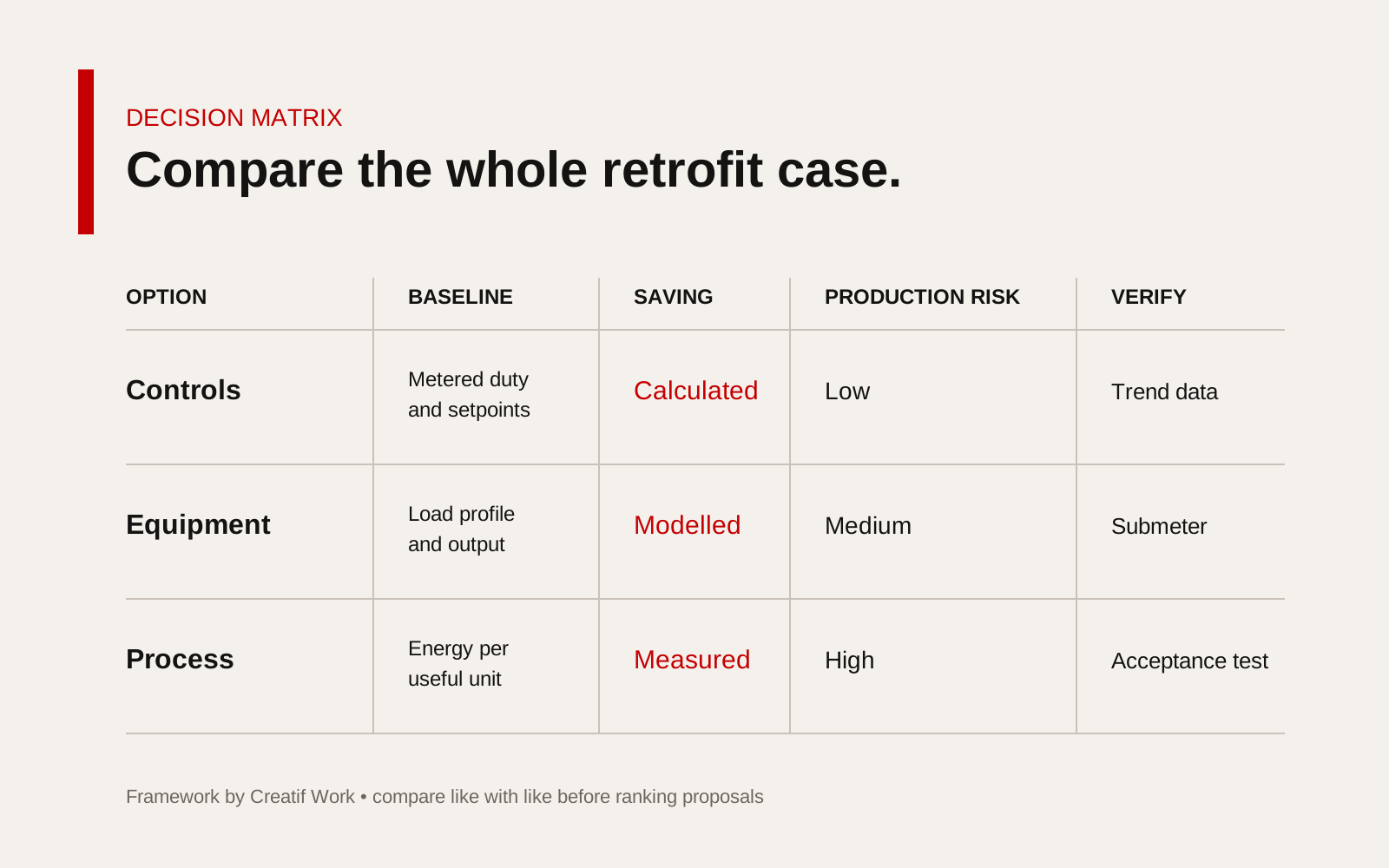
Comparison matrix for industrial retrofit options showing baseline, energy saving, production risk and verification.
Fix the baseline before comparing savings
A baseline should describe the plant under conditions relevant to the proposed investment. Twelve months of electricity bills may be useful for context, but they rarely isolate a compressed-air system, oven, pump train or production line.
Ask for:
- meter location and calibration status
- measurement dates and sampling interval
- production quantity and product mix
- operating hours, starts and idle periods
- weather or ambient conditions where relevant
- maintenance faults or abnormal events
- the calculation used to normalise the period
If production varies, compare energy per suitable unit as well as total energy. The unit could be a tonne, part, operating hour or batch. It must describe useful output rather than rewarding lower production.
Compare usable savings, not theoretical efficiency
An efficient motor does not save its nameplate improvement every hour. Savings depend on load, control strategy, duty cycle and the equipment around it. Heat recovery depends on whether a suitable heat demand exists at the same time and temperature. A controls project depends on sensors, sequences and operators continuing to use the intended settings.
Ask each bidder to split the estimate into three layers:
- Measured inputs: current flow, load, temperature, pressure, hours and output.
- Engineering assumptions: future setpoints, diversity, losses and expected demand.
- Calculated result: energy saved by carrier, annual operating effect and uncertainty.
This structure also helps a finance team see which claim can be verified and which remains sensitive to future production.
Put production risk beside the energy case
Industrial projects often fail at the interface between new equipment and the live process. A complete offer should identify electrical capacity, control-system integration, space, access, utilities, drainage, exhaust, structural loads and the permitted shutdown window.
Use a simple risk test before shortlisting:
- Can installation be isolated from production?
- What is the rollback plan if commissioning fails?
- Who owns programming and control changes?
- How will product quality be checked after restart?
- Which spares must be available before handover?
- What training and documentation will operations receive?
BAFA's programme covers several routes, including cross-cutting technology, process heat, measurement and control, sensor technology, energy-management software and process optimisation. That range is a reminder that equipment, data and operating practice often belong in one case rather than separate purchases.
Define acceptance before the purchase order
The measurement and verification plan should be agreed while suppliers are still competing. State the meters, data interval, reporting period, adjustment variables and decision rule. Define who reviews the result and what happens if production conditions prevent the planned test.
Retrofit comparison checklist
- One system boundary used by every bidder
- Baseline supported by dated measurements
- Production and quality constraints stated
- Savings split by energy carrier
- Assumptions and uncertainty visible
- Interfaces and shutdown work listed
- Commissioning and acceptance tests defined
- Training, manuals and source files included
- Post-installation measurement owner named
- Funding eligibility checked against current official guidance
Publish the evidence a buyer can use
Engineering suppliers should turn this same discipline into public content. A useful retrofit page explains the applicable processes, information required for a study, measurement approach, delivery boundary and one project with a clear before-and-after basis. It does not publish a universal saving claim.
Our guide to specification-led engineering content shows how to make technical information readable without flattening it. Creatif Work builds engineering websites that connect service scope, project evidence and enquiry inputs, so a buyer can send a useful brief before the first call. For teams also managing calculators, records or approvals, our custom software service begins with the decision and data rather than a feature list.