

Rebranding an Established Industrial Company
An industrial company rebrand should correct a business problem without making existing buyers wonder whether they have found the wrong supplier. Decide what must change, what people already recognise and where the identity has to work. Test real applications before approving a logo. Then replace assets in an order that protects operational information and avoids unnecessary waste.
The trouble often appears away from the homepage. A proposal carries one company name. A site sign uses an older mark. A product sheet contains a third version. A buyer can still identify the company, but staff spend time explaining the differences. That is a useful reason to review the identity. Simply being bored with a logo is not.
This guide covers established engineering businesses, manufacturers, contractors and technical suppliers. It also applies to companies bringing several acquired businesses together. The drawings are original planning mockups, not photographs of a client installation. Tests described below are procedures to run, not research results we have collected.
Download the rebrand planning workbook or the CSV template pack. Both are free and require no email address. The article includes the essential decision rules, inventories and checks.
Name the problem before changing the identity
Write a short account of what has changed in the business. Perhaps the company now serves a different buyer. Perhaps several divisions have incompatible documents. Perhaps the name suggests a capability the company no longer offers. The rebrand brief should explain that change in terms someone outside marketing can understand.
Separate recognition problems from information problems. A website that omits a current service needs better content. A sales team using outdated specifications needs document control. Neither failure is necessarily caused by the logo. Changing every visual asset while leaving these issues untouched produces an expensive version of the same confusion.
Ask the managing director, sales lead, operations manager and document owner for examples. Collect the actual proposal, sign, supplier pack or customer question. Do not accept “we look dated” as the only evidence. Which detail looks dated? Does it make an important instruction harder to read? Does it misrepresent the current business?
Agree a useful outcome. Staff can identify the approved template. Buyers can match the website to the company on their tender documents. The mark remains recognisable in a small catalogue reference. These outcomes can be tested. A claim that the rebrand will automatically raise revenue cannot be established by approving a design.
| Symptom | Possible cause | First response | Risk of the wrong response |
|---|---|---|---|
| Buyers ask whether two divisions are related | Unclear naming and endorsement | Define the company relationship | Separate logos may deepen confusion |
| Staff recreate proposal covers | Missing approved templates | Fix template access and ownership | A new mark will not control files |
| The website describes an old capability | Outdated positioning and content | Review scope and evidence | Visual changes can conceal the gap |
| The mark fails on workwear | Reproduction constraints | Test a permitted simplified version | Uncontrolled redrawing changes identity |
| A new market reads the name differently | Language or category mismatch | Review with local readers and advisers | A rushed rename may lose recognition |
Decide between a refresh and a rebrand
A refresh keeps the central recognition cues. It might improve typography, spacing, colour use and application rules. A rebrand changes the way the business identifies or explains itself more substantially. A rename goes further and introduces commercial, legal and operational dependencies that need separate attention.
Choose the smallest change that answers the problem. If the name is accurate and the mark is recognisable, improved applications may be enough. If the company architecture is misleading, polishing the old identity might preserve the wrong message. The decision is about the business, not which option gives a design team more freedom.
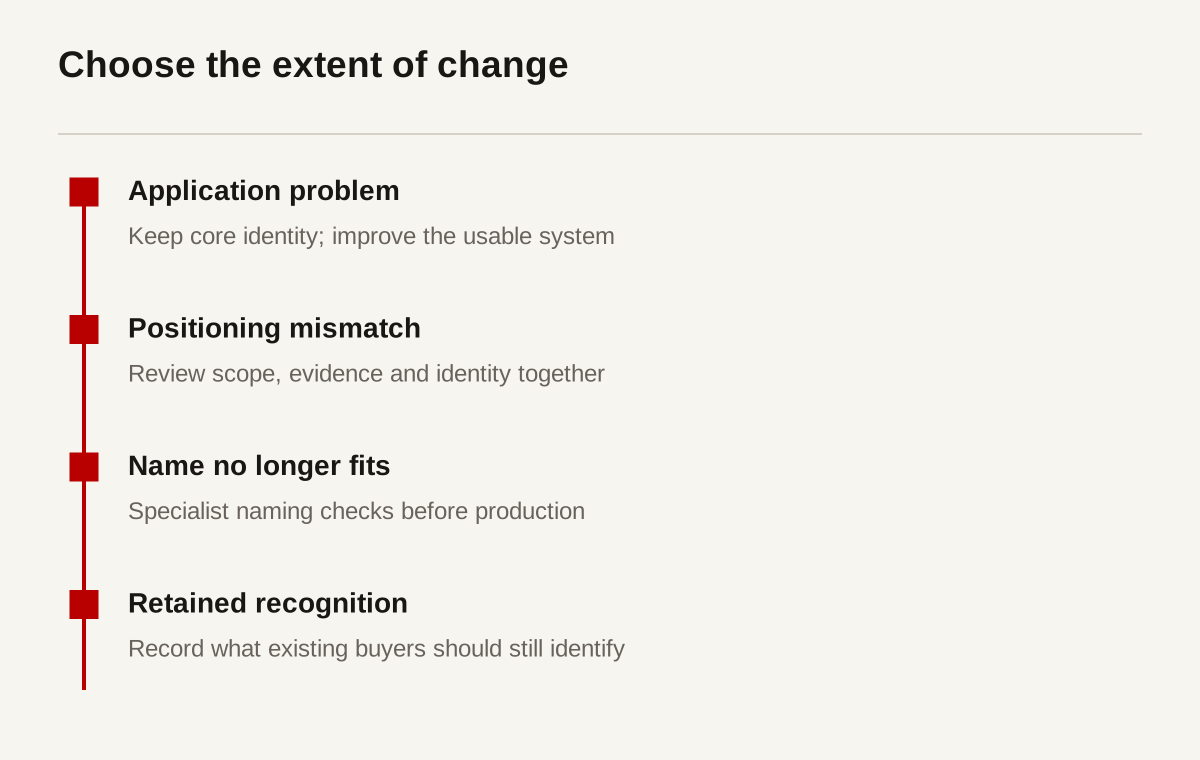
Record what is deliberately retained. It could be the established trading name, a distinctive shape, a familiar colour or the relationship between parent and subsidiary. Do not treat every inherited element as untouchable. Check whether it carries recognition or merely survives because nobody has challenged it.
Also record what a visual change cannot resolve. A confused service offer needs a service decision. An unsupported quality claim needs evidence. A poorly managed enquiry route needs an owner. These items can run alongside an identity project, but they should not disappear inside it.
Inventory where the company already appears
Walk through the physical and digital business. Start with assets staff use every week: quotations, invoices, drawing title blocks, email signatures, project reports, workwear, vehicle markings and site boards. Add websites, social profiles, downloadable packs, customer portals and directory entries.
For each asset, identify the audience and the consequences of a mismatch. An old social avatar may be tolerable during a transition. An invoice with unclear legal identity or payment instructions is not a decorative issue. Route that record to finance and the appropriate adviser before replacement.
Distinguish editable files from manufactured stock. A document template can be replaced quickly. Printed manuals, engraved plates and embroidered garments may depend on procurement cycles. The stock count matters because a phased rollout may be more sensible than discarding material that is accurate and usable.
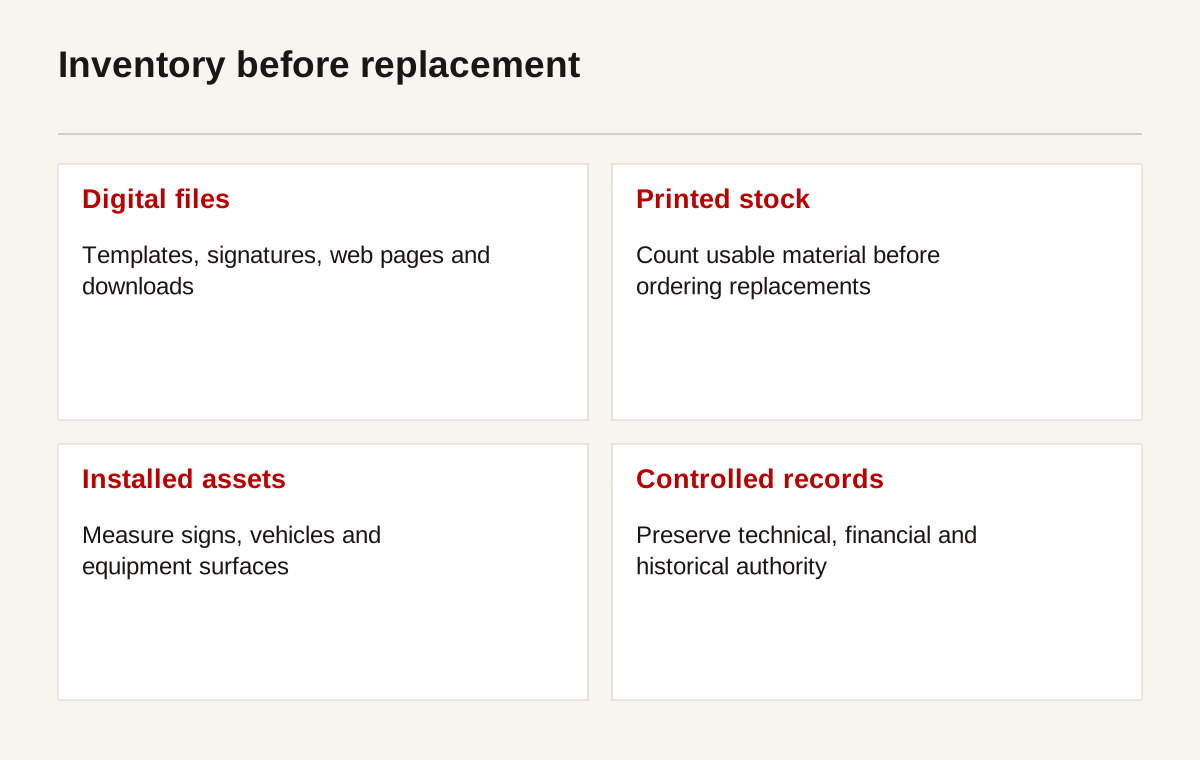
Do not change regulatory, technical or safety markings merely to match a new visual style. Those details may be controlled by other requirements. The responsible technical or safety person decides what can change and how. A designer should know where their authority ends.
| Asset | Main audience | Replacement trigger | Responsible owner |
|---|---|---|---|
| Capability document | Procurement and technical reviewers | Approved content and template | Sales with technical review |
| Drawing title block | Engineering teams and customers | Controlled drawing revision | Engineering document controller |
| Vehicle identification | Customers and site teams | Agreed fleet maintenance window | Operations and fleet owner |
| Invoice template | Customer finance teams | Approved identity and payment checks | Finance |
| Website | New and returning buyers | Tested release and continuity plan | Marketing with web owner |
Listen for recognition, not design preferences
Interview staff and a small number of willing buyers about the work. Ask how they identify the company on a document. Ask what they would need to confirm before sending it to procurement. Ask which company name they use in conversation. These questions are more useful than asking whether they like red or blue.
Use real material during the conversation. A supplier may recognise the company from a shortened name on a purchase order rather than the formal wordmark. A technician may depend on a consistent document code. Losing those cues can introduce friction even if the new identity looks more coherent to the project team.
Record the participant context and limits. Five conversations cannot establish how every buyer perceives the brand. They can reveal questions worth testing. Keep direct observations separate from your interpretation. “Could not find the legal company name” is a stronger note than “the old brand is weak.”
Include people who produce and maintain the assets. A proposal coordinator may explain why an official template is not used. It could be inaccessible, too slow or unsuitable for long technical tables. Calling the staff careless would miss a design requirement the new system needs to address.
Position the company using facts it can support
Positioning should explain the work, the buyer and the useful difference. Avoid a collection of adjectives that could describe any supplier. Name the capability, operating context and scope of responsibility. A business that handles a narrow engineering task can be clear about that task without pretending to cover an entire project.
Build an evidence map beside the positioning statement. List each public claim, its source and the person who can approve it. Separate current capability from past experience. Keep certification wording tied to the correct entity, scope and validity. A new identity does not expand what a certificate covers.
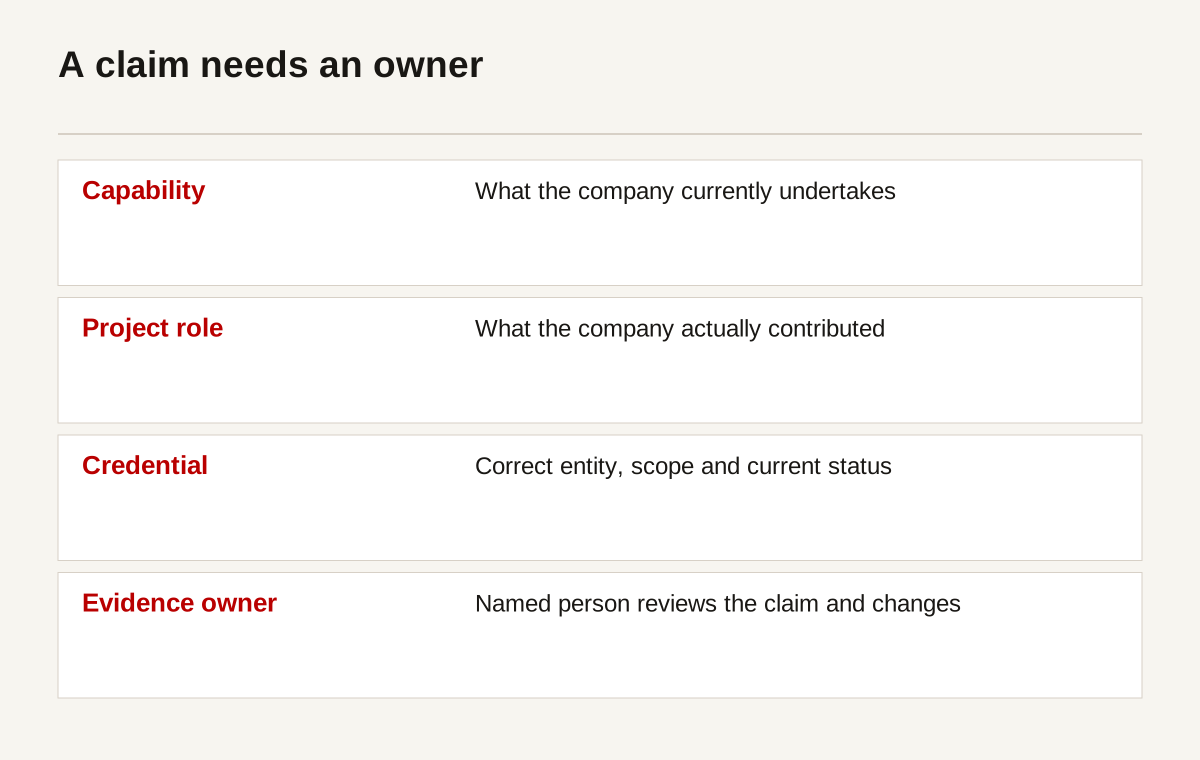
Consider a fictional maintenance business changing its description from “general services” to a clearly defined inspection and maintenance scope. The design might become more focused, but the substantive work is agreeing which activities it undertakes and what it excludes. An attractive brochure cannot make that decision for management.
Write a plain one-paragraph company description before the strapline. It should survive in a procurement form without a photograph or animation. If it needs a dramatic headline to make sense, the positioning is not finished. Check that sales, engineering and operations would give the same account.
Compare identity directions in real applications

This Hua Kwang Interior identity application is from our published portfolio. It shows a design application, not a tested recognition or business result. The planning diagrams elsewhere in this guide are original teaching examples and should not be read as production specifications for this identity.
Do not choose between concepts by presenting three large logos on blank white backgrounds. Give each direction the same tasks. Apply it to a capability cover, a drawing title block, a website header and a vehicle panel. This makes the review about usefulness rather than whichever presentation looks most impressive.
Use an original fictional identity for early application tests if client material is not approved. Label it clearly. Show realistic text lengths, technical tables and document references. A mockup with almost no text hides the very constraints the system has to handle.
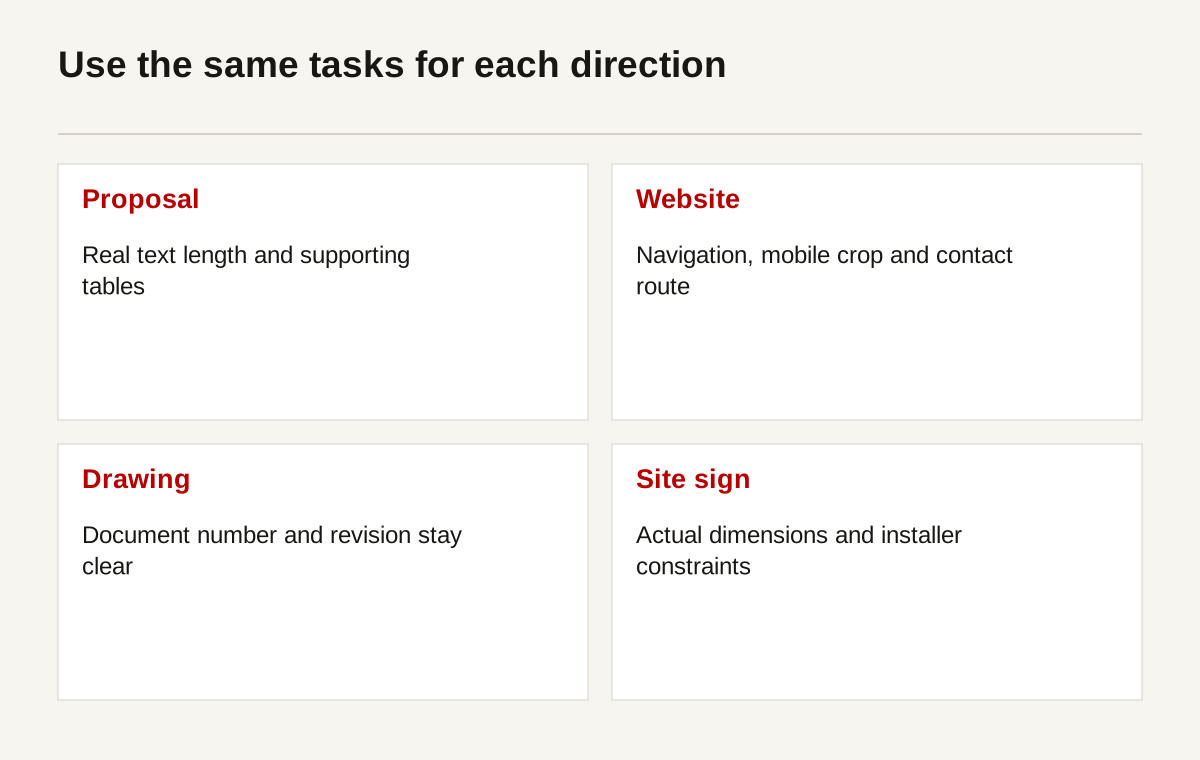
Keep the wording constant between directions. Otherwise reviewers may prefer a clearer message and attribute that preference to a different mark. Separate decisions about typography, information order and colour from decisions about the company's offer. They affect one another, but they are not interchangeable.
Agree who makes the final decision. Invite technical and operational feedback where it is relevant. Avoid a public staff vote framed as a popularity contest. People responsible for approvals should explain the choice against the brief and recorded tests, not against personal taste alone.
Test small sizes, one colour and difficult surfaces
Test the identity at the size it will actually appear. A mark that works on a proposal cover may fail in a browser tab or on a small asset label. Specify the intended use and size before asking a printer or embroiderer whether it can be reproduced.
Create a monochrome version where needed. Check whether important shapes collapse or appear as another letter. Examine reversals on dark surfaces. Do not expect a vendor to invent a simplified version at production time. That gives the company several undocumented identities instead of one controlled system.
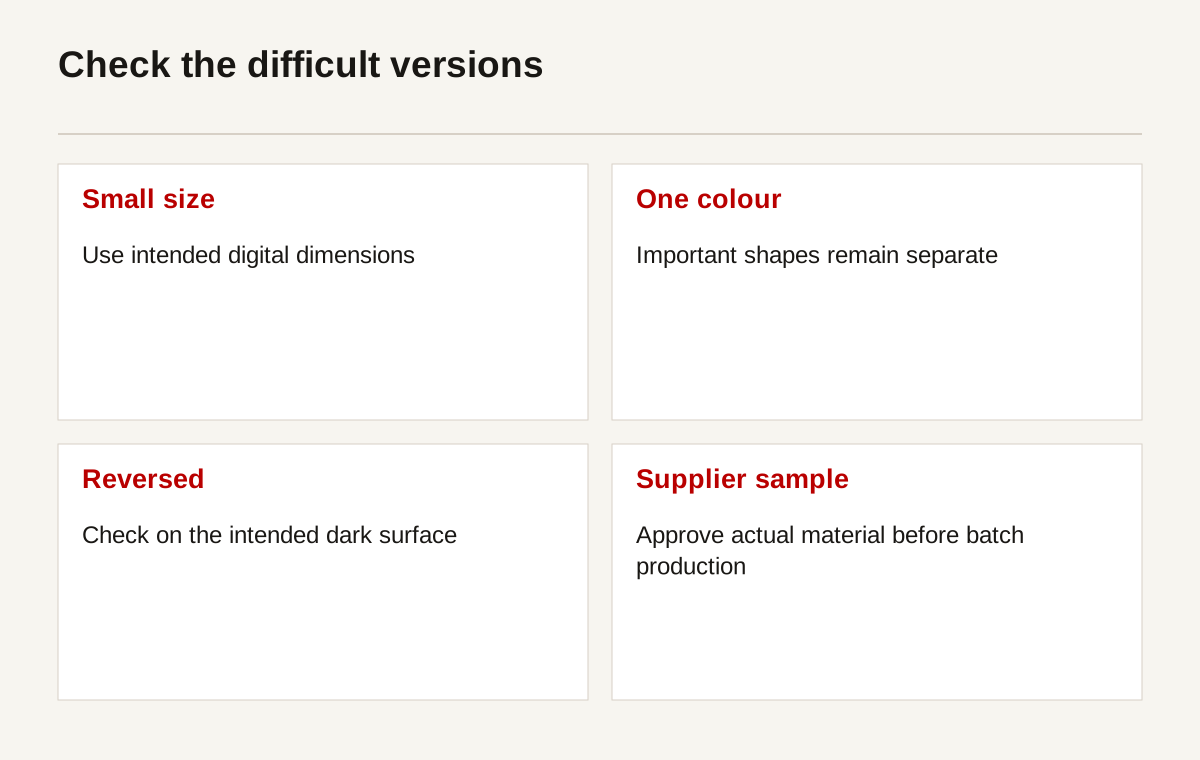
Ask production suppliers for samples when the material or process matters. Screen previews cannot prove embroidery, reflective vinyl or engraving quality. Define an acceptable sample before ordering a fleet or an entire batch of garments. Record the approved file, material and supplier settings for future orders.
Check digital text and controls independently. W3C contrast guidance provides relevant criteria for readable interface text. W3C guidance on colour explains why colour alone should not carry information. Logo artwork and interface text are different cases; a logo exception does not excuse an unreadable menu.
| Test | Constraint | Pass condition to agree | Finding to record |
|---|---|---|---|
| Small digital mark | Actual browser and device size | Recognisable without clipped detail | Record device and size |
| Single-colour print | One ink and intended paper | Distinct shapes remain separate | Attach approved proof |
| Workwear sample | Material and embroidery process | Wordmark is legible at normal use distance | Record supplier and sample |
| Drawing template | Dense technical content | Identity does not obscure drawing data | Technical approval required |
| Website controls | Text, focus and colour states | Applicable accessibility checks pass | Record tested states |
Design for signs, vehicles and equipment
Physical applications need measurements and context. Photograph the surface with permission. Record usable dimensions, joins, handles, windows and areas that must remain clear. Drawings should indicate where the identity sits, not claim that a generic mockup represents the actual vehicle or building.
Show front, side and oblique views when they change legibility. A vehicle panel seen close up on a laptop is not the same as a moving vehicle. Treat these views as planning aids. Final installation decisions belong with the installer and the relevant site or fleet owner.
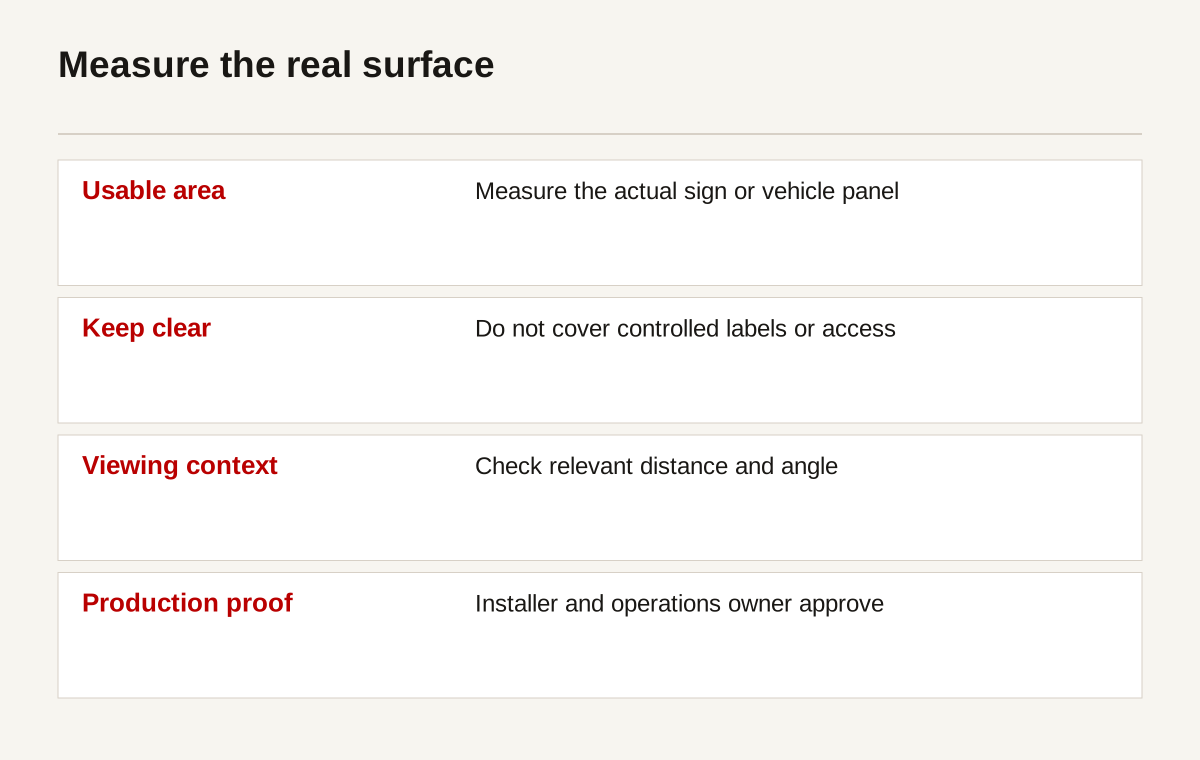
Check what already communicates important information. Do not cover inspection labels, access instructions or identification numbers with decorative brand panels. If the company wants a cleaner equipment photograph, move the camera or choose a different approved angle. Altering material facts is not a branding improvement.
Plan replacement dates around work. A vehicle can be marked during an agreed maintenance window. A site sign may depend on the principal contractor's approval. A fabricated display may need a material sample. Add these dependencies to the rollout register rather than promising everything on launch day.
Make documents usable, not just consistent
Templates should accommodate the content people actually write. Test a short quotation and a long technical proposal. Check wide tables, appendices, revision records and page breaks. A template that only works with a two-page sample will fail when engineering adds the real specification.
Preserve the distinction between company identity and document identity. A new logo should not erase drawing numbers, revision codes, approval states or legal names. Keep controlled fields in predictable places. Ask the document controller how staff recognise the current version before redesigning the header.
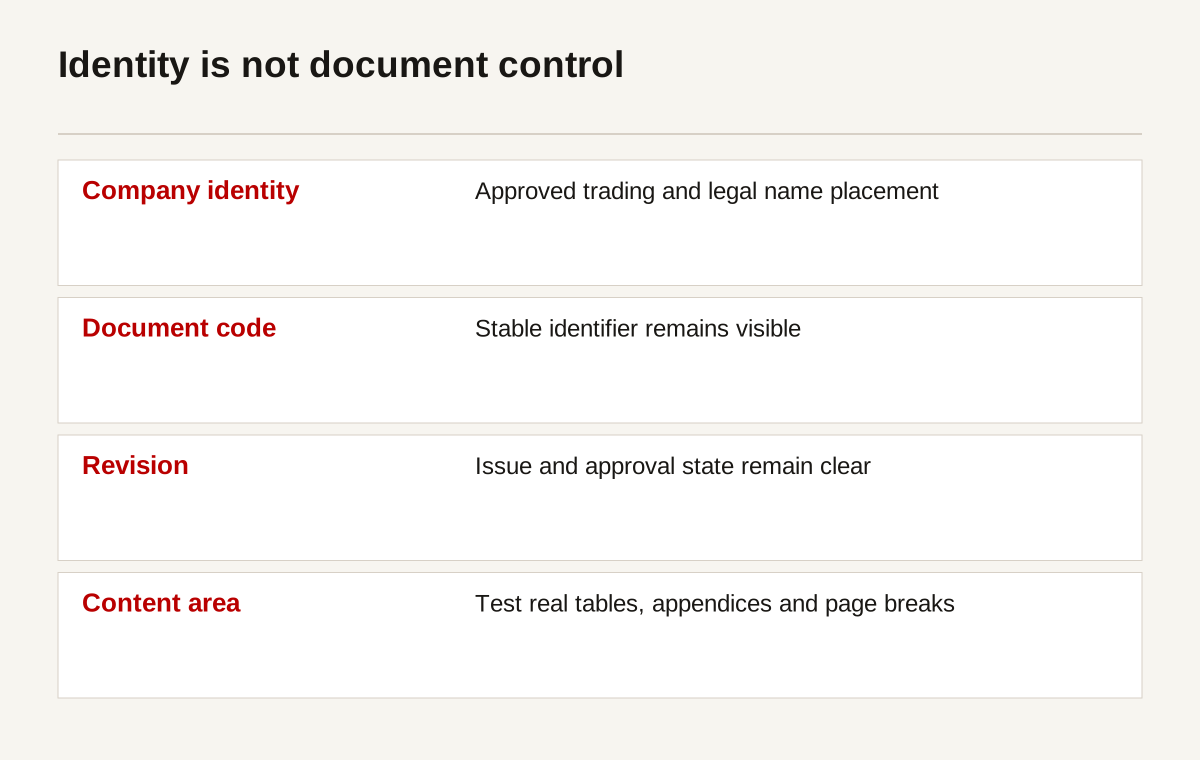
Build templates in the tools the team can maintain. Check font availability, export behaviour and accessibility. If a specialist font cannot be installed across the relevant environment, define a practical fallback. Do not leave staff to choose a replacement under deadline pressure.
Provide a short instruction page with the editable template. Explain what may change and what is fixed. Store an approved example beside it. Remove obsolete templates from normal access where policy permits, while retaining controlled archives for historical records. New artwork without a maintenance routine soon becomes another inconsistent file.
Put trademark and naming checks ahead of production
Naming deserves specialist review before substantial expenditure. A domain being available does not establish that a name is safe to use or register. Searches have limits and rights depend on territory, goods, services and facts. This article is a planning guide, not legal clearance for a proposed identity.
For Singapore, IPOS registration guidance explains pre-application checks and the role of professional advice. WIPO's availability guidance is a starting point for international searches. Neither a database result nor a design studio's opinion should be presented as guaranteed clearance.
If the UK is part of the plan, use the official UK trademark search route and obtain appropriate advice. For other countries, check the relevant national or regional office with an adviser familiar with the intended markets. Do not assume one filing gives identical protection everywhere.
Record the review status and conditions in the decision register. Management should know whether a direction is approved for concept testing, approved for production or still awaiting specialist review. This prevents a persuasive mockup from being mistaken for permission to print signs or announce a name.
Roll out in an order that protects continuity
A controlled transition does not mean leaving mismatches unexplained. Decide what must change together. Website contact details, proposal templates and signatures might form one release group. Manufactured items can follow when stock or maintenance cycles permit, provided important identity and operational information remains clear.
Plan how existing customers will recognise the company. Explain what changed and what did not. If the legal entity, bank details or contractual arrangements have not changed, do not imply they have. If they have changed, finance and legal teams need an appropriate separate communication and verification process.
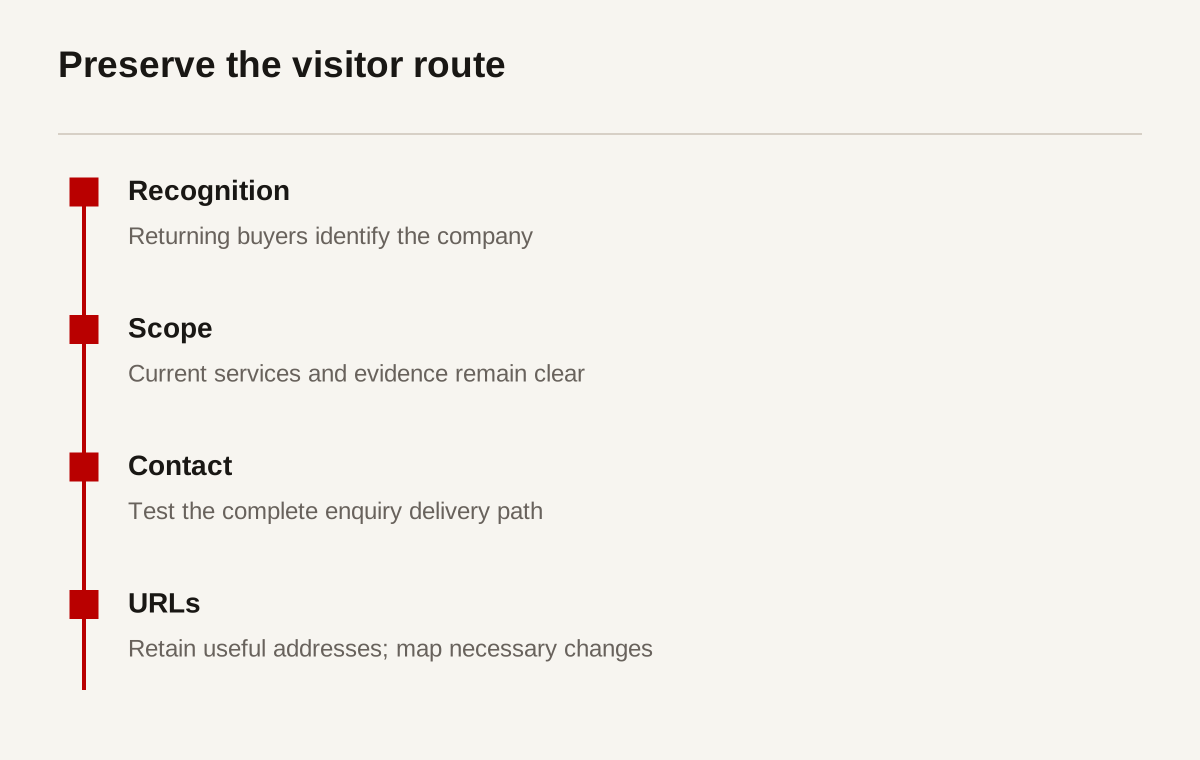
A website identity release needs the same care as any migration. Retain useful URLs where possible. Map necessary changes and test redirects. Google's site-move guidance is relevant when URLs change; a new logo does not require a new domain or a rewritten URL structure.
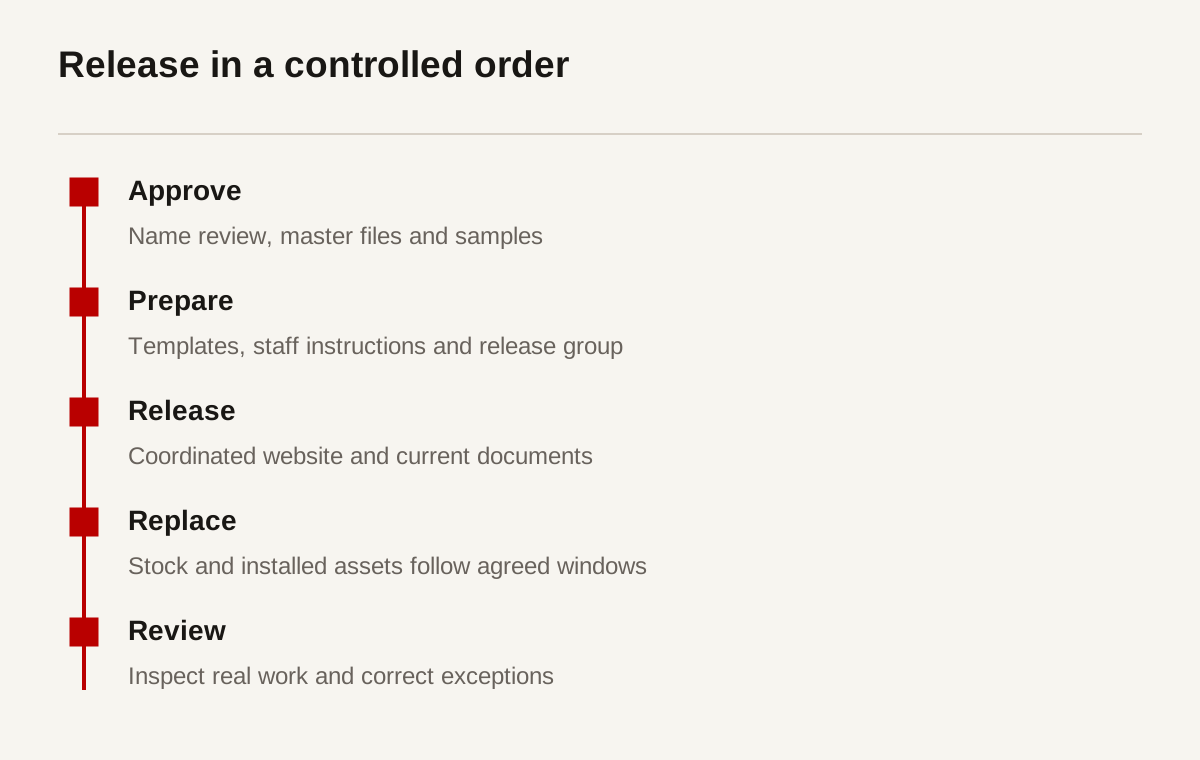
| Rollout item | Dependency | Approval | Phase |
|---|---|---|---|
| Master identity files | Direction and reproduction tests | Identity owner | Before release |
| Proposal and capability templates | Approved wording and fields | Sales and document controller | Coordinated release |
| Website identity | Tested pages and contact routes | Website owner | Coordinated release |
| Vehicle and site applications | Measurements and supplier proof | Operations | Planned replacement |
| Old document archive | Retention and access policy | Relevant record owner | Controlled transition |
Give staff clear rules and a route for exceptions
Prepare a supplier handoff that prevents redrawing
Give a production supplier the approved artwork and a short application record. Identify the version, intended material, dimensions, permitted colour treatment and areas that must remain clear. Include the responsible contact and approval route. A screenshot from a presentation should not become the source file for an engraved plate or embroidered garment.
Ask the supplier to identify any production constraint before manufacturing. Thin shapes may need an approved alternative. The available space may be smaller than the mockup assumed. A finish may change contrast. Record the issue and obtain the relevant approval instead of letting the supplier silently redraw the identity to fit their process.
When a sample arrives, compare it with the intended application, not only the artwork. Check the company name, reproduced shapes and placement of operational information. Ask the responsible team to inspect usability in the actual context where practical. Record the sample identifier and any corrections before approving a batch.
Retain that record beside the master files. A repeat order should reference the approved version and production specification, with changes reviewed explicitly. This reduces the chance that the next supplier uses a photograph of the previous item as their template. The handoff controls identity reproduction; it does not replace technical or safety approval for the object carrying it.
An identity guide should answer recurring questions. Which logo file goes into a proposal? Which version works on a dark surface? What happens when a customer requires a co-branded cover? Where is the editable presentation template? Long descriptions of design intent do not replace these instructions.
Assign an owner with authority to maintain the system. That person does not need to approve every email, but they should control master assets and recurring exceptions. Define how staff request a new application and how approved variations return to the library.
Store the files with understandable names. Include version, purpose and file type where useful. Avoid folders filled with “final”, “final2” and “newfinal”. Provide an approved index that points to the current files. Historical versions should not compete with production assets in ordinary searches.
| Governance rule | Practical example | Supporting template | Responsible team |
|---|---|---|---|
| One source for current master files | Proposal owner uses library link | Approved asset index | Identity owner |
| Controlled technical document fields | Drawing revision stays visible | Drawing title block | Engineering |
| Review co-branding requests | Customer logo added with permission | Partner application record | Sales and identity owner |
| Proof before physical production | Garment sample checked before batch | Supplier proof checklist | Procurement |
| Retire superseded digital templates | Old copy moves to archive | Release register | Document owners |
Explain exceptions in ordinary language. A legacy mark on an archived report may be correct. A supplier using a current but unauthorised redraw is not. Consistency is not the same as pretending every historical record was issued under the new identity. Keep dates and provenance intact.
Test comprehension before calling the project finished
Choose tasks rather than asking for a general score. Can a returning buyer identify the company? Can an employee find the approved quotation template? Can a reviewer separate the trading name from the legal entity? Can a technical reader identify the document revision? Run these checks on realistic material.
Use neutral instructions. Do not tell participants which part to look at or defend the design while they work. GOV.UK's moderated usability testing guidance provides a practical starting point. Obtain permission and record only what is needed for the research.
Describe findings with their limits. A few task sessions can expose a confusing title block. They cannot prove that the identity will increase revenue across every market. Report the materials, tasks, participant context and problems found. Repeat the affected tasks after changes, without inventing a success percentage from an unrepresentative sample.
Check website imagery too. W3C's image guidance helps decide whether an image needs useful text or an empty alternative. A decorative mark beside an already visible company name is different from a document image that carries information. Essential wording should remain real text where possible.
Keep a record of what changed and why
Work through one release decision with the responsible teams
Suppose an established contractor retains its trading name but changes its wordmark and document system. The first release group might include the website, email signatures and quotation template. Finance checks the company details. Sales checks the wording. Engineering checks that drawing references are still recognisable. The identity owner checks the approved artwork and versions.
The vehicle graphics remain until the agreed replacement window. The rollout record explains this openly. Staff are not told to improvise an update. Historical project reports remain unchanged, with their original issue dates. This is a fictional decision example, not a case study. Its purpose is to show how a coordinated release can preserve accurate records while improving current applications.
If a supplier then requests an old logo file, the owner can check the reason. A historical project archive may require it. A new proposal should use the current file. The same question can therefore have different correct answers, depending on the record and purpose.
Finish with a decision log. It should explain the business problem, evidence reviewed, recognition retained, applications tested and approvals received. Include deferred assets and the reason for deferral. This becomes useful when a new supplier or manager questions an unusual variation six months later.
Review the rollout after normal work has passed through it. Inspect a real proposal, a newly issued drawing, a mobile page and a supplier-produced item. Check whether staff have quietly created workarounds. A workaround may reveal a missing requirement rather than a failure to follow instructions.
Do not turn the review into a second redesign by default. Correct the specific problem. An overly long company name may need an approved compact application. A document with a dense appendix may need another template layout. A recurring question about scope may need better wording, not another change of colour.
The useful measure is whether people can identify the business and use its material correctly. Search visits, enquiry quality and sales results can be monitored separately, with their wider causes acknowledged. Do not attribute every business change after launch to the identity merely because the dates overlap.
Questions directors usually need answered
Do we have to rename the company?
No. A name can carry recognition that is worth retaining. Start with the mismatch between the current business and its public presentation. If the problem is inconsistent documents or outdated content, a naming change may create more work without addressing the cause. A rename needs a business reason and specialist checks.
Should we replace every old item on the same day?
Not necessarily. Coordinate high-risk and frequently used assets. Plan the rest around stock, installation and maintenance dependencies. Define how the transition will be explained. Accurate historical records should not be altered simply to make an archive look visually consistent with a new identity.
Can we use one identity across every country?
Perhaps, but do not assume the wording, rights and associations work everywhere. Check relevant languages with suitable readers and review trademarks for intended territories. Market expansion also needs current capability and local operating information. A translated strapline cannot stand in for that evidence.
What should be approved before printing signs?
Approve the name and relevant specialist review, master artwork, actual surface measurements, reproduction proof and installation constraints. Confirm who can authorise production. Concept artwork is not a fabrication instruction. Keep the approved proof and supplier details so repeat orders do not introduce an undocumented variation.
What should we do when the website needs changing too?
Treat the website as an information system, not just another surface for the mark. Check scope, projects, contact routes, editing ownership and existing URLs. Coordinate identity and content, but give each its own acceptance checks. A familiar visual identity cannot rescue missing specifications or unanswered enquiries.
Start with the mismatch in the business
Creatif Work begins with the problem the identity is meant to solve. That may lead to brand identity work, clearer documents, a website rebuild or a smaller application fix. It should not automatically lead to replacing everything the company owns.
Bring an existing proposal, a website page and a physical application. Explain what the company does now and where people get confused. Those examples give us something concrete to assess before discussing what should be designed. Start with the problem.
References and planning limits
Sources were reviewed on 1 October 2026. Check current guidance again before making legal, production or accessibility decisions. This guide contains original planning examples. It does not report a participant study, a revenue improvement or trademark clearance.