

Engineering Company Website Design: Complete Page Checklist

An engineering company website should let a buyer understand the service, applicable sector, technical boundary, proof and next step. It should also let the company maintain projects, registrations, documents and contacts without copying the same facts into several pages.
The right page count follows the information model. A small specialist may need fewer strong pages than a group operating across products, services and countries.
Which pages does an engineering company website need?
Most engineering websites need a home page, service pages, sector or application pages, project case studies, an evidence or qualification page, company and location information, careers, useful insights and contact routes. Product businesses may also need product families, specifications and documents.
| Page type | Decision it supports | Core content |
|---|---|---|
| Home | Is this firm relevant? | Scope, markets, proof and next routes |
| Service | Can it deliver this work? | Inputs, deliverables, method, limits, projects |
| Sector | Does it understand my setting? | Problems, standards, constraints and evidence |
| Project | Has it done comparable work? | Role, scope, conditions and outcome |
| Product | Does this item fit? | Application, specifications and documents |
| Qualification | Can it enter our process? | Entity, registrations, systems and evidence route |
| Location | Can it support this market? | Presence, coverage, local evidence and contact |
| Careers | What is the work and workplace? | Roles, projects, conditions and process |
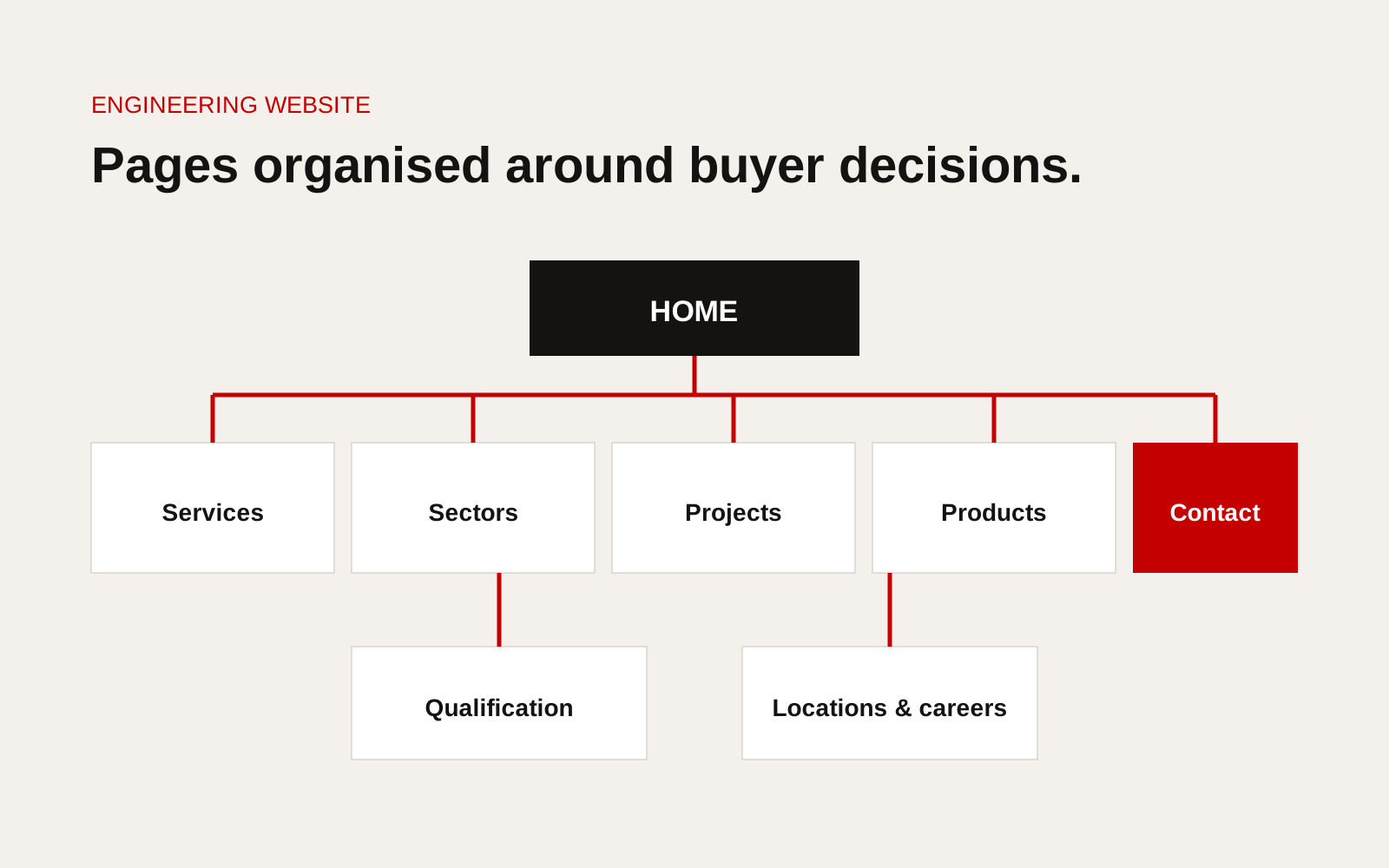
Engineering company website map connecting services, sectors, projects, products, evidence, locations, careers and contact.
Home page
State what the company does, for whom and where. Use one or two strong evidence points, then route users to services, sectors, products or projects. Avoid opening with a slogan that could belong to any technical firm.
The home page should not contain the full company story. It should help each priority visitor choose a useful path.
Service pages
Create a page when the service has its own buyer question, deliverables, evidence and enquiry route. Include:
- problem and project stage
- client inputs
- activities and deliverables
- responsibility and exclusions
- standards or requirements commonly handled
- relevant assets, tools or facilities
- comparable projects
- questions needed for an enquiry
Do not create one page per keyword if the service cannot support distinct content.
Sector and application pages
Sector pages should explain what changes in that operating environment. State typical assets, constraints, approval routes, buyer roles and relevant projects. Link back to the services that solve the problem.
An engineering firm working in marine, construction and manufacturing should not reuse one paragraph with the sector name swapped.
Project case studies
A project page should state context, the firm's exact role, technical scope, constraints, interfaces, deliverables and approved outcome. Connect it to the service, sector and location it proves.
Use controlled fields for client permission, date, location, service and evidence status. This makes the project library useful for both the website and tenders.
Product and specification pages
Product businesses need consistent fields, units, documents, revisions and filters based on real selection criteria. A PDF alone is difficult to search and compare. Present core data on the page and offer the controlled document for download.
Google's Product structured data guidance explains how visible product information can be supplied to search systems. Use only properties that match current page content.
Qualification and evidence
Create a page for legal entity, locations, registrations, certifications, safety and quality systems, capacity and the route to controlled documents. State scope, issuer and validity rather than displaying unexplained logos.
Locations and international markets
Only create distinct location pages when there is a real office, facility, team, licence, service difference or project body. Explain permanent presence, project presence and mobilised coverage accurately.
Company, people and careers
The About page can explain ownership, history and working approach. Team pages should show accountable roles without oversharing personal details. Careers should describe real work, locations, travel, conditions, application steps and current vacancies.
Contact and enquiry routes
Carry the service, product or project context into the form. Ask only for information needed to route the enquiry. Provide an urgent contact route only when a real response process exists.
Complete page checklist
- Home page gives scope, market and useful routes
- Each service has inputs, outputs and proof
- Sector pages contain distinct operating context
- Projects show role, constraints and outcome
- Products use consistent specifications and revisions
- Qualification evidence has scope and validity
- Locations reflect actual presence or coverage
- Careers answer practical candidate questions
- Insights support real technical or buyer decisions
- Enquiries preserve page context
- Legal, privacy and accessibility pages are current
- Every repeatable page type has a content owner
Prioritise the first release
Do not wait until every historic project and service description is perfect. Launch the smallest set that supports a real buyer journey: a clear home page, the highest-value service pages, two or three relevant sector pages, several approved project records, a qualification page and a contact route with useful fields.
Score every proposed page against three questions. Does a buyer need it to understand fit? Can the business maintain its facts? Does it lead to a meaningful next action? Pages that fail all three can wait. For the pages that remain, name a content owner, evidence owner and review date before launch. This prevents a technically sound site from becoming unreliable after the project team moves on. The second release should be driven by unanswered enquiries, search queries and missing tender evidence, not by a desire to make the navigation look larger.
Creatif Work designs engineering websites around services, evidence and the way technical buyers compare suppliers. Our website service includes information architecture, content structure and maintainable page systems, while our diagnostic can identify whether the real gap is design, evidence or the workflow behind the site.