

Build a Supplier Qualification Page Instead of Another About Page

An About page usually tells the company's story. A supplier qualification page helps a buyer decide whether the company belongs on a shortlist. Engineering firms often need both, but the qualification page should carry the evidence.
The best version does not publish every prequalification document. It states the facts a buyer can verify and provides a controlled route for the rest.
What belongs on a supplier qualification page?
Include the legal entity, locations, exact service scope, industries, current registrations and certifications, facilities and capacity, relevant projects, safety and quality systems, controlled-document route and the contact responsible for qualification.
| Page section | Buyer decision | Evidence |
|---|---|---|
| Company identity | Who would we contract? | Legal name, registration and locations |
| Scope | What can this supplier deliver? | Services, deliverables and exclusions |
| Eligibility | Can it enter this procurement? | Issuer, reference, grade, scope and validity |
| Capacity | Can it deliver in the period? | People, facilities and availability process |
| Project proof | Has it handled comparable work? | Role, constraints and approved outcome |
| Systems | How is work controlled? | Safety, quality and change processes |
| Qualification route | How do we verify more? | Named contact and document process |
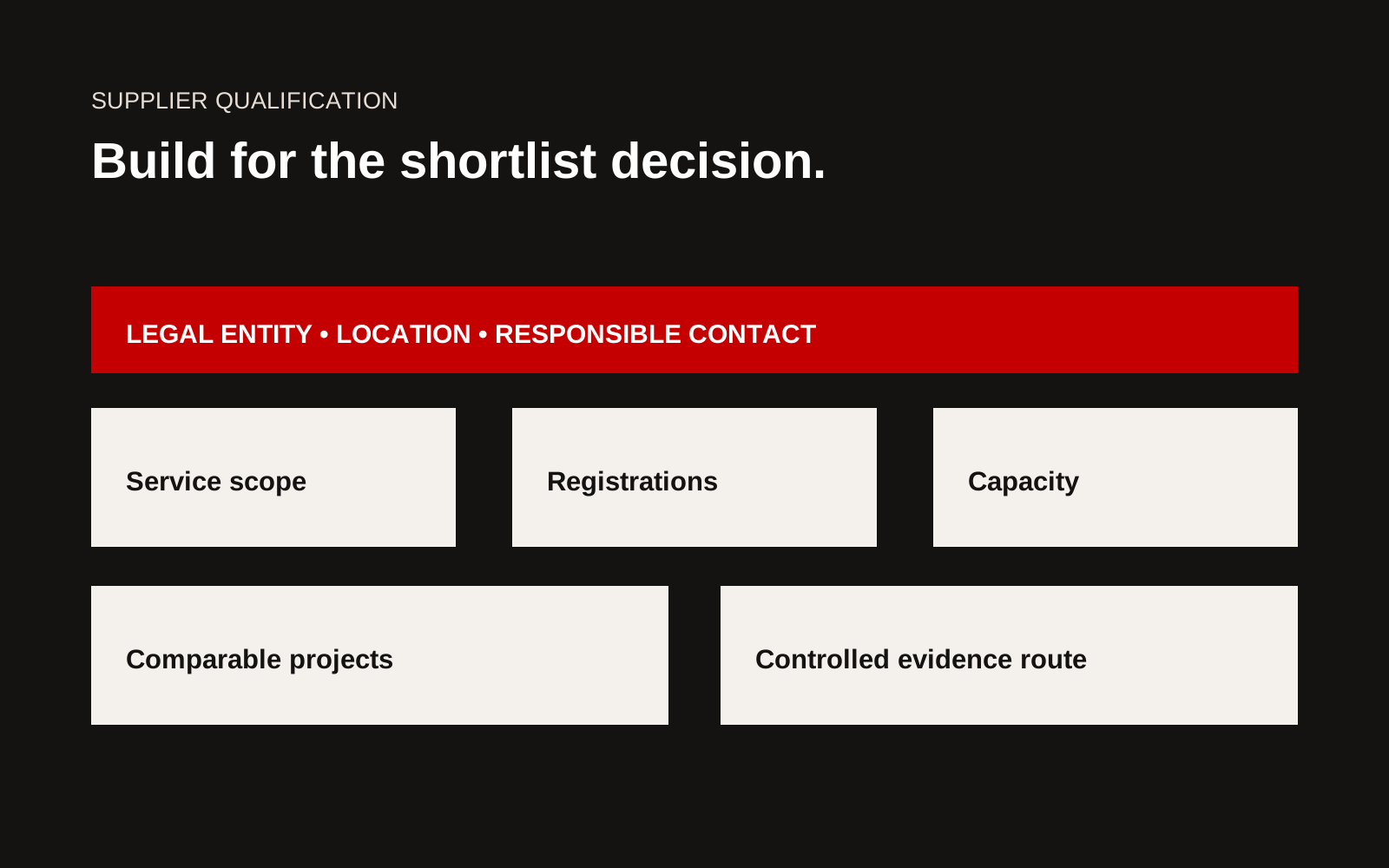
Supplier qualification page anatomy with legal entity, services, registrations, capacity, projects and controlled document route.
Start with the contracting identity
State the registered name and number, trading name, operating locations and group relationship. If several entities share the brand, explain which entity provides which service and holds each registration.
This prevents a common problem where certificates, projects and contacts from different companies appear on one page without a clear contract party.
Define the service boundary
Describe deliverables rather than broad capability words. "Mechanical engineering" could mean design, supply, fabrication, installation, testing, maintenance or all of them. State what is performed directly, what relies on approved partners and what sits outside the usual appointment.
For each service, link to a deeper page that shows inputs, method, output and relevant projects. The qualification page should be a useful index, not a second copy of every service page.
Present registrations with scope
Show:
- issuing body
- registered entity
- reference, workhead or category
- grade or limit where relevant
- scope
- validity or last verification date
Singapore suppliers should direct public-sector buyers to current official records and opportunity requirements, including GeBIZ where applicable. Do not claim universal eligibility from a registration badge.
Make capacity understandable
Public capacity can be stated without exposing a live resource plan. Describe facilities, core disciplines, principal equipment and the process for confirming project availability. Give the page a review date.
If numbers fluctuate, state the boundary and date. "Company-wide employees at 31 October 2026" is clearer than an undated workforce figure.
Use projects as qualification evidence
Choose projects relevant to the target sectors and package types. State the supplier's own role, location, date, constraints and approved result. A client logo alone does not show what was delivered.
Connect each project to the service it proves. This gives the buyer an evidence path instead of a gallery.
Separate public and controlled documents
| Public | Available during qualification | Controlled |
|---|---|---|
| Entity and service facts | Selected certificates and policies | Personnel, client and security records |
| Registration scope | Current insurance evidence | Rates and contract-sensitive terms |
| System overview | HSE and quality questionnaire | Project risk and incident files |
| Approved projects | Detailed references with permission | Confidential designs and data |
Explain how a buyer requests the middle category and how information is handled. Avoid forcing users to submit sensitive project details just to receive basic company evidence.
Replace generic claims with specific answers
Instead of "trusted partner", state the markets, work types and years or projects that support trust. Instead of "end-to-end", list the start and end of the service. Instead of "global reach", name the locations and delivery model.
Add review signals for changing evidence
Certificates, registrations, insurance, contacts, facilities and workforce figures change. Give each source field an owner and expiry or review trigger. The page can show a last-reviewed date without pretending every fact has the same validity period.
When evidence expires, remove or label it promptly. Do not leave an old PDF accessible through a search result after replacing the visible link.
Make the enquiry useful to procurement
Offer a qualification-specific route that asks for company, package, market, required records and deadline. Explain how confidential information is handled. Do not force buyers through a general marketing form.
Return a confirmation with the responsible contact and expected next step. This makes the page part of a working qualification process.
Test the page with a buyer task
Ask someone unfamiliar with the company to confirm the contracting entity, relevant service, applicable registration, comparable project and evidence request route. If they need the company profile PDF to answer basic questions, the page is incomplete.
Qualification-page checklist
- Contracting entity is unambiguous
- Locations and group relationships explained
- Services state deliverables and exclusions
- Registrations show scope and validity
- Certifications belong to the named entity
- Capacity figures have a date and boundary
- Projects show the supplier's exact role
- Safety and quality systems connect to delivery
- Controlled evidence has a clear request route
- Page owner and review frequency recorded
Review the page as a procurement task
Ask someone outside the sales team to find five facts without assistance: the contracting entity, service boundary, markets served, one comparable project and the route for requesting controlled evidence. Time the exercise. If an answer takes more than two minutes, the issue is usually structure rather than missing copy.
Repeat the test on a phone and from a slow connection. Check that certificates can be read, tables do not require horizontal scrolling and contact details carry enough context to route the enquiry. Give every changing field an owner and review date. Registrations, insurance, facility data and named contacts age at different rates, so one annual page review is rarely enough. A short monthly exception report is easier to manage: it only lists records approaching expiry, pages with withdrawn proof and enquiries that could not be routed from the information supplied.
Creatif Work builds engineering websites around the questions buyers use to qualify suppliers. Through our website service, an existing capability statement can become a maintained evidence system rather than another corporate About page. Our guide to Singapore construction tender pages shows a related approach for procurement-led content.