

Singapore Engineering Tender FAQs Buyers Actually Ask

Engineering buyers ask practical questions before they trust a tender response: does the supplier meet the eligibility rules, understand the package, have available people and equipment, control its interfaces, and possess evidence for comparable work?
A useful FAQ library helps the bid team answer consistently. It does not replace the tender documents. Every response must still follow the current conditions, forms and evaluation criteria.
What questions do Singapore engineering tender buyers ask?
Buyers usually need clear answers about eligibility, scope, technical compliance, capacity, safety, quality, project evidence, subcontractors, programme, commercial assumptions and the person accountable for delivery.
| Buyer question | Evidence to prepare | Weak response |
|---|---|---|
| Are you eligible? | Current registration, licence and legal entity | A logo strip with no scope or grade |
| Do you understand the package? | Deliverables, exclusions and interface matrix | Restating the tender title |
| Can you resource it? | Time-phased people, plant and commitments | Total company headcount |
| How is work controlled? | Method, inspection, permit and approval process | Policy statements only |
| Have you done this before? | Comparable scope, conditions and result | A gallery of unrelated projects |
| Who is responsible? | Organisation chart and decision rights | Names without project roles |
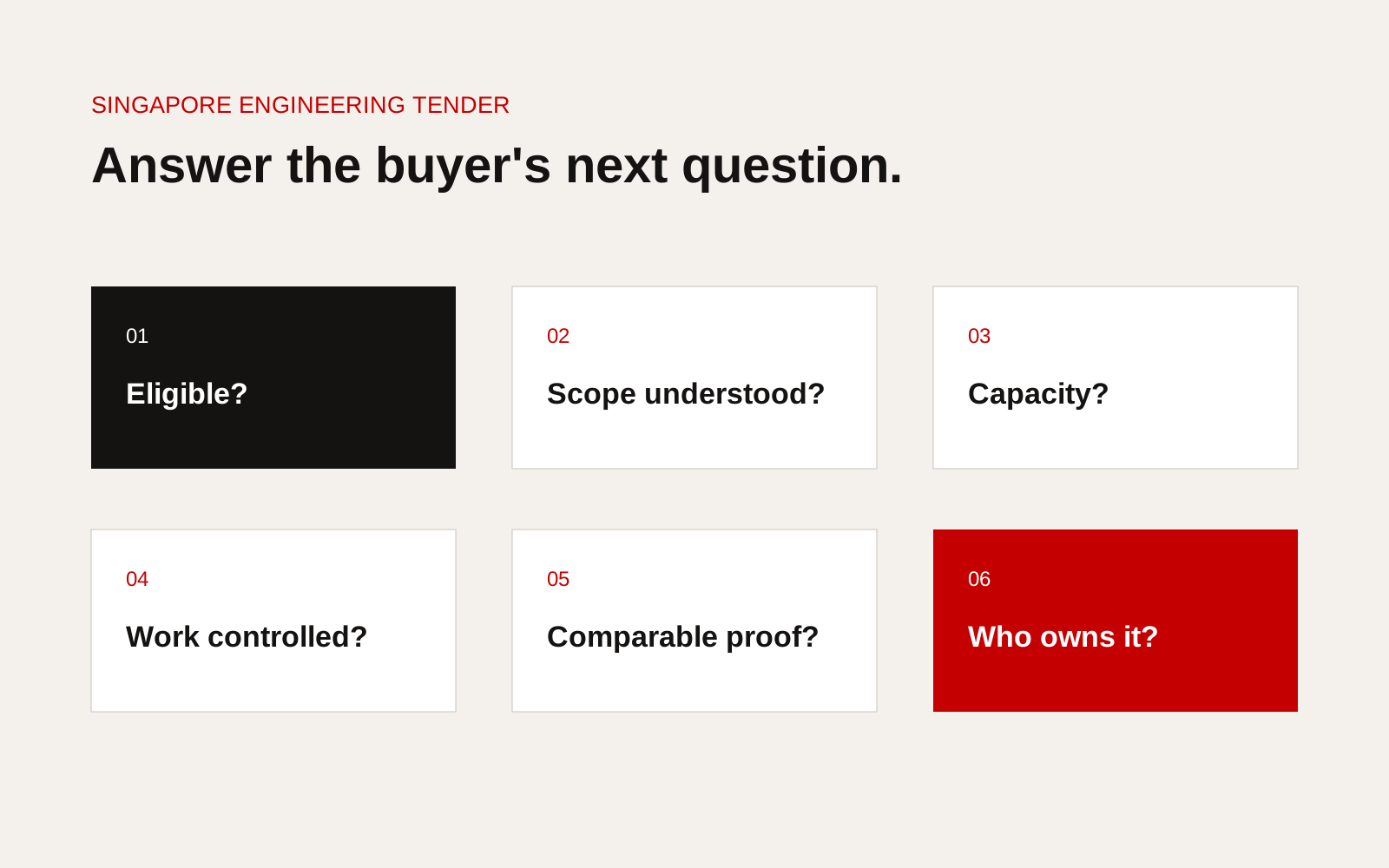
Singapore engineering tender FAQ map covering eligibility, scope, capacity, safety, projects and submission ownership.
Begin with eligibility and entity
State the bidding entity exactly as registered. List only registrations, workheads, grades, licences and certifications that are current and applicable to that entity and package. Give the issuer, reference, scope and validity date.
Singapore public-sector opportunities may be published through GeBIZ, the government's electronic business portal. Suppliers should use the opportunity notice and documents as the controlling source for eligibility and submission requirements.
Do not imply that one registration qualifies the company for every package. If a joint venture or subcontractor supplies a required capability, explain the contractual relationship and responsibility.
Explain the scope and interfaces
Translate the tender scope into deliverables, work packages and interfaces. Identify design responsibility, approvals, temporary works, supply, installation, testing, commissioning, handover and defects obligations where relevant.
Use an interface table:
| Interface | Supplier responsibility | Other party | Decision or handover |
|---|---|---|---|
| Existing asset | Survey and connection basis | Client or operator | Approved isolation and access |
| Design information | Named deliverable and check | Consultant or authority | Review status and date |
| Trade boundary | Supply and installation limit | Adjacent contractor | Coordinated detail |
| Testing | Procedure, equipment and record | Witnessing party | Acceptance certificate |
This is more useful than saying the firm offers an integrated solution.
Prove capacity for the contract period
Show key roles and plant by project phase. Include present commitments and the route for release, recruitment or subcontracting. Label named, confirmed, reservable and assumed resources separately.
For critical people, state project role, relevant experience, availability and replacement route. For plant, state ownership or hire basis, mobilisation, inspection and contingency.
Answer safety and quality questions through the work
Connect systems to the package. Explain how risk assessment, permits, competency, inspection and test plans, non-conformance, change and close-out will work.
A certificate supports the answer but does not replace it. State the certified entity, standard, scope, issuer and validity. Keep detailed personnel and project records controlled, with a clear route for evaluation.
Use comparable project evidence
Select projects by similarity of scope, constraints, standards, interfaces and delivery environment. State the firm's exact role and exclude work performed by others.
Each example should cover:
- project and delivery period
- client or approved description
- scope and contract role
- technical and site constraints
- key interfaces
- outcome approved for publication
- reference contact where permitted
Maintain one approved answer source
Store the standard question, approved answer, evidence reference, owner and review date. Tender-specific answers should inherit facts from this source, then address the opportunity.
Add questions the supplier should ask
Good tender clarification protects both sides. Ask about site information, design responsibility, interfaces, access, shutdowns, existing conditions, data formats, approvals, tests, handover and evaluation assumptions where the documents are unclear.
Submit questions through the required route and by the deadline. Keep answers with the affected requirement so estimators and technical writers use the same interpretation.
Prepare for presentations and interviews
Buyers may test whether the proposed team understands the written offer. Brief each presenter on scope, assumptions, risks and evidence. Do not let a polished speaker expand the commitment beyond the submitted tender.
Use likely buyer questions to rehearse decisions rather than memorised slides: what happens if access is delayed, a resource is unavailable, a test fails or a design input changes?
Close the learning loop
After submission, record questions, answer gaps and evidence that took too long to find. After the result, capture permitted feedback. Update the approved FAQ and project library so the next tender begins from better source material.
Tender FAQ checklist
- Bidding entity and eligibility verified
- Scope translated into deliverables and exclusions
- Interfaces and responsibility owners shown
- Resources time-phased against current commitments
- Safety and quality processes tied to the work
- Comparable projects approved and current
- Subcontractors and partners clearly identified
- Assumptions and clarifications logged
- Commercial and technical answers agree
- Final response owner named
Run a 30-minute answer review
Bring the bid lead, delivery lead and commercial owner together before submission. Give each person the same four prompts: Is this answer about the correct legal entity? Does it answer the question asked? Can the stated capacity be delivered during the contract period? Is every number traceable to an approved source?
Mark each response green, amber or red. Green means supported and ready. Amber means accurate but missing context, an owner or a document. Red means the claim cannot yet be proved. Resolve reds first, then ambers that affect eligibility or scoring. Do not spend the last hour polishing low-value prose while a mandatory certificate, interface assumption or resource conflict remains unresolved. Save the final answer and its evidence reference together so the next tender begins from an approved record rather than an old submission copied without context.
Creatif Work helps engineering firms organise buyer evidence before the next tender deadline. Our website service turns the public parts into useful capability pages, while custom software can support controlled answer and evidence libraries when teams are rebuilding responses from inboxes.