

BIM as Standard Process in German Infrastructure Projects

BIM became the standard process for Germany's federal trunk-road projects from 2025. For bidders, that changes more than the software used to draw a model. It makes information requirements, responsibilities, exchange rules, checking and the common data environment part of delivery planning.
The practical test is whether the team can show how a client's information requirement becomes a controlled, checked deliverable.
What does BIM as a standard process mean for German infrastructure projects?
It means BIM methods are expected across the federal-road project lifecycle, supported by defined use cases, client information requirements, a BIM execution plan, common data environment and structured model delivery. Contract-specific requirements still control the project.
BIM Deutschland's federal trunk roads page states that BIM has been introduced as the standard process for federal roads from 2025. Its master-plan material describes implementation across planning, construction and operation.
| Delivery element | Project question | Supplier evidence |
|---|---|---|
| AIA | What information does the client require? | Requirements review and clarification record |
| BAP | How will the team meet the AIA? | Roles, methods, exchanges and checks |
| Use cases | What decisions will BIM support? | Workflow and output for each use case |
| CDE | Where is information created, reviewed and approved? | Status, naming, permissions and audit trail |
| Models | Which discipline produces which content? | Model responsibility and delivery schedule |
| Checking | How is quality and coordination verified? | Rules, reports, issue and close-out process |
| Handover | What is accepted and in which format? | Checked files, metadata and records |
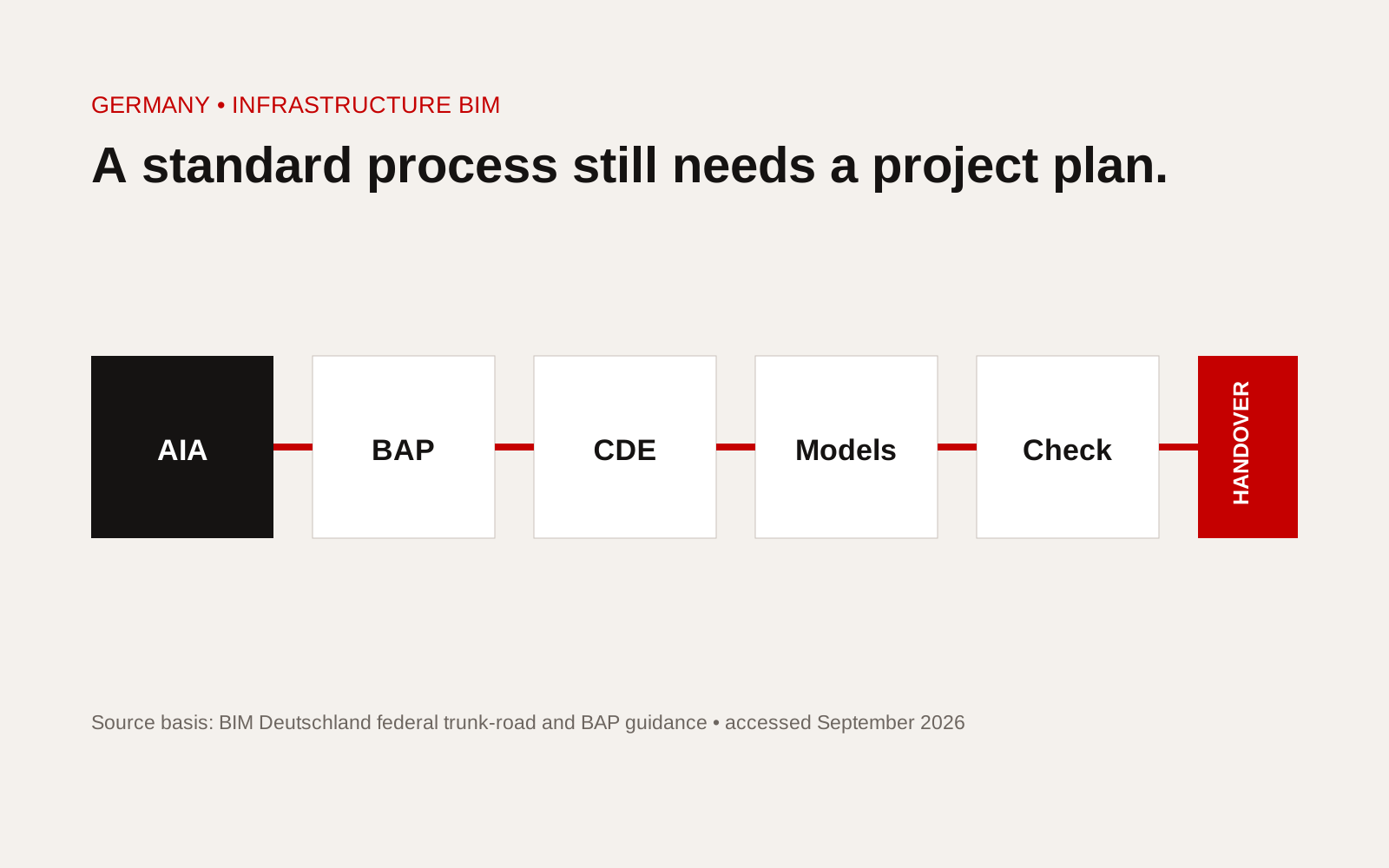
German federal infrastructure BIM workflow from information requirements through BAP, CDE, models, checking and handover.
Read the AIA as a delivery specification
The Auftraggeber-Informationsanforderungen, or AIA, states the client's information requirements. Review it alongside the technical scope and contract. Extract use cases, required information, level of information, formats, milestones, coordinate system, naming, CDE process, checking and handover.
Create a compliance matrix showing requirement, response, owner, deliverable and clarification. Do not leave BIM obligations in a separate technology section.
Make the BAP a working plan
BIM Deutschland's BIM execution plan guidance explains that the BAP responds directly to the AIA and defines implementation. It should be updated through the project where the contract permits, rather than filed after approval.
A useful BAP covers:
- project goals and BIM use cases
- organisations, roles and decision rights
- model and information responsibilities
- software, versions and exchange formats
- coordinate and georeferencing approach
- naming, status and approval workflow
- CDE access and information states
- model federation and coordination
- quality checks and issue management
- delivery schedule and acceptance process
Test the common data environment workflow
The CDE is not just a folder. It controls the state of information and who can rely on it. Test upload, metadata, naming, permissions, review, rejection, approval, revision and archive before the first major exchange.
Official federal-road AIA material available through BIM Deutschland includes a requirement for workflow testing in the CDE and checks involving native and IFC files, coordinates and coordination models. The project AIA remains the authoritative source.
Link use cases to decisions
Do not list use cases without explaining who uses the output. A coordination model supports clash and interface decisions. Quantity extraction supports calculation under stated modelling rules. Progress models support time and status review. Asset information supports handover and operation.
For each use case, define:
- decision or process supported
- responsible author and reviewer
- input models and information
- output and format
- delivery point and frequency
- checking rule
- acceptance owner
Prepare open and native deliveries
Projects may require native files, IFC, reports, schedules and other structured outputs. Test export settings and property mapping early. A model that looks correct in the authoring tool may lose classifications, properties or geometry during exchange.
BIM Deutschland's downloads library provides official templates and guidance. The BIM Portal also provides properties, AIA support, object templates and checking resources.
Keep a delivery register that lists each information container, required format, milestone, author, checker and acceptance status. This gives the project team one view of what is due and stops a technically correct model from arriving without the metadata, report or approval record required by the AIA.
Delivery readiness checklist
- AIA requirements extracted and assigned
- BAP responds to every relevant requirement
- Use cases tied to named decisions and outputs
- CDE workflow tested before live delivery
- Coordinates and model breakdown agreed
- Native and exchange formats trialled
- Property mapping and classifications checked
- Coordination issues have owners and status
- Acceptance criteria agreed for each milestone
- Handover record and archive route defined
Creatif Work helps construction and BIM consultancies explain this delivery discipline without reducing it to software logos. Our construction practice connects service scope, process and project evidence, while our website service turns AIA, BAP and CDE capability into pages a buyer can qualify. See also our guide to Germany's BIM Portal for infrastructure bidders.