

Location Pages for Australian Contractors Without Duplicate Copy
A contractor location page is useful when it explains a real operating difference: office, depot, team, licence, service coverage, local project record or mobilisation route. Copying one service page across twenty towns and changing the place name creates little value for buyers.
Build fewer pages and give each one evidence a person in that market would need.
What should a contractor location page include?
Include the actual base or coverage model, services delivered locally, relevant licences and registrations, named project evidence, mobilisation limits, local supplier or workforce information and a contact route owned by the region.
| Page element | Useful local content | Weak substitute |
|---|---|---|
| Presence | Office, depot, team or recurring project base | "Proudly serving" with no presence |
| Services | Scope available in the location | Full national list copied everywhere |
| Compliance | State or territory licences and entities | Generic certified-company claim |
| Projects | Comparable work, date and role | Project gallery from another region |
| Mobilisation | Coverage, lead time and constraints | Unlimited radius on a map |
| Contact | Responsible office or person | One national form with no routing |
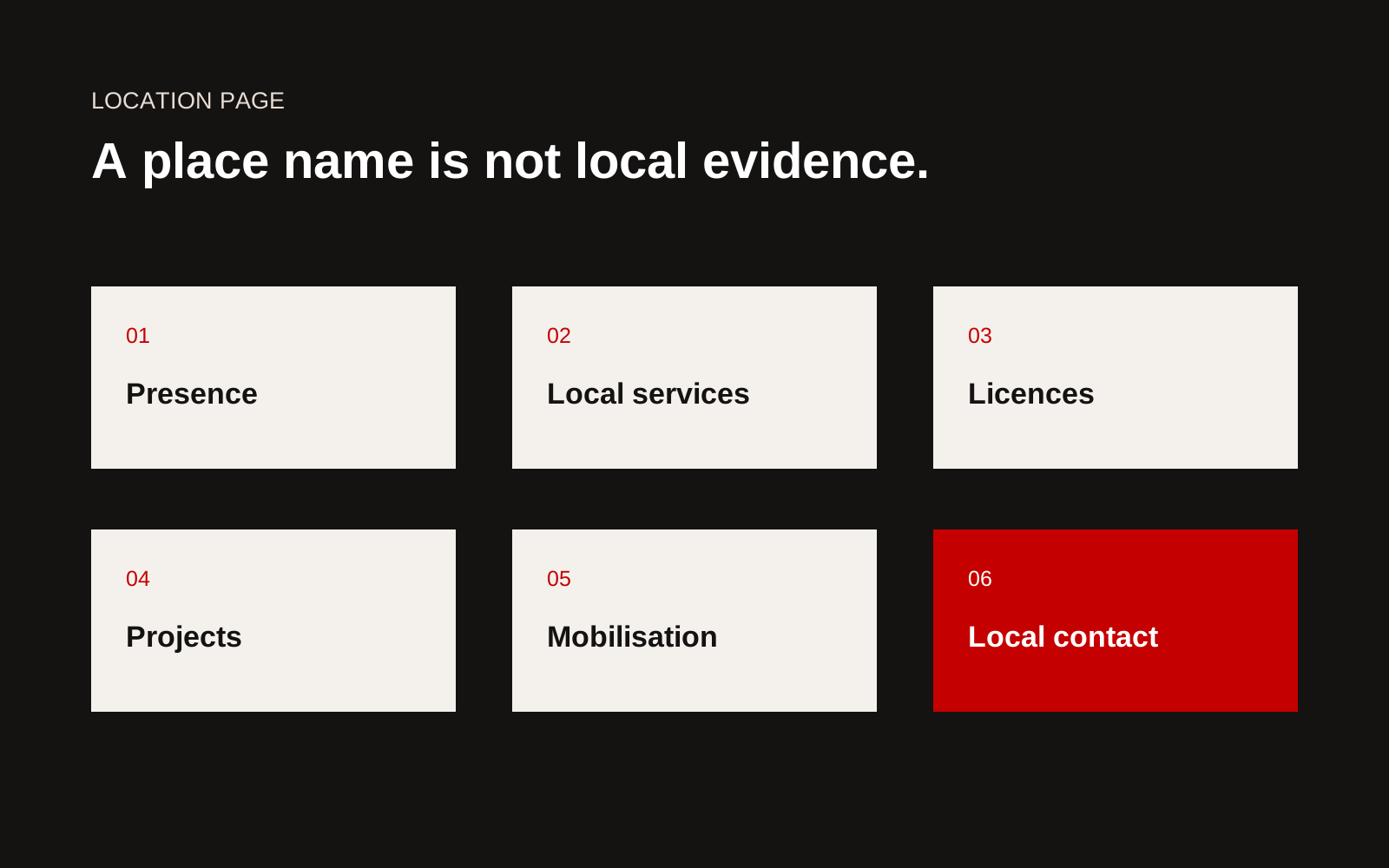
Location-page content model using local office, services, licences, projects, mobilisation and contacts instead of copied text.
Decide whether the page deserves to exist
Create a page when at least one of these is true:
- the company has a staffed office, yard or depot
- regulatory or licensing information differs
- the service range or operating conditions differ
- the region has a meaningful body of project evidence
- buyers need a specific mobilisation or support route
- the local searcher has a distinct procurement question
If none applies, use one strong regional coverage page or service page instead.
Google's spam policies describe doorway abuse as pages created to rank for similar queries that funnel users to one destination. Location pages should exist to help the local reader, not to manufacture near-identical search entries.
Build from controlled local facts
Create a location record before writing. Fields may include:
- legal entity and trading name
- physical office, depot or no permanent base
- service area and exclusions
- licence and registration details
- operating hours and urgent contact route
- local team and responsible manager
- plant, facility and supplier access
- current and completed projects approved for publication
- recruitment and supplier opportunities
- last review date and owner
This gives writers facts that cannot be replaced by generic adjectives.
Explain the coverage model honestly
Distinguish three arrangements:
- Permanent presence: staffed location with owned or controlled resources.
- Project presence: current or recurring delivery from a temporary base.
- Mobilised coverage: work delivered from another location or partner.
Each can be credible if it is described accurately. Do not give a serviced area the visual treatment of a permanent branch.
Connect the page to local proof
Choose two or three projects relevant to the region and service. State the contractor's exact role, project type, location, delivery period and approved result. A reader should be able to move from the location page to the full project record and relevant service.
If project disclosure is limited, provide enough context to show relevance without using an anonymous claim that could apply anywhere.
Avoid template paragraphs
A shared page structure is sensible. Shared copy is not. Use the same headings where they help comparison, then answer them with local facts.
Distinct-content test
- The opening explains a real presence or coverage model
- At least one service has a local difference
- Applicable licences or registrations are current
- Projects come from the market described
- Mobilisation and support routes are factual
- Contact is routed to the responsible team
- No paragraph could be moved unchanged to another location
- Title and heading match the actual scope
- Structured data matches visible business information
- Page has an owner and review date
Use internal links as evidence paths
Link the location to specific services and projects, not every page on the site. Link back from relevant projects to the location. This helps a buyer see how regional presence supports actual delivery.
Do not force all location pages into the main menu. A region index can organise them, while office pages can also appear in contact and service contexts.
Measure qualified behaviour
Track which location pages lead to project views, service views, calls, directions or useful enquiries. A page that attracts visits from an irrelevant area or produces no meaningful next action may need consolidation.
Creatif Work builds construction websites around actual coverage, services and proof. Through our website service, Australian contractors can maintain location facts once and connect them to projects without publishing thin copies. Our guide to selling to overseas buyers also explains why location and response routes matter to cross-border qualification.