

Germany's BIM Portal: What Infrastructure Bidders Need to Understand

Germany's federal BIM Portal is not a tender board and it is not another model viewer. It provides structured information requirements, standard properties, object templates and checking tools that public clients and their suppliers can use across planning, construction and operation.
For an infrastructure bidder, the useful question is not whether the team "does BIM". It is whether the team can read an Auftraggeber-Informationsanforderungen document, trace each required information item into its delivery plan and test the model before submission.
What is Germany's BIM Portal?
The BIM-Portal des Bundes is a federal platform for standardised BIM information requirements. Its modules cover properties and property groups, client information requirements known as AIA, semantic object templates and checking tools. Public content can be viewed by contractors, private clients, software providers and other construction participants.
BIM Deutschland describes the portal as a central platform for consistent handling of public construction information. Its BIM Portal overview says the system supports information from geometric data to specific component properties and checks whether required information is recorded correctly during planning, construction and operation.
The portal sits within a longer federal BIM programme. BIM Deutschland says the federal step plan was published in 2015. Master plans and implementation strategies followed for federal roads, rail, waterways and federal buildings. Its federal road guidance says BIM has been introduced as the standard process for federal road construction from 2025.
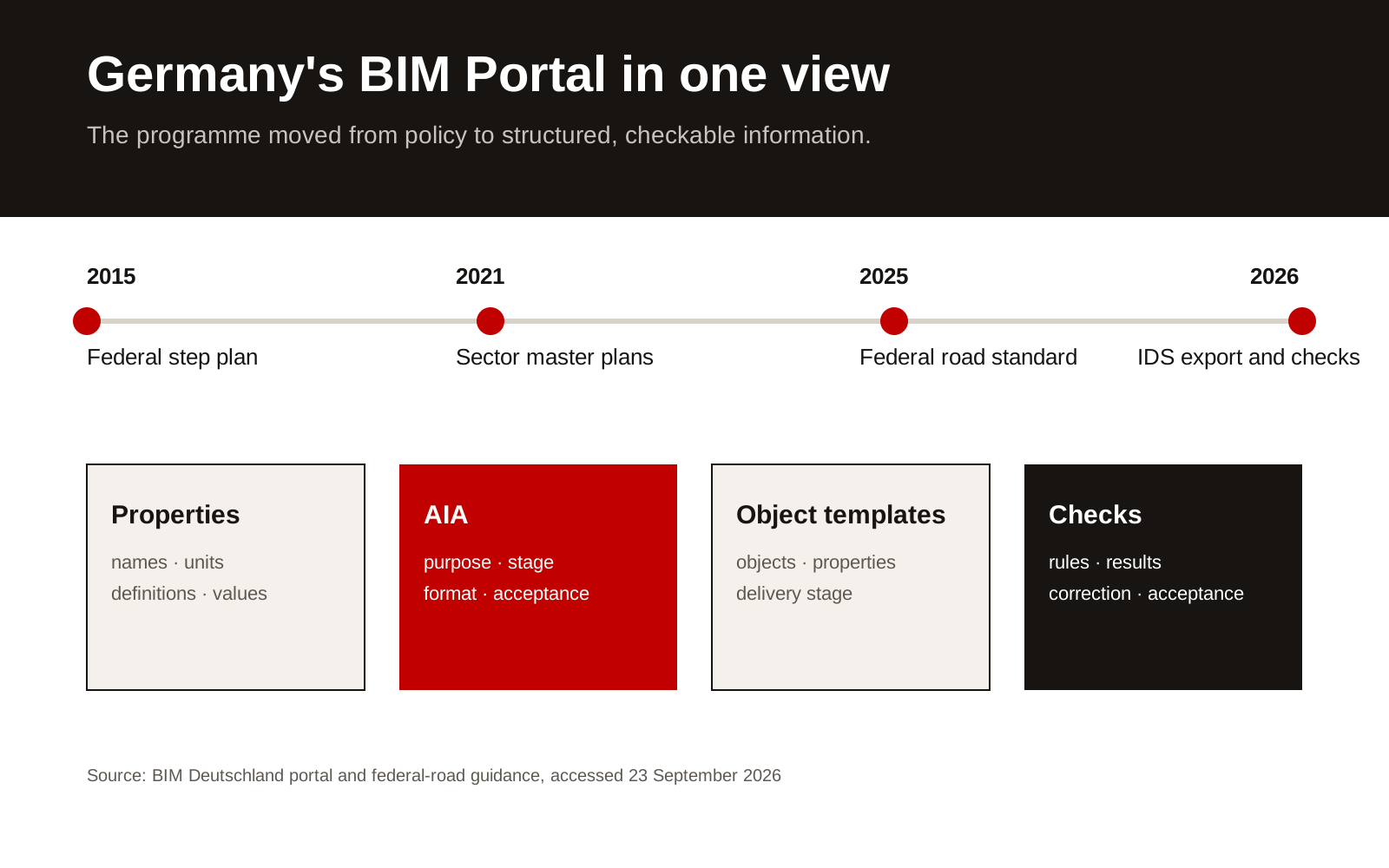
Timeline and four modules of Germany's federal BIM Portal for infrastructure bidders.
Understand the four modules
The portal's modules form a chain. Reading only the AIA text misses the machine-readable part of the requirement.
| Module | What it contains | What the bid team should check |
|---|---|---|
| Merkmale | Standard properties and property groups | Names, definitions, units, allowed values and identifiers |
| AIA | Client information requirements and templates | Purpose, delivery stage, responsible party, format and acceptance rule |
| Objektvorlagen | Semantic object templates aligned to the AIA | Which objects need which information at each stage |
| Prüfwerkzeuge | Rules and tools for quality checks | Whether the team's authoring and checking workflow can test the required data |
BIM Deutschland's portal functions article explains that standard properties are the basis for AIA and linked object templates. The checking tools then support quality assurance against those requirements.
This matters commercially. A bidder may price model production correctly but miss the work needed to map classification, populate required properties, validate exchanges and correct rejected information.
Read the AIA as a delivery specification
The AIA states what information the client needs, why it is needed, when it must be delivered and in what quality or structure. It should shape the offer before contract, not be handed to the BIM coordinator after award.
For every required delivery, extract:
- purpose and use case
- responsible author and reviewer
- project stage and due date
- model, document or data format
- object types and required properties
- level of information need
- naming and classification rules
- checking method and acceptance criteria
- common data environment route
- issue and correction process
The BIM Deutschland AIA guidance provides cross-sector and sector-specific examples for federal roads, rail infrastructure and federal buildings. These are useful references, but the project-specific AIA remains the requirement to price and deliver.
Check what changed in 2026
Two 2026 developments are particularly relevant to bid teams.
First, BIM Deutschland announced that object templates and checking rules could be exported in Information Delivery Specification format. The 24 June 2026 workshop page says models can then be created and checked against requirements provided through the portal.
Second, the federal buildings team published its sample AIA template in the portal on 6 August 2026. BIM Deutschland's publication notice dated 26 August 2026 explains how users can find and export it.
These announcements do not make every project identical. They make it more practical to start from common structures and to test information more consistently. Bid teams still need to identify amendments, project-specific fields and contractual precedence.
Build a bid-readiness register
Do not answer the BIM section with a software list. Create a register that links requirement to evidence.
| Bid question | Evidence to prepare |
|---|---|
| Can you interpret the AIA? | Completed requirement matrix from a comparable project |
| Can you plan delivery? | BIM execution plan extract with roles, exchanges and review points |
| Can you manage the CDE? | Workflow showing status, approval, issue and archive states |
| Can you populate the model? | Object and property mapping with units and source systems |
| Can you check before submission? | Model-checking report against named rules |
| Can you correct failures? | Issue workflow with owner, due date and verification |
| Can you hand over usable information? | Accepted exchange example and receiving-system test |
If client permission limits what can be shared, prepare an anonymised example. Keep the process, data structure and acceptance result visible while removing project-sensitive content.
Our article on BIM evidence for German construction firms provides a broader website and qualification checklist.
Show readiness without publishing the project model
A contractor's public website can support qualification if it names the work precisely. It can state which infrastructure types, delivery stages, information exchanges and checking processes the team has completed.
Useful case-study evidence includes:
- client information requirement translated into delivery responsibilities
- model and data formats used
- CDE workflow and approval states
- checking rules and issue volumes at an agreed stage
- accepted handover or exchange result
- lessons that changed the next delivery plan
Do not upload a client AIA, live model or internal CDE screenshot without permission. Recreate a safe diagram and have the project owner approve the facts.
Creatif Work helps construction firms organise technical evidence so a bidder's capability is clear before the tender response starts. Our website service can turn approved BIM delivery records into structured case studies, capability pages and downloadable material without exposing controlled project information.