

How Much Should a Business Website Cost in Singapore in 2027?
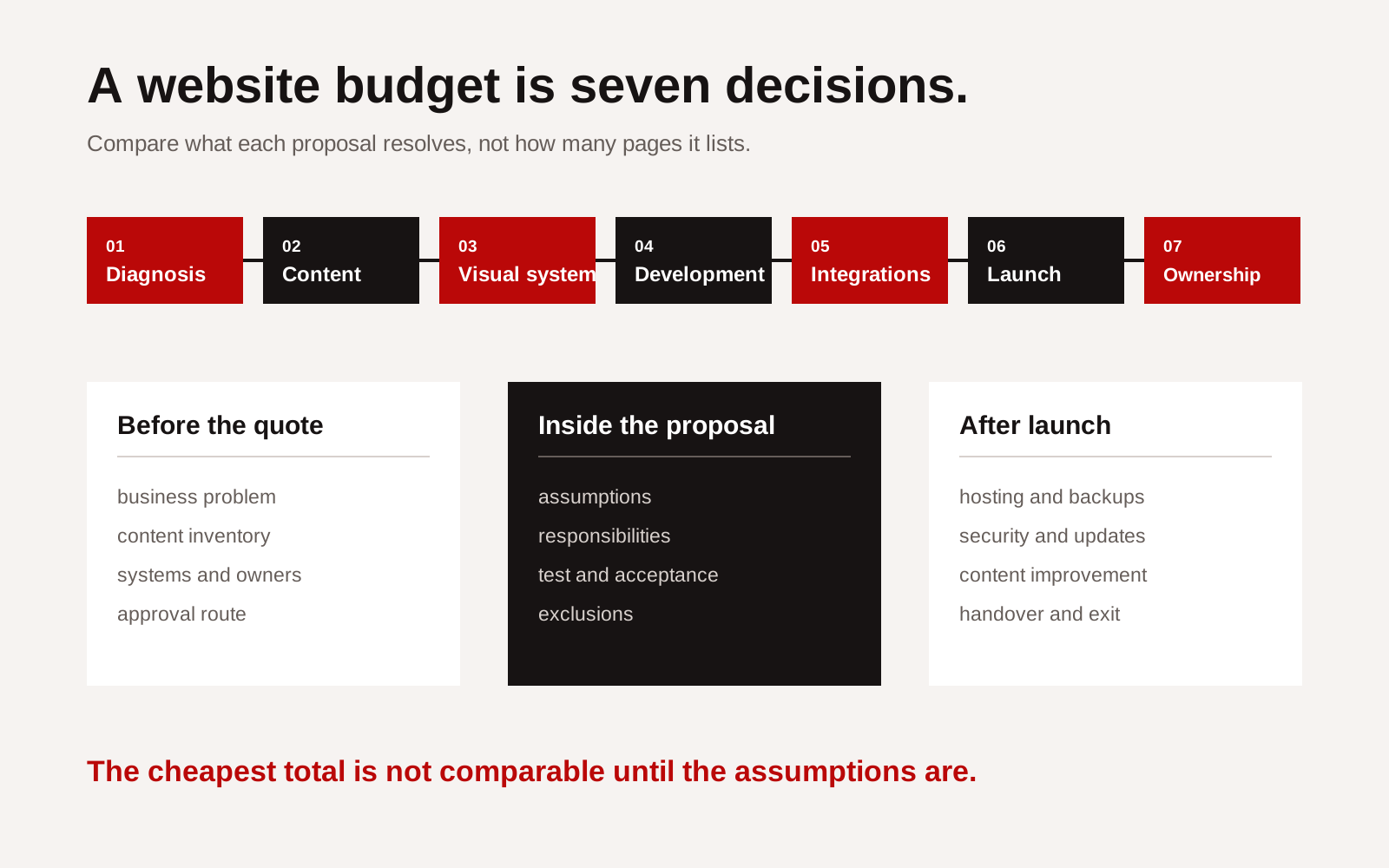
There is no honest single price for a business website in Singapore in 2027. A five-page site can be a template populated with finished copy, or it can require interviews, new positioning, photography, technical research, integrations and several approval groups. The page count looks similar. The work does not.
The useful budget is the cost of resolving the business problem, producing the missing evidence and owning the website after launch. Ask for that scope before asking agencies to compete on one total.
How much should a business website cost?
Budget for seven parts: diagnosis, content, visual system, development, integrations, launch assurance and ongoing ownership. The total depends on how much is already resolved, who must approve it and what the website must connect to. Compare assumptions and exclusions before comparing price.
This article does not publish a market rate card. A rate without your content, system and approval conditions would create false precision. For the current factors that move a quote, read what actually drives website price, then use the model below to brief suppliers on the same basis.
Build the budget in seven parts
| Budget part | What it should cover | Question that changes the scope |
|---|---|---|
| Diagnosis | Buyer interviews, current-site review, business goals and content architecture | Is the problem already agreed, or must the team find it? |
| Content | Copy, technical fact collection, case studies, photography and migration | Does approved material exist in a usable form? |
| Visual system | Page layouts, interaction, responsive states and image direction | Is the brand system settled and fit for digital use? |
| Development | CMS, templates, forms, performance and accessibility | Is this a standard publishing site or a custom application? |
| Integrations | CRM, recruitment, portals, product data and other systems | Who owns each system, credential and test environment? |
| Launch assurance | Quality checks, redirects, analytics, search setup and training | Is there an old site with valuable URLs and data to preserve? |
| Ongoing ownership | Hosting, updates, monitoring, support and improvement | Who is responsible after the warranty period? |
A proposal that omits one of these parts has not made it free. It has moved the work to your staff, another supplier or a later change request.
Separate a refresh from a rebuild
A refresh keeps the working foundation and repairs defined weaknesses. A rebuild replaces the structure or system because it prevents the site from doing its job.
Choose a refresh when:
- the content architecture still fits the business;
- the content management system is supported;
- core templates work on current devices;
- forms and analytics can be repaired; and
- the main problem is incomplete content or uneven presentation.
Choose a rebuild when:
- services, markets or audiences have changed substantially;
- important information has no proper place;
- the team cannot make routine updates;
- the platform blocks performance, accessibility or integrations; or
- old templates would force the new content into the wrong structure.
The cheaper route is the one that removes the real constraint. Keeping a weak structure can make a refresh more expensive over its useful life. Replacing a sound system can waste budget that should have gone into content.
Our rebuild or refresh guide gives founders a more detailed diagnostic before a brief is written.
Count internal time as part of the cost
Website budgets usually record the supplier fee and ignore the client's time. That hides a large part of the project.
List the people needed for:
- business and buyer decisions;
- technical fact checking;
- legal, privacy or regulatory review;
- gathering project photographs and permissions;
- system access and integration testing;
- final approval; and
- training and post-launch updates.
Assign one person the authority to close decisions. A project where four people can comment but nobody can approve creates repeated rounds and delayed content. That cost appears as staff time, launch delay or both.
Before requesting proposals, prepare a content inventory. Mark every page or asset as keep, update, create, merge or remove. The unknown items are not small details. They are part of the scope.
Put 2027 requirements into the brief
Some work should not be sold as an optional finishing layer.
Accessibility
Ask which accessibility standard and level the build will target, how it will be tested and which content responsibilities remain with your team. WCAG 2.2 is a W3C Recommendation and adds nine success criteria to WCAG 2.1. A proposal should describe practical checks, not merely say “accessible”.
Search and AI visibility
Google's Search technical requirements state that public pages need to be accessible to Googlebot, return a successful status and contain indexable content. That is a baseline. The budget must also cover useful page titles, redirects, internal links, structured data where applicable and the actual content buyers search for.
There is no special AI markup that substitutes for this work. Google's guidance for generative AI search keeps the same foundation: crawlable pages, useful first-hand content and a clear technical structure.
Privacy and form handling
List every form, uploaded file, analytics service and third-party system that handles visitor data. The site supplier should state what it configures. Your organisation still needs to decide what data is necessary, who can access it and how long it is kept.
Ownership and handover
The contract should identify ownership and access for the domain, code, design files, content, analytics, hosting and third-party accounts. It should also state what happens when the relationship ends. Our website ownership and handover checklist covers the questions to resolve before signing.
Compare proposals by assumptions, not page count
Put every proposal into one comparison table.
| Question | Proposal A | Proposal B | Proposal C |
|---|---|---|---|
| Who writes and approves the content? | |||
| How many unique page structures are designed? | |||
| Which integrations are included and tested? | |||
| What accessibility target is named? | |||
| What happens to existing URLs and search data? | |||
| Who owns every account and source file? | |||
| What support is included after launch? | |||
| What is explicitly excluded? |
Do not reward a longer deliverables list without checking the work behind each line. “SEO setup”, “security” and “custom design” can describe very different scopes.
Ask each supplier to walk through one difficult assumption. If the website needs fifty project records but only five are ready, who gathers and structures the other forty-five? If a CRM integration is included, who maps the fields and tests failures? If the launch date is fixed, what client decisions must be complete each week?
Budget for the years after launch
A website is not finished when it is deployed. Plan for:
- hosting, backups and security updates;
- software and licence renewals;
- monitoring and incident response;
- new projects, services and staff changes;
- accessibility and performance checks;
- search reporting and content improvement; and
- periodic design or platform changes.
Separate essential care from growth work. Essential care keeps the existing site available and secure. Growth work adds or improves content, search visibility, integrations and conversion paths. Combining them into one vague retainer makes it hard to know what is being maintained and what is getting better.
Write the brief before setting the number
A useful website brief states the business problem, audiences, decisions, content state, integrations, approval route, launch constraint and ownership requirements. It does not need to prescribe every page.
When suppliers price the same problem and assumptions, their proposals become comparable. When each supplier has to guess a different project, the cheapest total proves very little.
Creatif Work's website service begins by diagnosing what the site must change, then defines the build. Our hosting and support service separates ownership, routine care and ongoing improvement. If the budget is being discussed before the problem is clear, start with the problem.