

How Much Does a Custom Web App Cost in Singapore?

A custom web app in Singapore cannot be priced responsibly from the number of screens alone. Cost follows the workflow, users, permissions, data, integrations, exceptions, security, testing and rollout support.
The quickest way to a useful budget is to define one operational problem and the smallest release that can run it safely.
How much does a custom web app cost in Singapore?
The cost depends on scope and delivery risk. A simple single-team workflow with limited roles and no complex integration requires much less work than a customer-facing system with payments, offline use, migration, audit records and several external systems. Ask for a paid or defined discovery when critical requirements are still unknown.
| Cost driver | Lower complexity | Higher complexity |
|---|---|---|
| Workflow | Linear task with few exceptions | Many states, approvals and recovery paths |
| Users | One internal group | Customers, partners and administrators |
| Permissions | Few fixed roles | Record, field or organisation-level access |
| Data | New, clean records | Legacy migration and reconciliation |
| Integrations | None or stable single API | Several systems or uncertain interfaces |
| Availability | Business-hours internal use | Operational or customer-critical service |
| Security | Standard access and data | Sensitive data and stricter assurance |
| Devices | Modern desktop and mobile browsers | Offline, specialised device or legacy support |
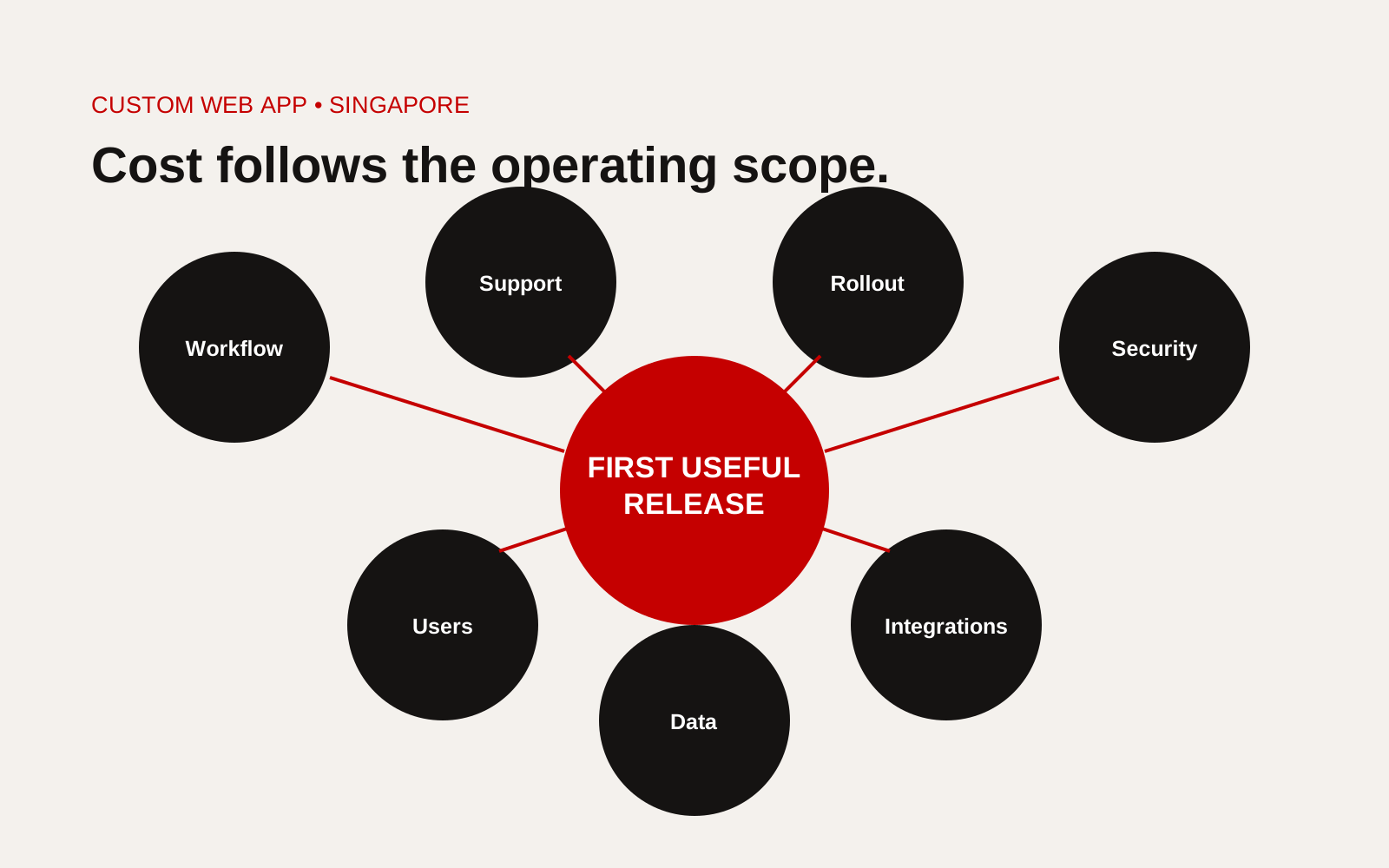
Custom web app scope model showing workflow, users, data, integrations, security, rollout and support as cost drivers.
Price the workflow, not the mock-up
A screen can look simple while hiding many rules. Define the start, end, actors, decisions and exceptions for each workflow.
For an approval process, answer:
- Who creates the record?
- Which fields are required?
- Who can edit after submission?
- How are reviewers assigned?
- What happens when information is missing?
- Can an approval be withdrawn?
- Which notifications are required?
- What appears in the audit history?
- How is the record exported or retained?
Each answer can change design, development and testing effort.
Define roles and data boundaries
List user types and what each can view, create, change, approve and export. Multi-company systems usually need stronger separation, administration and testing than a single internal team.
Map the data lifecycle: collection, validation, storage, use, sharing, retention and deletion. Singapore organisations handling personal data should review obligations under the Personal Data Protection Act and current guidance from the Personal Data Protection Commission. Legal and security requirements depend on the service and data.
Investigate integrations early
An integration estimate needs documentation, access, data examples, rate limits, authentication and a test environment. "Connect to our ERP" is not a scope.
For each system, record:
- owner and technical contact
- data read and written
- source of truth
- trigger and frequency
- API or transfer method
- error and retry process
- duplicate and conflict handling
- test access and approval
If access is uncertain, price a technical investigation before committing to the full integration.
Include migration and clean-up
Legacy spreadsheets and databases rarely match the new data model. Decide what is migrated, archived, corrected or excluded. Sample real records and measure duplicates, missing values and inconsistent formats.
Migration needs mapping, transformation, test loads, reconciliation, cutover and rollback. It is a project stream, not a final upload.
Budget for non-feature work
Reliable software includes work users do not see in a demo:
- discovery and process mapping
- technical architecture
- accessibility and responsive behaviour
- authentication and permissions
- logging, monitoring and backups
- automated and manual testing
- security review and remediation
- deployment and environments
- documentation and training
- launch support and maintenance
Removing these lines does not remove the risk. It transfers it to operation.
Use stages when uncertainty is high
A sensible route can be:
- Discovery: map workflow, users, data, exceptions and outcome.
- Prototype: test difficult interactions or technical assumptions.
- First release: support one complete useful process.
- Pilot: run with a controlled user group and measure issues.
- Expansion: add roles, locations or integrations after evidence.
This creates decision points before the entire budget is committed.
Ask agencies to price the same basis
Provide the workflow, roles, data, integration information and constraints. Ask each supplier to state assumptions, exclusions, client responsibilities, delivery stages, acceptance process, ownership and support.
Budget readiness checklist
- One business problem and success measure defined
- Users, roles and organisations mapped
- Main workflow and exceptions documented
- Data sources and retention needs identified
- Integrations investigated with real access information
- Migration volume and quality sampled
- Security and privacy review included
- Testing and acceptance ownership agreed
- Training, rollout and support included
- First release separated from future ideas
A useful estimate is a consequence of a useful scope. Creatif Work builds web apps and custom software for operational workflows. We begin with users, decisions, data and exceptions, then define the smallest complete release that can be tested in the business.