

Connecting Enquiries, CRM and Quotation Workflows

An enquiry integration needs to preserve the request, its identity, its owner and its current state from intake through quotation. Decide which system owns each record before connecting APIs. A form confirmation, CRM contact and approved quotation are different outcomes, and each needs its own acceptance evidence.
A visitor submits a request. The website shows success. The CRM contains a contact, but no salesperson owns the enquiry. A retry creates a second opportunity. The eventual quotation uses an outdated requirement copied from an email. Every tool is operating while the request itself is poorly controlled.
This guide focuses on the working integration: intake, validation, assignment, deduplication, qualification, quotation and exception recovery. It does not replace lead-generation strategy or guarantee legal compliance, sales growth or adoption. The HubSpot documentation cited illustrates concrete API decisions; another CRM needs its own current verification. All records and numerical examples are fictional.
Use the integration contract workbook or editable CSV registers. They are ungated, with five equivalent web tables below. Keep actual customer records, tokens and private attachments in authorised systems. Generated photographs illustrate work and do not prove a real integration result.
Define the enquiry as a record in its own right
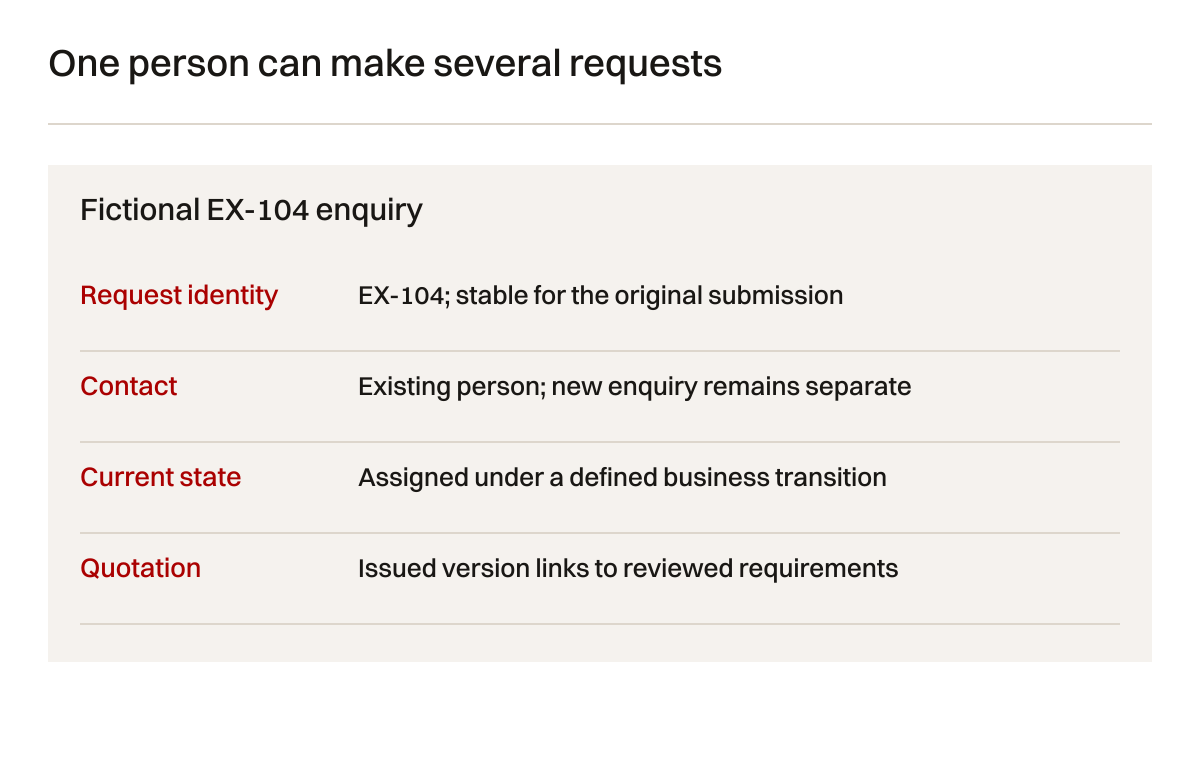
A person can make several requests. A company can have several contacts. A quotation can respond to a specific version of one request. If the system stores only a contact and free-form notes, those relationships can become unclear. Begin by naming the objects the workflow needs and the identity of each.
Assign an intake reference before attempting downstream work. The reference lets the team recognise the same submission during retries and investigation. It should not depend solely on an email address because one person can request different work. A record identifier also helps separate customer contact identity from the identity of the current enquiry.
For a fictional equipment supplier, enquiry EX-104 concerns replacement parts for one machine. The contact may already exist from an earlier project. The new request still needs its own context, state and assignment. If an API call times out after creating the contact, recovery should determine what exists before creating another request or opportunity.
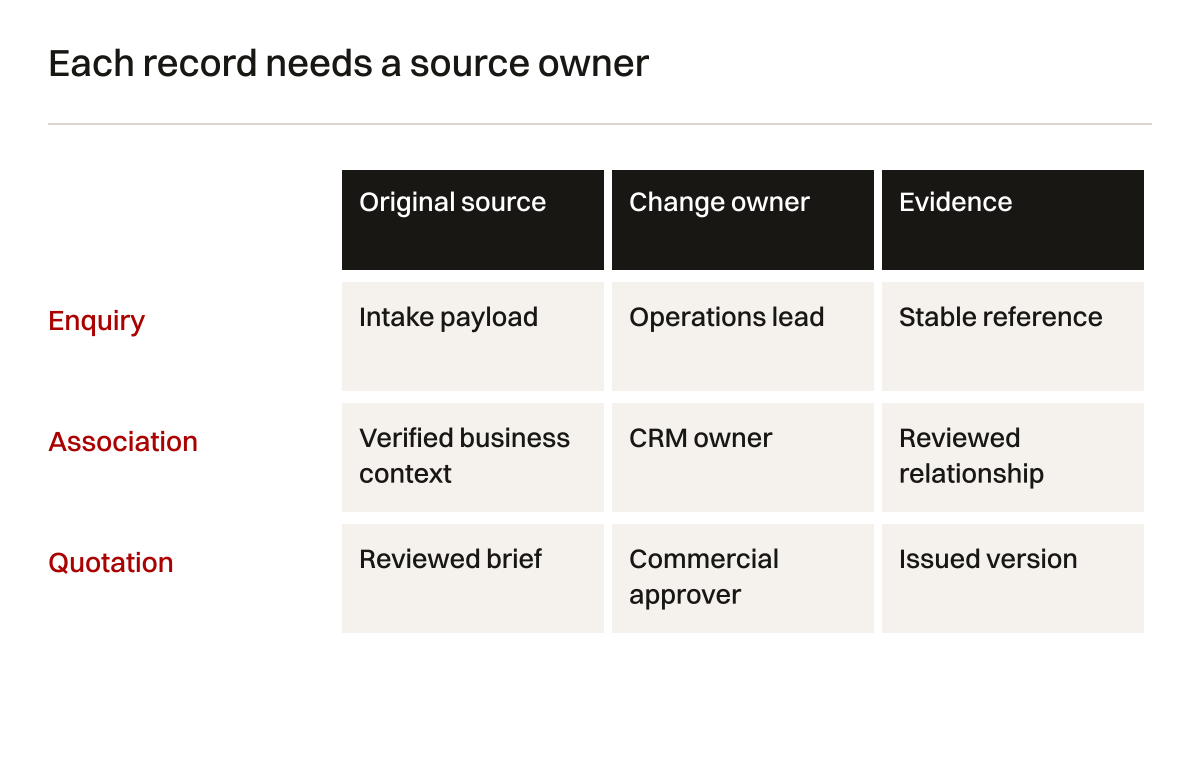
Document the source of record for each object. The website may own the original submitted payload. The CRM may own assignment and qualification. The quotation system may own an approved commercial version. The integration should preserve relationships rather than let every application overwrite every field whenever a message arrives.
HubSpot's Contacts API guidance describes record access and identifiers, including email-based operations in supported contexts. Use the endpoint's actual behaviour when designing contact handling. Do not infer that a contact identifier is a complete business rule for deduplicating enquiries.
Write the field contract before building the connection
The field contract identifies source, destination, format, required status and authority. A public field label is not necessarily the internal API property name. A visible sales stage is not necessarily the value required by a create request. Preserve those distinctions in the mapping record so a later label change does not silently break the integration.
Table 1: enquiry field contract. The example fields demonstrate the structure; actual required information follows the business task.
| Field | Source of record | Validation | Destination use |
|---|---|---|---|
| Intake reference | Intake service | Stable and unique to the submission | Retry correlation and enquiry identity |
| Contact address | Approved submitted contact field | Format and permitted handling | Contact lookup or review |
| Company context | Submitted and later verified record | Do not infer company solely from email domain | Relationship and assignment |
| Requested task | Original enquiry payload | Preserve meaning and required context | Qualification and quotation brief |
| Product or service reference | Public page or selected item | Valid approved identifier | Routing and technical review |
| Permission context | Actual collection flow | Record applicable notice and choice | Appropriate downstream use |
HubSpot's Properties API documentation distinguishes property types and configuration. Check the real account schema. A custom dropdown may require a specific internal value. A date field may have an expected representation. Validate those requirements with controlled records before accepting production data.
Do not gather every field that might someday be useful. Ask what the receiving team needs to route and assess the request. A technical attachment may belong after initial clarification. A personal identifier unrelated to the quotation task should not be added merely because a CRM template includes it. Data minimisation and approved use are business requirements, not boxes an API can certify.
Record provenance for later corrections. If the customer clarifies quantity, preserve the original request and the approved current interpretation according to the agreed model. A salesperson editing a CRM field should not silently rewrite the original submission history. The quotation needs the version of the requirements that was actually reviewed.
Define states using evidence and permitted transitions
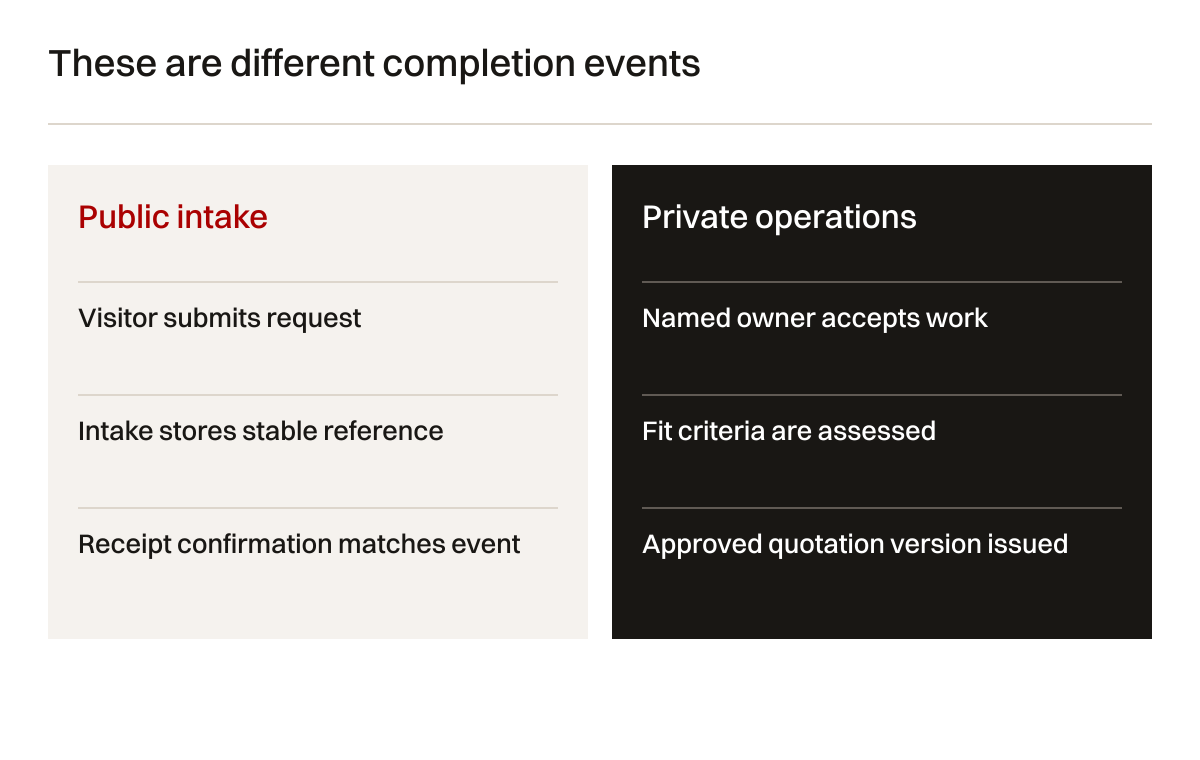
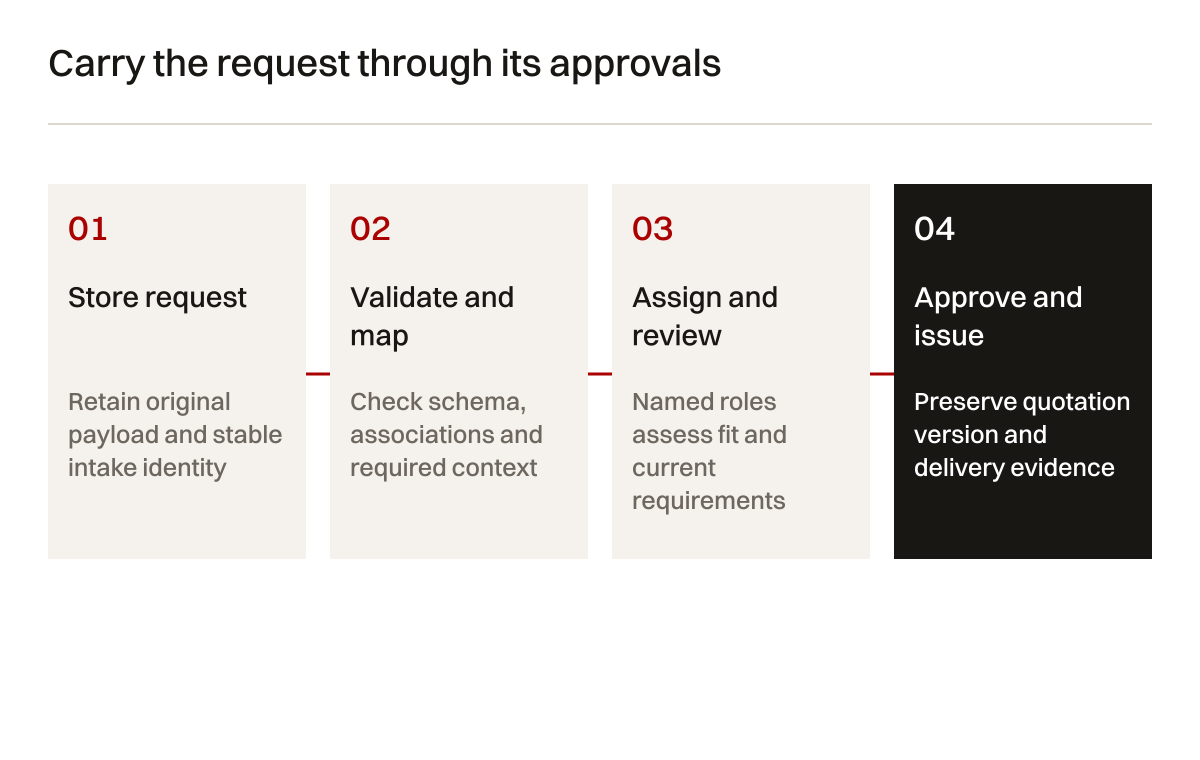
State names need meanings. “Received” may mean the intake service stored the request. “Assigned” means a named role has accepted responsibility. “Qualified” means the request meets the business's stated criteria. “Quoted” should refer to a specific approved quotation event. Without definitions, different teams can report the same record as several incompatible outcomes.
Table 2: state transitions and their evidence. These are proposed definitions for the fictional workflow, not universal CRM defaults.
| Transition | Required condition | Evidence | Decision owner |
|---|---|---|---|
| Submitted to received | Intake record stored | Stable request reference | Intake system owner |
| Received to validated | Required context accepted or clarified | Validation result and exceptions | Operations reviewer |
| Validated to assigned | Intended owner exists | Assignment record | Sales operations |
| Assigned to qualified | Approved fit criteria assessed | Qualification decision | Commercial lead |
| Qualified to quotation review | Current requirements identified | Linked reviewed brief | Sales and technical owners |
| Review to issued | Required approval complete | Issued quotation version | Authorised commercial approver |
Include permitted reversals. A qualified request can become unsuitable after clarification. A draft quotation can return for technical review. An issued quotation may need a new version. Do not erase the previous state history to make the dashboard look current. Preserve the event that explains why the next action changed.
HubSpot's Deals API guide explains that API requests use internal stage and pipeline identifiers. Match those values to the business definitions. A stage called “Quote sent” does not prove an actual quotation was approved or delivered unless the workflow records that evidence.
Keep notifications separate from state changes. An assignment email can fail while the CRM assignment succeeds. The responsible person still needs a route to see the record. Similarly, a successful notification does not prove the underlying write succeeded. Test the state and the communication independently.
Preserve associations instead of guessing them
The integration needs to connect the contact, company, enquiry and quotation appropriately. A contact may work with several organisations. A shared purchasing address may represent multiple requests. An email domain can be a clue, but it is not always reliable evidence of the contracting entity or project owner.
HubSpot's association documentation describes relationship types and direction. Inspect the correct objects and identifiers for the actual integration. Creating a contact and a deal in separate calls does not guarantee that the intended association exists.
For the fictional supplier, the customer contact represents a maintenance contractor requesting parts for its client's equipment. The contracting company and end-user site are different facts. The quotation workflow needs to know which organisation receives the offer. A single company field populated from the email domain can conceal that difference.
Define who can correct an association. Some changes need commercial confirmation. The integration can flag an uncertain match rather than create it automatically. Keep an exception queue for ambiguous company records and retain the original request reference. That lets the reviewer resolve the relationship without losing the customer's stated context.
Design retries so the same event stays the same event
Networks and APIs can fail after a request has been accepted. A timeout leaves uncertainty: did the destination create the record or not? Retrying a create operation without a recovery rule can generate duplicates. Define how the integration recognises the same event and checks the destination before repeating a consequential write.
Use a stable intake reference and a private processing log. Record the attempt, destination response and resulting record IDs. Where the destination supports a suitable unique property or operation, inspect its documented behaviour. Where it does not, design a reviewed lookup and recovery path. Do not claim that merely adding a custom field gives every endpoint idempotency.
Separate transient failure from invalid data. A temporarily unavailable service may justify a delayed retry. A required property with an invalid value needs correction. An expired authorisation needs account recovery. Repeatedly resending the same invalid payload consumes capacity without resolving the underlying problem.
HubSpot's usage guidelines explain rate limits and 429 responses. Applicable limits depend on the app and account arrangement. Design pacing and recovery for the actual documented conditions. Do not hard-code an assumed unlimited capacity because the pilot handled a few submissions.
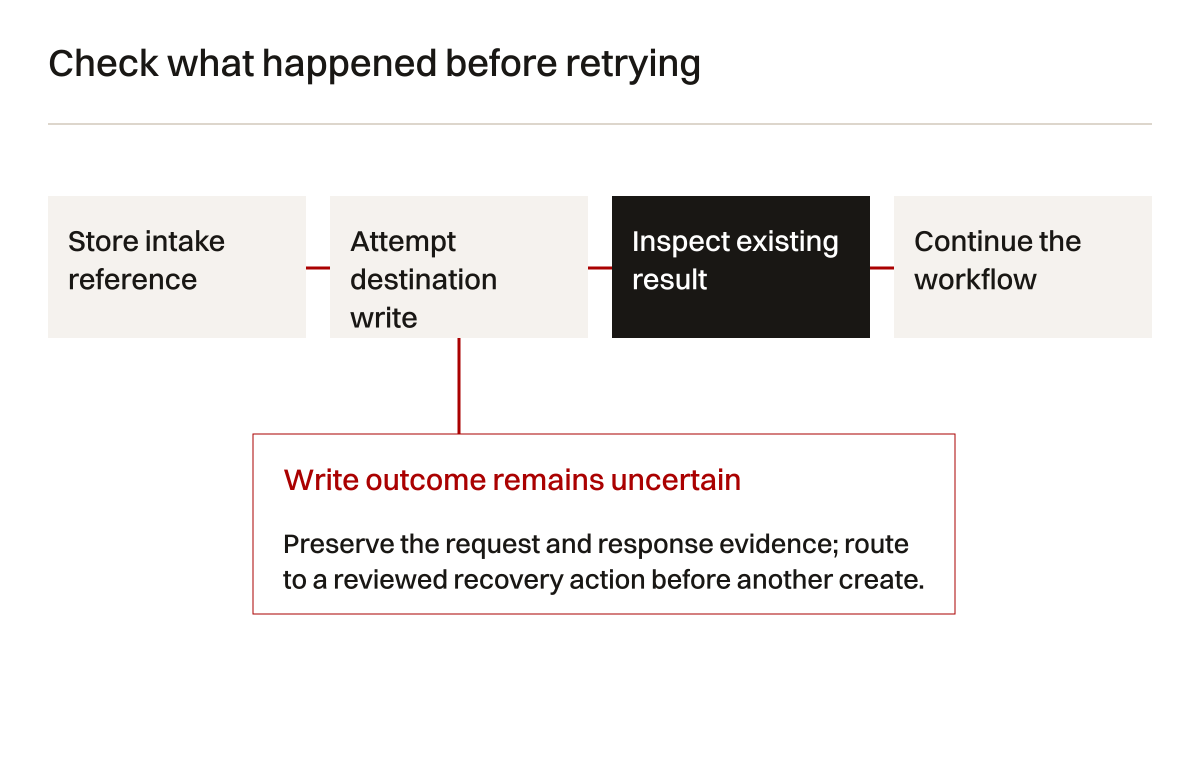
Table 3: failure handling and recovery. The action should preserve the request and avoid unsupported state changes.
| Failure | Evidence to inspect | Recovery action | Avoid |
|---|---|---|---|
| API timeout after create | Correlation and destination record | Determine existing result before retry | Blindly creating another enquiry |
| Invalid property value | Schema and response details | Correct approved mapping | Repeating identical invalid payload |
| Rate limit | Actual response and applicable limits | Pace and retry under reviewed policy | Treating the error as lost customer interest |
| Authorisation expires | Token and account state privately | Restore approved access | Publishing tokens in the log |
| Assignment unavailable | Named role and routing rules | Route to an approved fallback | Marking the request assigned to nobody |
| Notification fails | State write and delivery separately | Retain record and retry communication | Recreating the commercial record |
Test duplicate submissions as a separate business question. A visitor can submit twice because they received no clear confirmation. Two requests can also be legitimate, even when the contact and text look similar. The business needs a rule for flagging possible duplicates and a reviewer who can decide. Automatic deletion based only on matching email risks removing real work.
Keep API access and product limits visible
An integration needs authorised access to the intended account with appropriate scope. HubSpot's OAuth token guidance describes access and refresh token behaviour for that documented route. Select the current suitable authentication model for the actual app. Store sensitive material privately and define who owns future recovery.
Account capability can differ from API availability. The endpoint may exist while a feature, object or permission is unavailable under the chosen arrangement. Inspect the actual account before promising a workflow. The business should understand which task depends on a vendor capability and which can be implemented independently.
If webhooks or event journals are proposed, verify the exact API and product status. HubSpot's current webhooks journal documentation labels the described capability as beta. It is not a universal guarantee of a production-ready event mechanism for every account. A design should name its actual dependency and fallback.
Keep the integration contract readable by the business. It should say which event triggers work, which records are changed and what happens when the operation fails. Detailed secrets and code remain private, but the consequence of a missed event belongs in the operating description. A vendor diagram cannot replace that explanation.

Generated illustrative photograph. The records are not actual customer enquiries, approved quotations or evidence of a working CRM.
Control quotation versions and approval
A quotation responds to a specific set of requirements. Store that relationship. A later quantity clarification should not silently change the assumptions behind an issued document. Define whether the update creates a new draft, a new issued version or a commercial review task. The business needs an intelligible history of what was offered.
Technical review and commercial approval are different decisions. An engineer may confirm suitability while a manager approves terms. A system can record both without treating one as the other. The integration should prevent an incomplete approval from being presented as an issued quotation if that is the agreed requirement.
Record delivery separately. An approved PDF saved in the system does not establish that the customer received it. A sent email does not necessarily prove the attachment was correct. A portal download can establish a particular access event only under its actual measurement rules. Choose acceptance evidence that reflects the real delivery route.
Do not automate customer promises beyond approved scope. A receipt message can say the enquiry was received if that event is verified. It should not promise stock, technical compatibility or a response time the business has not agreed. Public form wording and private quotation workflow need the same boundaries.
Test the ordinary path and meaningful exceptions
Use a representative fictional request with a known expected result. The test should follow intake, CRM relationship, assignment, review and quotation state. Do not stop after the API returns a success code. Inspect the actual destination record and ask the working team to perform its next task.
Table 4: integration acceptance tests. Each test should retain the input reference and actual result in a private record.
| Test | Fictional input | Required outcome | Evidence owner |
|---|---|---|---|
| Ordinary intake | Valid scoped request | Request preserved and routed | Operations lead |
| Existing contact | New request from known person | New enquiry with correct contact relationship | CRM owner |
| Retry after uncertainty | Same intake reference | Correct existing or recovered record | Integration maintainer |
| Possible duplicate | Similar second submission | Reviewed handling without blind deletion | Sales coordinator |
| Unavailable owner | Request for absent role | Approved fallback and visible exception | Sales operations |
| Revised quotation | Clarified requirement | New approved version and retained history | Commercial approver |
Add a privacy review to the data flow. Know which service receives each field, who can see it and how long it is needed under the business's approved policy. This guide does not determine your legal obligations. The implementation should follow the approved requirements and seek appropriate advice where a legal question remains unresolved.
Test permissions with realistic roles. A coordinator may need to assign an enquiry but not change issued terms. A technical reviewer may need attachments but not unrelated customer records. An administrator can inspect system faults without automatically becoming the commercial approver. Keep these distinctions in the task model and actual account setup.
Measure the queue before designing a dashboard
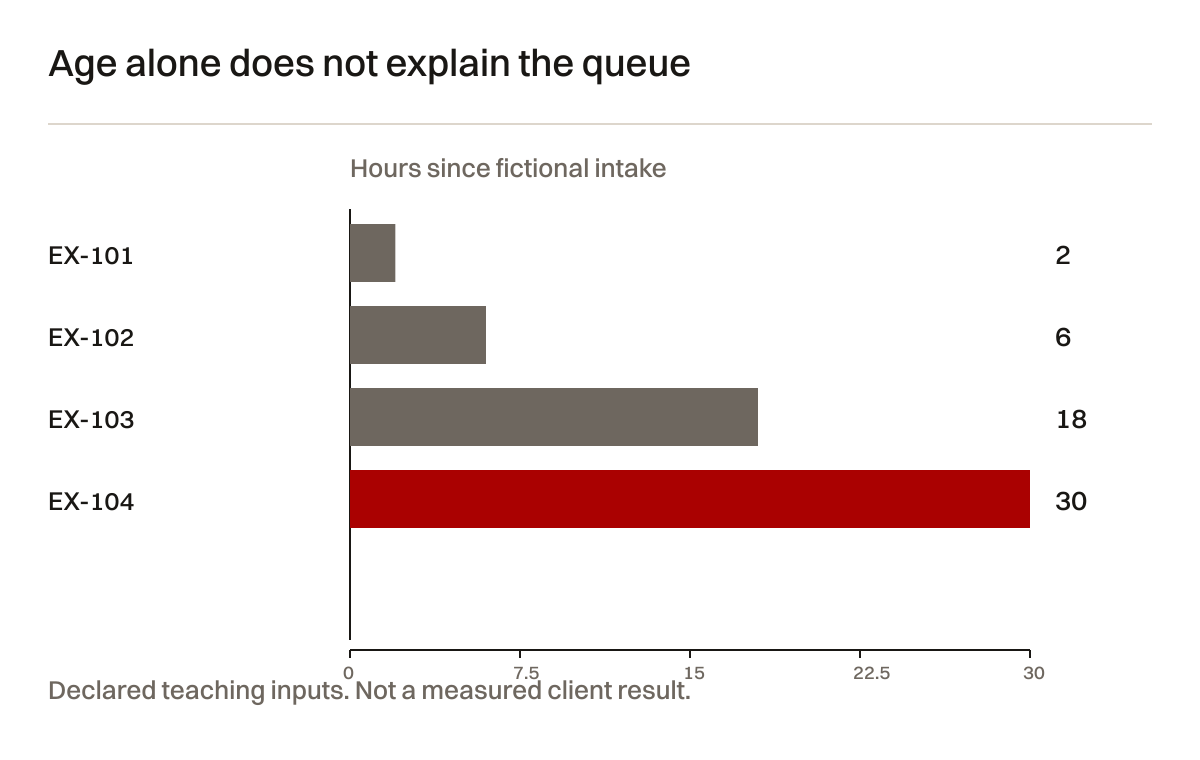
Define queue age precisely. It might be elapsed time since intake, time since assignment or time waiting for customer clarification. Those measures answer different questions. Decide the clock, timezone, exclusions and current state. A record waiting for a customer should not automatically be reported as the same operational delay as an unassigned request.
The chart uses four synthetic open enquiries at one hypothetical observation point. Their intake ages are 2, 6, 18 and 30 hours. The total is 56 hours, so the arithmetic mean is 14 hours. The ordered middle values are 6 and 18, giving a median of 12 hours. These are teaching inputs, not a client response benchmark or service commitment.
Two records might be waiting for clarification and two awaiting assignment. If those states are mixed, the average cannot tell a manager which action to take. Keep the state and responsible owner alongside the age. Do not turn the number into a performance accusation without checking the operating context.
Google's recommended analytics events distinguish events such as generating and qualifying a lead. Use the definitions appropriate to the implemented measurement. A public form event and a private CRM qualification decision are different records. Sending an event name does not prove the commercial criteria were assessed correctly.
Public website measurement concerns discovery and initial actions. The private CRM concerns operational handling and commercial progress. Protected quotation screens are not search landing pages. Search work should connect to accurate approved public services, while dashboard and integration work follows the private record model.
Assign operating ownership after release
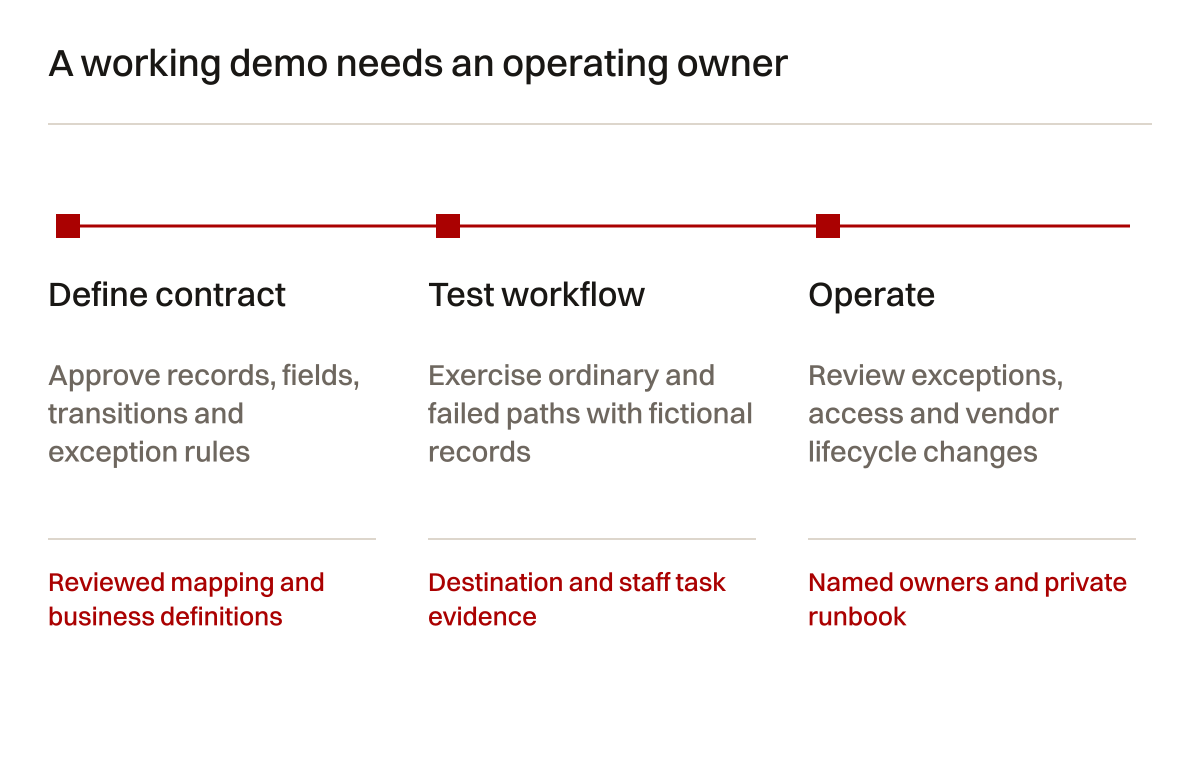
The integration needs someone to review exceptions, inspect vendor changes and maintain access. A functioning first demonstration does not establish ongoing operation. Name who handles failed writes, unavailable recipients, changed property values and quotation questions. Define which events require the business's approval rather than a silent technical workaround.
Table 5: owners and review triggers. The roles are starting points and require agreement in the actual operating model.
| Responsibility | Decision owner | Working owner | Review trigger |
|---|---|---|---|
| Intake fields | Commercial operations | Website editor and developer | Service scope or required context changes |
| Record relationships | CRM business owner | Integration maintainer | Object model or association changes |
| Qualification | Commercial lead | Sales coordinator | Fit criteria change |
| Quotation approval | Authorised approver | Commercial and technical reviewers | Requirement or terms change |
| Failed delivery | System owner | Named support role | Exception or vendor interruption |
| API access and limits | Authorised account owner | Integration maintainer | Token, account or API lifecycle change |
Keep a runbook for the most important exception. It should identify the request reference, evidence sources, permitted actions and escalation owner. A maintainer should know when to stop retrying and ask the business to resolve an ambiguous record. A sales colleague should know how to report a missing enquiry without forwarding secrets or a full private database.
Review the data model when the business changes. A second sales team, new product line or overseas quotation route may require different assignment and associations. The existing automation should not extend itself simply because new fields appear. Assess the new task, update the contract and repeat relevant acceptance tests.

Generated illustrative photograph. The interface does not represent a real deployed integration or verified customer request.
Work through a complete fictional request
The equipment supplier receives EX-104 from an existing contact. The intake service stores the original request and a stable reference. Validation confirms the model field and required description. The CRM lookup identifies the existing person. The integration creates the new enquiry under the declared model and associates the appropriate company after the business rule is satisfied.
The first downstream call times out. Recovery checks the private processing record and destination before retrying. It finds the created record and stores its ID. It does not create another opportunity. Assignment routes the enquiry to the approved coordinator. The notification is inspected separately from the CRM state.
The coordinator asks for a quantity clarification. The request retains its original payload and the current approved interpretation. The technical reviewer confirms the relevant scope. The commercial approver accepts the draft quotation. The issued version links to that reviewed requirement record and its delivery evidence is retained.
Later the customer changes the quantity. The workflow creates a reviewed new version rather than alter the already issued document silently. The previous version remains identifiable under the approved retention arrangement. The commercial report can now distinguish received, assigned, qualified and issued events with evidence instead of inferring them from a contact count.
Questions about enquiry integrations
Reconcile one uncertain write before returning the queue to normal
Suppose EX-104 is stored at intake and the contact lookup succeeds. The integration then attempts to create the commercial record. The connection closes before a response is recorded. At that point the system knows the intended request and the attempted operation, but does not know the final destination state. That uncertainty should remain visible instead of being translated automatically into “failed” or “complete”.
The recovery task first inspects the private processing log. It identifies the destination account, operation, intake reference and any available response fragment. It then checks the destination using the reviewed lookup route. If a corresponding record exists with the expected identity and context, the integration can record that result and continue under the approved rule. If several records match, a reviewer needs to resolve the ambiguity.
If no corresponding record is found, the maintainer should consider the lookup's own limits before creating again. A search index may have different freshness from direct record retrieval. A filter may be wrong. The account or association may differ from the one expected. The integration contract should name how those conditions are assessed rather than pretend that one empty search proves nothing was created.
Once the result is understood, preserve the recovery decision. Store the actual destination ID, the evidence used and the action taken. Do not rewrite the original attempt as if it had returned normally. The history explains why a record was delayed and gives the next maintainer a useful example of the exception route.
Then inspect the downstream task. Was the recovered record assigned? Did the appropriate coordinator receive a notification or find it through the queue? Did a later attempt already create another associated record? Recovery concerns the working request, not simply clearing a red error indicator. The commercial team should understand which enquiry now needs attention.
Test a requirement change after quotation approval
Use a fictional quantity clarification after the first quotation version is issued. The source record should retain the earlier interpretation and identify the new clarification. The next draft should point to the revised requirements. The commercial approver can then decide whether its terms and technical review still apply. This makes the change reviewable before another document is issued.
Ask a coordinator to locate both versions. They should be able to tell which one is current, what changed and whether the previous version remains available for its approved historical purpose. A simple filename containing “final” cannot reliably answer that task when several later files exist. A stable quotation identity and explicit version state are more useful.
Test the customer-facing route as well. If the portal shows the new draft before approval, the permission or state model is wrong. If an email points to the old file without identifying its status, the delivery task needs correction. A technically generated document is not automatically the document the customer should receive.
Keep acceptance proportional to the actual workflow. A business that issues manually reviewed quotations does not need an invented automatic-pricing demonstration. It needs reliable intake, associations, current requirements, approval and delivery. That narrower scope can be tested with evidence and understood by the people responsible for the commercial decision.
Is creating a CRM contact enough?
No. The business may need a separate enquiry identity, company relationship, assignment and current requirements. One person can make several requests. A contact record proves neither qualification nor quotation issue. Define the objects and transitions around the actual working process.
Can matching email addresses remove duplicates safely?
Email can support contact lookup under the documented API. It is not a universal rule for deleting enquiry duplicates. Two similar requests can be legitimate. Use stable intake references for retries and an approved review rule for possible repeated submissions. Preserve the original evidence until the business decision is clear.
Does an API success response prove the workflow works?
It proves a particular response under the tested conditions. Inspect the actual destination and perform the next staff task. Assignment, associations, notifications and quotation approval can fail or remain incomplete independently. Acceptance needs the evidence relevant to each stage.
Can we promise automatic quotation for every request?
Only where the business has approved the rules and exceptions and the implementation has been tested accordingly. Many technical requests require clarification and human approval. This guide uses an explicit review stage. A receipt event should not imply technical compatibility, stock or issued terms.
Is the queue-age example a response target?
No. The figures are synthetic arithmetic inputs. They demonstrate how mean and median can conceal different waiting states. Actual service commitments and operating targets require business approval and real context. Keep teaching charts separate from performance promises.
Where does SEO fit?
SEO concerns approved public pages that help buyers find and assess the business. The CRM and quotation records serve private operational tasks. A better integration can preserve enquiry context, but it does not automatically improve rankings or establish commercial growth. Review those outcomes separately.
Start with the request that gets lost
Bring the current intake route, an anonymised workflow example and the point where responsibility becomes unclear. Creatif Work's custom software work and web-app work can start from those operating requirements. The connection follows the record and its exceptions, rather than a list of tools to connect.
For public discovery and enquiry clarity, website implementation and SEO remain separate scoped responsibilities. Start with the problem.
Sources checked for this guide
Official documents checked on 4 October 2026. Several HubSpot pages redirect to current legacy or latest documentation sections. Verify the API version, account capability and beta status relevant to an actual build.