

Malaysia's 2026 Offshore Investment: What Local Engineering Firms Can Prepare

Malaysia's offshore activity outlook is a planning signal, not a list of guaranteed contracts. Local engineering firms should use it to test where their capability, capacity and evidence match expected work, then prepare for the procurement route of the relevant operator or main contractor.
The useful question is not "How big is the market?" It is "Which work packages can we deliver, with which people, assets, approvals and references?"
What should Malaysian offshore engineering firms prepare in 2026?
Prepare a package-level capability map, forecast capacity, current registrations and certifications, project evidence, HSE performance, local supply plan and a clear route for buyer qualification. Keep forecast activity separate from awarded work.
PETRONAS released its Activity Outlook 2026-2028 on 29 January 2026. It describes planned activity across Upstream, Downstream, Gas and Maritime and highlights fleet rejuvenation, lower-emission shipping, LNG and regasification, and OGSE capability in areas including carbon capture and renewables.
| Planning signal | Supplier preparation | Evidence a buyer can inspect |
|---|---|---|
| Offshore vessel demand | Vessel access, charter route and mobilisation plan | Particulars, class, availability process |
| Maintenance and projects | Trade capacity, shutdown experience and supervision | Comparable work and resource histogram |
| LNG and regasification | Applicable system and terminal capability | Standards, interfaces and references |
| Lower-emission shipping | Measured efficiency or integration work | Test basis and operating result |
| CCS and transition work | Transferable engineering scope | Named discipline, study or project evidence |
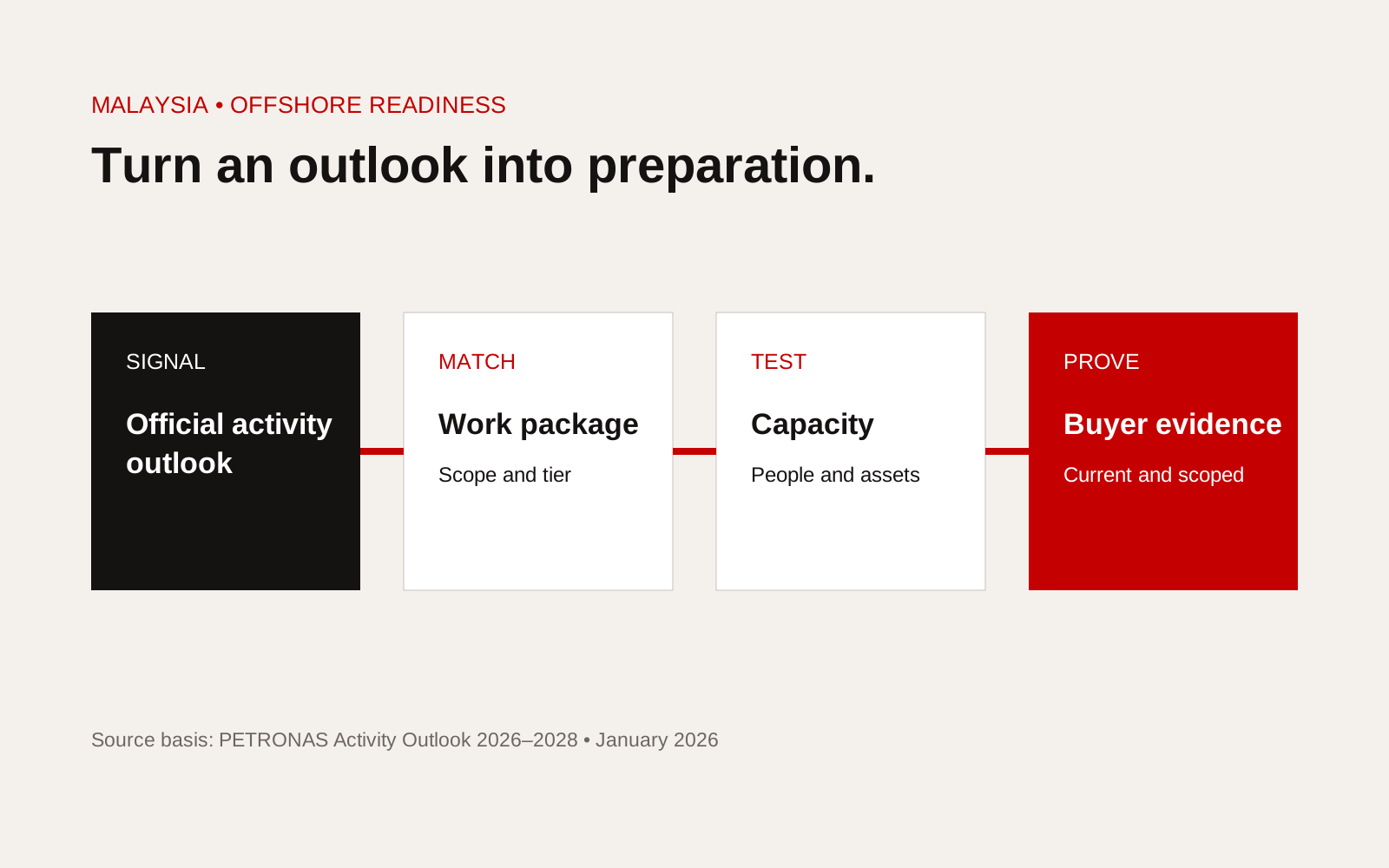
Malaysian offshore supplier readiness map linking activity outlook signals to capability, capacity, evidence and commercial preparation.
Convert the outlook into work packages
Read the official outlook by activity and timing, then map it to the services your firm can actually deliver. Avoid describing broad sector opportunity as company pipeline.
For each package, record:
- buyer and likely contracting tier
- asset, field or facility context
- technical scope and exclusions
- licences, registrations and approvals
- required people and competency
- equipment or vessel interfaces
- estimated tender and execution window
- comparable completed work
- partner or subcontractor dependency
- evidence gap and owner
PETRONAS publishes the full outlook through its supplier activity outlook page. Use the current document and procurement channels because forecasts and timing can change.
Test capacity, not only capability
A firm may have done the work before but still be unable to resource the next package. Build a capacity view for critical roles, equipment, facilities and approved vendors. Include work already committed, mobilisation, leave, training and maintenance.
Use three categories:
- Owned and available: resources controlled for the expected window.
- Contracted or reservable: resources with a clear commercial and timing route.
- Assumed: resources that still depend on recruitment, approval or partner availability.
Do not present assumed capacity as current capability in a qualification document.
Prepare evidence around the buyer's risk
An offshore buyer needs to know whether the firm can deliver the exact scope safely and recover when conditions change. A useful evidence pack connects each claim to a record.
| Claim | Better supporting evidence |
|---|---|
| Offshore experienced | Named project, asset type, scope and year |
| Strong safety culture | Defined system, responsibilities and relevant performance period |
| Fast mobilisation | Base, people, equipment, approvals and previous mobilisation example |
| Local capability | Malaysian facilities, workforce, suppliers and work performed locally |
| Integrated service | Interface and responsibility map across disciplines |
Avoid publishing client-restricted records or security-sensitive detail. State what can be supplied during qualification and who controls it.
Prepare for fleet and maritime requirements
The PETRONAS outlook includes planning information for supporting vessels and maritime activity. Vessel access alone is not enough. Record the contractual relationship, class and flag status, mission equipment, crew model, maintenance, mobilisation limits and availability process.
If a partner provides the vessel, explain responsibilities for technical management, HSE, client reporting and incident response. Buyers should not have to infer who controls the asset.
Keep transition capability specific
Terms such as energy transition, CCS and low-carbon solutions cover many different scopes. State the engineering discipline and deliverable: concept study, process design, fabrication, installation, monitoring, marine logistics or maintenance.
Do not claim a new sector capability solely because an existing skill is transferable. Explain what is directly proven, what is transferable and what still requires a partner, standard review or pilot.
Readiness checklist
- Official outlook matched to specific packages
- Forecasts kept separate from awards
- Contracting tier and buyer identified
- Current registrations and approvals checked
- People and equipment capacity time-phased
- Partner dependencies confirmed
- Comparable projects approved for use
- HSE evidence relevant to the scope
- Local content and supply chain described factually
- Evidence gaps have owners and dates
Creatif Work helps Malaysian firms make this preparation visible to regional buyers. Our marine practice organises services, assets and project evidence, while our website service turns the approved parts of a qualification pack into useful public pages. Our guide to Malaysian marine service pages gives a page-level structure for that work.