

The Maritime Singapore Master Plan: Questions Suppliers Should Ask Now
Singapore’s next maritime master plan is still being developed. Suppliers should not pretend to know the procurement programmes, grants or technical requirements before the plan is published. They can still prepare.
MPA has stated the plan’s four directions. A supplier can use them to test whether its investment case is tied to a real maritime problem, credible evidence and a route from pilot to deployment.
What is the Maritime Singapore Master Plan?
The Maritime Singapore Master Plan is an industry-wide blueprint being co-created by MPA and the Ministry of Transport for release in 2027. Its stated directions are hub competitiveness, Singapore’s International Maritime Centre, maritime innovation including AI, and a future-ready workforce. Detailed programmes are not yet the plan itself.
MPA’s current Master Plan page says the work is intended to guide business planning, investment and skills development. The plan was announced in March 2026 and is targeted for release in 2027.
That timing matters. A company can prepare evidence and partnerships now. It should not publish unsupported claims that its product is “aligned with the Master Plan” when only the strategic directions are known.
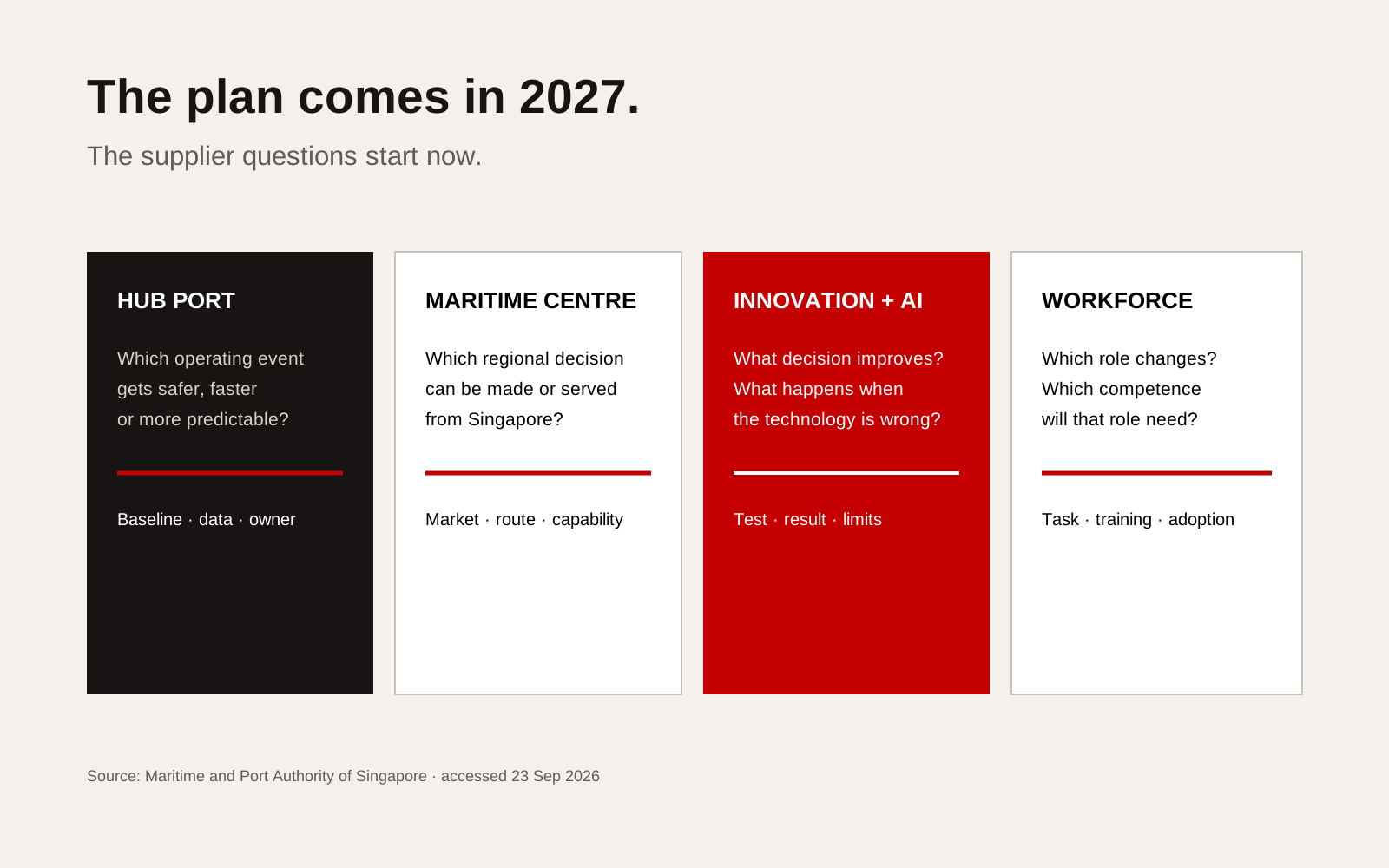
Four Maritime Singapore Master Plan priorities linked to supplier questions on customers, trials, data, skills and investment.
Turn the four directions into supplier questions
| Stated direction | Question for a supplier | Evidence worth preparing now |
|---|---|---|
| Hub-port competitiveness | Which port call, vessel or cargo task becomes safer, faster or more predictable? | Baseline process, delay or error data, integration map and operational owner |
| International Maritime Centre | Which regional or global maritime decision can be made from Singapore? | Customer segment, market route, local capability and cross-border delivery model |
| Innovation, including AI | What decision improves, and what happens when the technology is wrong? | Test protocol, data boundary, human review, result and deployment status |
| Future-ready workforce | Which role changes and what competence is required? | Task analysis, training route, adoption measure and named process owner |
The questions keep preparation grounded. They also stop every technology supplier from describing a product as innovation without showing the operating change.
Ask where the value appears
“Maritime productivity” is too broad for an investment decision. Name the event and the affected party.
Examples include:
- fewer manual handoffs during a port call;
- earlier detection of an equipment condition;
- less waiting before a berth or service attendance;
- faster review of controlled documents;
- safer inspection of a difficult location;
- a clearer exception route when shared data disagrees;
- better use of specialist staff across several assets.
Then quantify the current condition. How often does the event occur? How long does it take? What is the error or exception rate? Who pays for the delay? A pilot result has little commercial meaning without that baseline.
Separate a pilot from a deployable service
MPA and the Singapore Maritime Institute’s 2026 technology and research roadmap focuses on translating research into deployable systems. Its four action areas are autonomous port operation, safe and efficient delivery of alternative energy, smart ships, and intelligent and integrated port services.
For suppliers, the practical gap is often between a successful demonstration and repeatable delivery. Ask:
- Did the test use representative operating conditions?
- Was the baseline agreed before the test?
- Were failures and manual interventions recorded?
- Does the customer own a usable result after the project team leaves?
- Can the system connect to the required data and equipment?
- Are cybersecurity, maintenance and support responsibilities defined?
- What must change before use on a second vessel, terminal or company?
Publish the answers by stage. “Prototype”, “pilot”, “deployed” and “scaled” should not be interchangeable labels.
Build a partner map before a funding map
A grant does not create an operational owner. Start by mapping who supplies the problem, data, test environment, technical integration, safety review, commercial decision and ongoing support.
MPA’s MINT Fund evaluates factors including maritime impact, innovation, capability development, local value capture, team competence and scalability. Those criteria are useful preparation questions even where a company is not applying for that fund.
A credible partnership record names:
- the maritime company with the operating problem;
- the technology or research party;
- the person responsible for the test environment;
- the data owner and permitted uses;
- the acceptance criteria;
- the party responsible after the pilot;
- the commercial route if the result succeeds.
Prepare a small evidence room
Suppliers do not need to publish every technical file. They should be able to retrieve a controlled set:
- one-page problem and baseline;
- system and data-boundary diagram;
- pilot protocol and acceptance criteria;
- dated result summary, including failed cases;
- cybersecurity and access summary;
- implementation and support model;
- skills and training requirement;
- approved public case study;
- current product or deployment status.
This material supports customers, partners and future applications. It also gives the website facts that can be searched and understood. Our article on OCEANS-X and Singapore marine firms shows how to connect an industry initiative to specific supplier questions rather than to a generic trend page.
Creatif Work builds marine websites and evidence systems around real operating decisions. Through our website service, a Singapore supplier can publish the problem, trial and result clearly now, then update programme-specific detail when the Master Plan is released.