

OCEANS-X: What Singapore Marine Firms Need to Know

OCEANS-X is the Maritime and Port Authority of Singapore’s platform for maritime data discovery, exchange and system-to-system transactions. For a marine operator, service provider or technology firm, its importance is practical: port and vessel data can move into operational software without being copied manually between portals, spreadsheets and email.
It is not a replacement for every system a maritime company already uses. It is a common connection layer. The decision for management is therefore not “should we buy OCEANS-X?” but “which operational decision would improve if trusted maritime data reached our system earlier and in a consistent form?”
What is OCEANS-X?
MPA expands the name as Open/Common Exchange and Network Standardisation-eXchange. Its official OCEANS-X overview describes a government-to-government and government-to-business platform through which ecosystem partners can discover, access and share data in a standards-based, interoperable environment.
The platform also supports transaction flows. MPA gives port clearance as an example: a technology provider or maritime company can connect its own system to MPA services such as digitalPORT@SG and submit clearance applications through APIs. The OCEANS-X portal currently presents data categories including vessel arrivals and departures, vessels due in port, vessel information, port clearance and weather.
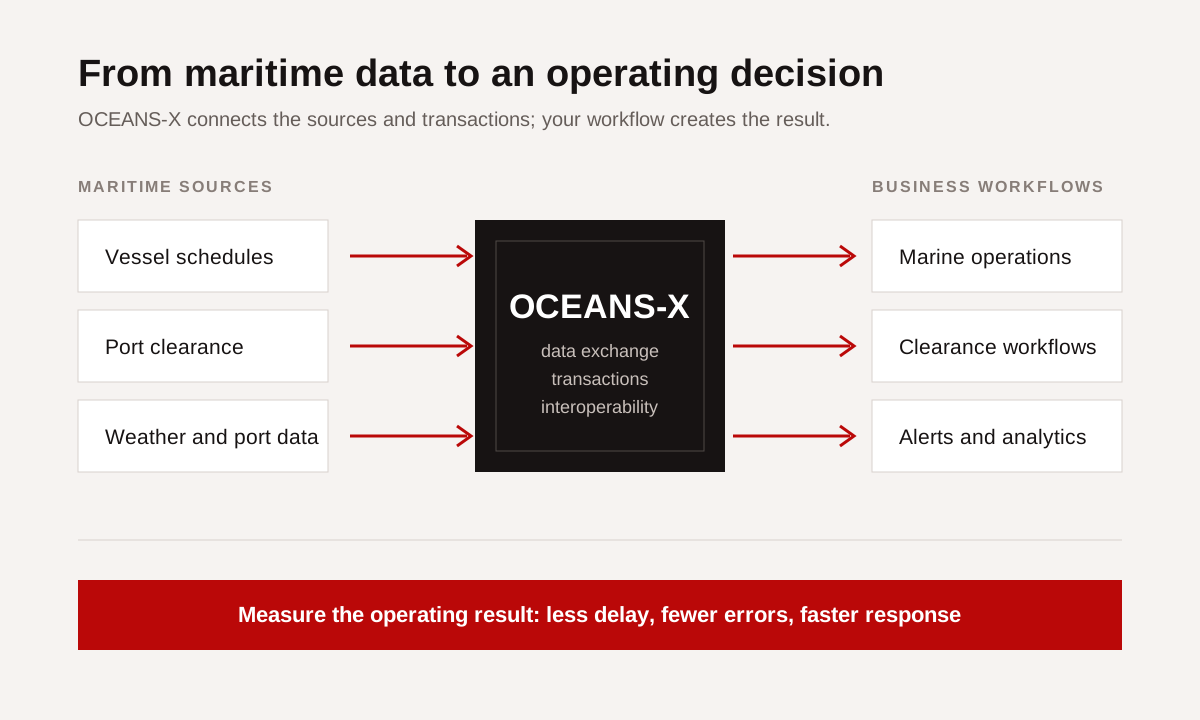
OCEANS-X is the exchange layer in the middle. A marine company still needs a defined workflow and a receiving system that can use the data.
That middle position matters. The platform can make data available and standardise access, but it does not decide what your dispatcher, superintendent, agent or commercial team should do with it. Value appears only when a data event changes an operating decision.
What can Singapore marine firms use it for?
The strongest first use cases are narrow, frequent and time-sensitive. They remove a manual check or help a team act earlier.
Port-call and service planning
A launch operator, supplier, towage provider or service engineer needs the latest vessel schedule to position people and assets. A change in estimated arrival or berthing time can affect crew transport, delivery windows, permits and the order in which jobs are handled.
MPA’s Just-In-Time platform already demonstrates this operating model. Its maritime competitiveness update says the JIT platform provides real-time vessel schedule information, helps optimise marine service schedules and had onboarded more than 150 port users after its 2024 launch for container, general cargo and bulk sectors. MPA also said it was working with ship liners and marine service providers to automate data sharing.
An OCEANS-X integration can extend the same logic into a provider’s own dispatch or job system. Instead of an employee repeatedly checking for changes, an update can flag the affected service booking, identify the responsible coordinator and preserve the change in the job record.
Port clearance workflows
Port clearance involves structured information and defined status changes, making it a natural API use case. The opportunity is not merely faster form submission. It is fewer duplicate entries, clearer exception handling and an audit trail connecting the data submitted to the internal job or voyage record.
The useful management metric is therefore not “number of API calls”. Measure time spent per clearance, correction rate, late or incomplete submissions and the number of manual handoffs.
Operational dashboards
Vessel movements, port conditions and internal job status are often viewed separately. A focused dashboard can bring together only the fields a role needs: which vessels are due, which jobs are confirmed, what changed and where a response is required.
This is not an argument for a wall of charts. The best operations screen usually answers three questions:
- What is happening now?
- What changed since the last check?
- What needs a person to act?
Everything else can remain in the source system until it is needed.
Cross-border and corridor services
MPA also positions OCEANS-X as infrastructure for cross-border data exchange and Green and Digital Shipping Corridors. That creates longer-term opportunities for software firms, owners, agents and service networks operating across more than one port.
The commercial case should still begin locally. Prove one repeatable workflow in Singapore, document its data contract and exception handling, then assess whether the same service can travel. International scale built on inconsistent local data simply moves the inconsistency faster.
Who should own an OCEANS-X project?
The sponsor should own the operating outcome, not only the technology budget. Depending on the use case, that may be the head of operations, port agency lead, fleet manager or commercial director. IT should own the technical controls and integration quality, but it cannot define whether a vessel update is operationally urgent.
A compact project team needs four named responsibilities:
- Process owner: defines the decision and the acceptable response time.
- Data owner: confirms which fields are authoritative and who may use them.
- Technical owner: manages authentication, integration, logging and recovery.
- Front-line user: tests whether the workflow works under real operating pressure.
If any one is missing, the project tends to become either a technically sound integration nobody uses or an attractive interface with unreliable data beneath it.
What should you prepare before integrating?
Start with a decision, not a dataset
“We want vessel data” is too broad. “When the estimated berthing time changes by more than 30 minutes, alert the coordinator and recalculate the service window” is buildable. It names the event, threshold, user and action.
Write five candidate decisions in that form. Score each by frequency, cost of delay, data availability and implementation effort. The highest-value low-complexity case should be the pilot.
Map the source of truth
For every field, state which system is authoritative. Vessel identity, estimated arrival, customer instruction, service booking status and invoice status may come from different places. Decide what happens when two sources disagree and which changes may overwrite an internal record.
This is data governance in plain language. It matters more than the choice of dashboard framework.
Design for exceptions
Marine operations do not follow a perfect happy path. A schedule changes, connectivity drops, a vessel is substituted, a job is cancelled or a required field arrives blank. Every automation needs a visible failure state and a route back to manual control.
The pilot specification should include:
- stale-data and unavailable-service behaviour;
- duplicate and conflicting record handling;
- manual override authority;
- notification and escalation rules;
- retry and recovery logic; and
- an audit log a manager can understand.
Put cyber risk inside the workflow
Connecting systems creates value and expands the trust boundary. The International Maritime Organization’s maritime cyber risk guidance places cyber risk within safety management, while the UK Department for Transport’s cyber security code of practice for ships covers assessment, resilience, incident handling and recovery.
For an OCEANS-X integration, that means least-privilege access, protected credentials, logged transactions, tested revocation and a documented fallback if an external connection is unavailable. Do not give a dashboard write access when it only needs to read. Do not leave a former vendor’s credential live after handover.
Security claims should be precise. “Enterprise-grade security” says nothing. State where data is stored, which roles can see it, how access is removed and how long logs are retained.
Build, buy or connect what you already have?
Use the smallest intervention that can deliver the operating result.
Configure an existing system when your current marine, fleet or ERP software already supports the required integration and workflow. This is usually the lowest-risk route.
Add a focused connector when the core system is sound but needs data from OCEANS-X or a small approval layer. A connector can be less disruptive than replacing the application teams already know.
Build a custom operational tool when the workflow is genuinely specific, crosses several systems or creates a service the company intends to sell. The case for custom software is strongest when the process itself differentiates the business, not when a standard product already handles it well.
Our custom software service uses the same test: begin with the decision, data and exception path, then build only the interface needed to run it. The free file converter is a much smaller example of the principle: one clear job, handled locally, without unnecessary account or history layers.
A sensible 90-day pilot
Days 1–15: define. Select one decision, document the current workflow and baseline the time, errors and delays it creates.
Days 16–30: verify. Confirm data access, field definitions, usage conditions, security controls and the internal source of truth.
Days 31–60: connect. Build the smallest working flow, including exception states, logs and manual fallback. Test it with historical and live scenarios.
Days 61–75: operate. Put it in front of the actual coordinator or operations team. Watch how it is used during schedule changes, not only during a demonstration.
Days 76–90: decide. Compare the result with the baseline. Expand only if it reduced a meaningful cost, delay or risk and the team trusts the data.
How to explain the capability to buyers and partners
If the integration becomes part of the service, publish the operational result rather than the architecture diagram alone. Say what data enters the workflow, what decision it improves, what the fallback is and what the customer can expect.
That makes the capability legible to a superintendent, principal or technology partner who will never see the code. It follows the same discipline as a good vessel or equipment page: state the parameters a knowledgeable buyer is comparing. Our guide to selling from Singapore to overseas buyers explains the wider evidence those readers need, and the Creatif Work marine practice shows how to organise it around fleet, class, completed work and a clear response route.
OCEANS-X creates access to trusted maritime data. Turning that access into a dependable service is a product and operations problem. If your team has a workflow worth connecting but not yet a clear system brief, talk to Creatif Work. We can map the decision, prototype the smallest useful tool and build the public explanation alongside the operational product.