

From Prototype to Production: A Better Innovation Case Study
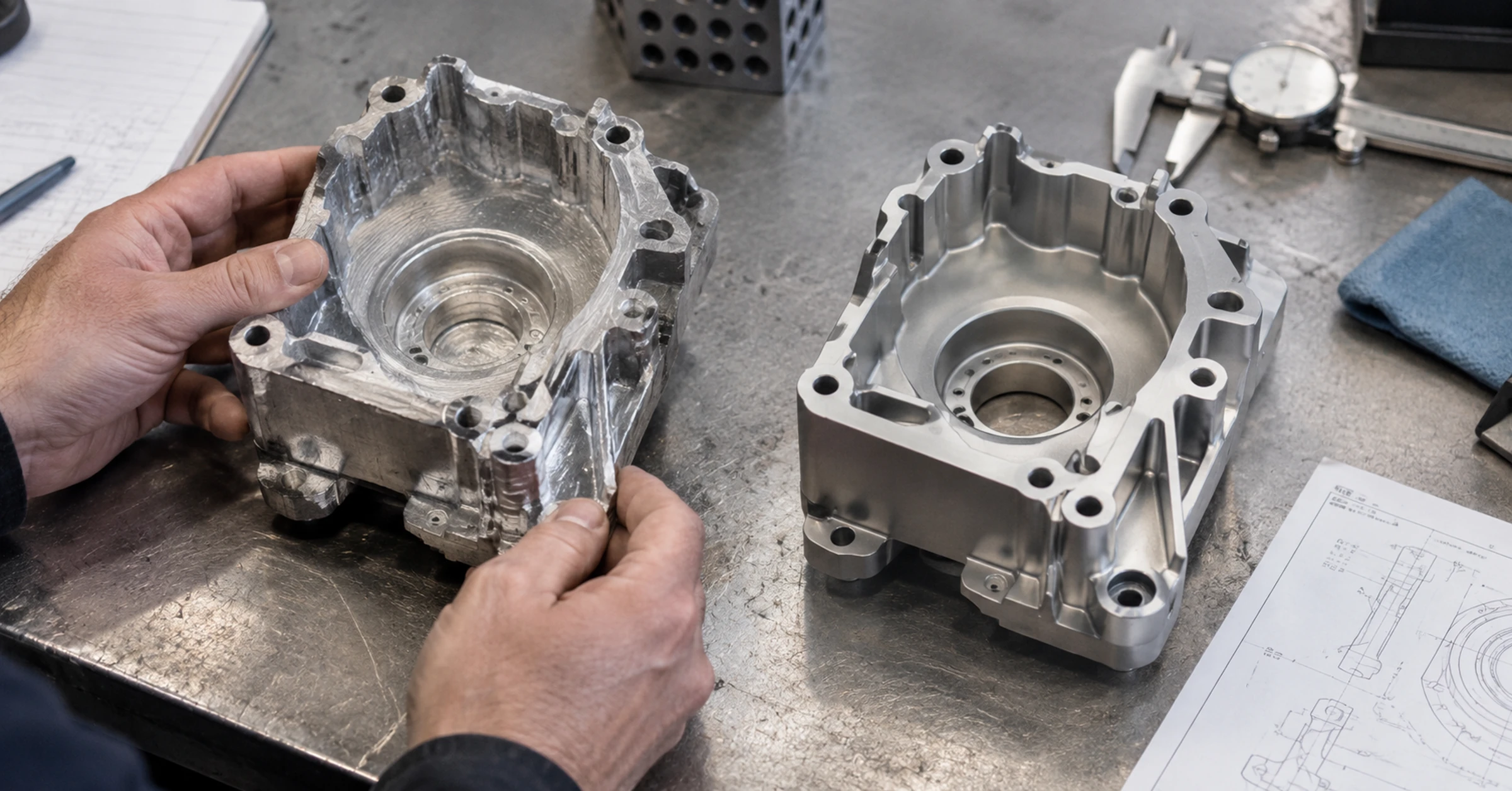
An innovation case study should show the starting hypothesis, prototype configuration, test conditions, measured result, failed assumptions, production changes and remaining limits. That sequence is more useful than calling a prototype successful.
That sounds simple, but most weak pages fail because they mix fact, aspiration and sales language. The useful task is to separate them, assign an owner and show the reader what can be checked now.
What should the page say first?
An innovation case study should show the starting hypothesis, prototype configuration, test conditions, measured result, failed assumptions, production changes and remaining limits. That sequence is more useful than calling a prototype successful. Put that answer near the top, then provide the evidence in the same order a technical or commercial reviewer would use it.
The official France 2030 maturation guidance material addresses maturation, technology transfer and industrialisation. It is a useful reference point, but a supplier still needs to explain how the requirement applies to its own product, project or service. A badge or link does not make that connection for the reader.
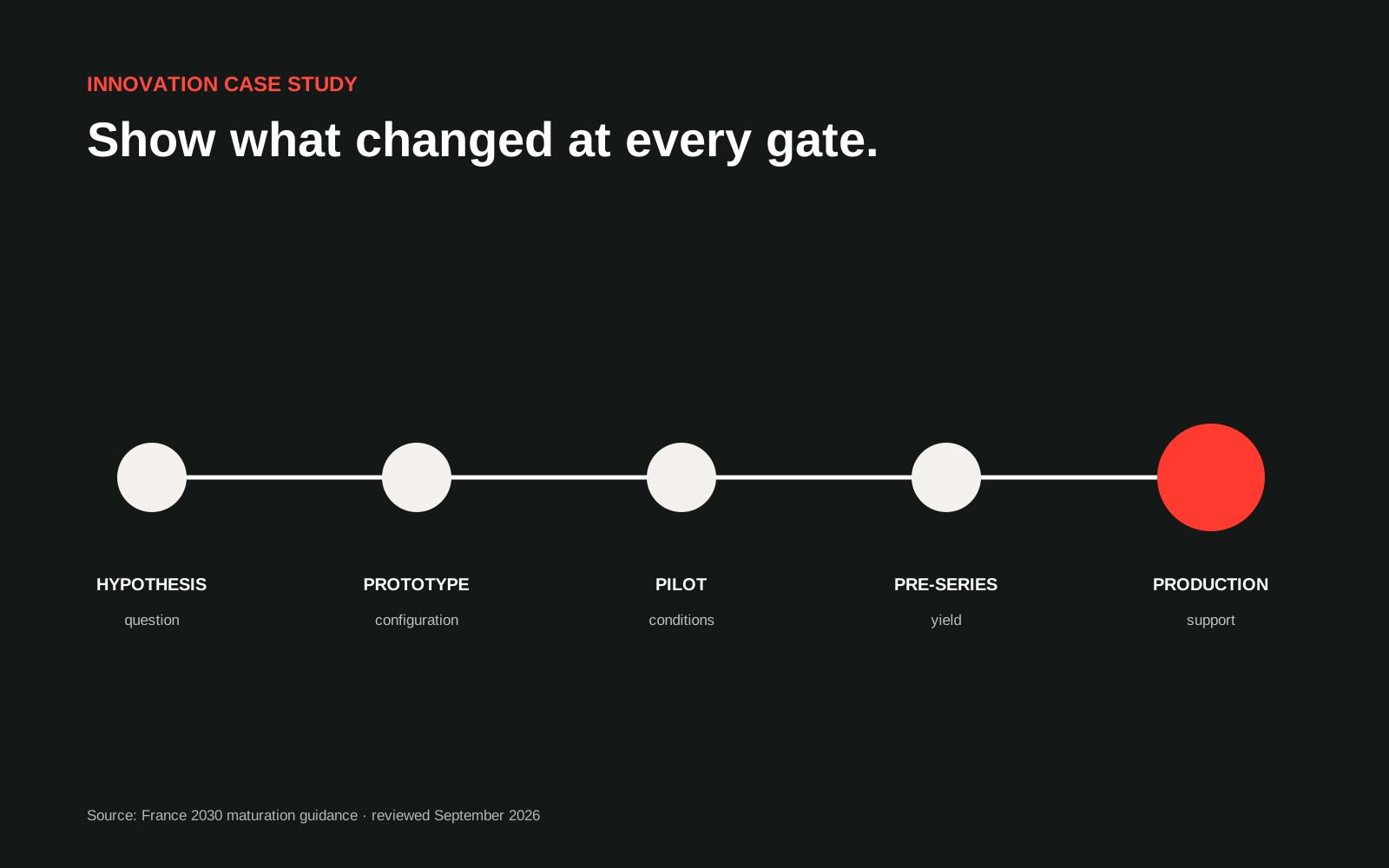
Editorial decision map for From Prototype to Production: A Better Innovation Case Study.
Build the evidence in decision order
| Stage | Question | Evidence | Publication note |
|---|---|---|---|
| Prototype | Can the principle work? | Configuration and test record | Name the conditions |
| Pilot | Can it work with real interfaces? | Integration results | Name exceptions |
| Pre-series | Can it be repeated? | Yield and quality controls | Use ranges |
| Production | Can it be supplied and supported? | Process and service evidence | Date the claim |
This table can become the publishing brief. Each row should have a named source, a responsible owner and a review date. If a claim changes by product variant, location or contract, keep that scope beside the claim.
Separate four types of statement
Start with observed facts. These include a measured result, accepted deliverable, issued document or completed activity. State the method and date where they affect interpretation.
Then identify professional judgement. Judgement is valuable, but label it as a conclusion and show the evidence behind it. Do not present an engineer's view as if it were a standard or a test result.
Next, state commitments. A planned trial, target or service response is not an achieved result. Name the condition, responsible party and point at which the commitment will be reviewed.
Finally, state limits. Limits can include an untested environment, excluded interface, geographic boundary, client restriction or pending approval. A clear limit makes the proven part of the claim stronger.
Use a compact evidence record
For every important claim, record:
- the exact wording that may be published;
- the underlying report, test, certificate or acceptance record;
- the product, project, location and period covered;
- the person authorised to approve the wording;
- the next review date and trigger for an earlier review;
- the public contact who can answer a qualified follow-up.
This is more reliable than copying old proposal text into a new page. It also makes later updates faster because the team knows where the statement came from.
Design for two reading speeds
A senior buyer may scan the page in under a minute. A technical reviewer may spend much longer checking scope and documents. Serve both.
The first screen should contain the decision, the relevant scope and one strong item of proof. A structured table or diagram can then show how the parts connect. Detailed evidence, downloads and references can follow. Keep important facts as readable page text instead of hiding them only in images or PDFs.
Use descriptive headings that match real questions. “What was tested?”, “Where does this apply?” and “What happens next?” are stronger than “Our excellence” or “Our approach”. They also give search engines and AI systems clearer passages to interpret.
Make uncertainty useful
Uncertainty is not an apology. It tells a partner what work remains.
Use a short format:
- Proven: what the evidence supports now.
- Not yet proven: the condition, scale or interface outside that evidence.
- Next test: the activity that will reduce the uncertainty.
- Decision after the test: what the result will allow the team to approve, change or stop.
This format helps a funder, buyer or project partner understand why the next step matters. It also prevents a later case study from contradicting the original page.
Check the page before release
Ask a reviewer who was not involved in drafting to answer these questions:
- Can they identify the exact product, project or service being described?
- Can they tell which statements are measured and which are planned?
- Is every date-sensitive document current?
- Are units, definitions and baselines visible?
- Does the published result include the test or operating conditions?
- Are commercial, security and client restrictions respected?
- Is there a clear next step for a qualified reader?
- Could a colleague update the page without guessing who owns the evidence?
If any answer is no, fix the evidence structure before polishing the language.
Connect the page to the rest of the website
The article or project page should not sit alone. Link it to the relevant engineering capability, a detailed website or content service, and the most relevant project evidence. Use specific link labels so the reader knows what they will find.
If the topic will change, add it to a review rhythm. Our SEO and AI visibility service can help turn source material into maintained pages and connected technical articles, rather than a one-off publishing exercise.
Source and scope note
This article uses France 2030 maturation guidance as the primary external reference. Check the live source, contract documents and competent authority guidance before making a compliance or procurement decision. The table above is an editorial and evidence-management tool, not a substitute for formal assessment.
What should happen next?
Choose one live claim that matters to a current buyer. Find the underlying evidence, narrow the wording until it matches that evidence, and publish it with the scope and review date. Then connect it to the service or product page where the decision begins.
Creatif Work designs evidence-led websites and content systems for engineering, construction and marine firms. If useful proof is scattered across proposals, reports and staff knowledge, start with a diagnostic or contact us to map a practical publishing structure.