

Before and After Data for an Industrial Retrofit Case Study

A credible industrial retrofit case study explains what changed and how the result was measured. Two utility bills and a percentage are rarely enough. The reader needs to know whether production, product mix, weather, operating hours or system boundaries also changed.
The aim is not to turn a project page into an audit report. It is to publish the smallest set of facts that lets a technical buyer judge whether the result might transfer to another plant.
What before-and-after data should a retrofit case study include?
Include the same system boundary, comparable operating periods, production or load data, energy by carrier, relevant adjustment variables, the installed change and the verification method. State whether the result is measured, calculated or estimated.
| Evidence block | Before | After | Note to publish |
|---|---|---|---|
| Boundary | Equipment and loads included | Same boundary, with additions stated | A diagram is often clearer than prose |
| Period | Dates and operating hours | Dates and operating hours | Explain why the periods are comparable |
| Output | Units, tonnes, batches or load | Same production measure | Show normalised as well as total energy |
| Energy | Electricity, gas, steam or fuel | Same carriers and meters | State meter source and interval |
| Conditions | Setpoints, weather, product mix | Changed conditions | Explain adjustments, not only the formula |
| Result | Baseline value | Verified value | Label measured, adjusted or projected |
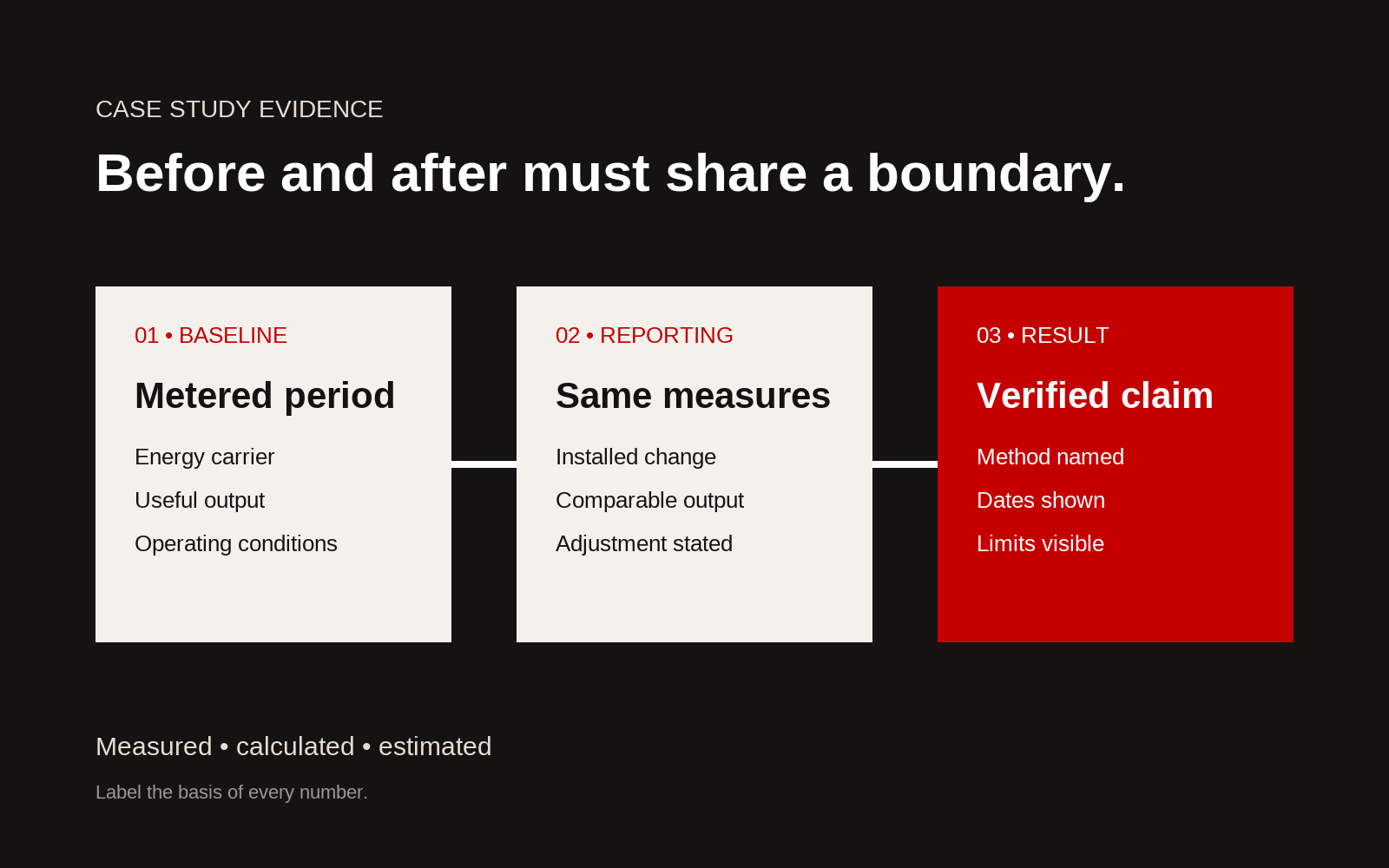
Before-and-after industrial retrofit evidence sheet comparing boundary, output, energy use and verification.
Start with one defensible claim
Choose the main result before assembling images and quotes. It might be lower electricity per tonne, reduced gas per batch, fewer compressor run hours or recovered heat used elsewhere. Do not combine several unrelated improvements into one number.
A strong claim follows this pattern:
For the defined system and comparison periods, measured energy per unit of output changed from X to Y after the retrofit, using the stated normalisation method.
If the result is an engineering estimate because the monitoring period is incomplete, say so. A precise estimate is not the same as a measured outcome.
Draw the boundary
Retrofit evidence becomes confusing when the baseline measures one area and the post-project result measures another. Create a simple system diagram showing:
- incoming energy meters
- equipment included in the calculation
- useful output or process demand
- recovered energy crossing the boundary
- excluded loads
- temporary or backup equipment
Germany's BAFA guidance for energy and resource efficiency uses a savings concept to describe the existing and proposed situation for relevant projects. The current BAFA Module 4 guidance is a useful official reference for the discipline of documenting an efficiency measure, although a public case study is not a funding application.
Make periods comparable
Before-and-after periods do not have to be identical, but differences must be visible. Record operating hours, output, product mix, setpoints, maintenance status and weather where it affects demand.
Use both total and normalised figures when each answers a different question. Total energy shows the bill and emissions effect for the period. Energy per unit shows process performance. If output fell sharply, a lower total does not prove improved efficiency.
A practical data table
| Metric | Baseline period | Reporting period | Adjustment |
|---|---|---|---|
| Operating hours | Record actual | Record actual | Explain planned downtime |
| Useful output | Record actual | Record actual | Normalise where appropriate |
| Electricity | Metered | Metered | State meter and losses |
| Fuel or heat | Metered or reconciled | Same method | State conversion factors |
| Key process condition | Recorded | Recorded | Adjust only with a stated basis |
Do not invent a clean dataset after the project. If the baseline is weak, make that limitation part of the case study and explain what monitoring was added for future work.
Separate implementation from outcome
Buyers also want to know whether the project could be delivered in their plant. Include the shutdown window, controls integration, commissioning stages and any temporary arrangement that protected production.
A clear project story has four parts:
- Starting condition: the equipment, constraint and evidence available.
- Decision: why this intervention was selected over alternatives.
- Delivery: interfaces, downtime, commissioning and operator involvement.
- Outcome: measured result, period, method and remaining uncertainty.
Photos should serve these parts. A polished equipment shot is less useful than a labelled image of the installation boundary, meter or control change.
Review claims before publication
Give engineering, operations and the client a compact approval sheet containing every numerical claim, its source and the exact wording proposed for publication. Remove client-sensitive data and security detail, but do not remove so much context that the number becomes misleading.
Publication checklist
- Client permission and approved naming
- One main claim with a source owner
- Boundary is the same before and after
- Dates and operating conditions stated
- Output or load is included where relevant
- Measured, calculated and estimated values labelled
- Units and conversion factors checked
- Limitations stated beside the result
- Images do not expose controlled information
- Technical reviewer and approval date recorded
A case study should shorten the next buyer's technical conversation. Our article on engineering project pages for international buyers explains the wider evidence structure. Creatif Work builds engineering websites and website systems where project facts can be maintained once and connected to the services they prove. That is more useful than a gallery of finished equipment with no measurable outcome.