

How to Publish Verified Marine Performance Without Overstating It

A verified result can still be overstated. Verification may cover one voyage, meter, calculation or reporting period. It does not automatically prove every vessel, operating condition or future saving.
The publication task is to preserve the boundary that made the result true.
How should a marine performance result be published?
State the asset, operating condition, baseline, intervention, measurement period, unit, method, exclusions and verification status. Name what the verifier checked. Do not turn a verified data point into a fleet-wide claim or a measured reduction into a guaranteed future outcome.
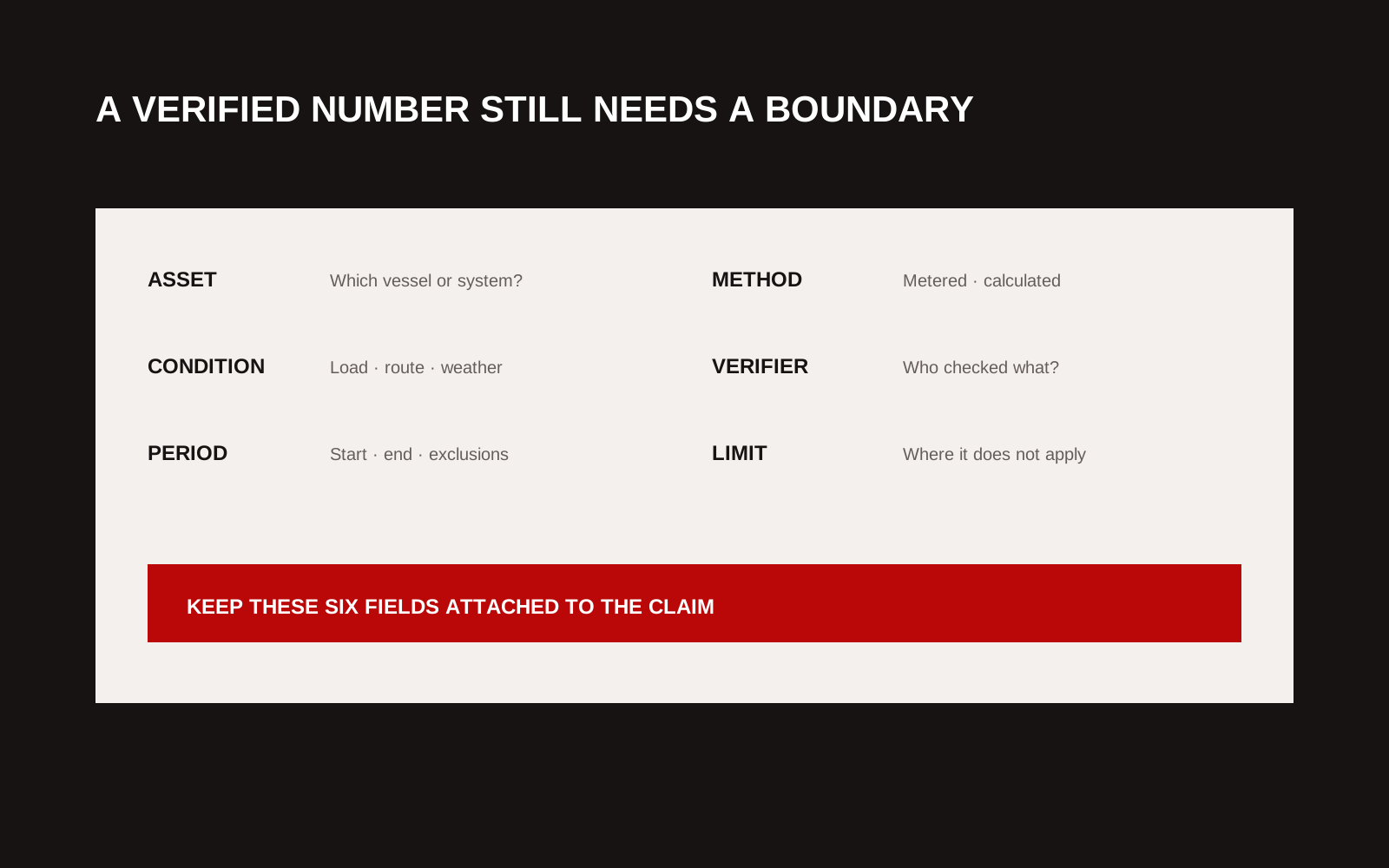
Marine performance claim template showing baseline, method, boundary, verifier and limitation.
Use a claim record before writing copy
| Claim field | Question to answer |
|---|---|
| Asset | Which vessel, system or equipment? |
| Baseline | Compared with what period or configuration? |
| Intervention | What changed, and who controlled it? |
| Condition | Load, route, weather, fuel or operating mode? |
| Period | How long was the result observed? |
| Method | Metered, calculated, modelled or estimated? |
| Verification | Who checked what and against which criteria? |
| Limit | Where should the result not be applied? |
If the team cannot complete the record, the claim is not ready to publish.
Distinguish four evidence states
Use consistent labels across case studies and product pages:
- modelled: calculated before or outside operation;
- tested: measured under a defined trial or test condition;
- operational: observed during normal use over a stated period; and
- verified: checked by a named independent or authorised party against a stated scope.
“Verified” should never appear alone. A classification society, verifier, client engineer and internal quality manager may all check different things.
FuelEU Maritime places formal responsibilities on shipping companies and accredited verifiers. The regulation requires monitoring, reporting and verification of defined vessel information. A supplier's verified equipment result may support that process, but it is not automatically a verified FuelEU outcome.
Write the result in one auditable sentence
Use this structure:
For [asset and condition], [intervention] produced [result and unit] against [baseline] during [period], measured by [method]. [Verifier] checked [scope]. The result excludes [material exclusions].
If a client will not approve the number, publish the method and decision instead. For example, explain that the trial confirmed a control response within the agreed acceptance range without disclosing the proprietary threshold.
Do not remove inconvenient conditions
Weather, load, route, hull condition, fuel and crew practice can affect marine results. Include the material conditions used to normalise or interpret the data. If no normalisation was performed, state that.
Avoid these shifts:
| Evidence says | Overstatement says |
|---|---|
| Trial result on one vessel | Proven fleet saving |
| Modelled annual reduction | Annual reduction achieved |
| Equipment energy use | Total vessel efficiency |
| Verified meter accuracy | Verified emissions reduction |
| Result within test range | Works in all operating conditions |
Show the verification route
Readers should be able to understand the chain without seeing confidential records.
- Name the primary data source.
- State the calculation or comparison method.
- Identify quality checks and corrections.
- Name the verifier and scope, where publication is permitted.
- Give the issue or verification date.
- State where the controlled report is held.
The FuelEU verification implementing regulation describes the importance of tracing data from primary source to report. The same discipline makes a public case study stronger even when the project is outside FuelEU.
Give marketing an approval workflow
Technical claims often become broader as they move from a report to a sales deck, website and social post. Use one approved claim record as the source. Require technical review when the sentence, number, graphic or context changes.
A simple release check covers:
- source record attached;
- client permission recorded;
- units and dates checked;
- verification scope retained;
- exclusions visible near the claim;
- image and caption approved; and
- page owner and next review date assigned.
Archive superseded claims rather than copying them into new pages.
Make the page useful to procurement
Give the buyer the result, method, operating boundary and next technical document. Do not bury the evidence under a long company introduction. Provide a named enquiry route for the current report or product data.
Our article on UK maritime emissions evidence gives a related page structure. The marine sector page shows how project, capability and operational proof can work together.
Creatif Work builds marine content systems that keep technical boundaries intact from source record to public page. If the result is credible but the current copy goes further than the evidence, start with the problem.
Audit the claim after publication
Claims change context when they are copied into presentations, distributor pages and short social posts. Search for the exact result sentence after release and record where it appears. Check that the asset, period, method and limitation travelled with the number.
Assign a claim identifier and expiry or review date. If a later operating period gives a different result, do not overwrite the original case silently. Update the page with the new period or archive the earlier statement with its original context.
Create a correction route for technical staff, customers and partners. The route should reach someone able to pause the claim while evidence is reviewed. Keep the original text, correction decision and publication date in the content record.
Review translations separately. Units, decimal conventions and words such as “verified”, “certified” and “approved” may acquire a broader meaning when translated. A bilingual technical reviewer should confirm the final statement. The objective is not cautious copy for its own sake. It is a result that a buyer can repeat without turning it into something the underlying evidence never proved.