

Regional Construction Careers Pages That Answer Practical Questions

“Join our team” is not enough for someone deciding whether to move, drive or fly to a regional project. The candidate needs to understand the work, roster, location, duration and living arrangement before investing time in an application.
The careers page should reduce uncertainty. It should also stop recruiters from answering the same basic questions in every first call.
What should a regional construction careers page answer?
Answer where the role is based, whether travel is required, the roster, expected project duration, accommodation arrangement, licence or ticket requirements, site conditions, reporting line and recruitment stages. State which details vary by project and confirm them again in the job listing.
Infrastructure Australia's 2025 Market Capacity Report forecast that regional infrastructure workforce shortages could rise sharply towards 2027. A careers page will not solve that shortage. It can prevent avoidable candidate drop-off and help the right people assess the role earlier.
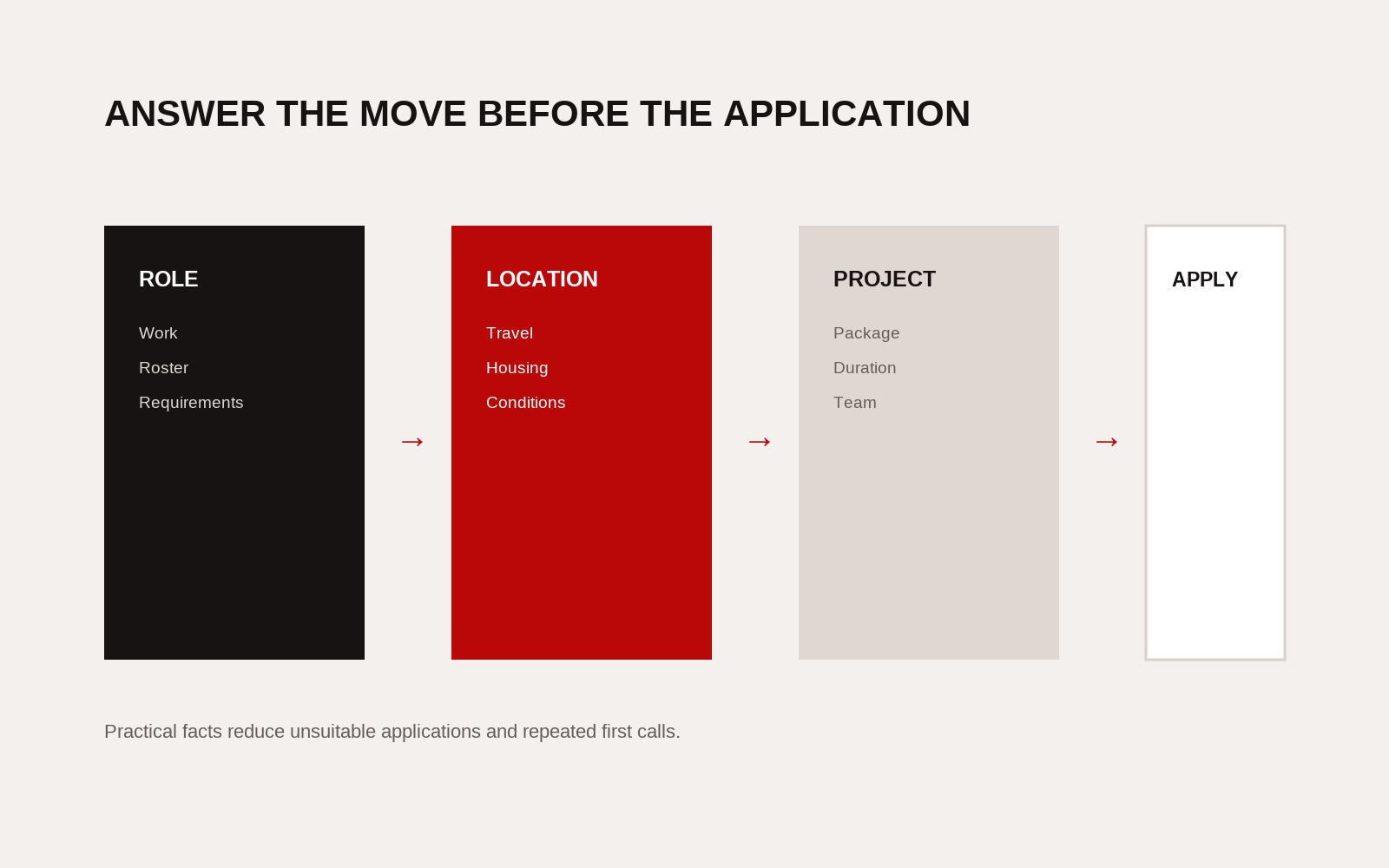
Candidate journey map for an Australian regional construction careers page.
Use three levels of information
| Level | Purpose | Example content |
|---|---|---|
| Company careers page | Explains the employment model | Regions, disciplines, safety, development, general recruitment process |
| Location page | Explains the practical place | Travel routes, climate, housing approach, nearby services |
| Job page | States the offer | Roster, dates, duties, requirements, employment type and contact |
Do not repeat the same generic paragraph across every location. If the practical arrangements are identical, maintain one central explanation and link to it. If they differ, make the differences explicit.
Put the hard facts first
Candidates should not have to pass a values statement before finding the location. Use a summary panel at the top of each role:
- work location and nearest town;
- employment type;
- roster and shift pattern;
- travel arrangement;
- accommodation arrangement;
- expected start and project period;
- required licences or tickets;
- physical or environmental conditions; and
- closing date and recruitment contact.
If accommodation or travel is still being finalised, say so. Do not use “provided” without explaining what that means and who pays.
Show the work properly
Candidates want to know what they will build or maintain. Describe the package, project stage, equipment and interfaces. Explain whether the role is site-based, office-based or mixed. Use real project photographs only with approval and accurate captions.
An engineer may want design authority, software and assurance details. A supervisor may need crew size, work fronts and reporting lines. A tradesperson needs tools, tickets, shifts and conditions. Create role-family pages only when they can answer those differences.
Jobs and Skills Australia's NERO tool can help teams understand regional occupation patterns. Use the data for planning, not to make unsupported claims about a particular vacancy.
Make progression concrete
“Career growth” does not explain a route. Show examples:
| Starting point | Next responsibility | Evidence required |
|---|---|---|
| Graduate engineer | Own a defined work package | Competency record and supervised delivery |
| Site engineer | Coordinate several work fronts | Programme, quality and interface performance |
| Leading hand | Supervise a crew | Trade competence and leadership evidence |
| Supervisor | Plan and assure a package | Safety, quality and production records |
| Project support | Own a reporting process | Accuracy, timeliness and stakeholder feedback |
These are example structures. Publish only routes the company actually supports.
Explain the recruitment process
A visible process reduces uncertainty and helps candidates spot fraud. State the stages, expected contact channel and whether medicals, checks or assessments apply. Tell applicants that the company will not ask for payment.
A practical sequence might be:
- application reviewed against stated requirements;
- short call about role and location;
- technical or hiring-manager interview;
- checks and evidence review;
- written offer; and
- mobilisation information.
Give candidates a route to request an adjustment. Make forms usable on a phone and allow a CV upload format that works without specialist software.
Keep the page current
An old regional role damages trust quickly. Each listing needs an owner, closing rule and archive behaviour. Remove expired jobs from the active index, but preserve a clear expired status if external links still point to the page.
Review quarterly:
- location and project information;
- roster and travel wording;
- licences and role requirements;
- recruiter contact details;
- employee stories and consent;
- accessibility of forms; and
- analytics from page visit to completed application.
Do not measure only applications. Track suitable applications, interview acceptance and drop-off after practical conditions are discussed.
The construction sector page shows how project proof and company capability can support recruitment as well as procurement. Our website service can structure role, location and project information so candidates can make a practical decision. If the recruitment team is explaining the same facts repeatedly, start with the problem.
Check the page with people who made the move
Interview recent hires who relocated or started a regional roster. Ask what they needed to know before accepting, which detail arrived too late and which part of the listing was unclear. Speak separately with someone who declined after the first call. Their reason may reveal a missing fact rather than a weak employer brand.
Use those interviews to improve the page, but do not turn employees into scripted endorsements. A useful story can state the role, project type, travel pattern, living arrangement and what the person wishes they had known. Obtain consent and let the employee approve the final wording.
Recruitment and project teams should sign off practical conditions. Marketing owns readability, not the truth of a roster or allowance. Add a “last checked” date to location information and connect every active vacancy to the same approved source. If arrangements change after an applicant has applied, communicate the change directly rather than relying on a page update.