

Australia's Infrastructure Workforce Peak: What Contractors Can Prepare

The workforce peak is not only a recruitment problem. It affects bid capacity, programme risk, supervision, accommodation, subcontractor availability and the evidence a contractor must show before a client trusts the resourcing plan.
Infrastructure Australia's 2025 Market Capacity Report gives contractors a planning signal. It estimated the infrastructure workforce at 204,000 in October 2025 and a shortage of 141,000. Total workforce demand was forecast to reach 521,000 in mid-2027, with the shortage potentially approaching 300,000.
What should contractors prepare before the workforce peak?
Contractors should prepare a role-by-role demand forecast, critical-skill alternatives, regional mobilisation assumptions, supervisor ratios, subcontractor commitments and evidence for retention and training. The resourcing plan should be linked to the programme and reviewed whenever project timing or location changes.
The official 2025 Infrastructure Market Capacity Report found that regional shortages could rise from 38,200 in October 2025 to 181,000 in 2027. It also reported that 63 per cent of surveyed firms saw labour costs and 59 per cent saw skill shortages as a substantial threat to business growth.
These are national forecasts, not a rate card for one tender. A contractor still needs a local plan by occupation, project stage and region.
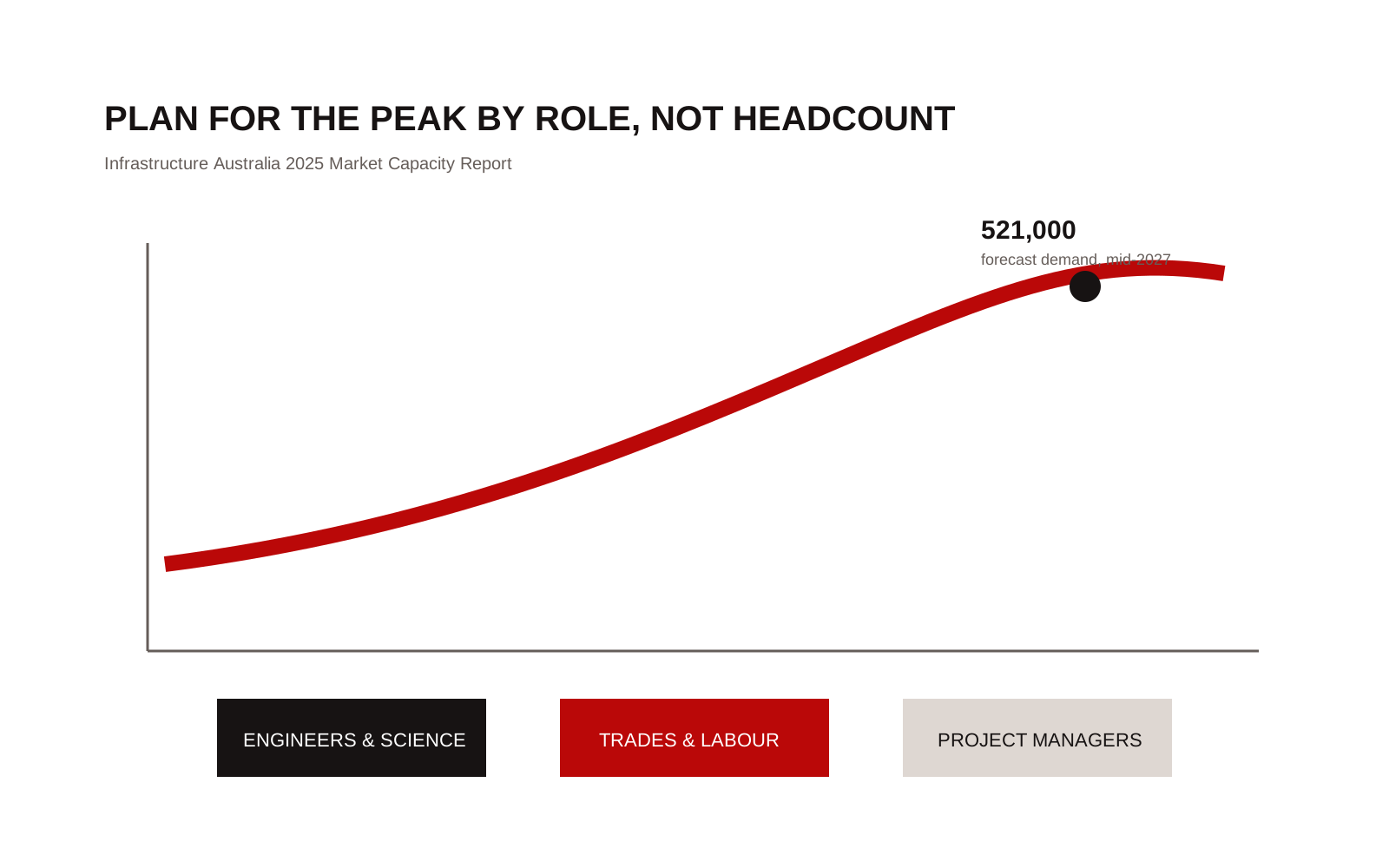
Chart of Australia's infrastructure workforce demand and contractor preparation priorities towards 2027.
Turn the programme into a workforce curve
Do not begin with headcount. Begin with work fronts and decisions.
| Programme input | Workforce question | Evidence to retain |
|---|---|---|
| Mobilisation date | Which roles must be available first? | Recruitment lead time and named source |
| Peak work fronts | Which skills overlap across packages? | Weekly demand curve by occupation |
| Regional location | What travel, housing and roster assumptions apply? | Mobilisation basis and accommodation plan |
| Design maturity | How much rework risk affects labour demand? | Design release and change assumptions |
| Subcontract split | Which capacity is committed rather than assumed? | Letters, agreements and current pipeline |
| Commissioning | Which specialist roles arrive late? | Test plan and specialist availability |
Run three cases: base programme, delayed access and compressed completion. The point is not to predict every vacancy. It is to see which roles become a single point of failure.
Separate occupation shortages
Infrastructure Australia's detailed report projected that shortages for engineers, architects and scientists could peak at 126,000 in late 2026. Trades and labour shortages could reach 126,000 in mid-2027, while project management shortages could reach 59,000 at the same time.
Those groups need different responses. Graduate recruitment will not solve an immediate senior assurance gap. A labour-hire contract does not create project knowledge. A contractor should classify each role as:
- recruit locally;
- mobilise from another region;
- develop internally;
- secure through a specialist partner;
- redesign the work or sequence; or
- hold as a client decision or programme risk.
Use Jobs and Skills Australia's NERO data tool to check regional occupation and employment patterns. Record the access date because the dataset is updated.
Prove the plan without publishing personal data
Tender evidence can include workforce assumptions, training completions, competency coverage, retention measures and mobilisation experience. Public careers and capability pages can show roles, project conditions, regions and development routes.
Do not publish named future employees without consent. Do not count an unconfirmed subcontractor as committed capacity. Label forecasts and confirmed resources separately.
A simple evidence ladder is useful:
- Intent: a role or partner is planned.
- Process: a recruitment, training or procurement route exists.
- Commitment: an agreement or accepted offer is in place.
- Mobilised: the person or team is available for the work.
- Performing: records show the role is meeting the requirement.
Make regional conditions part of the offer
Regional recruitment pages should answer practical questions: roster, travel, accommodation, project duration, site conditions, licence recognition, training and who the person will work with. Hiding these details increases unsuitable applications.
Our guide to construction careers pages sets out the information candidates need. For buyer-facing content, the construction sector page shows how to present capability and project evidence without publishing confidential plans.
Review bid capacity at gates
Set workforce gates before bid approval, preferred tenderer, award and mobilisation. At each gate, compare demand with confirmed supply and record the remaining actions. Escalate when a critical role has one source, depends on an uncertain start date or requires a regional move with no housing plan.
The national peak will not hit every occupation and region at once. That is why a contractor's own evidence matters more than a broad assurance that people can be found.
Creatif Work helps technical firms turn operational records into clear construction websites and tender-supporting content. If the workforce plan is sound but candidates and buyers cannot see the practical evidence, start with the problem.
Put workforce assumptions into the bid risk register
Each critical occupation should have an assumption, evidence source, confidence level, trigger and action owner. For example, a mobilisation plan may assume a stated number of supervisors can transfer from another project after a defined milestone. Record what happens if that milestone moves.
Review the register with programme, commercial, people and delivery leads. Recruitment should not carry a risk created by an unrealistic construction sequence. Procurement should not count subcontract capacity that the commercial team has not secured.
After award, compare actual mobilisation with the tender assumption. Capture time to hire, accepted offers, early attrition, training lead time, accommodation constraints and subcontract availability. These figures improve the next bid and give leaders a better basis for deciding which tenders the business can support. Keep personal information out of the planning dataset. Aggregate by role and status, and restrict named records to the authorised people system.