

Maritime OT Cybersecurity Skills in Singapore: What Employers Need
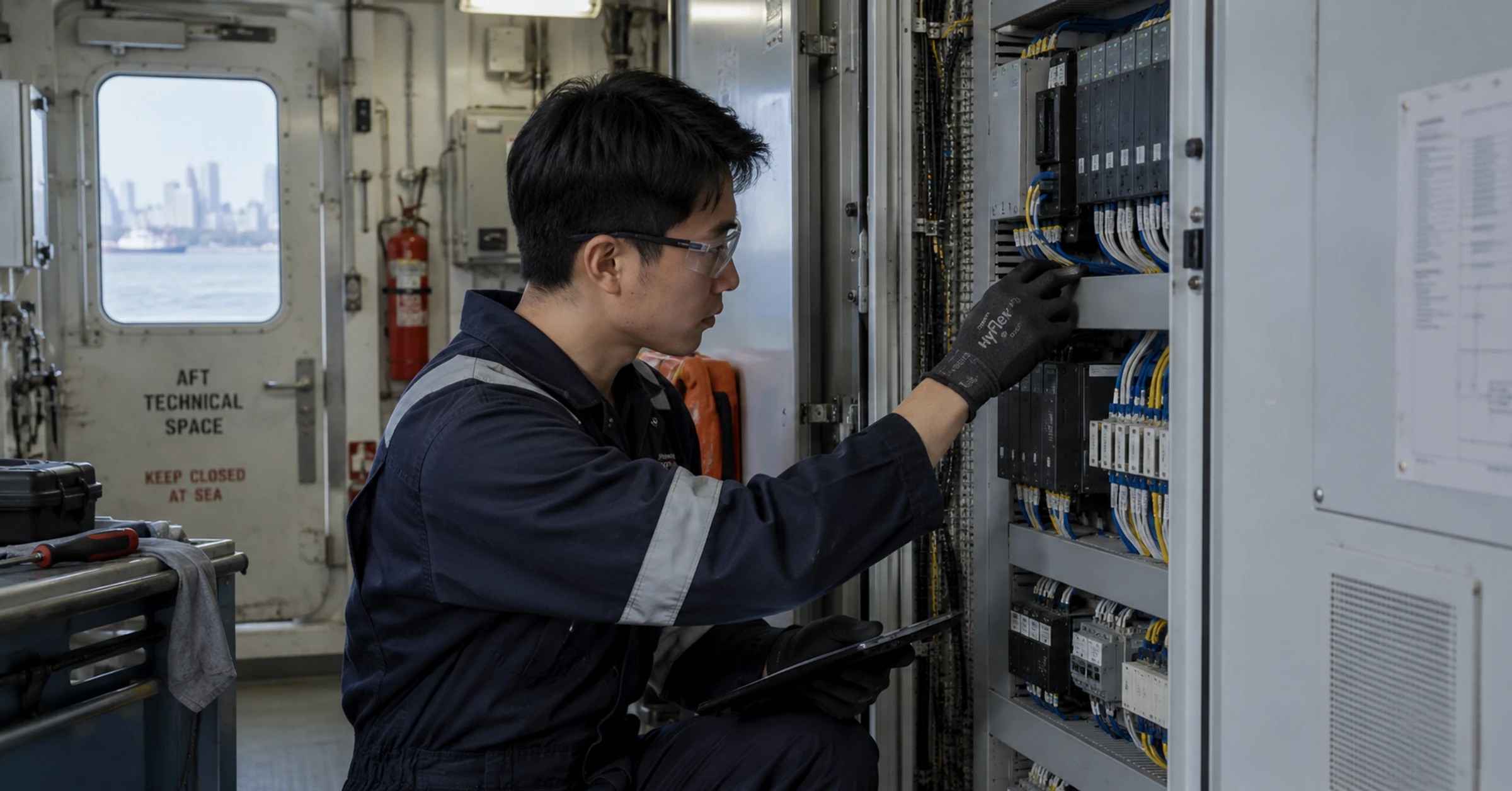
Maritime cybersecurity hiring becomes difficult when the role is described as ordinary corporate IT security with a ship added to the job title. Operational technology changes the consequence, access conditions and recovery priorities.
Singapore employers need people who can connect cyber controls to navigation, propulsion, power and cargo operations. That capability can be built through a mix of recruitment, cross-training and realistic exercises.
What skills should employers look for?
A maritime OT cybersecurity role needs five connected abilities: understand shipboard systems, map IT and OT interfaces, assess operational consequence, coordinate safe incident response, and communicate with crew, engineers and shore teams. Employers should test these abilities through scenarios, not rely on IT certificates alone.
Singapore's Cyber Security Agency created the Operational Technology Cybersecurity Competency Framework to give system owners, employers and training providers a more specific view of OT roles and competencies. In April 2026, MPA announced a Cybersecurity for Maritime Operational Technology programme for corporate IT professionals, including applied work on the MariOT testbed.
Those initiatives make one point clear: the gap is not solved by treating OT as another office network.
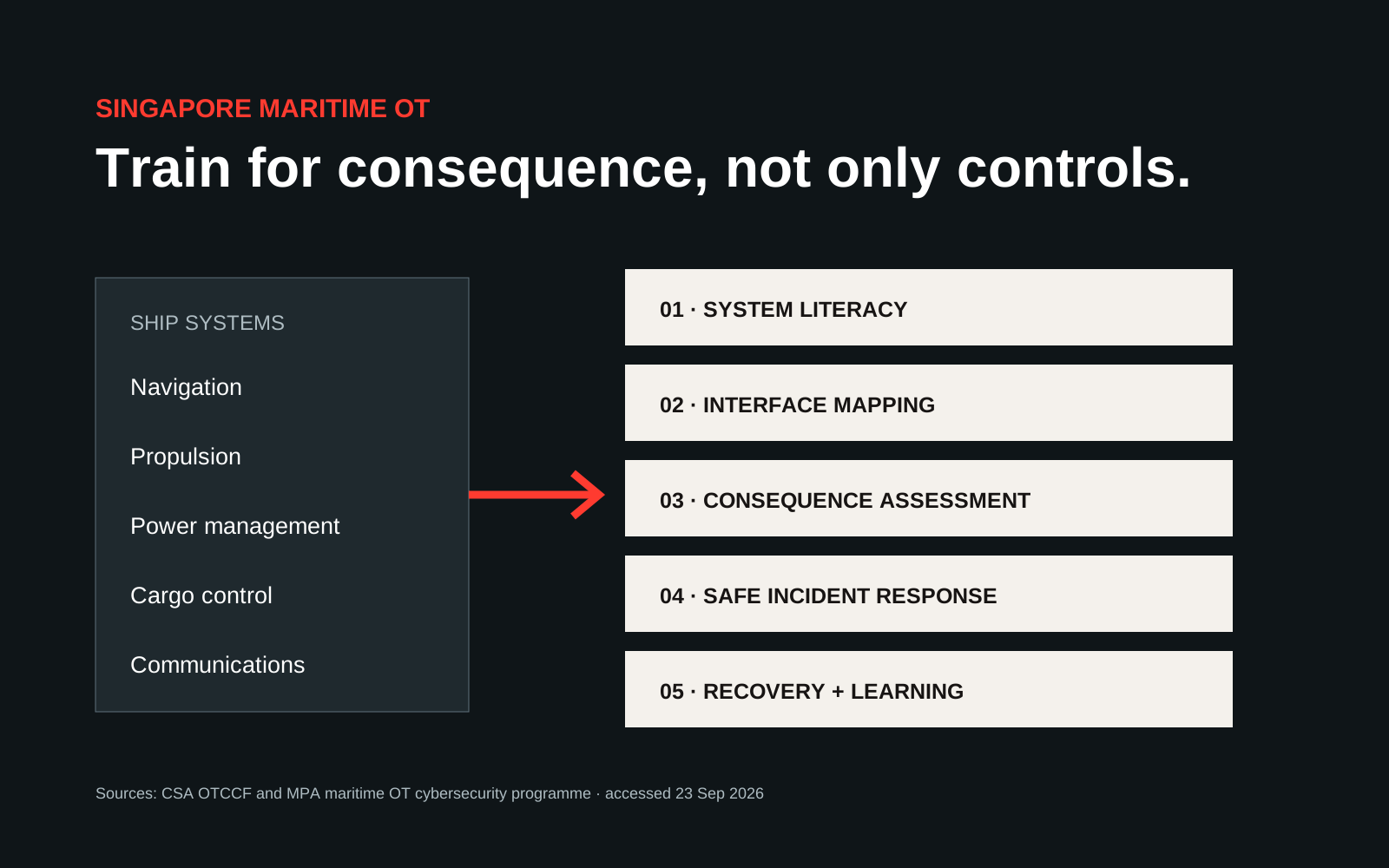
Maritime OT cybersecurity skills map linking ship systems, people, exercises and incident response.
Build a role around systems and consequences
| Capability | What good evidence looks like | Interview or exercise prompt |
|---|---|---|
| Ship systems literacy | Can describe navigation, propulsion, power and cargo dependencies | What could fail if this device is isolated? |
| Interface mapping | Current data-flow and remote-access map | Trace a vendor connection from shore to equipment |
| Risk assessment | Consequence-based scenario analysis | Prioritise three alerts during manoeuvring |
| Response coordination | Playbook with crew and shore responsibilities | Who can authorise isolation and when? |
| Recovery and learning | Tested backup, restoration and post-incident records | How would you prove safe restoration? |
MPA's Singapore Registry of Ships identifies communication, propulsion and power control, navigation and cargo management as important OT groups in its SRS Cyber Notation. Employers can use those groups to anchor role scenarios in real operations.
Decide what to hire and what to train
Few candidates will arrive with deep experience in every system. Split the requirement into three parts.
First, identify non-negotiable knowledge for the role. A shore response lead may need incident coordination and fleet access governance. A vessel engineer moving into cyber may already understand consequence and safe operation but need security architecture and evidence skills.
Second, list trainable gaps with a time limit. Pair corporate IT staff with marine engineers, use system walkdowns and require supervised scenario work.
Third, name specialist capability that can remain external, such as penetration testing or product-specific forensics. Record how the external party gains safe access and who owns operational decisions.
This prevents a job description from becoming an impossible list of every cyber, marine and compliance skill.
Use exercises to reveal coordination gaps
A realistic exercise should force trade-offs. For example, a suspicious remote connection appears while a vessel is approaching port. The team must decide what to isolate, how to protect safe navigation, who contacts the vendor and what evidence to preserve.
Assess the exercise on:
- system and consequence understanding;
- clarity of command between master, chief engineer and shore team;
- safe use of isolation and fallback modes;
- communication with vendors and authorities;
- preservation of logs and decision records;
- recovery criteria and post-event learning.
MPA commissioned the MariOT training facility to provide high-fidelity shipboard simulations. Employers without access to a testbed can still run tabletop exercises using their own network and responsibility maps.
Write the job description in operational language
Lead with the systems, fleet context and decisions, not a long tool list. State whether the person is responsible for governance, engineering, monitoring, response or a combination.
Include travel or vessel access, on-call expectations, authority during an incident, and the relationship with safety management. Explain which teams provide marine engineering and corporate IT support.
Avoid calling a role “OT security” if the work never reaches operational systems. Candidates need an honest scope, and managers need a basis for assessing performance.
Give managers an assessment rubric
Use the same capability map for recruitment, development and promotion. Rate observed work rather than self-reported familiarity. A person may be strong at technical analysis but need support when briefing a master or deciding what evidence to preserve.
For each capability, define three levels: can explain with guidance, can perform in a supervised scenario, and can lead the task in the operating environment. Attach examples and dates to the rating. Reassess after a fleet technology change, new vendor connection or major incident exercise.
This also makes team design clearer. Not every individual needs the highest level in every area. The employer needs enough coverage across the team, with named deputies and a route to external specialists.
A 90-day capability plan
During the first 90 days, ask the role owner to:
- validate the fleet's high-level IT and OT boundary;
- identify critical remote-access routes and owners;
- review one vessel or system against the incident process;
- run one cross-functional scenario;
- record the largest people, process and technology gaps;
- propose a training and testing plan with named owners.
The output is not a perfect cyber programme. It is a shared view of what needs protection and who can act.
Creatif Work builds marine websites that make technical capability legible to owners, yards and procurement teams. Our custom software service can also help structure internal registers or workflows when critical OT evidence is still spread across disconnected files.