

An Australian Infrastructure Bid or No-Bid Evidence Matrix

A bid or no-bid decision should happen before the proposal team commits weeks of work. The matrix should test eligibility, strategic fit, delivery capacity, evidence, risk and commercial logic. A high pipeline value does not make every opportunity suitable.
The decision record also protects the business from changing the reason for bidding after effort has begun.
What belongs in an infrastructure bid or no-bid matrix?
Include mandatory eligibility gates, client and project fit, comparable experience, people and plant capacity, supply chain, delivery and contractual risk, evidence readiness, competitive position and the realistic value of winning.
Infrastructure Australia's 2025 Infrastructure Market Capacity Report describes continuing workforce and supply pressure across the national pipeline. That makes resource truth and opportunity selection part of bid quality.
| Decision area | Gate or scored question | Evidence owner |
|---|---|---|
| Eligibility | Can the entity meet every mandatory condition? | Commercial or company secretary |
| Strategic fit | Does the project match target sectors and geography? | Leadership |
| Technical fit | Has the firm delivered comparable scope and interfaces? | Technical lead |
| Capacity | Are people, plant and suppliers available by phase? | Operations |
| HSE and quality | Can required systems and records be evidenced? | HSE and quality leads |
| Commercial | Is the risk-adjusted return acceptable? | Finance and commercial |
| Evidence | Are references, data and permissions ready? | Bid lead |
| Competition | Is there a credible reason to select the team? | Capture lead |
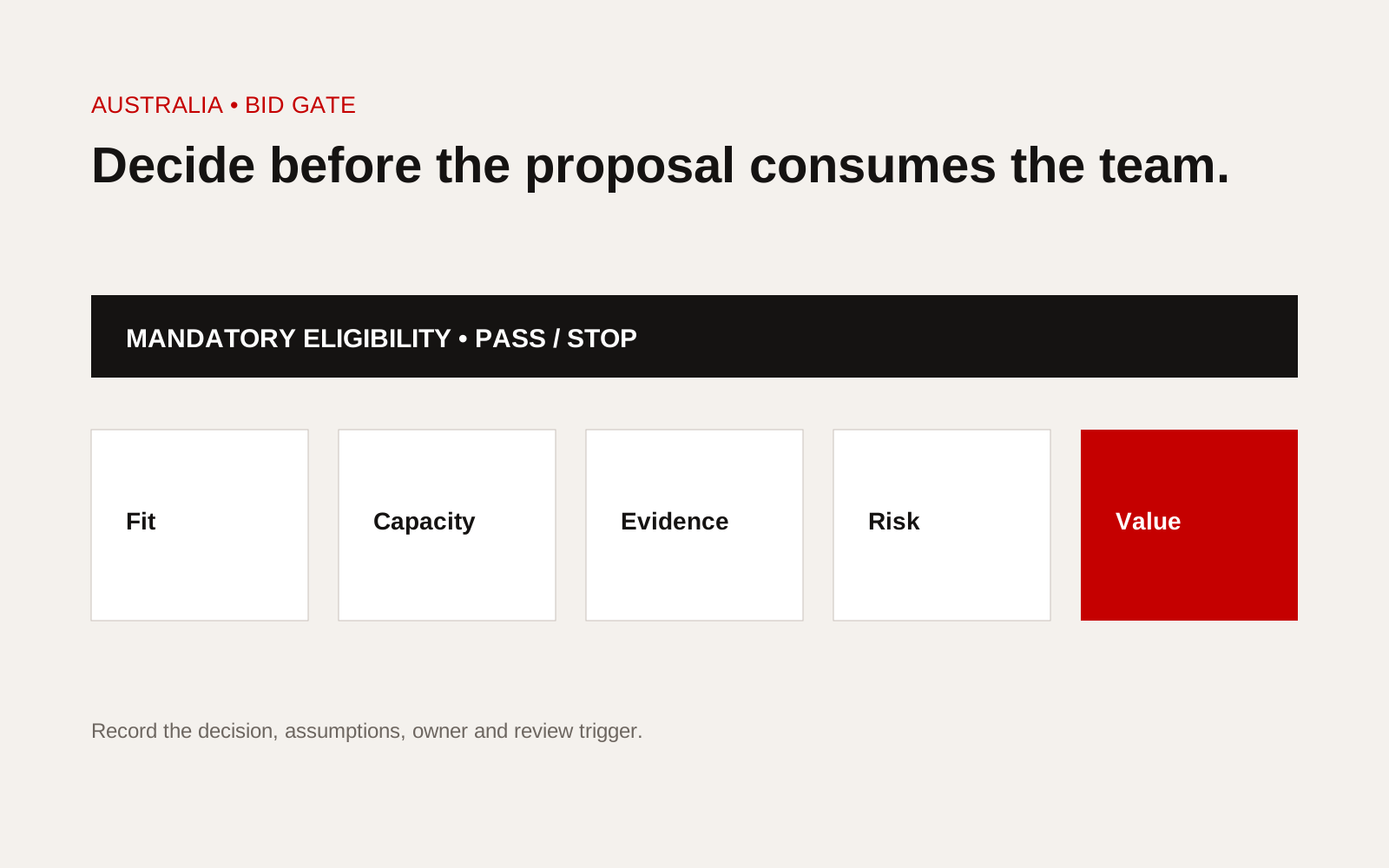
Australian infrastructure bid decision matrix scoring eligibility, fit, capacity, evidence, risk and commercial case.
Put mandatory gates first
Failing a mandatory condition should stop the decision unless a compliant partner or clarification can close it. Gates may include legal entity, registrations, licences, financial thresholds, insurance, local presence, conflicts, security or specific experience.
Record the source clause and evidence. Do not rely on "we should qualify".
Score fit against a defined strategy
A project can be attractive but still sit outside the company's chosen work. Score sector, geography, client, package size, delivery model, capability development and reference value against an agreed strategy.
Avoid changing weights to justify a preferred tender. Set the model before reviewing the opportunity and require a written exception when leadership overrides it.
Test capacity across the portfolio
Map demand by month for critical roles, supervision, plant, facilities and suppliers. Include awarded work, preferred positions and competing tenders with a clear probability rule.
Use status labels:
- named and available
- employed but awaiting release
- partner or supplier confirmed
- recruitment planned
- assumed with no secured route
The last two should reduce the score and trigger an action, not appear as current capacity.
Assess evidence readiness
List the likely evaluation criteria and whether current evidence exists. A strong capability with no permitted reference, approved data or available technical author is a bid risk.
| Evidence status | Meaning | Decision action |
|---|---|---|
| Ready | Current, approved and directly relevant | Use and tailor |
| Adaptable | Relevant but needs project framing | Assign owner and date |
| Obtainable | Exists with client or partner permission needed | Seek permission before gate |
| Missing | No credible supporting record | Reduce score or no-bid |
Include delivery and contract risk
Review scope clarity, interfaces, programme, site access, approvals, ground or existing asset information, design responsibility, damages, warranties, payment, escalation, security and data terms.
Separate manageable risk from unknown risk. Unknowns need clarification, investigation or a pricing assumption before the final gate.
Record the commercial basis
Estimate bid cost, probability, delivery margin, cash profile, bonding or insurance demands, downside and strategic value. Avoid treating revenue as value without capacity and risk.
The matrix should not produce a decision automatically. It should show the facts and assumptions leadership is accepting.
Run more than one gate
An early gate can reject ineligible or clearly unsuitable opportunities before capture effort begins. A second gate can review clarified scope, team, partners and commercial assumptions before the full submission. A final gate can confirm that the signed offer still fits the conditions leadership approved.
Record what changed between gates. A new design obligation, shortened programme or unavailable project director may turn an earlier bid decision into a no-bid. The team should not continue only because time has already been spent.
For a joint venture, agree the decision authority, bid cost allocation, evidence ownership and withdrawal rule before presenting the partnership to the client. A partner name may strengthen eligibility while adding interface and governance risk. Score both sides.
After award or loss, compare the original assumptions with the outcome. This improves the weights and stops the matrix becoming a form completed for compliance rather than a real portfolio tool.
Bid gate checklist
- Mandatory conditions traced to evidence
- Strategic weights agreed before scoring
- Comparable work tested by scope, not client logo
- Portfolio capacity time-phased
- Critical subcontractors checked for shared demand
- Evidence permissions confirmed
- Contract and delivery unknowns assigned
- Bid cost and decision value recorded
- Executive override requires a reason
- Final decision, assumptions and review date stored
Calibrate the matrix after each decision
The scoring model should improve with use. After every submitted bid, record the result, buyer feedback, effort spent, margin assumptions, delivery outcome and any risk that appeared later. Compare those facts with the original scores. If bids rated highly for strategic fit repeatedly lose on capability or price, the weighting is wrong or the evidence test is too generous.
Hold a quarterly calibration session with business development, delivery, commercial and finance. Review a won bid, a lost bid and a declined opportunity. Ask whether the gate criteria would produce the same decision with what is now known. Change definitions only when a pattern appears, and date the version so old decisions remain understandable. The matrix is not a device for making every decision look objective. It is a shared record that exposes assumptions early, protects scarce bid resources and gives leaders a basis for saying no when enthusiasm is stronger than evidence.
Creatif Work helps construction firms organise the evidence behind these decisions. Our custom software service can support a controlled opportunity and evidence workflow, while our website service makes approved capability easier for buyers to verify before the tender.