

UK Construction Website Design for Framework Buyers

A framework buyer is rarely browsing for inspiration. They are checking whether a supplier fits the lot, geography and risk profile, then deciding whether it is worth opening a formal conversation.
Website design for this audience is therefore an information design problem. The page must help a buyer qualify the contractor quickly without pretending that the website is the tender response.
What does a framework buyer need from the website?
A framework buyer needs an exact service and lot fit, operating geography, relevant accreditations, financial and delivery context, project evidence, named governance and a clear prequalification contact. A contractor website should let the buyer reach these facts in two or three clicks, with dated documents and honest scope boundaries.
The Cabinet Office's Procurement Act 2023 guidance collection covers frameworks, conditions of participation, technical specifications, assessment and contract management. The September 2026 Framework Practice Guide also emphasises preliminary due diligence and clear routes to market.
Your website does not determine qualification. It can make the supplier easier to understand before formal checks begin.
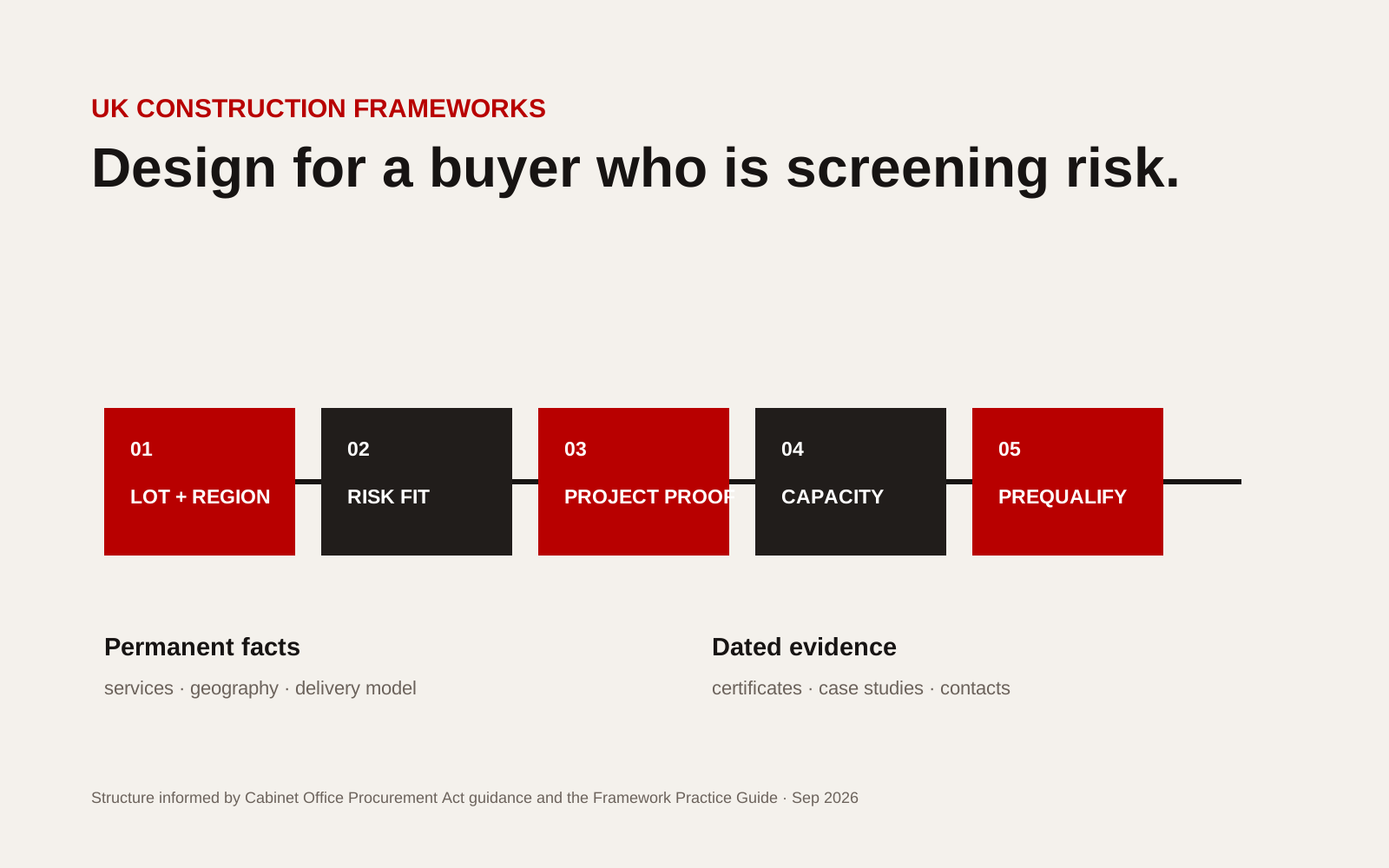
Framework buyer website journey from supplier scope through evidence to prequalification contact.
Map the site to the buyer's screening sequence
| Screening step | Information to show | Best location |
|---|---|---|
| Lot fit | Trades, services, project stages and exclusions | Service page |
| Geographic fit | Regions served, depots and mobilisation limits | Service and contact pages |
| Risk fit | Competence, quality, safety and governance approach | Capability page |
| Evidence | Comparable project, value band if approved, outcome and responsibility | Case study |
| Capacity | Delivery model, typical package scale and current contact route | Capability page |
| Next step | Named framework or prequalification enquiry | Contact route |
Avoid hiding all of this inside a PDF. Search, mobile use and accessibility all improve when the core facts exist as readable page content.
Separate permanent facts from changing evidence
The website should distinguish stable company information from records that expire.
Stable information includes the legal company identity, core services, regions and delivery model. Changing evidence includes certifications, insurance, policies, approved supplier status and staff credentials. Add an owner and review date to every changing item.
A quarterly publishing check should ask:
- Is the certificate current and does its scope match the claim?
- Has the service area changed?
- Does the case study still represent the work being pursued?
- Does the contact reach the person who handles framework enquiries?
- Are old policies or logos creating a false impression?
This simple review prevents the website from becoming a stale prequalification pack.
Build case studies around comparability
Framework buyers need to compare the project with their requirement. A case study should therefore name the sector, location, work package, delivery conditions, contractor responsibility and result.
Do not lead with a long client tribute. Lead with the decision the buyer is trying to make. If the project involved live operations, constrained access, staged handover or regulated information, say how that affected delivery.
Include one item that can be checked, such as a completion date, accepted handover record, programme milestone or measured result. Obtain approval before publishing commercial values or client-sensitive data.
Our guide to UK construction framework readiness sets out the evidence a smaller contractor can prepare before a procurement window opens.
Make competence and responsibility easy to follow
A framework page should link to a capability section that explains competence assessment, subcontractor controls, change management and escalation. Name roles, not just personalities.
Use a concise responsibility flow:
- enquiry and fit review;
- bid or prequalification owner;
- technical and commercial approval;
- mobilisation and project governance;
- handover and performance review.
This gives the buyer a picture of continuity. It also reveals internal gaps before they appear in a questionnaire.
Design the enquiry for procurement work
One generic contact form mixes framework, careers, suppliers and small project enquiries. Give framework buyers a specific route.
Ask only for information needed to direct the enquiry: organisation, framework or project, lot or service, geography, expected procurement stage and contact details. Do not request sensitive tender documents through an unsecured public form.
Confirm what happens next. A useful confirmation might say that the commercial team will review fit and reply with a named contact. Do not promise a response time the team cannot maintain.
A practical page set
For many contractors, the minimum useful structure is:
- a framework-buyer landing page;
- one page per core service or lot;
- a competence and governance page;
- comparable case studies;
- current accreditations with scope and date;
- a framework-specific enquiry route.
The design should help buyers scan, compare and verify. Animation and visual polish can support that job, but neither replaces the evidence.
Test the site before a procurement window opens
Give a colleague a simple task: find whether the company can deliver a named package in a named region, then locate a comparable project and the framework contact. Watch the route without prompting. If they return to the main menu repeatedly or open several unrelated downloads, the structure needs work.
Run the same test on a phone and on a slower connection. Procurement research happens between meetings and on managed corporate devices, not only on a large studio screen. Check that tables remain readable, document links are labelled, keyboard focus is visible and important facts do not depend on animation.
Finally, submit a test enquiry. Confirm the message reaches an active mailbox, consent text is accurate and the reply gives a real next step. A well-designed front end cannot compensate for an enquiry that disappears into an unowned inbox.
Creatif Work designs construction websites for technical and procurement readers. If framework growth is the objective, our website service can structure existing company evidence around buyer screening, then connect the right pages to a focused enquiry route.