

How to Show Competence and Responsibility on a Contractor Website

Procurement teams cannot judge competence from a row of logos. They need to understand what the contractor does, who controls the work, what evidence exists and where responsibility changes hands.
The website will never replace prequalification or project due diligence. It can, however, remove uncertainty before a buyer starts that process.
What should the page show first?
A contractor capability page should state the exact work covered, the responsible role, the competence and change-control process, and one project example with a clear boundary. Put certifications and policy downloads after that explanation. The page should make responsibility easier to follow, not merely say that the company is responsible.
The UK's Building Safety Regulator treats competence as connected to dutyholder roles and organisational arrangements. The regulator's course guide on client, principal designer and principal contractor roles shows why role clarity matters alongside individual capability.
Do not claim a statutory dutyholder role unless it applies to the service and project. The website should describe the firm's actual scope and invite project-specific confirmation.
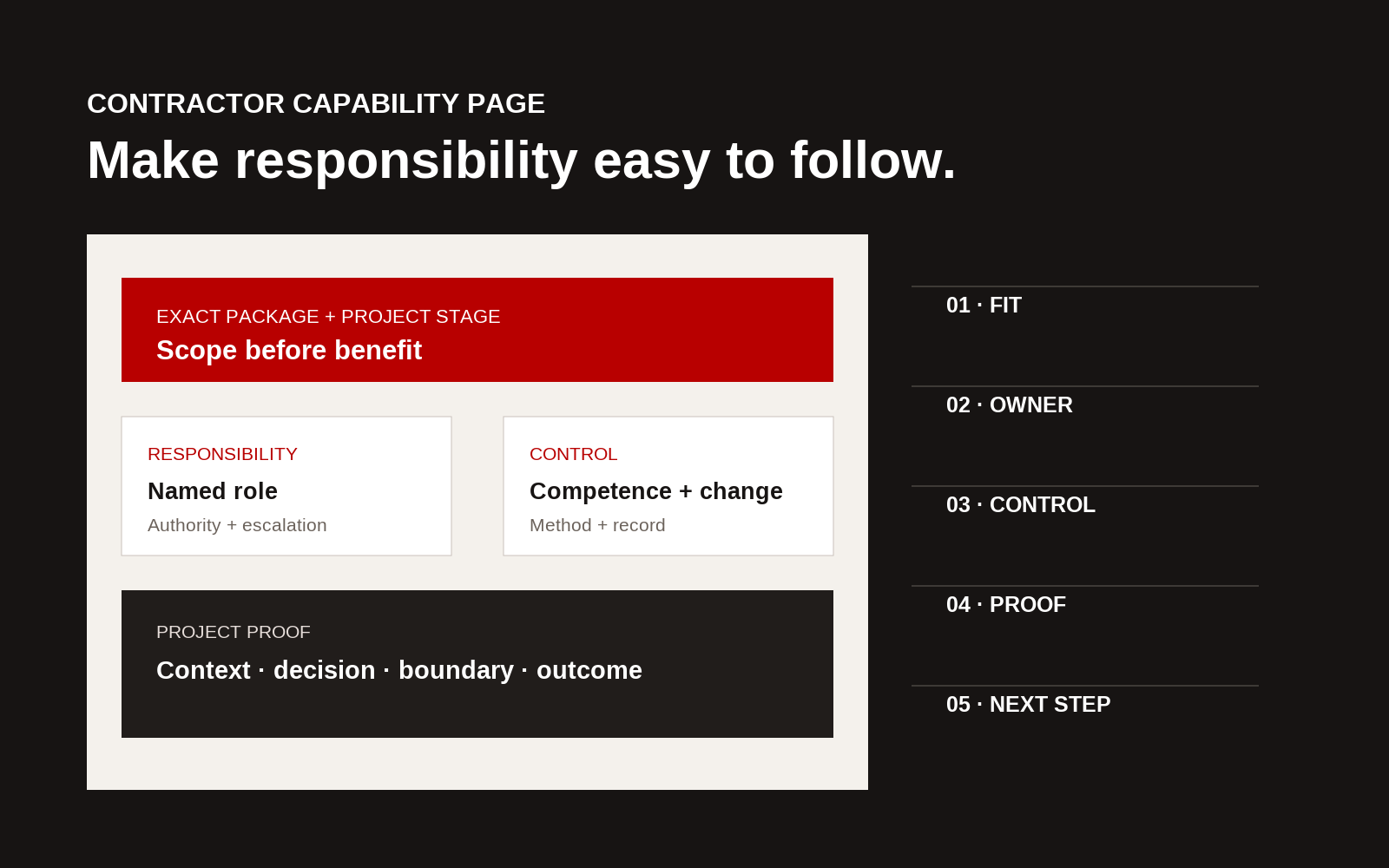
Annotated contractor capability page showing scope, named responsibility, evidence and project proof.
Build the page around a buyer's four questions
| Buyer question | Page content | Weak substitute |
|---|---|---|
| Can you do this package? | Scope, building types, package limits and locations | “Full-service contractor” |
| Who is accountable? | Named role, reporting line and escalation route | Team portraits without roles |
| How do you control risk? | Competence, change, inspection and handover process | A generic safety promise |
| What proves it? | Relevant project example and available records | An unlabelled project gallery |
Use these questions as the page order. It matches the way a buyer narrows risk: relevance first, governance second, proof third.
State the boundary before the benefit
Start with a two-sentence scope statement. Name the work, project stage and geographic or sector limits. If the company designs some packages but installs others to another party's design, say so.
Boundaries improve trust because they help a buyer allocate the missing responsibility. They also reduce poor enquiries. A subcontractor that clearly says it provides design development within an approved performance specification will attract different conversations from one that simply says “design and build”.
Useful boundary details include:
- design responsibility and review stage;
- supply, installation, testing and commissioning scope;
- interfaces with principal contractor, designer and specialist supplier;
- work carried out directly and work managed through subcontractors;
- records delivered at handover.
Explain competence as a process
List the steps used to decide that a person or supplier is suitable for the work. Keep the public version short but specific.
For example: define the role, review evidence against the role, record any supervision condition, approve the appointment, and reassess after a defined change or interval. If an external certification supports part of that process, explain what it covers and when it expires.
Do not publish personal training files. Name the organisational method and the evidence available during procurement. The distinction protects staff data while giving the buyer something testable.
Show who owns a change
Changes expose the real operating system. A diagram can show who raises a change, who completes the technical review, who approves it and who records the installed condition.
Keep the diagram tied to your actual workflow. If approval varies by package or project, state that the project responsibility matrix governs. Never imply that website copy overrides a contract or appointed dutyholder arrangement.
Our building safety evidence guide includes a short audit for checking whether the written process matches live work.
Use a case study as evidence, not decoration
A useful case study contains six items:
- project and package context;
- the contractor's precise responsibility;
- a constraint or risk that shaped the work;
- the decision and control used;
- the resulting record or accepted outcome;
- a date, boundary and approving party where publication is permitted.
If the outcome is calculated rather than measured, say so. If the project is under a confidentiality agreement, publish the method without naming the client. A buyer learns more from one well-bounded example than from twenty photographs with no explanation.
Put supporting material in the right place
Use a simple evidence hierarchy:
- Page copy for scope, responsibility and process.
- Project pages for applied evidence.
- Downloads for current certifications, policies and formal statements.
- Secure procurement exchange for controlled or sensitive documents.
Add document dates and owners. Remove expired versions. Make contact routes specific, such as “request our competence management summary” rather than “learn more”.
Check the page with three different readers
Before publication, ask a commercial lead, technical manager and someone outside the project to review the same page. The commercial lead should confirm that the page fits the work being pursued. The technical manager should confirm that scope and responsibility are accurate. The outside reader should be able to explain who does what without private project knowledge.
Record unresolved comments rather than smoothing them over. If reviewers disagree about responsibility, the copy has exposed an operating question that needs an internal answer first. This small review is more useful than polishing a statement that nobody is prepared to own.
Recheck the page after an organisational change, new certification, major project handover or change in the service offered. A capability page is a current operational summary, not a permanent brochure.
The website's role is to make the next due-diligence step easier. It should not try to pass due diligence by itself.
Creatif Work builds construction websites that organise evidence around real procurement decisions. Our web design service can map your current records into clear scope, governance and project pages, then identify what should remain off the public site.