

UK Building Safety Culture in 2026: What Contractors Must Evidence
Building safety culture is often described as an attitude. Buyers and regulators need something more testable. They need to see how a contractor decides who is competent, assigns responsibility, controls work, records changes and learns when the plan does not hold.
In 2026, a polished values statement does not answer those questions. The useful evidence sits in everyday management records and in the way a contractor explains those controls before appointment.
What does a contractor need to evidence?
A UK contractor should be able to show that competent people are assigned to defined duties, project information is controlled, design and site changes are authorised, concerns can be raised, and lessons lead to specific changes. Culture becomes credible when each claim has an owner, a record and a review date.
The Building Safety Regulator's Industry Competence Committee describes competence management as an organisational responsibility, not a one-off check on an individual's certificate. Its competence guidance consultation focused on organisations carrying out design or building work and on those managing higher-risk buildings.
This is not a compliance opinion for a particular project. Dutyholders should confirm the current legal requirements and project classification with competent advisers.
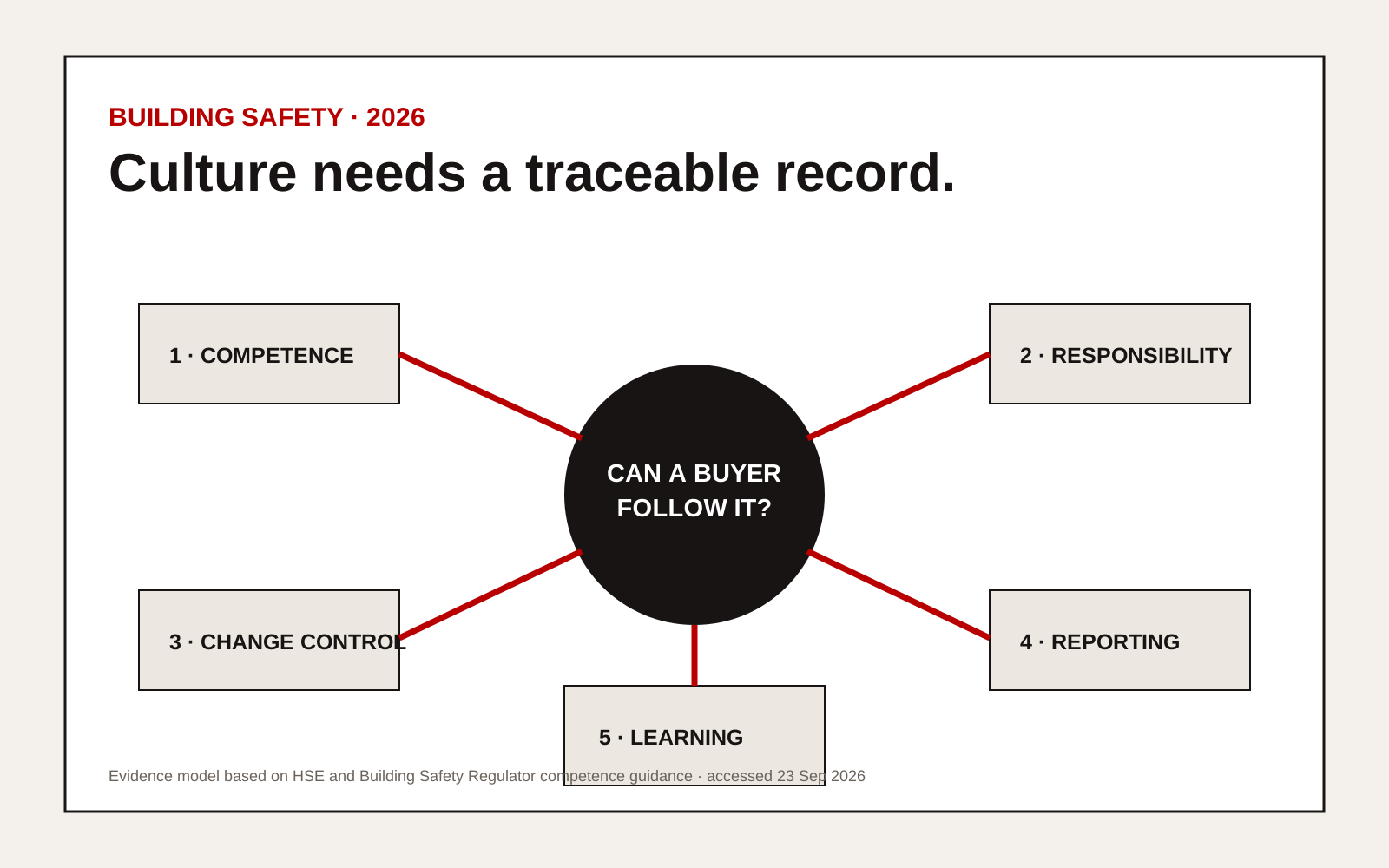
Building safety evidence loop connecting competence, control, records, review and improvement.
Turn five broad claims into inspectable records
| Claim | Record a buyer can inspect | Question for leadership |
|---|---|---|
| Our people are competent | Role profile, competence criteria, assessment and supervision plan | Who decides that evidence is sufficient? |
| Responsibilities are clear | Project responsibility matrix with named deputies | What happens when an owner changes? |
| Changes are controlled | Design and site change log with approval route | Can work proceed before approval? |
| Problems are reported | Issue, near-miss and escalation records | Can a person stop work without penalty? |
| We improve | Review actions with owners and due dates | Which process changed after the last review? |
The table is deliberately plain. A long policy is not stronger evidence if nobody can trace a live project decision through it.
Competence must match the work and the context
A training certificate proves that someone completed a course. It does not by itself prove that the person can perform a defined task on a particular building, with the available supervision and information.
For each safety-critical role, record:
- the task and decision authority;
- the knowledge, skills, experience and behaviours required;
- the evidence reviewed and who reviewed it;
- any limitation, mentoring or supervision condition;
- the date or event that triggers reassessment.
This prevents a common failure: presenting a list of impressive credentials without connecting them to the work. It also makes subcontractor review more useful. The question becomes “competent for what?”, followed by “under whose control?”
Responsibility should survive a handover
Responsibility charts often look clear at tender stage and fail when staff, subcontractors or packages change. Build the chart around decisions rather than job titles alone.
For example, identify who accepts design information, who checks buildability, who approves a substitution, who confirms the installed condition and who preserves the record. Give each decision a deputy and an escalation route. When a person changes, update the named owner and record the handover.
This is where information management and safety culture meet. Our UK golden thread checklist explains how to keep decisions traceable without turning every project into a document warehouse.
Test the culture through changes and bad news
Good culture is easiest to claim when the project is on programme. Test it when a specified product is unavailable, a drawing conflict appears, or a team member raises a concern.
Use a short audit sample:
- Select three recent changes and trace the request, technical review, approval and installed record.
- Select one near miss and confirm who received it, what was decided and whether the action closed.
- Ask a site team member how to stop work and escalate a concern.
- Compare the written process with what actually happened.
- Check whether commercial or programme pressure bypassed a control.
The result should not be a perfect score. It should reveal where the system depends on memory, hierarchy or one experienced person.
Put enough evidence on the website, not the whole file
A contractor website is not the controlled project record. Its job is to let a buyer assess the management approach before asking for the supporting material.
A useful capability page names the work covered, explains the competence process, identifies governance ownership and gives one short example of a controlled change. It can link to certifications or policies, but it should not use badges as a substitute for explanation.
Avoid claims such as “safety is our number one priority” unless the next paragraph shows how that priority affects authority, reporting and review. Our guide to showing competence on a contractor website gives a page structure for that evidence.
A quarterly leadership check
Ask these questions every quarter:
- Which roles are safety-critical and when were they last reassessed?
- Where are responsibility gaps covered by informal knowledge?
- Which change controls were bypassed or delayed?
- What concern was hardest for a junior person to raise?
- Which lesson changed a template, approval route or training plan?
- Does the public website still match the current process?
Building safety culture is not made visible by adding more promises. It is made visible by connecting people, decisions and records. Creatif Work designs construction websites around the questions procurement and technical teams actually ask. Our website service can turn approved evidence into a clear public capability story without exposing the controlled project file.