

BIM Consultancy Website Design: How to Explain a Technical Service

A BIM consultancy website should explain the decision it helps the client make and the information it will deliver. Terms such as coordination, digital delivery and information management are too broad unless the page defines the project stage, inputs, outputs and responsibilities.
The service is not the software. It is the judgement, process and controlled deliverable produced with it.
How should a BIM consultancy explain its services?
For each service, state the client problem, project stage, required inputs, method, deliverables, standards or project requirements, checking process, exclusions and one relevant project example.
| Buyer question | Page answer |
|---|---|
| When do we appoint you? | Project stage and trigger |
| What do you need? | AIA, models, programme, standards and access |
| What do you do? | Activities, workshops and checks |
| What do we receive? | Named documents, models, reports or decisions |
| Who remains responsible? | Client, designer, contractor and consultant roles |
| How is quality checked? | Rules, review, issue and acceptance process |
| What is outside scope? | Authoring, coordination, approval or operation exclusions |
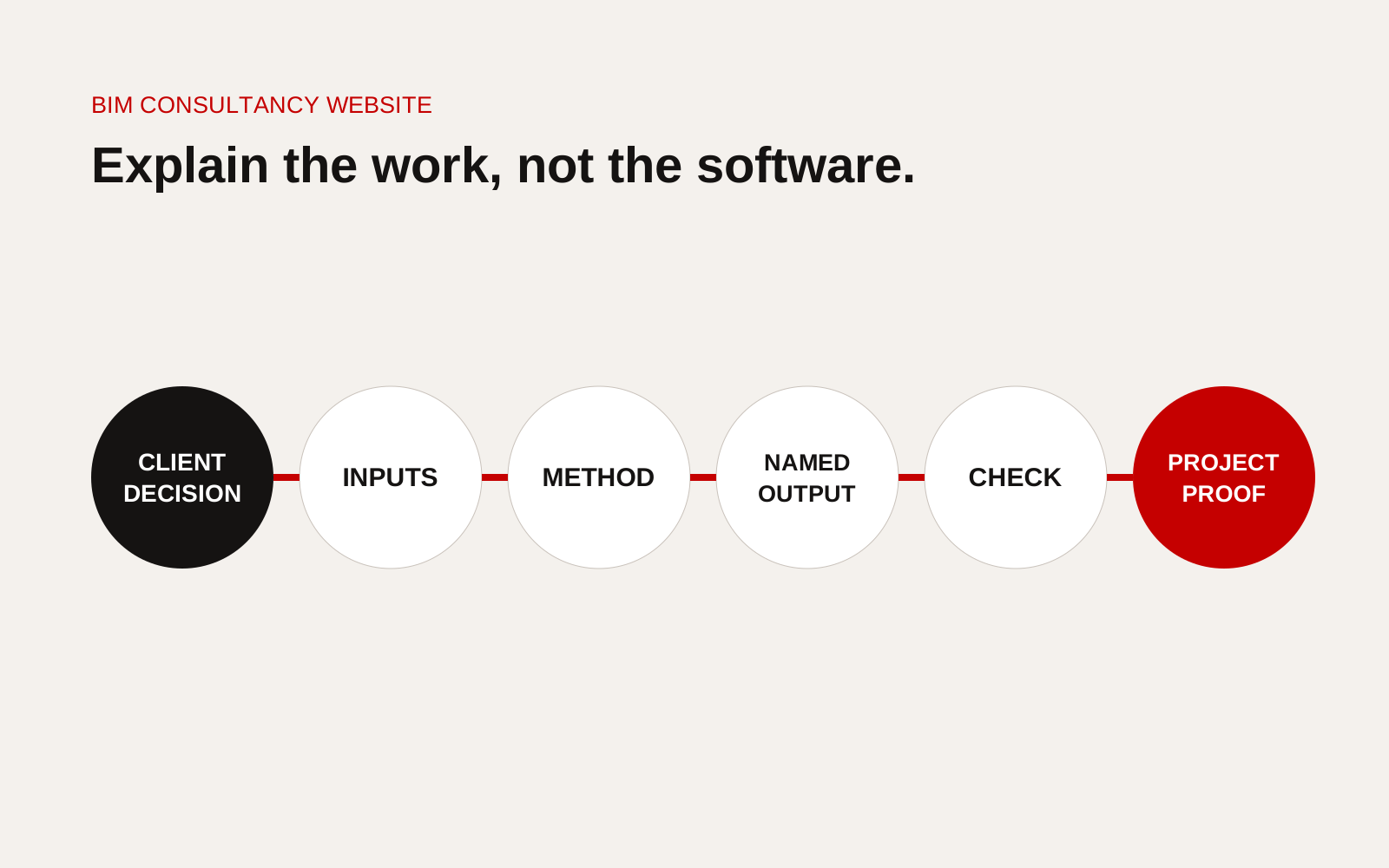
BIM consultancy service page linking client decision, inputs, method, deliverables, checks and project evidence.
Name services by the decision or deliverable
Replace a generic "BIM services" list with specific offers such as:
- AIA development and information-requirement review
- BIM execution planning
- information-management setup
- CDE workflow design and mobilisation
- model coordination and issue management
- model and information assurance
- asset-information handover
- client-team training and delivery support
If terminology differs by market, explain the work in plain language before using abbreviations.
Separate advisory and production roles
A consultant who writes requirements, manages information, authors models and checks compliance may create unclear responsibilities. State which roles the consultancy performs and how conflicts are managed.
On each page, include a responsibility table:
| Activity | Client | Lead designer or contractor | BIM consultant |
|---|---|---|---|
| Define information need | Approves | Contributes | Facilitates and drafts |
| Author discipline model | Oversees requirement | Usually owns | Only if included |
| Coordinate models | Receives outcome | Resolves design issues | Federates and manages process |
| Accept deliverable | Owns decision | Submits | Checks against agreed rules |
Adapt the table to the actual appointment. Do not publish a universal allocation as if it applies to every contract.
Show the inputs and outputs
Buyers price and compare a technical service through its boundaries. A coordination service might require current discipline models, agreed coordinates, model breakdown, CDE access and a responsibility matrix. Outputs may include a federated model, issue register, coordination meetings and reports at stated intervals.
Use sample artefacts with dummy or approved data. A legible issue report or information-flow diagram often communicates more than a rendered model.
Explain standards through application
Listing ISO 19650 or local guidance does not show capability. Explain how the team applies information requirements, naming, status, review, approval and CDE workflow. State that project and appointment requirements govern the delivery.
For German infrastructure work, BIM Deutschland provides AIA, BAP and use-case resources. Other markets and clients may use different templates. The page should describe adaptable method without claiming one template fits all.
Build case studies around decisions
A consultancy case study should show:
- client and project problem
- project stage and appointment
- information inputs and condition
- consultancy responsibility
- method and major issue
- deliverables produced
- approved outcome or decision supported
- limitation or next phase
Avoid case studies that show a model image but no consultancy contribution.
Design useful enquiry questions
Ask for project stage, procurement route, appointment need, current information requirements, models and formats, CDE status, milestone and contact role. Let the prospect attach a brief after a clear privacy explanation.
Show who uses each deliverable
A named output becomes clearer when the page says who reviews it and which decision follows. An AIA workshop may support the client's information strategy. A coordination report may support a design-interface meeting. A model assurance report may support milestone acceptance. This detail also helps prospects avoid buying an artefact they do not have the people or process to use.
State the delivery rhythm as well as the final file. Weekly issue management, milestone checks and handover assurance involve different client time and responsibilities. Where a service depends on timely models or decisions from others, put that dependency beside the deliverable rather than hiding it in proposal terms.
Service-page checklist
- Client decision stated in the first paragraph
- Project stage and appointment trigger clear
- Inputs and preconditions listed
- Deliverables named, not described as support
- Roles and exclusions visible
- Checking and acceptance explained
- Standards tied to actual activities
- Sample artefact readable and approved
- Case study shows the consultancy's contribution
- Enquiry collects project context
Creatif Work builds construction websites for technical firms whose value sits in method and judgement. Our website service turns service boundaries, artefacts and project proof into clear pages. When the consultancy also needs a controlled issue, model or approval workflow, our custom software service can address that system separately.