

What a Construction CDE Capability Page Should Prove

A common data environment capability page should not be a software-logo strip. Buyers need to know whether the contractor can define the process, configure it, govern access, run exchanges and produce evidence when something changes.
The platform matters. The operating model matters more.
What should a CDE capability page prove?
Prove that the team can translate project information requirements into roles, metadata, states, permissions, reviews, exchanges and handover records. Show a project example with scale and responsibility. Name the software only where it helps define the supported workflow.
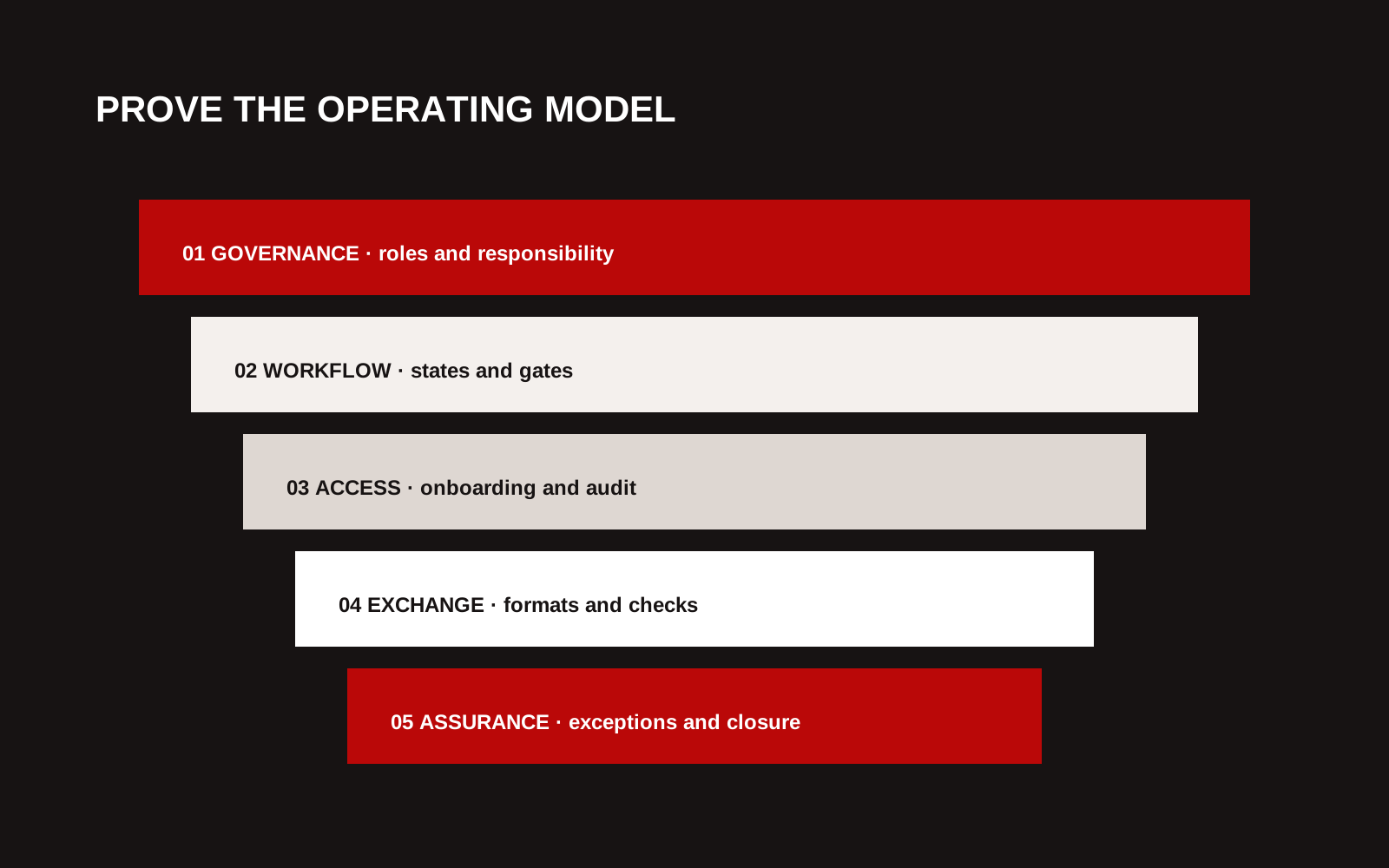
Construction CDE capability evidence stack covering governance, workflow, access, exchange and assurance.
Use five proof areas
| Proof area | Public evidence | Controlled evidence |
|---|---|---|
| Governance | Roles, standard and responsibility model | Appointment and detailed matrix |
| Workflow | States, review gates and issue route | Configuration and approval records |
| Access | Role-based approach and onboarding | User list and audit logs |
| Exchange | Formats, checks and schedule | Models, reports and validation output |
| Assurance | Review cadence and exception handling | Audit findings and closure evidence |
This gives procurement enough to assess maturity while keeping client information and security details private.
State the contract role
Clarify whether the company acted as appointing party, lead appointed party, appointed party, information manager or platform administrator. Do not claim responsibility for the whole project because the team uploaded models.
For each case, state:
- project stage;
- number or type of organisations coordinated;
- main information exchanges;
- CDE responsibility;
- review or assurance task; and
- approved outcome.
Use ranges or anonymised details when the client does not permit exact figures.
Show one workflow
An annotated workflow is more useful than a platform screenshot. Show how information moves from work in progress to shared, accepted or published use, including rejection and archive.
Name the decision at each gate. For example, a model may pass an information-standard check but still fail technical review. A buyer should see that the team understands the difference.
BCA's information management resource page describes SS ISO 19650:2-2024 and provides implementation resources. Link to it for the current Singapore context rather than copying the standard into a capability page.
Explain configuration and change
A capability claim should cover how the team starts and maintains the environment:
- confirm project requirements;
- agree naming, metadata and status;
- configure roles and permissions;
- test workflows with sample containers;
- onboard teams;
- monitor exceptions and usage;
- manage changes; and
- prepare exchange and archive.
State who approves a configuration change and how users are told. A CDE can become unreliable quickly when every package invents its own status.
Publish assurance measures carefully
Useful measures include review turnaround, naming error rate, overdue issues, exchange acceptance and handover-field completeness. Publish only measures with stable definitions and permission.
Do not use “zero clashes” as a broad quality claim. Coordination issues can be filtered, accepted or reclassified. State the test and project stage.
Separate cyber detail from buyer evidence
The public page can state authentication options, role-based access, logging, hosting regions where contractually relevant, backup approach and security review process. It should not expose system architecture, account patterns or client permission structures.
Give qualified buyers a route to controlled security information. Maintain a current owner and issue date.
Add a case-study evidence block
Use a consistent six-field block:
| Field | Example of useful content |
|---|---|
| Requirement | Coordination and issue exchange across stated packages |
| Role | Lead appointed party information-management support |
| Configuration | Agreed status, metadata and review route |
| Scale | Disciplines, contributors or exchange frequency |
| Assurance | Checks performed and exception process |
| Outcome | Accepted exchange or handover result with boundary |
Avoid turning the case into an interface tour. The point is what the process allowed the project team to decide.
Our SS ISO 19650 checklist provides the operational detail behind the page. The construction sector page connects CDE proof with wider project capability.
Creatif Work plans construction websites around the evidence procurement and technical teams need. If the company has run complex environments but its site only shows software badges, start with the problem.
Collect the evidence while the project is live
Do not wait for completion to reconstruct CDE performance. At agreed stages, export approved measures, workflow diagrams, anonymised exception examples and acceptance records. Ask the client early which information may be published and under what description.
Maintain a case-study record with project role, information requirement, platform, contributor scale, exchange frequency, assurance checks and outcome. Separate the platform configuration from the management service so a buyer can see what the company actually delivered.
When a measure improves, preserve the baseline and method. A falling naming-error rate is useful only if the sampling basis remained consistent. When a process changes, mark the break in the series.
Before publication, let the project information manager review the page for both accuracy and disclosure risk. Let procurement review whether it answers a qualification question. Remove client metadata, screenshots and user names that are not needed. A compact, approved case with a clear boundary gives buyers more confidence than a large gallery of interface screens.
Add a visible review date to the case record. Platform features, project roles and standards change. The owner should confirm that the described workflow remains supported before the case is reused in a tender.