

Marine and Offshore Marketing: Reaching Shipowners, Yards and Operators

Marine and offshore marketing should help a buyer check service scope, operating coverage and relevant experience before making contact. Planned procurement and urgent service enquiries need different information and response routes. Publish only the availability, credentials and asset experience the company can verify. A vessel image or port statistic does not establish that capability.
A fleet manager may need a service during a port call. A yard buyer may be assembling a planned package. A technical purchaser may need a model, document revision and approval scope. A commercial manager may be assessing an overseas supplier for the first time. One generic page cannot answer every question equally well.
This guide is for marine service companies, equipment suppliers and specialist offshore businesses. It is a commercial planning guide, not operational, safety or emergency advice. We focus on the information that allows a suitable buyer to make a responsible next decision.
The hero and diagrams are original planning illustrations. They do not depict a client's vessel, yard or facility. Coverage examples are not promises of service in those locations. Port figures are dated MPA context, not a forecast of sales for any supplier.
Download the marine marketing workbook, or use the CSV templates. The files are free without registration. The article includes equivalent instructions and example records.
Identify the buyer and operating context
Start with the work the company actually performs. “Marine services” can include very different appointments. Equipment supply, inspection support, repair, fabrication and engineering work need distinct information. Identify which activities the business undertakes and which are handled by other parties.
Name the people who assess the requirement. A fleet operator may care about coverage and operational constraints. A yard may need the package boundary and interfaces. A technical procurement reader may need current model information. An agent may need a dependable route to the responsible commercial team.
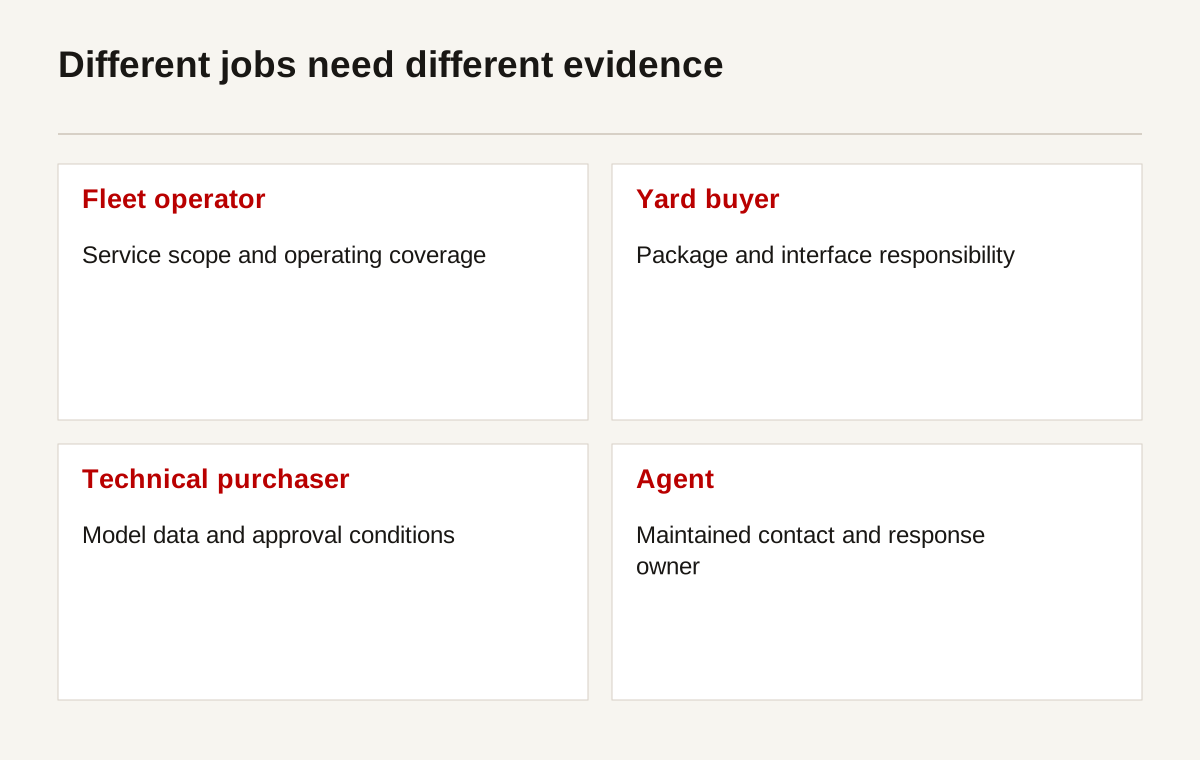
| Buyer | Assessment job | Useful evidence | Suitable next route |
|---|---|---|---|
| Shipowner or fleet operator | Check whether the service fits the vessel and operating context | Verified scope, asset experience and coverage | Planned or urgent assessment route as appropriate |
| Yard procurement team | Assess a defined package and interfaces | Appointment boundary, technical documents and project records | Package enquiry with requirements |
| Technical purchaser | Identify compatible equipment or support | Exact model, units, revision and approval scope | Product or technical assessment |
| Vessel agent | Route a request to a responsible provider | Current contacts, information needs and availability limitations | Maintained commercial contact |
| Offshore project team | Evaluate specialist responsibility | Relevant asset context, scope and published limitations | Project-specific assessment |
The table is a planning model, not a claim that all maritime purchases follow one procedure. Your actual route may involve several readers and formal procurement. Ask the commercial and technical teams where requests originate and who ultimately authorises the appointment.
Do not collapse different activities into one promise
A supplier may hold stock but not provide installation. A service team may support certain asset types but not every equipment model. A partner may provide overseas attendance that the company does not self-deliver. Those distinctions belong in the public explanation.
Write a scope statement for each activity. Include the asset or application, the responsibility, the conditions for assessment and the important exclusions. Have the person responsible for delivery approve it before publication.
When a capability is still being developed, keep it out of the current service promise. A reader should not have to discover during an urgent conversation that the website described a future plan rather than an available service.
Separate planned work from urgent requests
Planned procurement can allow time for document review, comparison and formal approvals. An urgent request may begin with a short description from a phone. That difference affects what the page should explain and how the contact route should work.
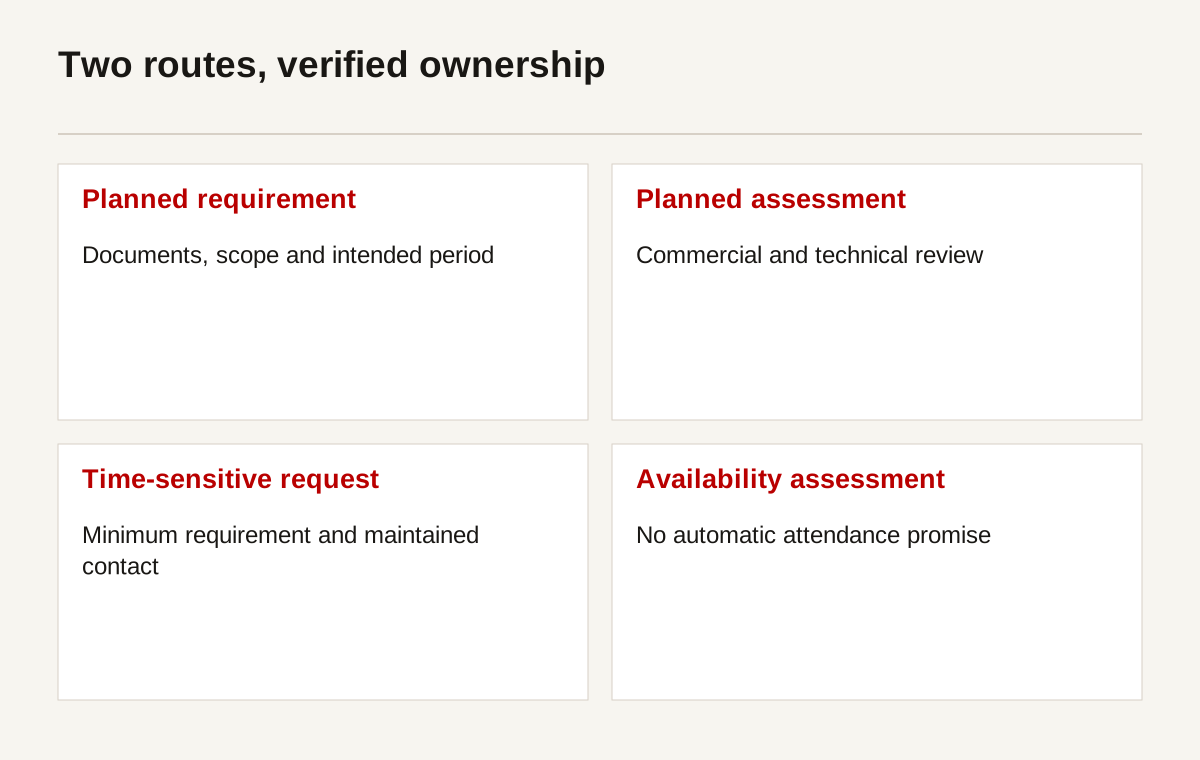
For planned work, provide the scope, technical records and information needed for assessment. Help the buyer prepare a package. For a time-sensitive service request, make the maintained contact and essential information visible without requiring a long company introduction.
Do not call a website form an emergency route unless that operating arrangement is real and verified. Do not label a number “twenty-four-hour support” because it reaches a mobile phone. Confirm who covers it, what they can decide and how absence is handled.
Define what urgency changes
An urgent request may change the order of information collection. It does not remove technical review, safety responsibilities or the limits of the company. Explain that attendance and feasibility are subject to assessment where that is the actual process.
The website should not instruct a reader how to manage a hazardous incident. Direct safety or emergency matters to the appropriate established procedures and authorities. Keep commercial response language separate from emergency instruction.
Record the two routes internally. Identify the responsible team, minimum information and escalation path. Give the editor a clear rule for updating the public contact details whenever coverage or team responsibility changes.
Publish coverage as a record, not a coloured world map
A map with many coloured regions can imply an ability to deliver everywhere. Replace that ambiguity with a record of what coverage means. Is it an office, a self-delivery location, a partner arrangement, an equipment shipping destination or a market where enquiries are assessed?
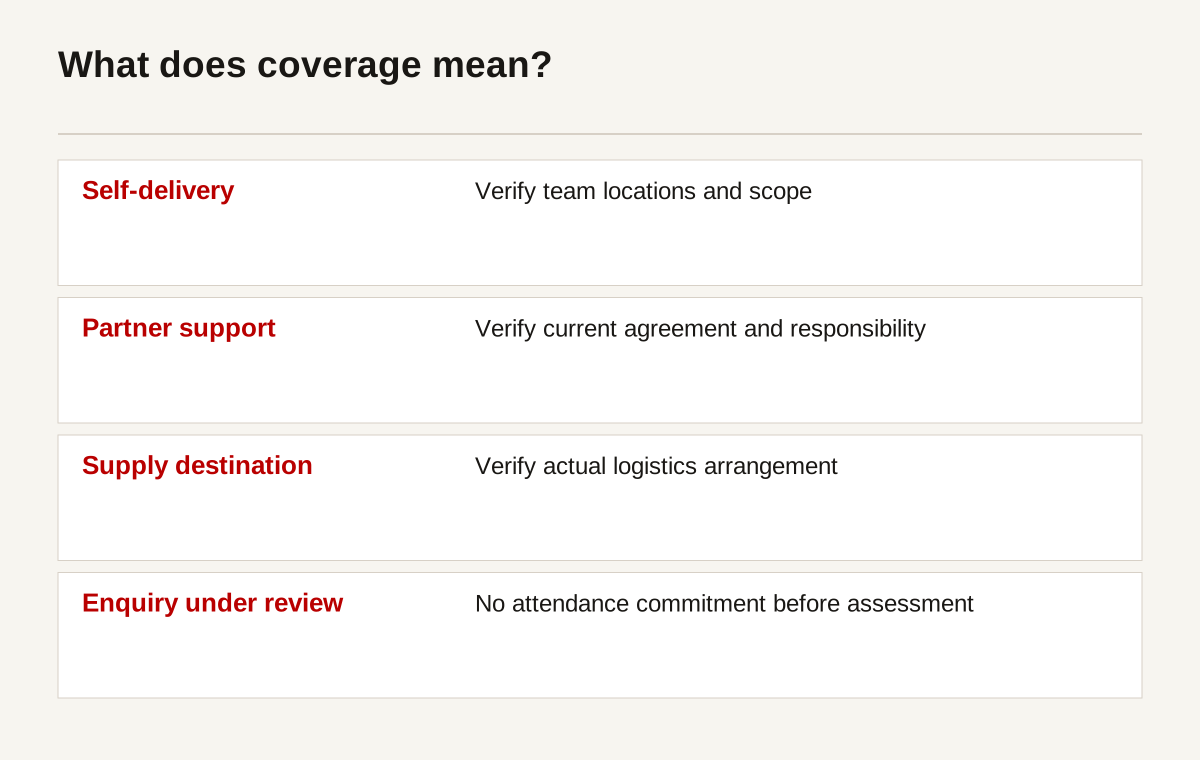
| Service record | Asset or application | Geography to verify | Limits to publish |
|---|---|---|---|
| Planned service attendance | Supported asset types | Actual team operating locations | Access, scheduling and assessment conditions |
| Equipment supply | Exact product range | Verified dispatch and delivery arrangements | Stock status, logistics and installation exclusions |
| Partner-supported attendance | Agreed specialist scope | Locations covered by the named arrangement | Responsibility and confirmation requirements |
| Engineering assessment | Defined technical scope | Where the team can accept appointments | Information and approval requirements |
| Overseas enquiry | Proposed requirement | Location under review | No attendance promise before assessment |
Use this table to collect facts, not to announce coverage before checking it. If a region is uncertain, assign it a verification owner. A clear unknown is safer than a confident, unsupported service promise.
Make distance and time understandable
State the office location and normal commercial contact hours where useful. If buyers in the UK, France or Germany need to contact a Singapore team, use an explicit time zone. Do not rely on “office hours” without explaining whose office.
For Malaysia and Australia, describe the actual arrangement rather than assuming geographic proximity creates service coverage. Identify whether a request is assessed remotely, shipped or attended. The website should make the distinction readable without a call.
Avoid publishing response-time claims without evidence and an operating agreement. “Contact the team to assess availability” can be more accurate than a fixed attendance promise. When a promise is maintained, give it an owner and a review trigger.
Turn asset experience into usable evidence
A vessel name can help identify a project, but it does not explain the company's role. Build an experience entry around the appointment. State the permitted asset context, scope, period, relevant constraints and verified work delivered.
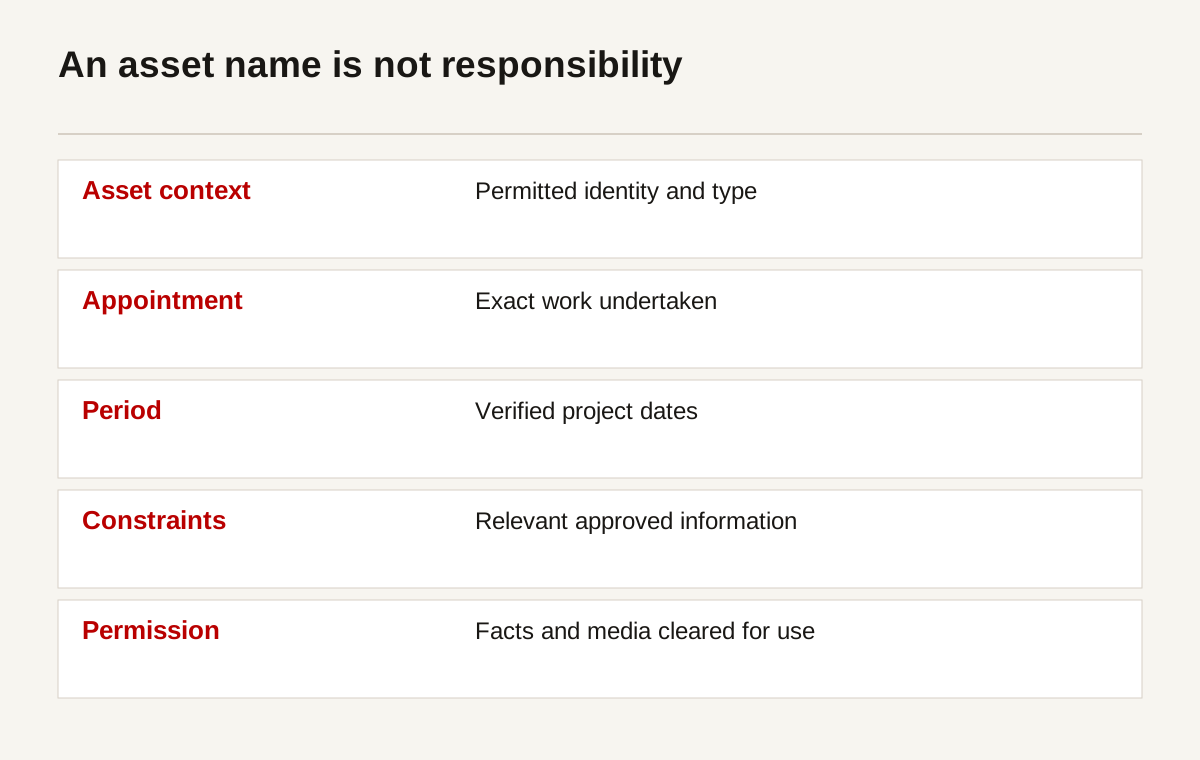
Keep the record accurate when a vessel changes name or ownership. The IMO identification-number guidance explains permanent ship identification. Where a number is relevant and permitted, verify it rather than assuming the current name alone identifies the historical work. Do not publish vessel details simply because they are searchable elsewhere.
State responsibility without borrowing the vessel's reputation
If the company supplied a component, say so. If it completed a particular repair package, identify that package. Do not use a prominent vessel or offshore asset to imply design or operational responsibility the company did not hold.
Describe constraints that matter to the next buyer. That might be a defined interface, a restricted work window or a documentation requirement, provided the record is approved. Avoid revealing security, commercially sensitive arrangements or operational details without permission.
Where the client cannot be named, use a permitted description. “Planned maintenance package for a commercial vessel; identity withheld” can be informative if the actual scope is clear. Do not create a fictional vessel name to make the record feel complete.
The absence of a measurable outcome does not prevent a useful project entry. A factual responsibility and completion record can help assessment. Invented uptime, savings or turnaround improvements would weaken it.
Structure equipment information for comparison
Product information should let someone identify the exact item and the conditions relevant to their application. A photograph and a broad description may be insufficient. Organise model, application, key dimensions, units, interfaces and maintained documents according to the product.
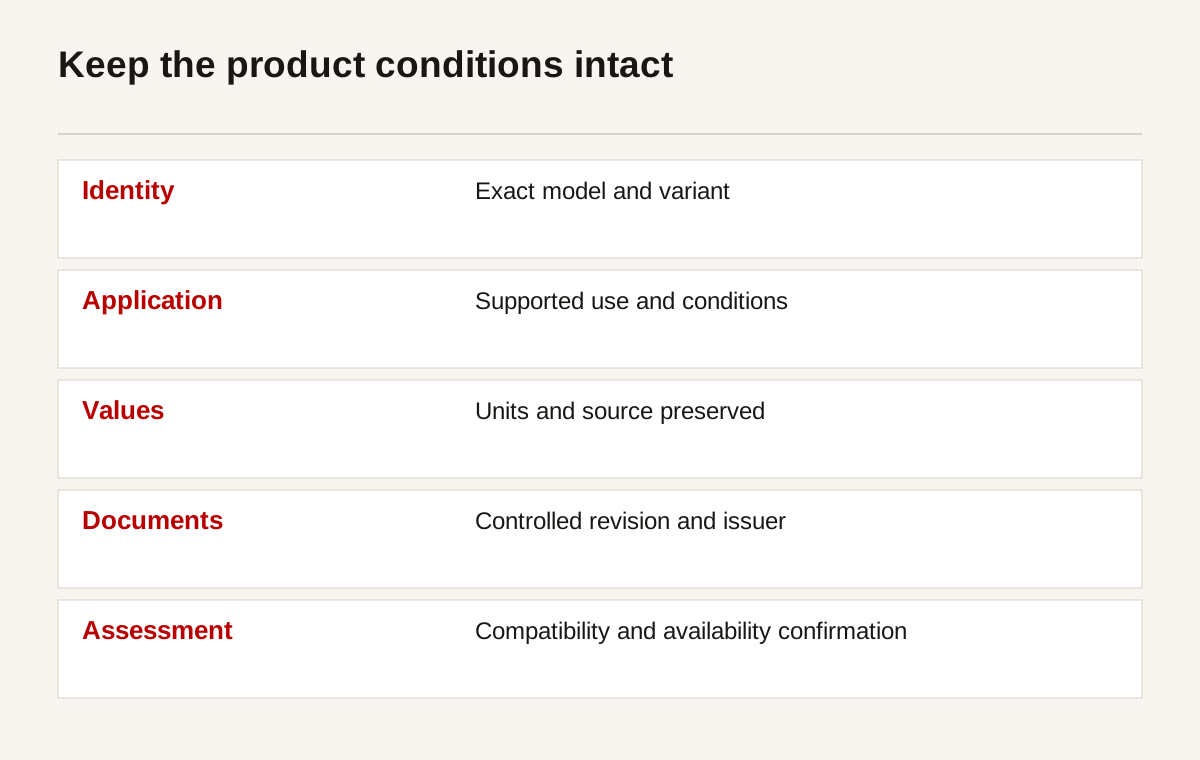
Use the manufacturer's controlled information where authorised. Record the document revision and source. Distinguish an indicative image from an image of the exact variant. A family photograph should not quietly represent every configuration.
Do not change units without showing the basis. If a converted unit is useful, have the responsible technical reviewer check the calculation and rounding. Conditions such as temperature, pressure, material or configuration can be essential to interpreting a specification.
Handle a model that has been replaced
Suppose a product family remains available, but the model in an old project photograph has been discontinued. This is an illustrative record problem. Keep the historical project description accurate. Do not silently relabel its photograph as the new model.
Ask the product owner whether a replacement exists and which conditions differ. Update the current product page from the controlled source. Identify the older variant clearly where buyers may still need support information. A successor link should explain that compatibility requires assessment rather than imply a direct substitution.
Review downloadable data sheets and enquiry routing at the same time. A request arriving with an older part number needs to reach somebody who can interpret it. The public page can tell the reader which identifiers and application details to provide without prescribing an unverified technical replacement.
Record the change date and approval source internally. This allows future editors to distinguish a historical project fact from a current supply promise. It also prevents a polished redesign from reintroducing an obsolete specification through an old document library.
Keep procurement and technical questions connected
Put the readable application summary on the page and offer the controlled document for detailed review. Link the enquiry to the model so the buyer does not have to reconstruct the context. Explain whether stock, lead time or availability requires confirmation.
Avoid presenting a dated stock image as current inventory. When availability is not integrated with an approved stock system, use accurate language that directs the buyer to confirmation. A visually convincing “in stock” label creates a promise the team must be able to maintain.
A table can support comparison when products share real attributes. Label the headers and provide a useful caption. The W3C table tutorial provides implementation guidance. Do not build a comparison that treats different test conditions as equivalent simply to fit the layout.
Show facilities without exposing sensitive details
Facility evidence can clarify the work the company performs and the setting in which it operates. Begin with the assessment question. Does the buyer need to see the relevant workshop area, equipment, access arrangement or a completed package? Choose images that answer that question.
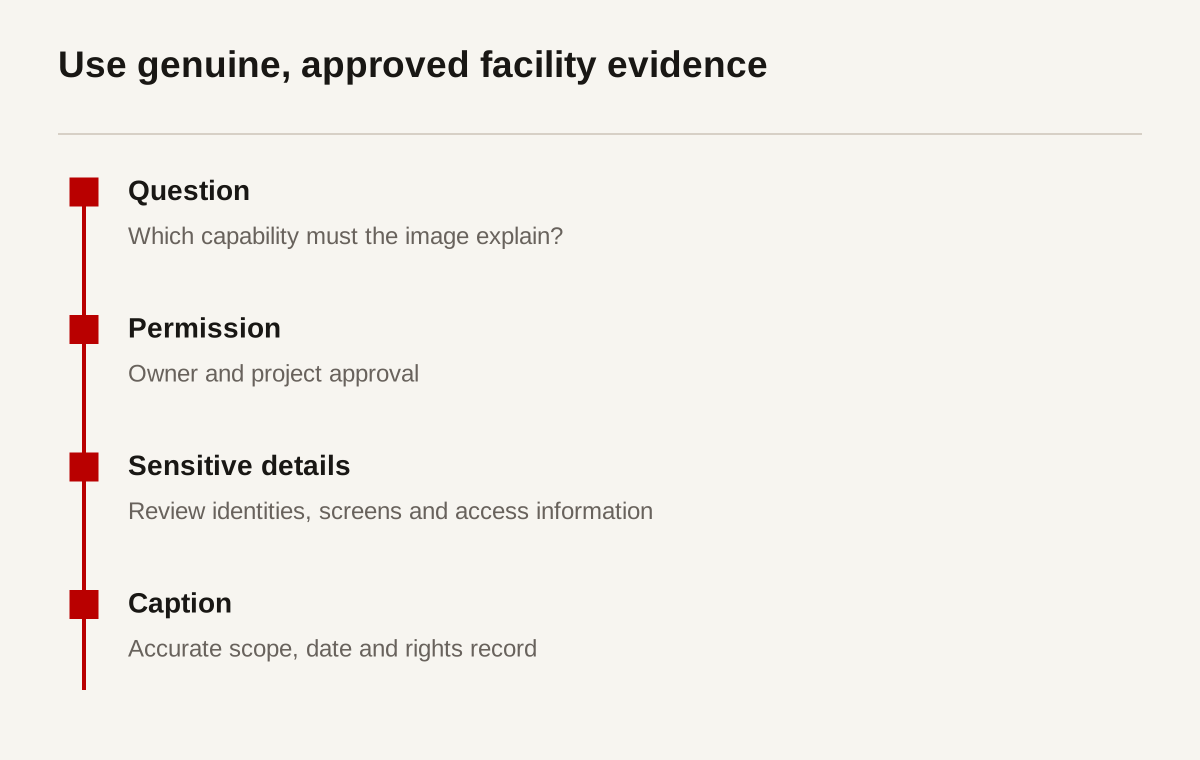
Use genuine, approved photographs for actual facility claims. When no suitable images are cleared, a labelled process diagram can explain the information to collect. Do not use generated imagery to pretend the company owns a yard or workshop.
The diagram below is a publication checklist, not a photograph or floor plan of a client facility.
Build the permission check into production
Ask the facility owner and responsible project staff to approve the intended use. Check people, client marks, vessel identities, screens, access details and documents visible in the frame. A photograph can disclose more than its author intended.
Do not alter an image in a way that misrepresents protective equipment, operational conditions or the actual facility. If a sensitive detail cannot be handled appropriately, choose another image. An attractive shot is not more important than accurate, permitted publication.
Keep the caption and rights record with the original file. The W3C image tutorial helps determine the text alternative for its information purpose. The surrounding page should also explain the scope depicted, rather than relying on alternative text to carry every qualification.
Present compliance at the right level
Separate company credentials, personnel qualifications, product approvals and vessel certificates. They apply to different things. A certificate displayed beside an equipment image can easily imply an approval that it does not provide.
The IMO's survey and certification overview explains the role of flag-state administrations and recognised organisations in ship certification. It is not a general endorsement of a commercial supplier. Use the exact issuer record and scope for the claim being published.
| Credential type | Application to verify | Source or issuer check | Renewal and display responsibility |
|---|---|---|---|
| Company management-system certificate | Entity, activities and locations covered | Certificate and issuer verification | Company credential owner |
| Product approval or test record | Exact model and stated conditions | Issuer or manufacturer source | Technical product owner |
| Personnel qualification | Individual role and current validity | Authorised qualification record | Responsible team and staff consent |
| Vessel certificate | Specific asset and document purpose | Relevant flag or recognised-organisation record | Do not imply supplier-wide approval |
| Facility authorisation | Activities permitted at that facility | Applicable authority and current record | Facility owner |
Do not shorten a conditional approval into “fully certified”. State the actual status and link to verification where appropriate. Keep documents readable, but avoid publishing personal or sensitive certificate details unnecessarily.
For a specific overseas claim, consult the applicable authority and responsible reviewer. Requirements can differ by asset, flag, activity and location. This guide does not prescribe technical compliance for every market.
Create a register with issue date, expiry, source, scope and review owner. A redesign should not carry obsolete badges into a new layout without checking them. Remove or clearly archive material that no longer represents the current status.
Make mobile enquiries usable and honestly routed
A time-sensitive buyer may be using a phone while coordinating several parties. Put the service scope and contact route where they can be found. Keep the information request short enough to begin assessment, without losing details essential to route the work.
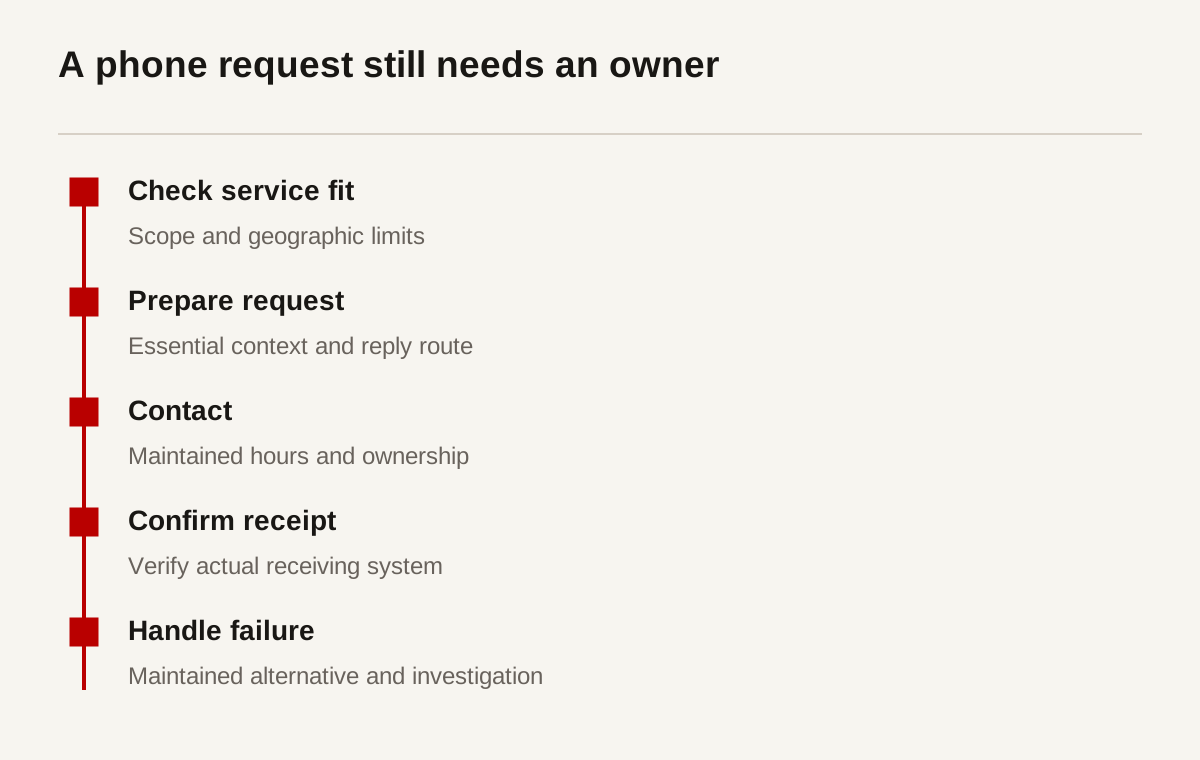
| Request type | Information to begin assessment | Responsible owner | Escalation limitation |
|---|---|---|---|
| Planned package | Scope, asset context, location and intended period | Assigned commercial or project team | Follow the actual procurement route |
| Product enquiry | Model or application, quantity and destination | Product team | Availability and compatibility need confirmation |
| Time-sensitive service | Requirement, asset context, location and reply route | Maintained service contact | No automatic attendance promise |
| Missing submission confirmation | Time and route used, without unnecessary confidential detail | Website or receiving-system owner | Provide a maintained alternative contact |
| Safety or emergency matter | Follow appropriate established emergency procedures | Relevant emergency or operating authority | Do not treat marketing contact as emergency instruction |
Use persistent labels, clear errors and known attachment limits. The W3C forms tutorial is an implementation reference. Do not hide the required information behind a decorative interaction that is difficult to operate on a small screen.
Test the route on your own site. Mark the test and agree it with the receiving team. Confirm actual delivery, attachment handling and ownership. Endpoint acceptance alone is not evidence that someone received the request.
Give absence and failure an owner
An assigned contact can leave, travel or be unavailable. The public route should not depend on one person without a maintained coverage arrangement. Decide who updates it and how absence is handled.
Test the alternative route, too. An error message that says “email us” is only useful if that address is current and checked. Keep any response-hour claim aligned with the actual team's coverage and time zone.
Do not put vessel names, contact details or requirement text into public analytics. The receiving system and measurement system have different purposes. Keep enquiry content within the approved business handling process.
Reach overseas buyers with actual delivery information
A market page should answer a real question. Explain how the company assesses requests from that location, the delivery model and the verified responsibilities. Do not create pages for Singapore, Malaysia, Australia, Germany, France and the UK by changing the country name in identical copy.
If a local partner is involved, describe the arrangement only with permission and current agreement. Say who takes responsibility for assessment and delivery. A partner logo does not explain the commercial boundary.
For language versions, use a competent reviewer who understands the technical scope. Preserve units, product names, conditions and contact limitations. Google's multi-regional and multilingual site guidance provides the search implementation context. Translation alone does not establish local service capacity.
| Channel | Buyer stage | Proof needed first | Useful review measure |
|---|---|---|---|
| Service-specific search | Identifying a possible provider | Clear scope and verified coverage | Relevant enquiries and scope questions |
| Product search | Technical or procurement assessment | Current model and document records | Requests tied to suitable applications |
| Agent or partner relationships | Routing and qualification | Maintained contacts and responsibility | Suitable requests reaching the right owner |
| Selected trade event | Planned commercial conversation | Approved capability and project material | Recorded assessment steps after meetings |
| Professional content | Research and internal circulation | Useful answer with credible sources | Buyer questions answered, not reactions alone |
Choose channels the team can support. An overseas campaign without response ownership can generate disappointment rather than opportunity. Establish the information and contact arrangement before expanding the audience.
Read maritime statistics without forecasting your sales
MPA reported container throughput of 39.0 million TEUs for 2023 and 41.12 million TEUs for 2024 in its January 2025 port-performance release. Its 13 January 2026 release reported 44.66 million TEUs for 2025. The visual below uses those container-throughput values only.
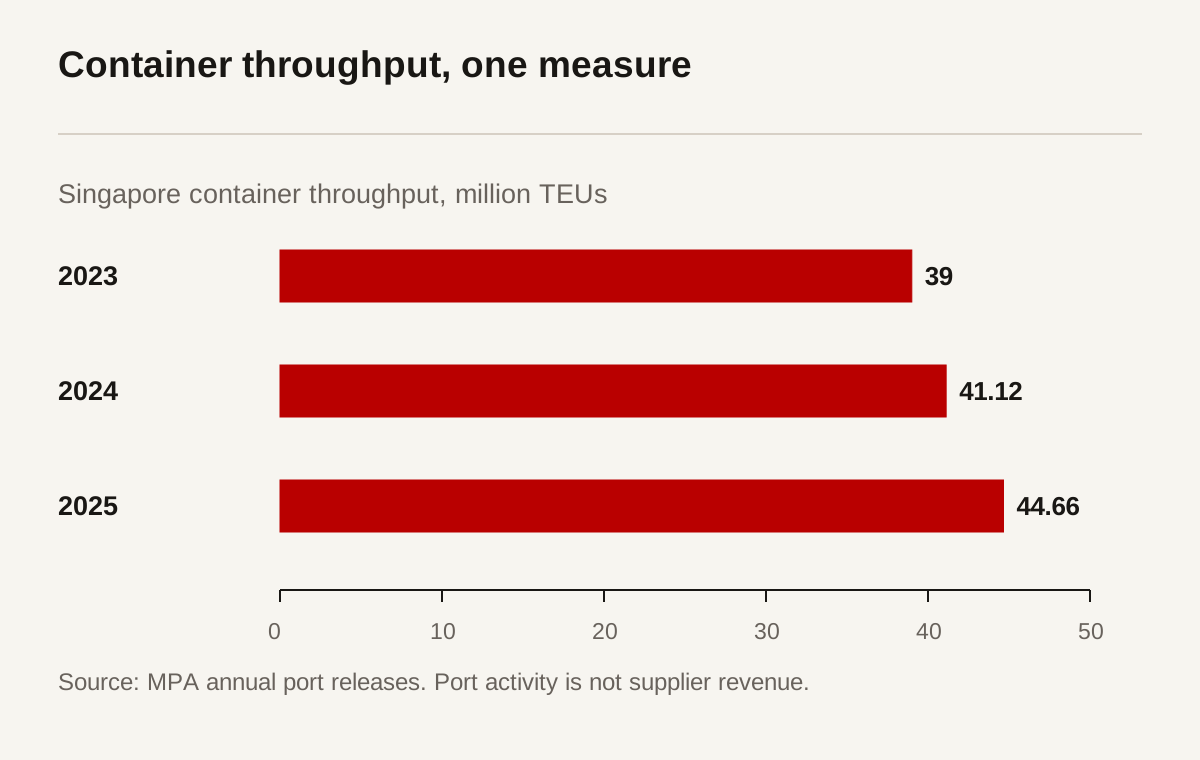
TEUs are not gross tonnage, fuel sales or the number of vessels served by a particular company. Do not combine those measures into one trend. The data file preserves the unit, period and source for each value. No interpolation or supplier-sales estimate is used.
Turn context into a question to investigate
Port activity can help frame a discussion about the industry's operating context. It cannot tell you whether your service category has grown, whether your stock fits buyer needs or whether a website campaign will win work.
Ask which activities are relevant to your appointment. Review authorised commercial records, actual customer questions and the procurement routes you can serve. A company supplying a specialised offshore component should not treat container throughput as a direct measure of its addressable demand.
Keep the market figures out of client-result claims. It is misleading to place an MPA growth statistic beside a studio case study and imply the project achieved it. Source labels and surrounding interpretation matter as much as the chart itself.
Maintain the information that makes the promise
Coverage, contacts, credentials and product availability can change faster than a company story. Treat them as maintained records. Give each one a responsible owner and a trigger for review.
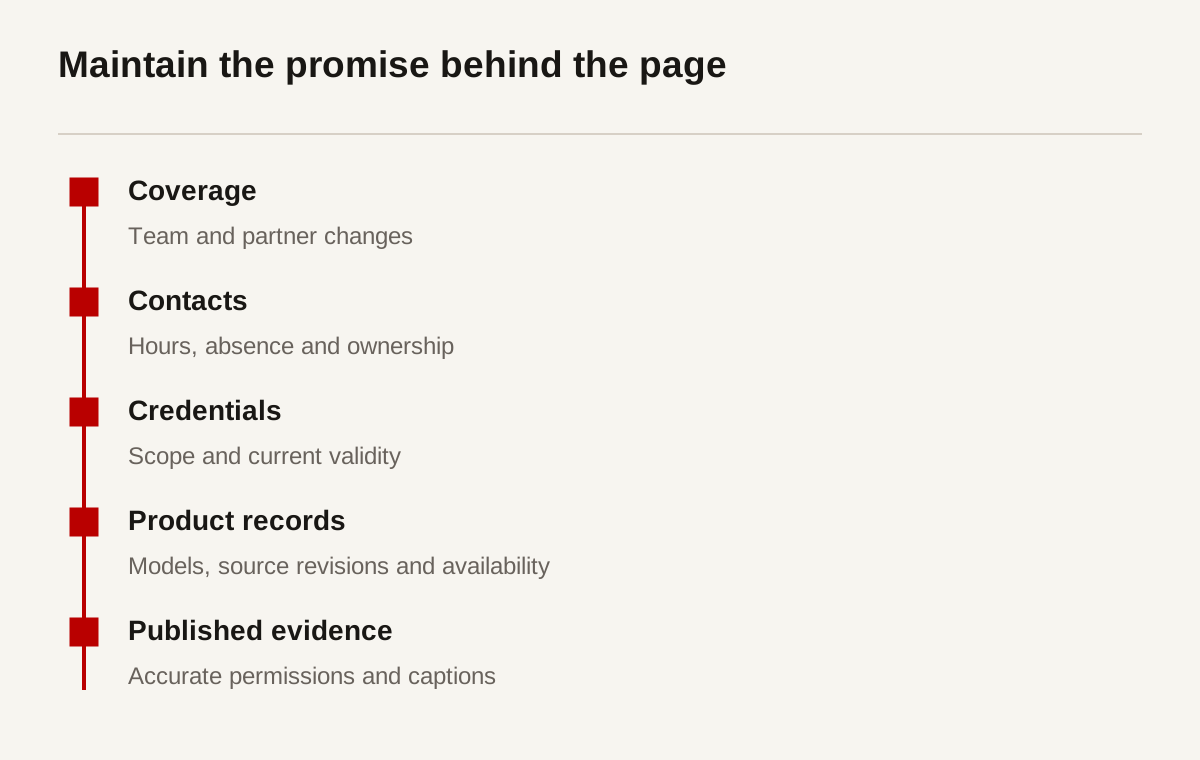
A service lead should review coverage when staffing or partner arrangements change. A product owner should review documentation when a model or specification changes. A credential owner should review validity before expiry. The editor then publishes approved changes across pages and downloads.
Use one source of approved facts wherever possible. A capability pack and service page should not describe different locations or response hours. A project entry should link the current service without rewriting the historical appointment.
Review the commercial handoff regularly
Ask whether useful requests reach the intended team and whether repeated questions reveal missing information. Keep a list of enquiries that were outside scope, lacked essential context or could not be routed. Those are different issues and need different fixes.
Use Google's Search Essentials as a general search reference. Search readiness is not a promise of ranking or a substitute for current operating information. A findable but inaccurate service page can be worse than a quiet one.
Use task observation to check important pages. The GOV.UK moderated usability guidance supports defined tasks such as identifying coverage or preparing a requirement. A small test can identify confusion; it does not establish an industry-wide response rate.
Set a ninety-day production plan
Resolve an inaccurate record before distributing it
Suppose a partner-supported location appears on a service page, but the agreement has changed. This is an illustrative scenario, not a client incident. First ask the delivery owner to confirm the current arrangement. Do not let an editor replace the partner name with a broader coverage claim just to avoid an empty section.
Identify every place that repeats the record. The location may appear in a capability PDF, an event presentation, an email signature and a translated page. Update the approved source, then remove or correct those copies. Keep the historical project entry accurate without implying the arrangement remains available today.
Tell the receiving team what changed. They need to know how to answer a request that refers to an older document. Record which enquiries need case-by-case assessment and which cannot be accepted. The website correction is only one part of the change.
Finally, verify the public pages and downloads. Open the actual visitor links rather than relying on the editor's preview. Confirm that cached documents, language versions and search-facing summaries no longer repeat the unsupported promise. Keep the review date and responsible owner in the internal register.
This process is useful for contacts, stock statements and credentials as well as geography. It helps a small commercial team maintain a reliable record without attempting to rewrite the entire website whenever one fact changes.
Begin with current scope and response ownership. Collect evidence next. Only then expand pages and channels. Otherwise the publication effort can distribute a promise that nobody has checked.
During the first month, agree buyer routes and verify coverage. Inspect public contact details and test owned enquiry delivery. Collect credentials, product sources and publication permissions. Record unknowns with a responsible reviewer rather than filling them with assumptions.
During the second month, draft the most important service and product pages. Build a controlled capability outline. Prepare approved experience records and image captions. Test mobile assessment tasks before publishing or redesigning the complete site.
During the third month, use the material in selected commercial channels. Review enquiry fit and repeated questions. Repair information and routing gaps. Decide the next quarter's work from the evidence, not a fixed demand to publish every day.
Use the workbook as the maintained record
The workbook contains service specifications, coverage records, enquiry requirements and credential reviews. Sample rows are explicitly marked examples. They do not describe Creatif Work's clients or establish service availability in any country.
Complete service scope first, with the responsible technical and commercial staff. Complete coverage next, checking the exact delivery model. Use the enquiry sheet to define what each route needs and who owns it. Keep the credential sheet with the reviewer responsible for validity.
The CSV pack provides the same structures and the source data for the port-context visual. There are no macros, private vessel records or client analytics. The article remains usable without opening either file.
Questions marine directors should settle
Should we advertise global coverage?
Only if the statement accurately describes the company's maintained operating arrangement. Separate self-delivery, partners, supply destinations and enquiries subject to assessment. A country list is not proof of attendance capability.
Can we show every vessel we worked on?
Only with the appropriate publication permissions and an accurate description of responsibility. A public vessel record does not automatically permit publishing a client's work or operational details. Keep the experience claim narrower than the evidence, not broader.
Do port records prove demand for our service?
No. They provide industry context in specified units and periods. Your service needs its own assessment of buyers, relevant activity and capacity. Do not turn overall throughput into a forecast of enquiries or revenue.
Should urgent requests go through the contact form?
Only where the process and response arrangement support it. Make maintained commercial contacts visible and explain their limits. Safety and emergency matters need the appropriate established procedures, not an unverified marketing route.
Make the company's actual scope easier to find
At Creatif Work, we start with the gap between what buyers need and what the website currently explains. For a marine business, that may be unclear coverage, outdated product records, unqualified project photographs or enquiries with no owner.
We can turn approved information into maintainable website pages. Where there is a real customer-document or request-management need, web application work can support that workflow. A portal is not necessary simply because the business operates overseas.
Sources and scope
References were reviewed on 1 October 2026. Recheck operating coverage, technical requirements and regulatory material before relying on them for a specific appointment.
- MPA 2024 port-performance release: 2023 and 2024 container-throughput values.
- MPA 2025 port-performance release: 2025 container-throughput value.
- IMO identification-number guidance: asset identification context.
- IMO surveys and certification: vessel certification context, not supplier endorsement.
- Google multilingual and multi-regional sites and Search Essentials: search implementation context.
- W3C images, tables and forms: accessible information and interaction.
- GOV.UK moderated usability testing: task-based review method.
No client interviews, representative site audit or measured marketing outcomes are reported here. All coverage and workflow diagrams are illustrative. The port series is not a sales forecast, and this article does not provide operational emergency advice.