

A Principal Contractor Prequalification Page for 2027

A principal contractor prequalification page should help a client establish who the contractor is, what work it controls, how competence and systems are managed, and which evidence can be reviewed. It should not try to replace project-specific prequalification.
Build it from maintained records so the public page and tender answers agree.
What should a principal contractor prequalification page include?
Include the legal entity, locations, service and project scope, relevant registrations, dutyholder and competence approach, building safety, health and safety and quality systems, supply-chain controls, comparable projects, current certifications and a controlled document request route.
| Section | Buyer question | Public evidence |
|---|---|---|
| Entity | Who will contract and hold responsibility? | Legal name, number, group and locations |
| Scope | Which projects and roles are undertaken? | Sectors, delivery models, limits and services |
| Competence | How are capable people and organisations appointed? | Role framework, verification and review |
| Systems | How is work planned, controlled and recorded? | Process overview and scoped certificates |
| Supply chain | How are designers, trades and products managed? | Selection, information and performance process |
| Projects | Has the contractor delivered comparable work? | Role, constraints and approved result |
| Documents | How can current evidence be checked? | Named route and responsible contact |
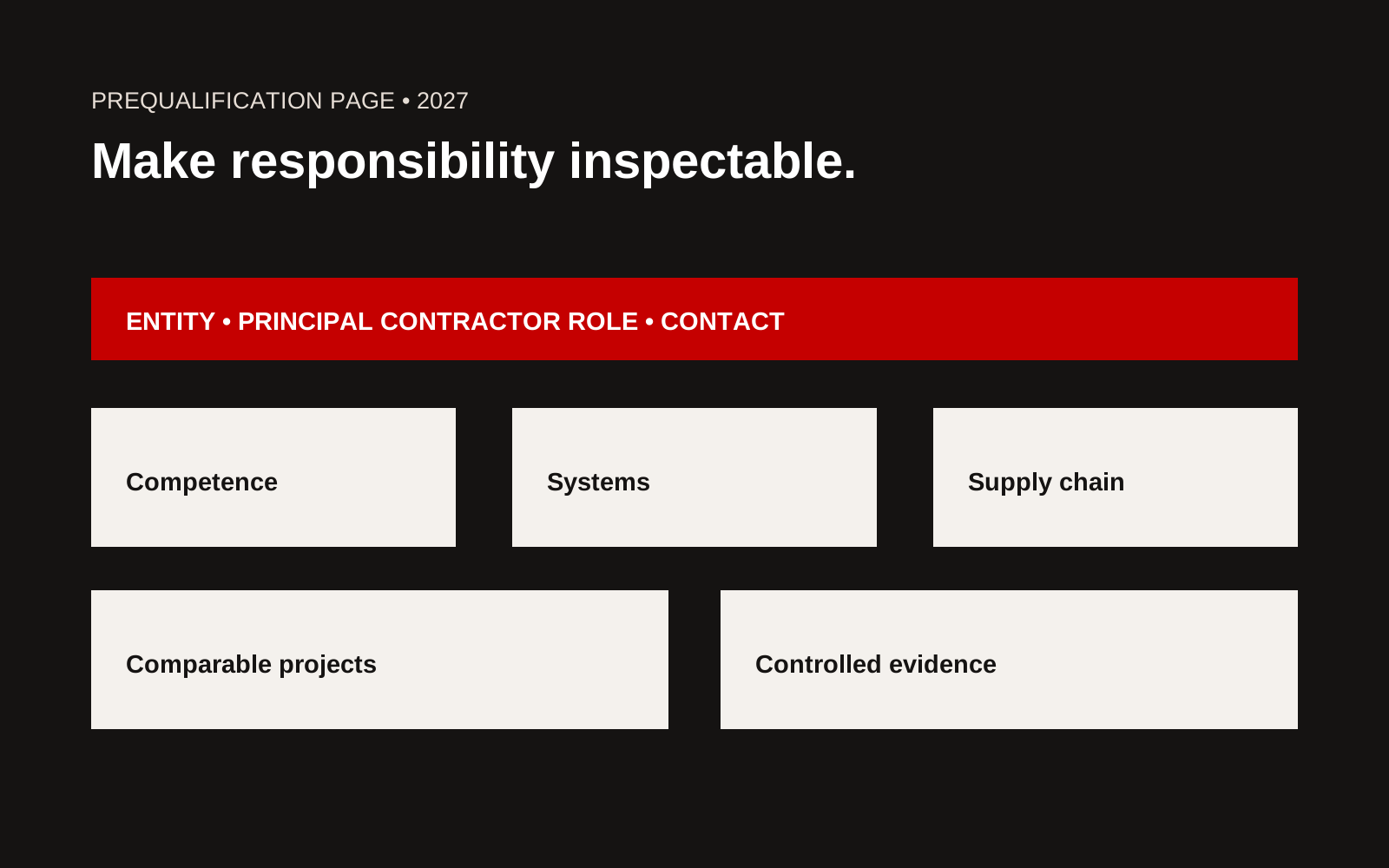
Principal contractor prequalification page with entity, competence, systems, supply chain, project evidence and document request route.
State the entity and role
Give the registered entity, company number, office locations and group relationship. Explain whether the company acts as principal contractor, design and build contractor, main contractor or package contractor, and under which project conditions.
Do not imply that every group company shares the same certification, experience or insurance.
Explain competence as a process
State how organisational and individual competence is defined, checked, maintained and reviewed for project roles. Describe supervision and escalation where experience is developing.
Avoid publishing personal certificates. Keep them in the controlled qualification process and publish the governance.
The Building Safety Regulator is the official source for current England building-safety guidance within its remit. Check project location and applicable regime, because UK jurisdictions and building types can differ.
Connect systems to delivery
A management-system certificate needs entity, standard, scope, certification body and validity. Explain how planning, design control, change, product information, inspection, non-conformance and handover work on projects.
One approved process example can show the system better than a policy statement.
Explain supply-chain control
Describe selection, scope definition, competence review, onboarding, product approval, information exchange, supervision, performance and corrective action.
State how contractor-designed portions and specialist design are coordinated. Buyers need to see how responsibilities move across appointments, not only that a preferred supplier list exists.
Use comparable projects
Choose project evidence by building type, dutyholder role, procurement, complexity, occupancy and constraints. State exact contract role, design responsibility and result.
Do not use a project completed by another entity without explaining the relationship and relevant people or systems.
Create a controlled evidence route
Public pages can show system summaries and current certificate details. Insurance, references, performance records, personnel evidence and sensitive project material may require controlled access.
Give buyers:
- a qualification contact
- expected information needed from them
- confidentiality route
- typical response process
- document currency statement
Address product and information control
Explain how product information is checked before procurement, how substitutions are reviewed, and how the approved decision reaches site and handover records. State who owns manufacturer information, design acceptance and installation evidence.
For building and asset information, describe naming, status, review and approval at a high level. Do not publish live project records or security-sensitive building information.
Show performance with a boundary
If the page includes safety, quality, programme or social-value measures, define the entity, projects, period, workforce and calculation. Separate company-wide data from one project result.
A trend or corrective-action example can be more useful than an undated headline number. Keep the full record available through the controlled route.
Prepare for change in 2027
Assign a regulatory owner and review official updates. The UK's single construction regulator is still developing, so the page should reflect confirmed current duties and evidence, not predict final implementation.
Record which sections need review when competence, construction products, building control or reporting requirements change. This makes the public page maintainable during transition.
Page checklist
- Contracting entity and group relationship clear
- Principal contractor role and limits stated
- Competence governance explained
- Certifications show scope and validity
- Building safety and current guidance linked
- Design, product and change controls described
- Supply-chain process covers competence and information
- Projects show exact role and constraints
- Controlled evidence route is usable
- Page owner and next review date visible
Test the page against a real shortlist
Ask a framework manager, estimator or external adviser to assess the page as though they had ten minutes to decide whether to invite the contractor. They should be able to confirm the entity, role, relevant work, competence system, supply-chain controls and route to controlled evidence without opening a general company brochure.
Record every question the page cannot answer and classify it. Public gaps should be added to the page. Sensitive evidence should receive a clear request route. Project-specific questions belong in the tender response rather than a generic claim. Repeat the test after any regulatory, certification or organisational change. Keep the prequalification page linked to the same source records used for tenders, so corrections do not depend on someone remembering every place a statement was copied. Measure useful qualification enquiries and clarification requests, not simply page views.
Creatif Work builds construction websites around the questions framework and private buyers use to qualify contractors. Through our website service, an existing prequalification pack can become a maintained public evidence layer without exposing controlled records. Our guide to UK framework readiness provides a related procurement checklist.