

The Project Evidence Library Behind Faster Tender Responses

A project evidence library is not a folder of old submissions. It is a structured record of approved project facts, scope, conditions, outcomes, documents, permissions and owners. It lets a bid team find relevant proof without copying unsupported statements from the last tender.
The library should feed proposals, capability statements and public case studies while respecting different permission levels.
What should a project evidence library contain?
Store project identity, client permission, location, dates, contract role, services, asset or facility, scope, interfaces, constraints, people, approved outcomes, metrics, documents, references, confidentiality level and review date.
| Record group | Example fields | Owner |
|---|---|---|
| Identity | Approved name, client, location, dates | Project director |
| Scope | Contract role, deliverables, exclusions | Commercial and technical |
| Context | Asset, sector, procurement and constraints | Bid or marketing lead |
| Performance | Measure, unit, period, source and reviewer | Technical or project controls |
| People | Approved role and experience | People team |
| Documents | Certificates, reports, photos and drawings | Document control |
| Permission | Public, tender-only, client approval, expiry | Commercial or legal |
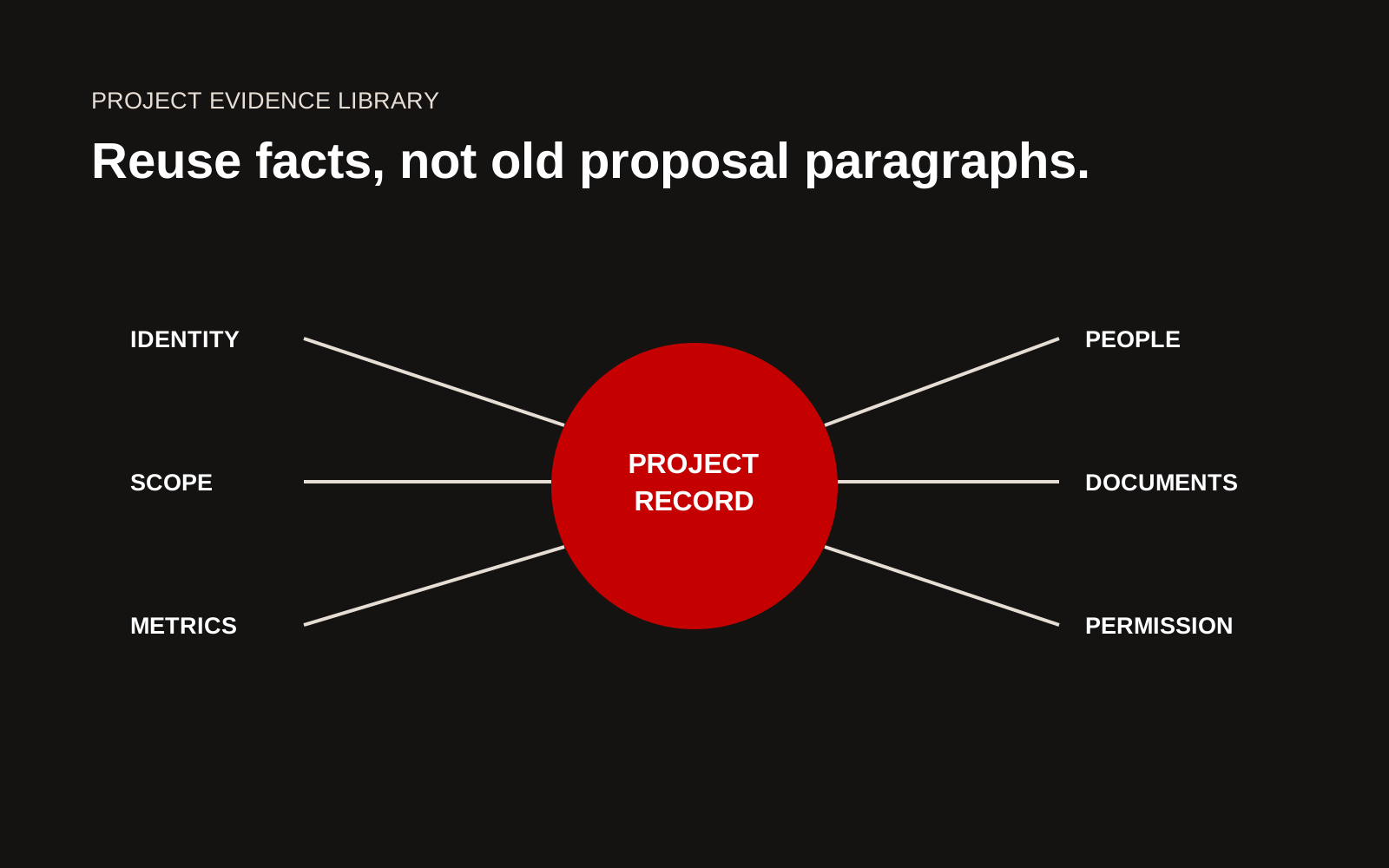
Project evidence library data model connecting project facts, services, metrics, people, documents, permissions and tender responses.
Design the record before choosing software
Collect five recent tenders and identify the project facts repeatedly requested. Compare the wording and find contradictions. Use this to design the fields, controlled vocabularies and permission levels.
A spreadsheet can support an early library if ownership and rules are clear. Custom software becomes useful when relationships, permissions, approvals, document versions or many contributors become difficult to control.
Capture the exact contract role
State whether the company was main contractor, joint-venture partner, designer, subcontractor, supplier or consultant. Record the scope it actually delivered.
Do not use total project value or full project outcome as if it all belonged to one package. Store package-level quantities and outcomes where approved.
Store metrics with their context
Every number needs:
- metric name and definition
- value and unit
- reporting period
- project and workforce boundary
- source document
- calculation where applicable
- technical reviewer
- permission level
- next review date
This prevents an old statistic from becoming a timeless corporate claim.
Use tags that support decisions
Tag by fields evaluators use: sector, asset, service, contract role, geography, project size band, delivery model, constraint and evidence type. Avoid an uncontrolled tag list where "rail", "railway" and "transport" split the same records.
Search should help a writer find comparable evidence, not merely the same words.
Separate permission levels
Use clear access classes:
- public and approved
- available in a controlled tender
- internal reference only
- restricted to named people or contracts
A record can contain fields with different classifications. Public project dates may sit beside a tender-only reference contact and restricted contract data.
Build an approval workflow
A proposed record should move through technical, commercial and client-permission review where needed. Store who approved which wording and when.
When a tender writer edits an approved claim, the system should make the change visible for review rather than silently replacing the source record.
Design retrieval around tender questions
Test the library with actual requests: projects delivered in a region, work under live operations, packages above a stated scale, or examples using a certain delivery model. Measure whether a user can find and verify the best record without knowing the project name.
Search results should show why a project matched. Filters can narrow sector, service, role, geography and evidence status, but free-text search remains useful for constraints and outcomes.
Handle people evidence separately
Link approved project roles to employee experience without copying full CVs into every record. Respect consent, employment changes and personal-data access. A bid can generate a current CV from approved fields while the public case study names only authorised team members.
Plan import and clean-up
Start with a small, valuable set of projects. Reconcile duplicates, conflicting dates, client names and role descriptions before scaling. Mark unverified fields rather than filling them from memory.
Set a minimum complete record and an archive state. A half-imported library with no confidence indicator can make tender work slower, not faster.
Connect website and tender outputs
The public website can use the approved title, scope, image and outcome. Tender tools can include deeper metrics and documents based on user permission. Both should reference the same project ID.
This avoids the website stating one role while the proposal states another.
Evidence-library checklist
- Record fields come from real tender questions
- Contract role and delivered scope are explicit
- Metrics include units, periods and sources
- Tags use controlled vocabulary
- Documents have versions and owners
- Client and confidentiality rules recorded by field
- Public and tender outputs share one project ID
- Changes retain an audit trail
- Records have review dates
- Expired evidence is archived, not silently reused
Set a minimum viable project record
Start with ten strong projects rather than importing every old folder. For each, require the project name, customer type, location, dates, contract role, scope, key constraints, approved outcomes, evidence source, disclosure level and an owner. Add people, metrics and media only when they connect to the same record.
Test five common tender questions against the library. A user should be able to find a comparable project, confirm the entity that delivered it, identify the relevant person, retrieve an approved outcome and request controlled evidence without searching email. Log every failed search. The missing result may mean a tagging problem, an incomplete record or a genuine evidence gap. Review those failures monthly and improve the model before adding more software features. Retrieval time, reuse of approved facts and fewer clarification messages are better early measures than the number of documents uploaded.
Australian public procurement notices and awarded-contract information may be available through AusTender, but the tender documents and client approval remain the source for a supplier's own claims.
Creatif Work builds construction websites and custom software around structured project evidence. We can begin with the record model and governance, then build only the interface needed for teams to find, approve and reuse it.