

When More Articles Make Your SEO Harder

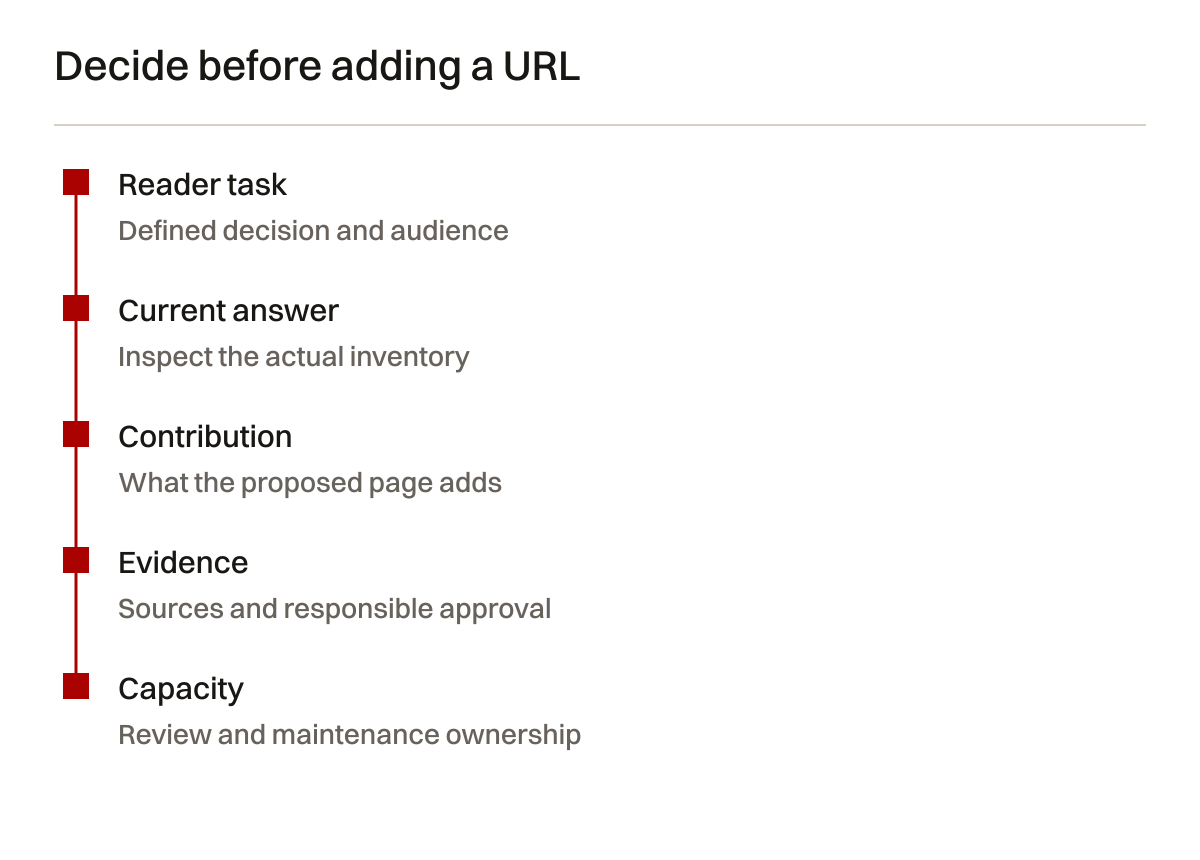
Publishing more articles can make SEO harder when new pages repeat existing answers, lack reviewed evidence or exceed the team's maintenance capacity. Frequency alone is not a penalty. Before adding a URL, define the reader's decision, inspect the current answer and identify what the new page contributes. Sometimes the right next step is an update, not another article.
A calendar says two articles a day. The team has enough drafting capacity. It does not have enough time to check technical claims, design useful diagrams, maintain source records or update service pages after business changes.
Soon several articles answer the same question. A buyer finds an older version. The navigation points to a scheduled page. The newest guide contains a fluent explanation that nobody qualified has approved. More output has created more work, without a clear improvement in the answer.
This guide is a pre-publication decision method. It is not a claim that daily publishing is harmful or that a particular number of articles triggers a search penalty. All calendar, capacity and overlap examples are invented planning scenarios, not an audit of another organisation.
Use the editorial decision workbook or CSV template pack. It helps record page purpose, evidence, overlap, review effort and an explicit publish, update, merge or defer decision.
Separate volume from purpose
Google's spam policies describe scaled content abuse in terms of manipulation and low-value content, regardless of how it is produced. That is not a universal ban on frequent publishing.
A newsroom, technical publisher or product business may have many genuinely different updates. A small service company may have fewer distinct questions it can answer well. Neither should choose its production model by copying the other's calendar.
Ask what each article enables the reader to do. That might be preparing an assessment, comparing responsibilities or understanding a documented change. “Target another keyword” is not a complete reader purpose.
Do not confuse a writing target with a ranking requirement
A word-count target can reserve enough drafting time for a complex subject. It is not a search-engine threshold. Google's helpful-content guidance says it has no preferred word count.
A long article can still omit the answer. A short page can answer a bounded question accurately. Choose depth according to the task and evidence. Do not add generic paragraphs just to cross a minimum.
The same applies to cadence. Publishing weekly or daily describes production timing. It does not establish originality, reliability or demand. A reporting system should measure those qualities separately rather than calling every released page progress.
Write the proposed page's purpose before its title
Use one sentence: “This page helps this reader make this decision using this evidence.” If the sentence could describe several existing articles, inspect those pages before proceeding.
The title can then name the actual question. A keyword variation should not conceal an identical purpose. “Website refresh guide” and “When to refresh your website” may need one maintained answer rather than two pages repeating the same conditions.
| Proposed question | Existing answer to inspect | Distinct contribution needed | Possible decision |
|---|---|---|---|
| How do we prepare an assessment? | Current preparation guide | New appointment or changed requirements | Update if the task is unchanged |
| How does a specific test work? | Broad service explanation | Reviewed test method and limits | Publish if the narrower task is distinct |
| What changed in a regulation? | Existing current guidance | Verified change and implications | Update and record meaningful revision |
| Which country do you serve? | Service scope and delivery page | Real different operating arrangement | Avoid a location-copy page |
| Should we rebuild our site? | Current refresh-or-rebuild article | Different decision and evidence | Clarify existing answer before duplicating |
The examples are editorial scenarios. They do not establish search volume or prescribe a decision for every business. A subject owner still needs to inspect the actual facts.
Define a useful next step
An article can help without demanding an enquiry. The next step might be a technical document, relevant service scope or a preparation worksheet. It should fit the reader's current task.
Check whether the organisation can receive the action it suggests. A page asking for a drawing review needs a responsible receiving route. A guide that promises a template needs a file that actually opens. Editorial purpose includes those practical consequences.
If the page has no clear reader task or maintained next step, hold the brief. Do not rely on a strong headline to repair an unresolved purpose. That problem becomes harder to fix after design, scheduling and internal links are already built.
Inspect the content inventory before adding another URL
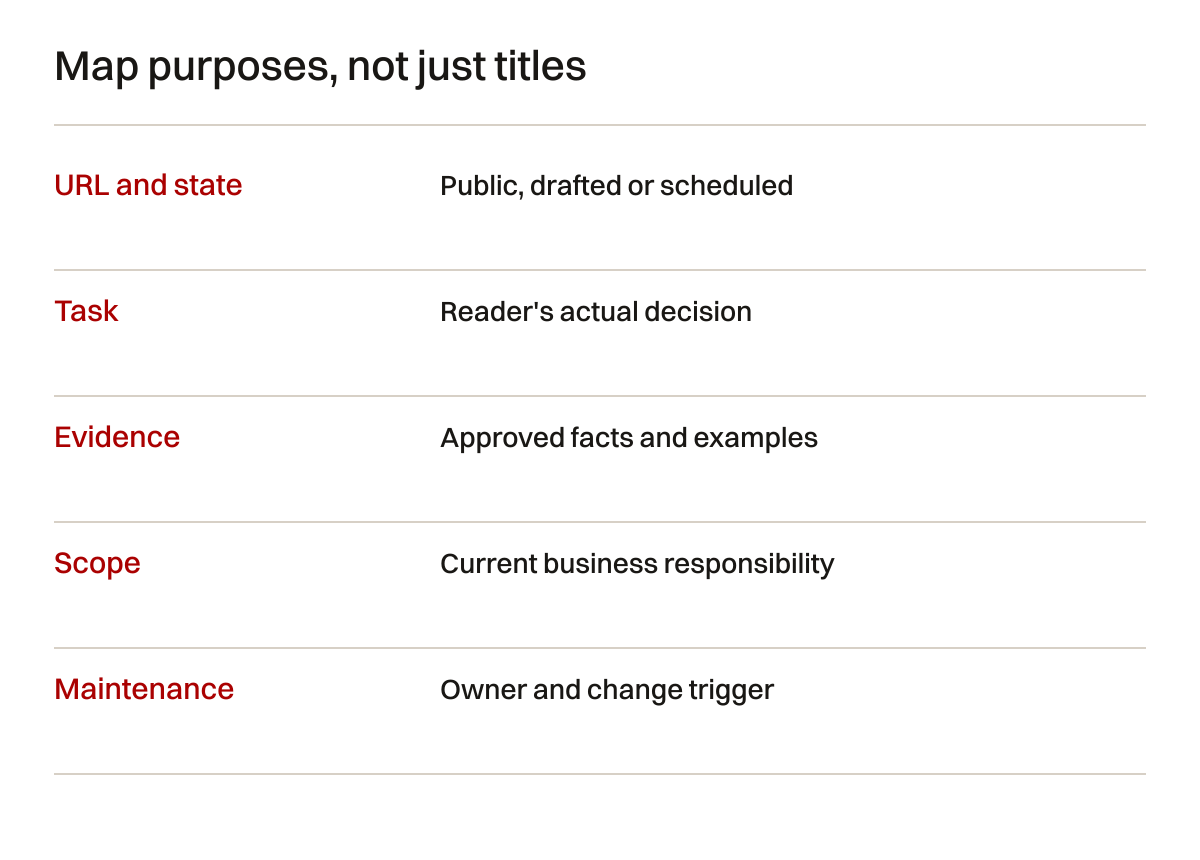
Maintain a page inventory with purpose, audience, main question, supporting evidence, owner and review trigger. Include important service pages and downloads, not only blog articles. The best existing answer may sit outside the blog.
Search by topic and purpose. A different title can conceal a similar answer. Read the relevant sections, compare examples and inspect next actions. Automated similarity can help locate candidates, but editorial judgement decides whether the purpose is distinct.
Keep scheduled material in the inventory
Two writers can accidentally prepare overlapping answers for different future dates. Include drafted and scheduled items with their status. Do not treat an unpublished page as already available to the public.
Check links against publication order. A November guide should not direct readers into a December page that is not public. Update the earlier article later if the relationship becomes useful. The content plan can know about future material without exposing broken visitor paths.
Record cancellation decisions too. If a draft is merged into another brief, preserve the rationale and clear its scheduling state. Otherwise the original draft can return later under a new title and recreate the same overlap.
Distinguish overlap from a genuine problem
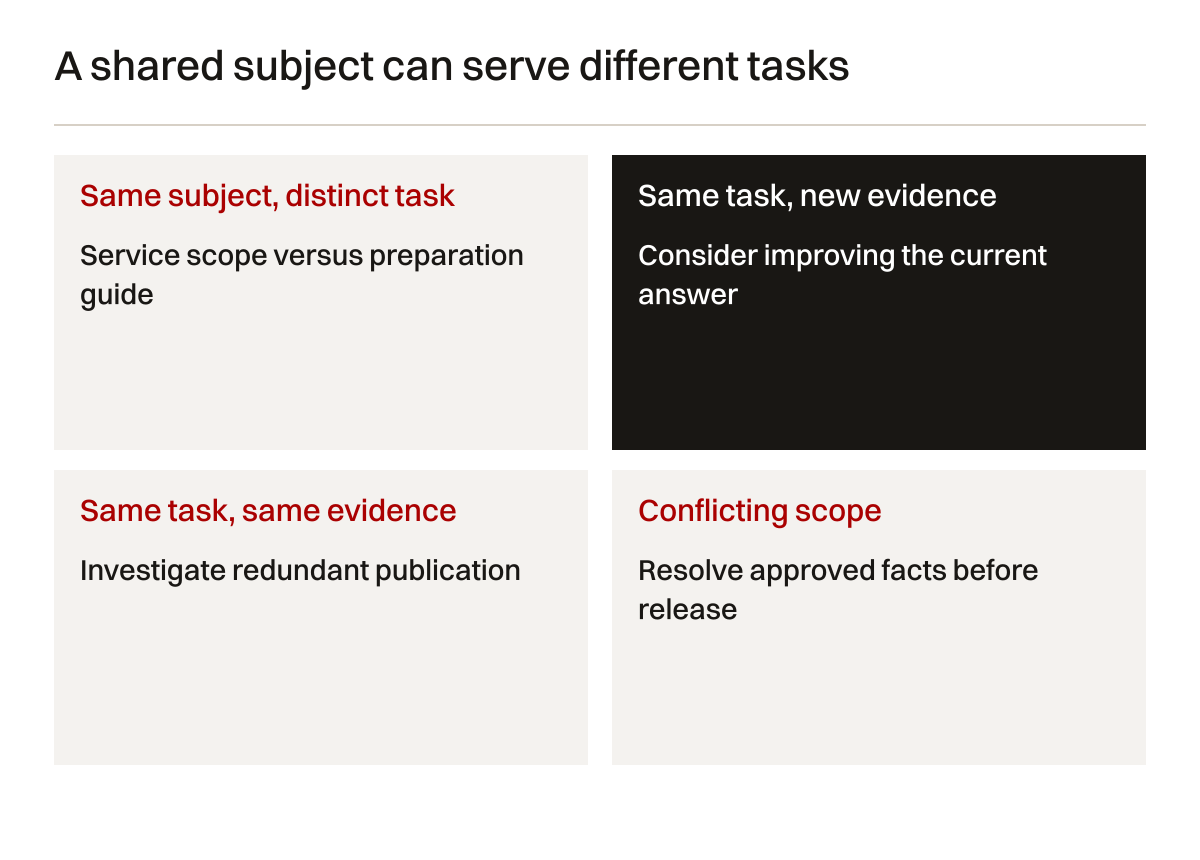
Several pages can legitimately discuss the same subject. A service explanation, preparation guide and case record may serve different decisions. Shared vocabulary is not proof of harmful competition or a reason to delete pages.
The practical warning is repeated purpose with conflicting, incomplete or hard-to-find answers. Inspect whether the reader can identify which page to use and whether the pages provide distinct value. Available search observations can add context, but do not make page-count alone a diagnosis.
Be careful with the word cannibalisation
Do not announce a ranking problem merely because two pages appear for related queries. They may answer different meanings or stages. Establish the observed issue: unstable destination, confusing content, conflicting scope or a page that does not satisfy its assigned question.
Then test the proposed intervention. A merged article may improve clarity. It can also remove useful detail or make a focused answer difficult to navigate. Preserve distinct information and inspect the receiving page before retiring the original address.
Record what would demonstrate improvement in the reader path. That may include fewer contradictory statements, a maintained main answer and appropriate supporting links. Do not promise a ranking gain from consolidation before seeing evidence.
Choose publish, update, merge or defer
A new page is justified when it serves a genuinely different task with sufficient evidence and a maintenance owner. An update is justified when the existing purpose remains useful but its answer needs correction or additional detail.
A merge can be useful when repeated pages contain compatible material that belongs in one answer. Deferral is sensible when important evidence, approval or operating scope remains unresolved. A declined brief can be a valuable editorial decision.
| Decision | When it may fit | Required check | Risk to avoid |
|---|---|---|---|
| Publish | Distinct task and reviewed contribution | Current inventory and public path | Another differently titled repeat |
| Update | Same task, incomplete or changed answer | Facts, sources and meaningful revision | Cosmetic freshness without substance |
| Merge | Compatible repeated purposes | Receiving page and preserved unique detail | Losing a useful focused answer |
| Defer | Evidence or approval missing | Named dependency and review date | Filling gaps with invented claims |
| Retire | Inaccurate or unavailable purpose cannot be repaired | Business approval and destination decision | Deleting useful material from low traffic alone |
Make the decision visible to the business
Use a short explanation. “Update the current guide because the buyer task is unchanged and the new requirement affects its checklist” is inspectable. “Improve topical authority” is too vague to justify the choice on its own.
State what the decision displaces. If updating an important guide replaces two new articles, show that trade-off. A founder can then approve the work based on consequence, not an unexplained publication count.
Keep a review trigger. A deferred article can become publishable when an approved technical record arrives. A maintained guide can need revision when the service changes. An editorial decision is a record of the present evidence, not a permanent verdict about the topic.
Give every brief an evidence budget
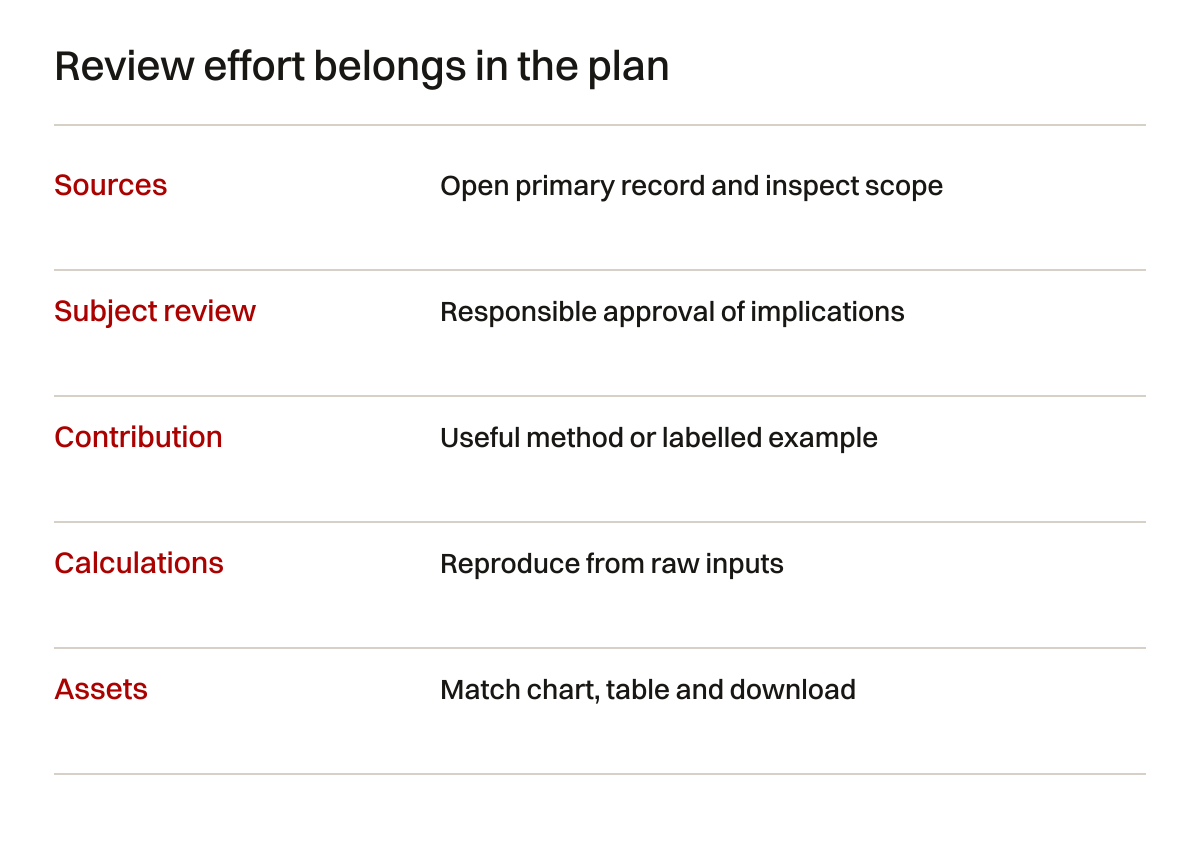
Before drafting, identify the claims needing support. Assign a source or approver to each material statement. Estimate the effort required to obtain and review those records. Do not count only writing hours when assessing production capacity.
The evidence can include official documentation, an approved technical record, a defined demonstration or an original method. Each has a different role. A source can establish a requirement. A fictional example can demonstrate reasoning. Neither should be presented as a client result.
Citation quantity does not establish support
Open the source and check its scope. A study of US consumer browsing may not describe Singapore industrial procurement. An official technical page may explain a control but not predict its commercial effect. State those limits beside the claim.
Do not attach a citation to a paragraph containing several unsupported conclusions. Separate the supported fact from your recommendation. Use the source as evidence, not as a decorative badge that makes the entire article look researched.
Keep source review dates and early-review triggers. A frequently changing product or policy may need review before the article's routine calendar date. Assign someone to notice that change. An archive of links is not maintenance if nobody checks whether the underlying facts remain valid.
Allocate subject review before drafting at scale
A qualified reviewer has limited time. Ask when they can assess technical claims, which records they need and what happens if they reject a section. Book that capacity before scheduling dozens of articles.
Approval should concern facts and implications, not whether the copy sounds impressive. A term can imply a regulated responsibility, a tested capability or a guaranteed result. The reviewer should correct that implication even when it weakens the headline.
A missed approval is a publishing dependency
If the reviewer is unavailable, narrow the answer to facts already approved or defer publication. Do not treat an AI-generated explanation as a temporary substitute for subject approval. Temporary public misinformation still reaches real buyers.
Keep the draft's unresolved claims marked internally. Remove those internal notes only after the issue is resolved. An editor changing “probably” into a confident statement is not completing fact checking.
Define correction authority. Someone should be able to pause a scheduled article or fix an inaccurate page without waiting for the next monthly meeting. Publication systems need an editorial stop mechanism as well as an output queue.
Estimate maintenance as recurring work
Every published page creates a future review obligation. Its size depends on how often the facts change, the consequences of an error and the usefulness of the page. Some stable explanations need little work. Fast-changing conditions need more.
The synthetic example below assumes an average twenty-minute review per article per quarter. That assumption is illustrative, not a recommended review standard. Real review effort can vary greatly and urgent changes occur outside the calendar.
| Synthetic inventory | Assumed minutes per quarterly review | Total quarterly minutes | Total quarterly hours |
|---|---|---|---|
| 60 articles | 20 | 1200 | 20 |
| 120 articles | 20 | 2400 | 40 |
| 240 articles | 20 | 4800 | 80 |
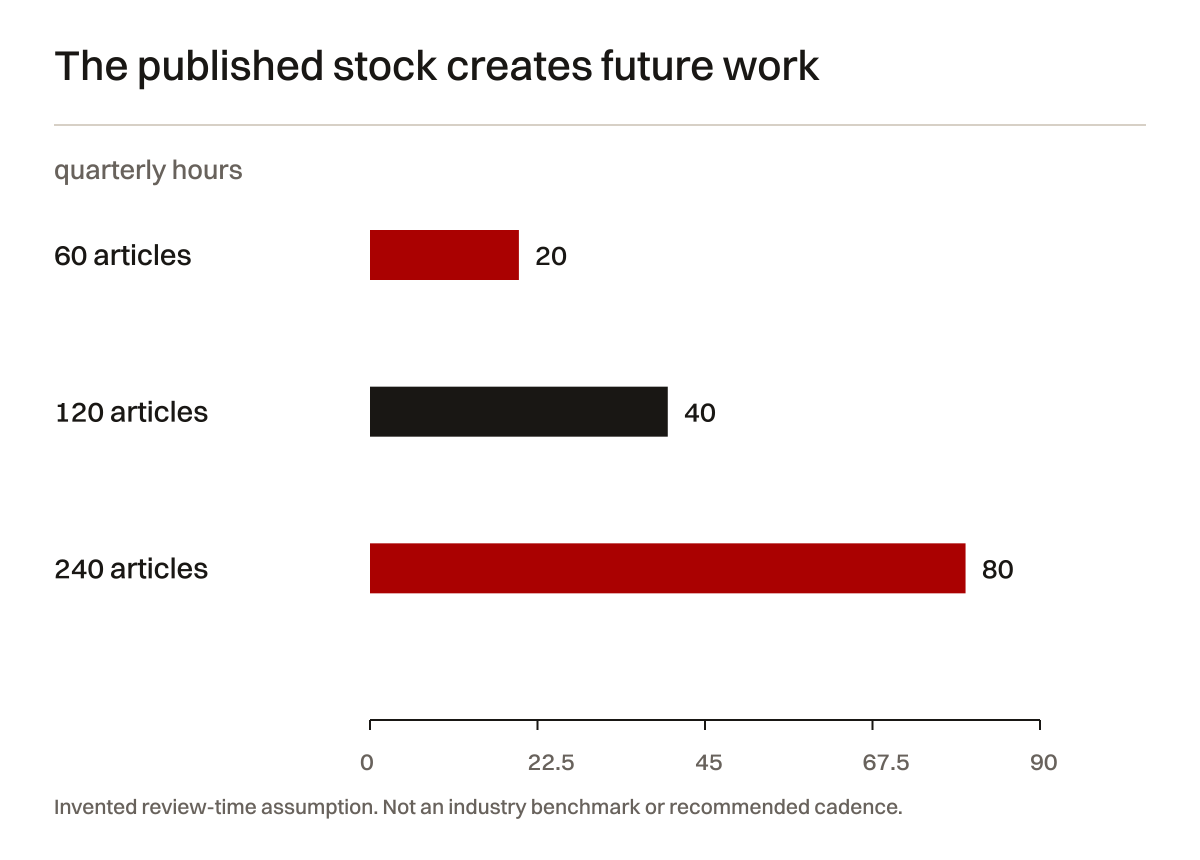
The calculation is inventory multiplied by the assumed review time. It demonstrates that maintenance grows with the published stock. It does not prove all reviews take twenty minutes or that publication should stop at any of these counts.
Include correction and asset effort
A source check can lead to a factual update, revised diagram, changed download and link review. Those tasks require more than rereading the paragraph. Keep related assets in the same maintenance record.
Estimate specialist bottlenecks separately. Writers may have capacity while technical reviewers or designers do not. A single total-hours figure can hide that mismatch. Identify which role limits safe publication before expanding the calendar.
Use a rolling view of obligations. Add scheduled pages and known product changes. Retain capacity for corrections. The purpose is not to discourage ambitious publishing. It is to prevent the team acquiring an inventory it cannot keep accurate.
Make visuals explain the argument
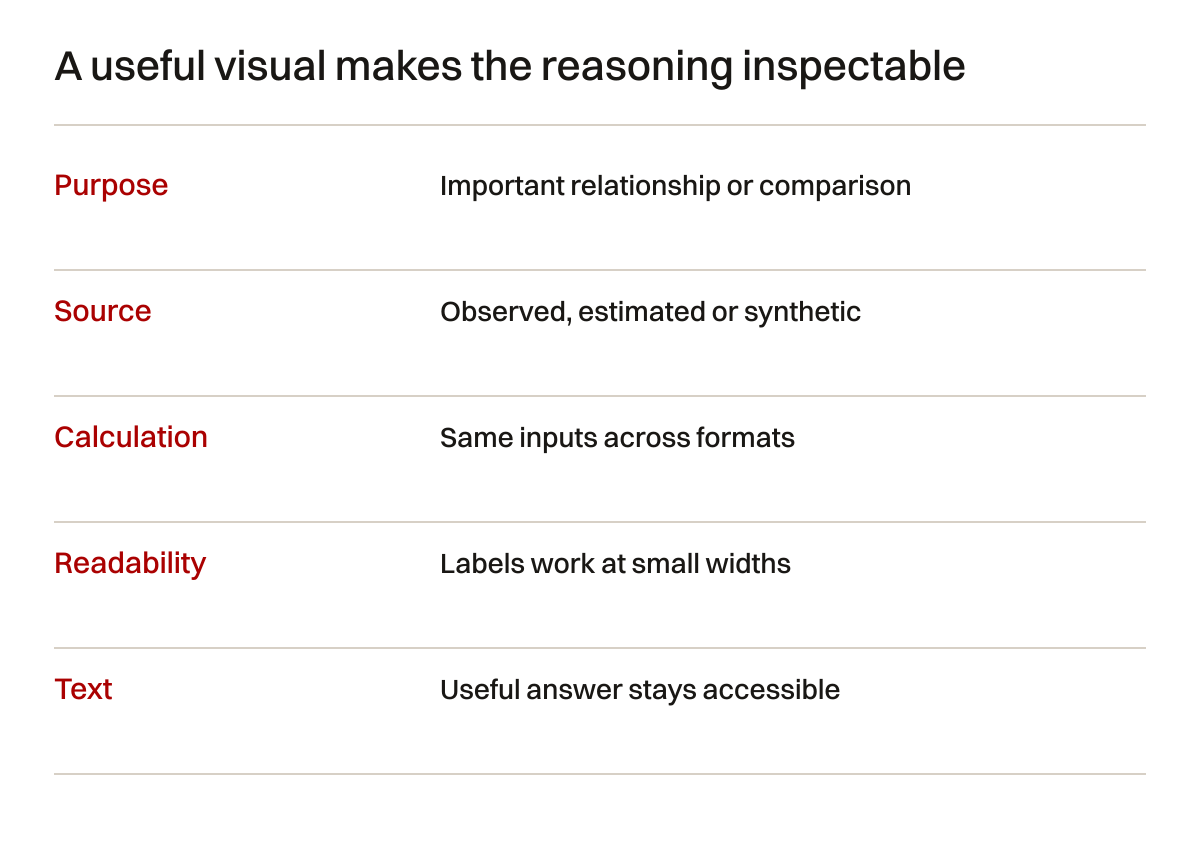
A comprehensive guide needs visual pacing, but each asset should contribute information. Use a flow for an actual sequence, a table for repeated comparisons and a chart for a defined dataset. A stock image can set context; it should not be presented as proof of technical work.
Write the chart's source, unit, period and limitations before designing it. Confirm that the numbers in the asset match the article and downloadable data. A beautiful chart with an unclear denominator makes the argument less credible.
Review the actual page, not just the artwork
Inspect tables and images at small widths. Keep labels readable and alt text descriptive. Important instructions should remain in page text, not appear only inside an image. A large desktop diagram can become illegible when compressed into a phone screen.
Keep downloads current with the article. If a checklist changes, update the spreadsheet and any chart derived from it. Test the public files after release. Do not accept the existence of a filename as proof that a visitor can use it.
If an image is illustrative or generated, do not imply it documents a completed project. Rights and authenticity matter independently of visual quality. A convincing fictional image becomes misleading when the surrounding copy presents it as evidence.
Use AI without outsourcing the editorial decision
AI can organise a controlled inventory, suggest missing questions or help draft a clearly labelled example. It can also generate plausible source references, unsupported comparisons and repeated answers. Review its contribution against the actual brief.
Google's generative-AI content guidance calls for manual accuracy checks. The problem is not that a tool helped write the text. The problem is publishing unverified output as though it represents inspected expertise.
Give the assistant a bounded task. Ask it to identify possible overlaps within supplied page purposes. Then have an editor read the relevant pages. Ask it to flag missing evidence fields. Do not ask it to invent “industry data” so a chart can be produced.
Verify calculations independently
An assistant can misread a unit, round an estimate or mix time periods. Reproduce the calculation from the raw inputs. Keep the formula and assumptions beside the example. In the maintenance illustration, sixty articles multiplied by twenty minutes produces twenty hours, not twenty articles of review capacity.
Review language implications too. A confident adjective can turn a suggested process into a guarantee. A synthetic example can become a client story through a careless introductory sentence. These are factual problems, not merely stylistic ones.
Do not remove limitations because they make the page feel less persuasive. A reader comparing providers benefits from understanding what is known and what needs checking. That distinction is part of the expertise the article should demonstrate.
Handle title, snippet and link differences accurately
Google's title-link guidance supports descriptive titles. Its snippet guidance describes how displayed summaries may be selected. Use both to implement an accurate preview, not to promise a fixed appearance.
Different titles do not automatically make two pages distinct. If they serve different questions, the content should demonstrate that difference near the top. If they repeat the same answer, changing the title is cosmetic differentiation.
Use Google's link guidance for crawlable implementation. Then perform the editorial check: does each link help the reader find the maintained answer? A large number of related links can still create a confusing path.
Make merge and retirement changes deliberately
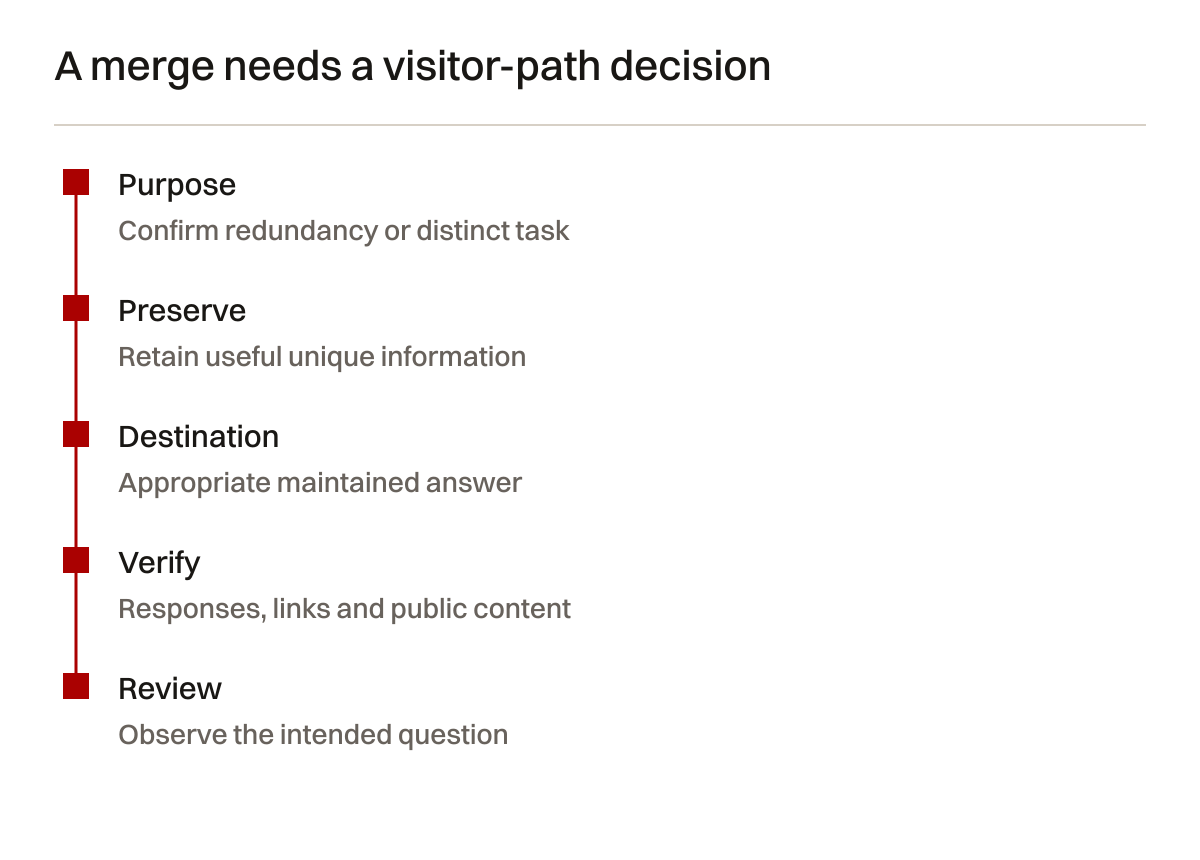
If you merge pages, inspect the receiving answer and preserve useful unique information. Obtain approval for the retired purpose. Decide the relevant destination, update internal references and verify actual public responses.
Google's site-move guidance provides technical context for changed addresses. A content decision still needs a business reason. Do not redirect every retired page to the homepage merely because it is convenient.
Do not use a canonical as an editorial shortcut
Google's canonical documentation concerns preferred-URL signals for duplicate or similar content. It does not remove confusing public pages or make unrelated answers equivalent.
First decide what a visitor should encounter. If two pages have useful distinct purposes, clarify them. If one is genuinely redundant, plan the change deliberately. A technical tag should implement a reasoned structure, not conceal an unresolved editorial problem.
For retiring unavailable services, preserve accurate support information where appropriate. Buyers arriving from older documents need an honest explanation. Search demand is not a reason to continue presenting discontinued work as available.
Keep discovery records accurate after release
Check the sitemap and internal paths after publishing, merging or retiring pages. Google's sitemap overview explains its discovery role. Submission is not proof that every article is indexed.
If using structured data, ensure it describes visible, accurate page information. Google's structured-data introduction provides implementation context. A valid record does not guarantee a rich result or AI citation.
Dates should describe actual publication and meaningful changes. Do not change a year or timestamp to create a false impression of new research. Keep the source review and substantive revision records distinct where they serve different purposes.
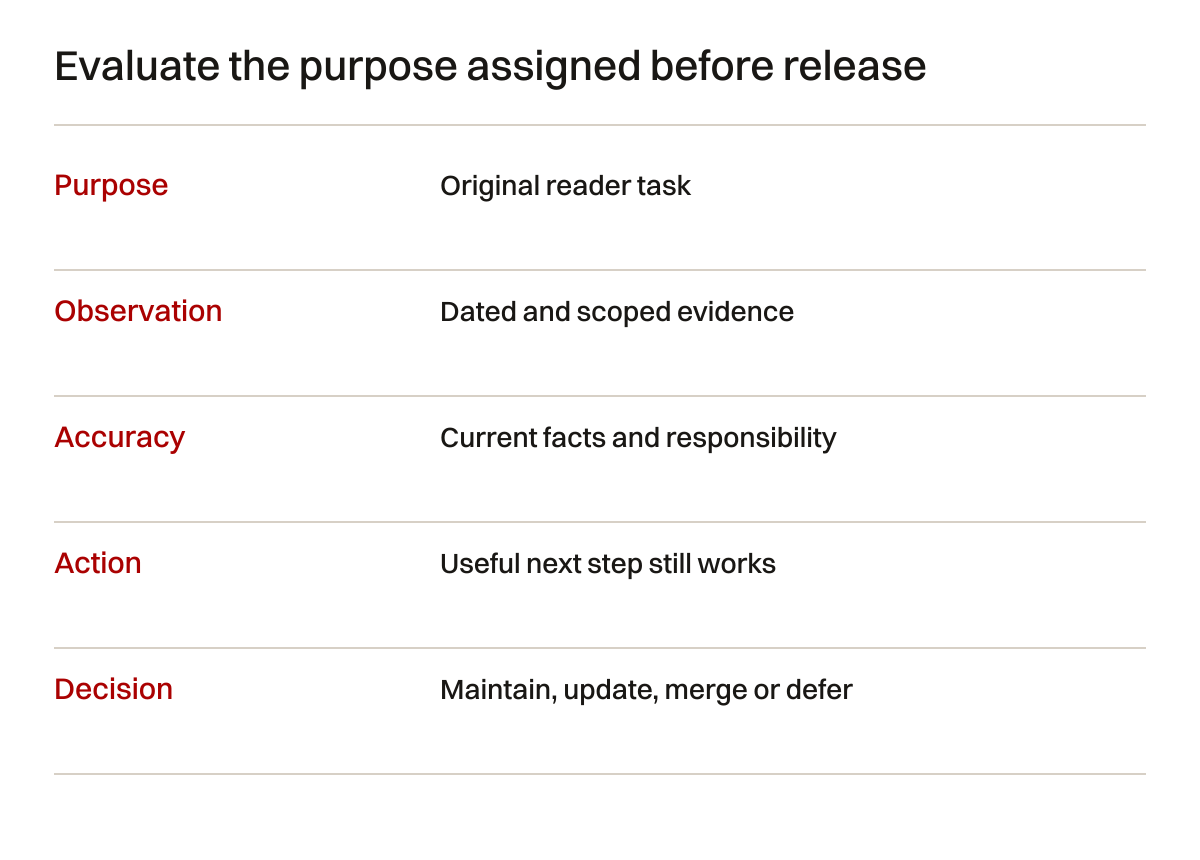
Review results against the assigned purpose
An educational guide may help existing clients prepare better information. A commercial service page may help suitable buyers check scope. A policy update may reduce confusion. Those purposes need different evidence.
Do not define every article's success as traffic growth. Also do not excuse an acquisition article's weak relevance by later relabelling it as general awareness. Record the purpose before publication and explain any subsequent change.
| Assigned purpose | Evidence to inspect | Reason to update | Reason not to rush |
|---|---|---|---|
| Prepare an assessment | Received questions and checklist use | Missing or changed prerequisites | Sparse activity alone is inconclusive |
| Explain service responsibility | Scope review and clarification patterns | Buyers infer unsupported duties | Ranking movement is not proof of confusion |
| Provide current guidance | Source and subject-owner review | Material requirement changed | Cosmetic date change adds no substance |
| Support buyer comparison | Relevant page/query observations | Answer lacks important conditions | More words may not address the gap |
| Preserve customer information | Support questions and factual review | Obsolete instructions | No new enquiries does not make it useless |
Walk through a fictional editorial backlog
A fictional construction supplier has scheduled three guides: “Choosing a supplier”, “How to compare construction suppliers” and “Questions to ask before appointing a supplier”. The drafts use the same checklist, examples and contact recommendation. No separate buyer task has been defined.
The editor reads the drafts and current service page. One maintained comparison guide can answer the repeated task. The service page needs clearer appointment boundaries. A separate narrow technical guide remains useful because it explains a distinct preparation requirement with reviewed evidence.
The team therefore merges compatible draft material, updates the service page and keeps the technical guide. It does not claim that fewer pages will automatically rank better. It claims that the new structure is clearer and easier to maintain, which can be inspected directly.
Account for the work saved and the work added
Fewer duplicate drafts reduce repeated review. The combined guide still needs editing, source verification, useful visuals and a public-path check. Merging is not a zero-effort shortcut. Record the revised scope rather than calling the original three-article plan complete.
The technical reviewer discovers that one checklist requirement varies by appointment. The guide is amended to explain the condition. A generic AI draft had presented it as universal. The correction matters more than meeting the original publication day.
The team updates the calendar and inventory. Cancelled drafts are marked clearly. Related links point only to public pages when the guide releases. Future writers can see the retained purpose and avoid recreating the cancelled articles under different titles.
Observe without inventing a success story
Later, the team reviews relevant questions and available discovery records. The receiving staff can comment on whether callers understand preparation requirements. Those observations are useful, but a small sample does not prove a general conversion improvement.
If clarification remains common, inspect the wording and task again. If the buyer need has changed, update the answer. If the audience rarely uses the article, review distribution and demand assumptions. Do not automatically create three new wording variations to compensate.
This scenario is fictional. Its value is the decision record: what repeated, what remained distinct, which fact needed correction and why the calendar changed. A founder can evaluate that reasoning before accepting claims about future search results.
Build a calendar that can hold an article
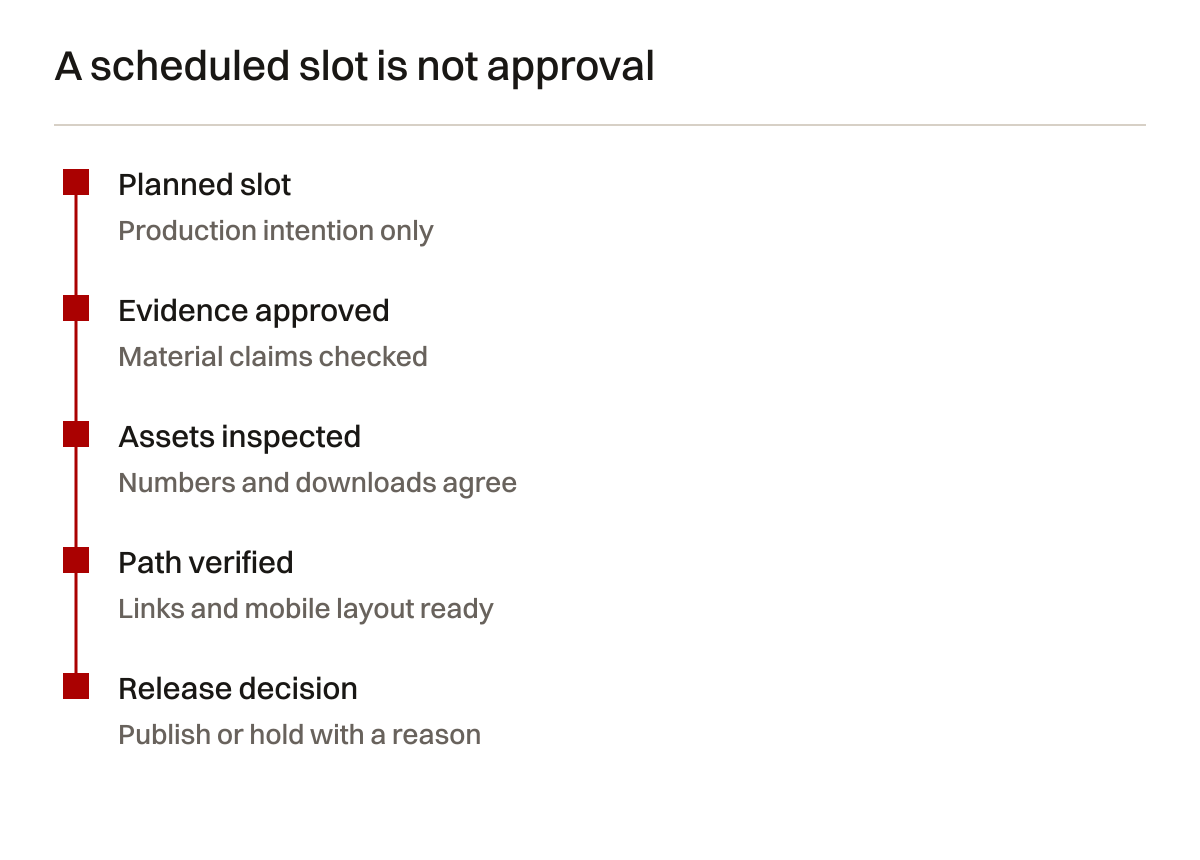
A scheduled time is a production intention, not an approval. Keep readiness checks independent of the calendar. The system should let the editor hold an article whose facts, assets or public path are not ready.
Use defined statuses for brief, evidence, subject review, design, publication readiness and release. A draft can move backwards when a material claim changes. That is not administrative failure. It prevents an outdated approval being carried into a changed article.
| Release check | Evidence required | Reason to hold |
|---|---|---|
| Reader task | Distinct purpose recorded | Existing page already answers it |
| Material facts | Source and subject approval | Unresolved technical implication |
| Example status | Synthetic or observed label | Fictional count presented as research |
| Assets | Chart, table and download agree | Different numbers or broken files |
| Public path | Links and small-width layout checked | Scheduled destination still unavailable |
| Maintenance | Owner and review trigger recorded | Nobody accepts future accuracy work |
Leave room for an actual news requirement
A business can need timely information outside the permanent calendar. A service condition may change. An official rule may affect a published checklist. Deal with that fact directly rather than waiting for the next scheduled broad guide.
State what changed and which readers are affected. Link to the primary record and review the existing relevant page. A short notice can point to the maintained answer. It should not become a long generic article just because the publishing template normally expects one.
Do not publish a speculative interpretation as a settled requirement. If the subject owner is still assessing applicability, explain that boundary. The calendar can reserve a follow-up decision without promising an answer before it is known.
Consider seasonal material before duplicating it
A recurring event can justify a new page when the facts and task differ substantially each year. It can also be served by an updated permanent guide. Ask whether readers need historical comparison, current instructions or a dated event record.
Preserve historical meaning where it matters. An old article describing what happened in a completed period should not be silently rewritten to imply it describes the present. A current guide can link to that historical record while carrying the updated task.
If creating a new annual page, explain what is new. Do not merely replace the year and add a fresh timestamp. The source record, examples and required action should justify the distinction. If they do not, improve the current maintained answer.
Review the production queue as evidence changes
At each planning meeting, inspect the items closest to release. Ask which approvals depend on facts that have since changed. Check whether a newer article now overlaps the planned one. Confirm that all relevant future links will be public at release time.
If a guide is held, record the reason and next review date. Use the slot for another ready, distinct answer only if that decision makes sense. Do not generate a replacement overnight to preserve the visible cadence.
The team can report held items openly. A founder should understand that a factual dependency was not resolved, rather than receiving a count that treats a draft as published. This preserves the difference between planning activity and public work.
The result is a calendar that supports editorial judgement. It still enables ambitious publishing. It also makes accuracy, originality and visitor usefulness conditions of release instead of tasks someone is expected to fix afterwards.
Questions before increasing the cadence
Which new reader tasks have been identified? Which existing answers were inspected? Who approves the technical facts? How much review and maintenance capacity remains after drafting? What will be deferred if an urgent correction appears?
Ask which evidence supports any demand estimate. Ask whether synthetic examples are labelled. Ask whether article, chart and download values agree. Ask how overlapping briefs are caught before they become public pages.
Finally, ask what would make the team choose not to publish. A programme that cannot reject a weak brief is a production queue, not an editorial strategy. A higher cadence becomes sensible only when the organisation can support the distinct work and keep it accurate.
Start with the problem
If your calendar is full but your service pages remain unclear, bring the inventory and buyer questions to Creatif Work. Our SEO service can help define what needs a new answer, what needs updating and which claims require evidence before publication.
The first decision should concern the information problem, not an arbitrary article count. For a related business-scope decision, our refresh-or-rebuild article asks when existing work should be improved rather than replaced. Start with the problem.