

What an SEO Retainer Should Deliver Each Month

A monthly SEO retainer should leave you with inspectable findings, prioritised work, clear implementation ownership, verified changes and a decision about what happens next. Article counts and dashboards can be useful records. They do not establish that the work addressed your business problem or produced suitable enquiries.
You receive a report every month. It contains ranking arrows, a traffic chart and a list of published articles. The same technical recommendations appear again. Nobody can explain whether the developers received them, whether the pages changed or why the next month needs the same work.
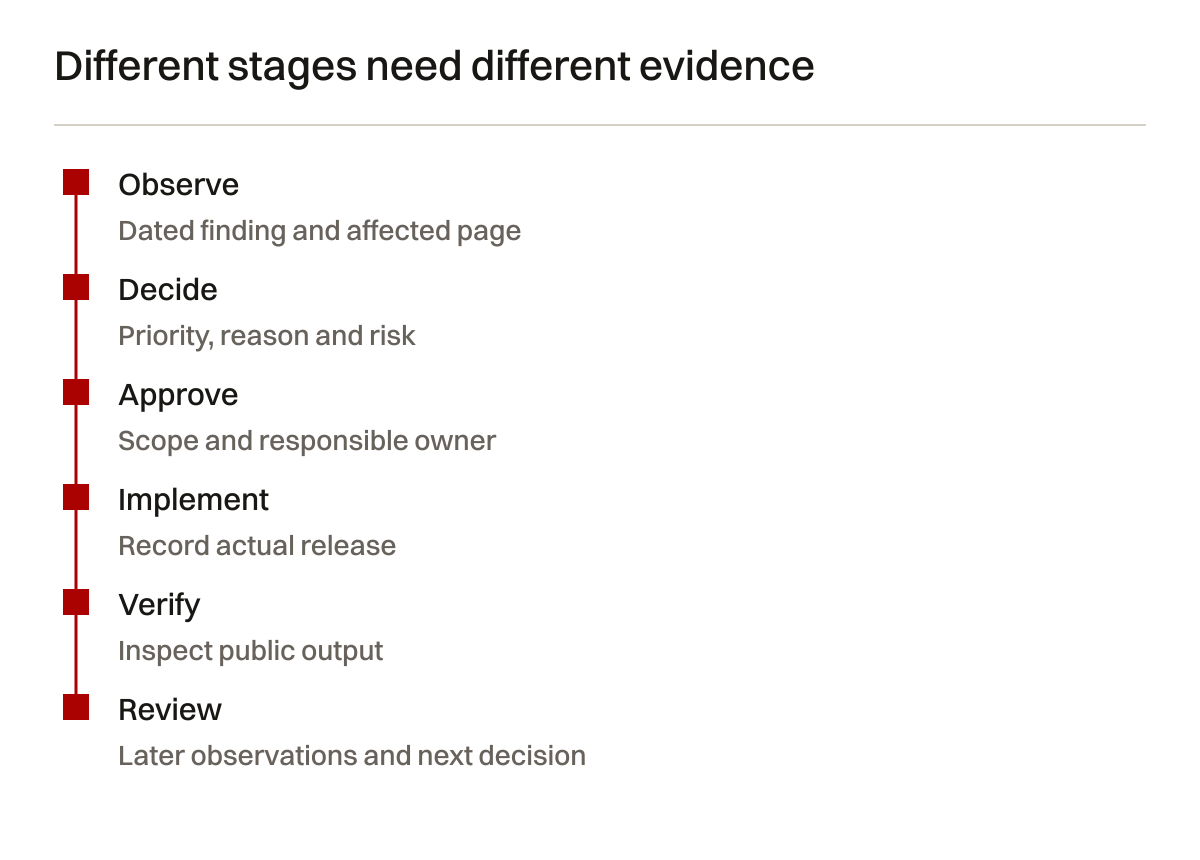
That is a delivery problem before it is a ranking problem. A founder needs to distinguish research from a recommendation, a recommendation from implementation, and implementation from an observed outcome. Otherwise recurring activity becomes impossible to evaluate.
This guide is a vendor-evaluation and operating framework. It does not prescribe a universal service package, price or monthly article quota. The examples are fictional working records, not Creatif Work client results or promised contractual deliverables.
Use the monthly SEO delivery workbook or CSV template pack when comparing proposals and reviewing delivery. Define the actual scope with the provider before using a template as an acceptance checklist.
Require a working record, not just a presentation
A polished PDF is useful when it communicates a decision. It is weak when it conceals which evidence was inspected. Ask for the underlying records: dated observations, affected addresses, approved changes, responsible people and verification results.
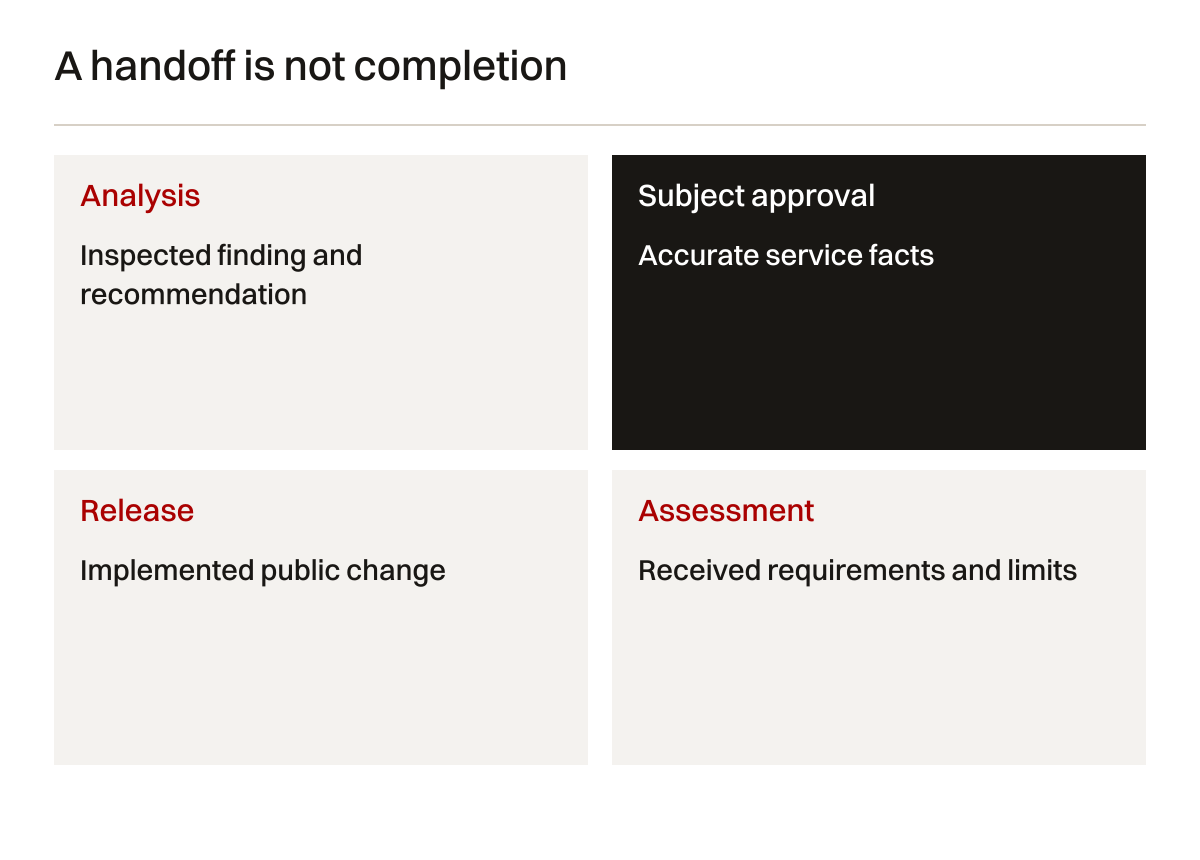
The record should distinguish what happened from what is proposed. A page audit is not an implemented correction. A drafted article is not published. A deployed template is not proof that every relevant page behaves correctly. Those distinctions should survive into the executive summary.
Google's guidance on hiring an SEO encourages asking how work will be explained and cautions against guaranteed rankings. Use that as a basis for practical questions, not as a substitute for reviewing the provider's actual method.
Ask what the client will own
The business should retain appropriate control of its accounts, published material and agreed work records. Define access arrangements explicitly. Do not assume a private provider dashboard contains everything needed for a future handover.
Agree how approved research, briefs, drafts, source registers and change logs will be delivered. Clarify licensing for paid datasets and third-party assets. Ownership of an article does not automatically include a right to redistribute a subscribed tool's raw database.
Use role-based access where available. Give people the access required for their work, not an unrestricted login because the proposal uses the word “optimisation”. Keep credentials outside public or widely shared reporting documents.
Define the problem the recurring work serves
Write the commercial and operational issue in normal language. Examples might include unclear service scope, unsuitable enquiries, missing evidence for procurement readers or repeated technical faults after releases. These are problem statements, not guaranteed outcomes.
The retainer should connect its activities to that issue. A content programme might answer qualification questions. A technical review might reduce unnoticed public failures. A measurement review might establish which observations can support a decision.
Do not ask a provider to prove the entire business value before any work begins. Ask them to define a reasonable hypothesis, the evidence needed and the limits. That makes the first months useful without pretending uncertainty has disappeared.
| Work record | What it should contain | Acceptance check | What it does not establish |
|---|---|---|---|
| Finding | Observation, URL, date and evidence | Reviewer can reproduce it | That a recommendation is implemented |
| Recommendation | Reason, proposed scope and risk | Business can approve or reject it | That the expected effect will occur |
| Implementation | Released change and affected pages | Actual public output inspected | That search processing has completed |
| Content | Reader task, sources and approval | Published page matches approved scope | That every reader is a buyer |
| Measurement | Definitions, filters and limitations | Counts can be explained | Sole-cause attribution to SEO |
| Next decision | Options, owner and review trigger | Someone can act on it | A fixed future ranking |
Name non-goals
If the programme is not responsible for paid campaigns, sales follow-up or every CMS release, say so. If the provider identifies an enquiry problem but another team owns the form, define the handoff. A non-goal is not permission to ignore a material issue. It is a responsibility boundary.
Likewise, define which markets and services the work covers. A provider can report discovery in an unsupported market, but should not automatically turn it into a sales priority. The business still decides which requirements it accepts.
Our one-time setup versus retainer article discusses engagement models. This guide addresses the narrower question of monthly evidence, ownership and acceptance after a recurring programme has been chosen.
Agree the first-month baseline
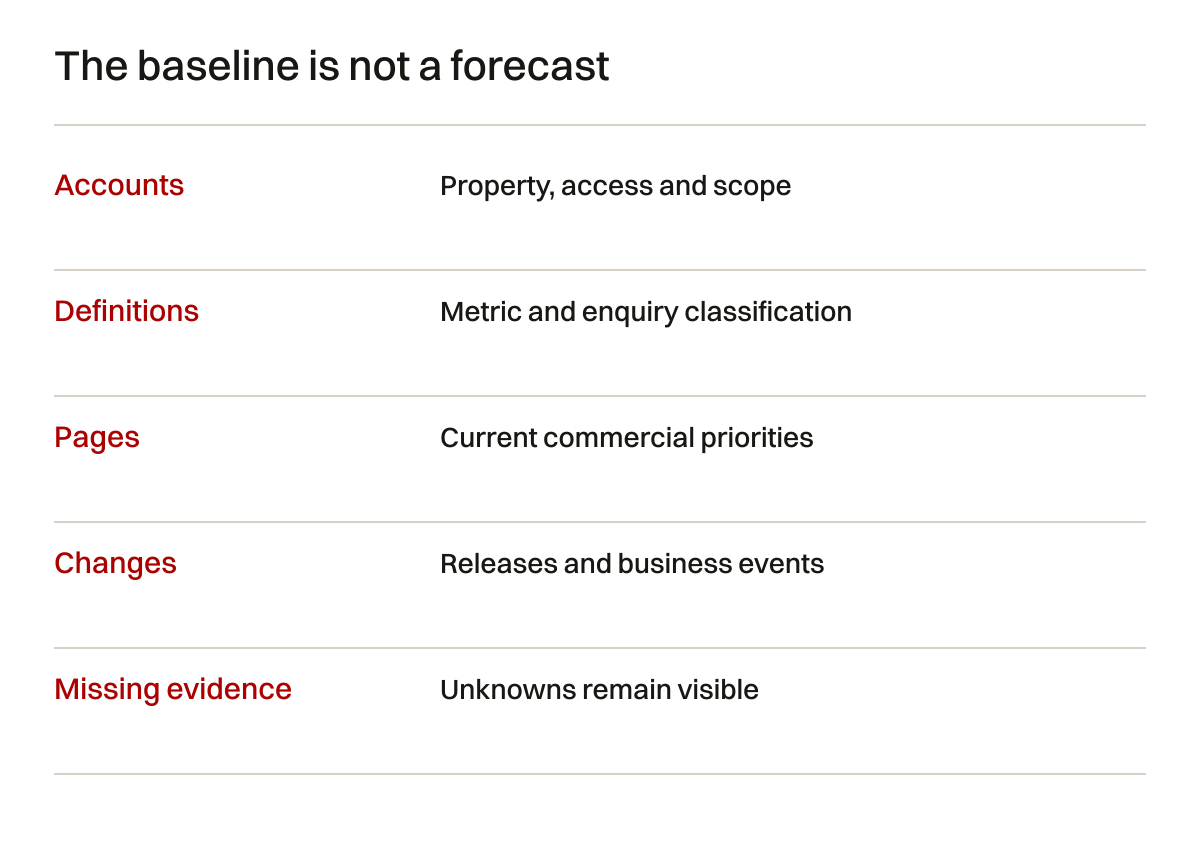
The first month often needs access review, content inventory, measurement checks and an agreed page map. Those are foundations for subsequent decisions. They are not an excuse to postpone every useful action until a large audit is complete.
Record the exact period and filters used for baseline observations. Identify important service pages, known campaigns and recent releases. Note missing data. If the site has no reliable enquiry source history, say that attribution is incomplete rather than fabricating a baseline.
A baseline is not a forecast
An initial count helps later comparison. It does not show how many future leads a retainer will produce. A single unusual month can be misleading. Review relevant business events and use additional periods where the data permits.
Google's Search Console and Analytics comparison guidance explains why clicks and sessions differ. Require the provider to identify which metric appears in each report instead of blending them into a vague traffic score.
Keep actual request records separate from site events. A form-open event is not a received enquiry. A received message is not necessarily suitable work. Define qualification before reporting “leads”, and retain unknown classifications rather than making the denominator convenient.
Choose work by consequence, not quota
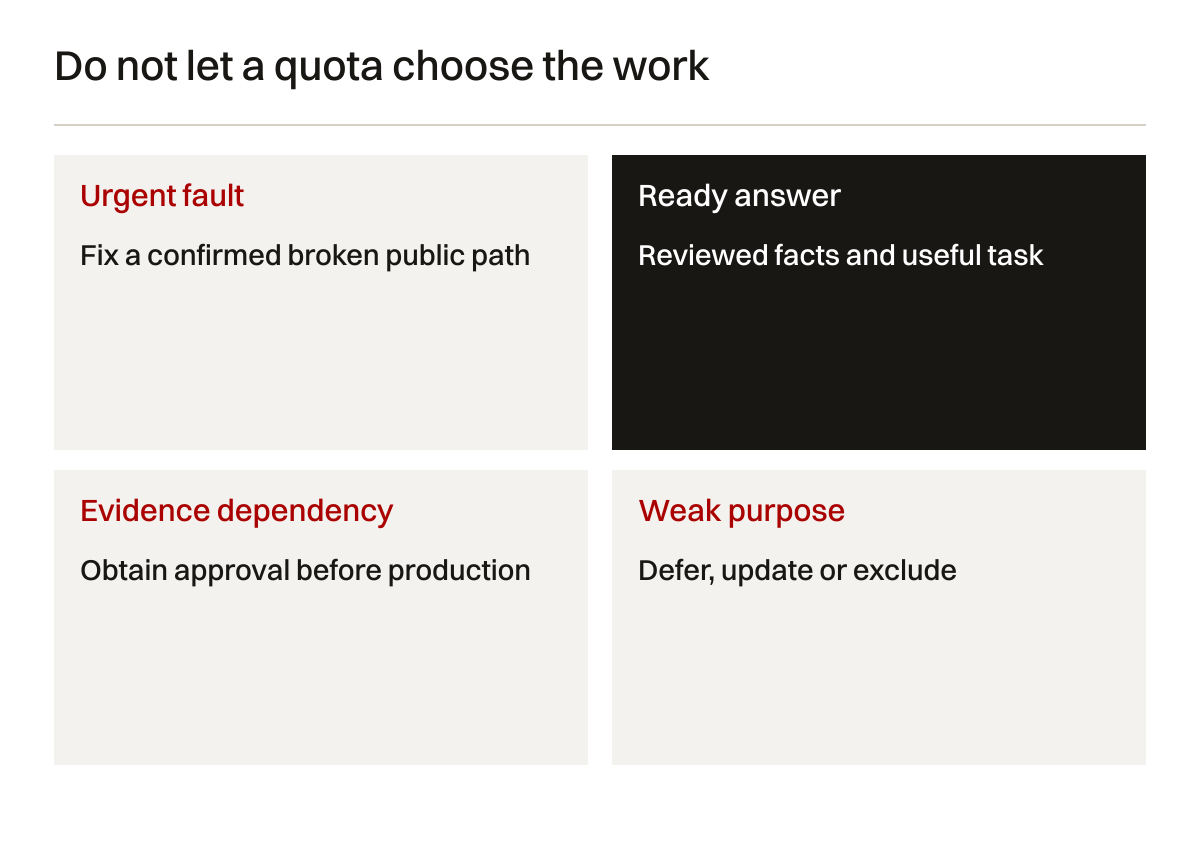
An article quota can help plan capacity. It cannot determine which work matters most. An important service explanation may need correction before three new guides. A broken public page may deserve immediate attention before a routine content refresh.
Review the backlog at the start of each cycle. Connect each item to a finding or defined buyer question. State expected effort, required input, owner and acceptance check. Where the evidence is weak, scope a check rather than a large implementation.
Preserve room for maintenance
A programme that consumes every available hour producing new material has no capacity to keep old information accurate. Reserve review capacity based on actual content and technical change. The exact allocation should fit the organisation, not a universal percentage.
List change triggers as well as calendar reviews. A product specification, partner arrangement or service responsibility change can require an immediate page update. Waiting for the annual review would leave an incorrect public promise active.
Keep urgent work visible in the report. If it displaces planned articles, explain the trade-off and revised schedule. That makes a lower publication count understandable without pretending the original plan was completed unchanged.
Define who implements each recommendation
Some retainers include implementation. Others provide research and briefs. Both can be legitimate if the boundary is clear. The problem is a proposal that implies completed work while depending on an unnamed developer or client reviewer.
For every priority action, name the proposer, approver, implementer and verifier. One person can hold several roles, but the responsibilities should still be recorded. Include escalation when a dependency is late.
| Activity | Proposed owner | Approval needed | Completion evidence |
|---|---|---|---|
| Correct service scope | Editor or search lead | Service owner | Approved facts on public page |
| Repair template directive | Developer | Technical release owner | Actual response and directive check |
| Update internal links | Editor or developer | Relevant content owner | Destination and anchor inspected |
| Publish researched guide | Writer and designer | Subject reviewer and editor | Public page, sources and asset checks |
| Repair form receipt | Operations and developer | Receiving team | Test request received and handled |
| Explain result uncertainty | Analyst | Programme owner | Defined observations and limits |
Avoid the recurring recommendation loop
If an issue appears for a third month, the report should say why it remains open. Was it rejected, blocked by missing approval, awaiting a release or never assigned? Repeating the original recommendation is not progress.
Create a dependency record. State what is needed from the client, who can supply it and the decision if it does not arrive. The provider can offer alternatives, reduce scope or hold publication. It should not invent technical information merely to maintain output volume.
At the same time, the client should not interpret a blocked approval as provider completion. Both sides need the same status definitions. A delivery meeting should resolve ownership rather than argue from different meanings of “done”.
Record changes at the address level
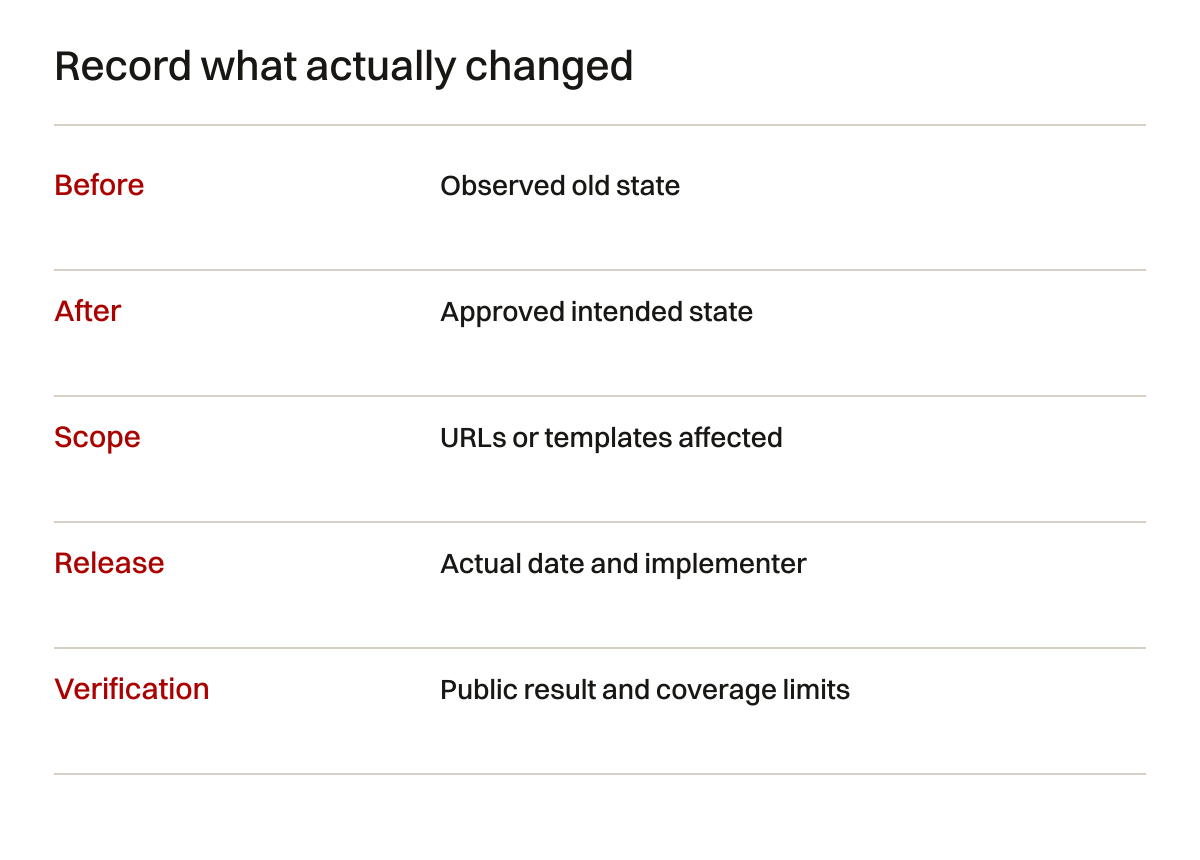
A useful change log identifies the affected URLs or templates, the previous state, intended new state, release date and verification. “On-page optimisation completed” gives too little information to inspect or reverse.
For redirects and address changes, retain mappings. For title edits, retain approved wording. For content updates, retain the supporting facts and reviewer. For a site-wide template change, test representative pages and state the coverage limits.
| Fictional item | Intended change | Status | Verification needed | Later question |
|---|---|---|---|---|
| Capability scope | Add approved appointment limits | Published and checked | Mobile page matches approved copy | Are clarification questions changing? |
| Redirect repair | Old address reaches relevant successor | Implemented, awaiting check | Actual old and new response | Has search processing changed? |
| Technical guide | Add reviewed preparation worksheet | Draft awaiting reviewer | Facts, assets and download inspection | Does it serve the planned task? |
| Analytics event | Count receipt rather than form opening | Proposed | Test definition and delivery | What historical comparison remains valid? |
| Internal link | Connect guide to relevant service | Published and checked | Anchor and destination inspected | Does the path remain appropriate? |
These are fictional records. They illustrate distinct statuses, not work already performed for a client. The later questions are hypotheses for review, not promised effects of each change.
Tie technical claims to the relevant documentation
Google's canonical guidance explains preferred-URL signals. Its sitemap overview explains a discovery mechanism. Neither makes a submitted URL automatically indexed or commercially valuable.
A provider should cite the control being changed and explain the actual fault. A canonical preference, an indexing directive and an access restriction solve different problems. A long list of tool warnings is not enough to justify changing all of them.
When a recommendation depends on a hypothesis rather than an official requirement, label it. That can be a sensible test. The distinction helps you assess risk and prevents the provider presenting every preferred editorial choice as a search-engine command.
Evaluate content as a reviewed public answer
For each article, ask which reader task it serves and what original contribution it adds. Sources, examples, diagrams and templates should support that task. Length alone does not establish usefulness.
Google's helpful-content guidance explicitly rejects a preferred-word-count premise. A comprehensive guide can still be worthwhile. Its length should follow the questions covered, not an invented minimum for ranking.
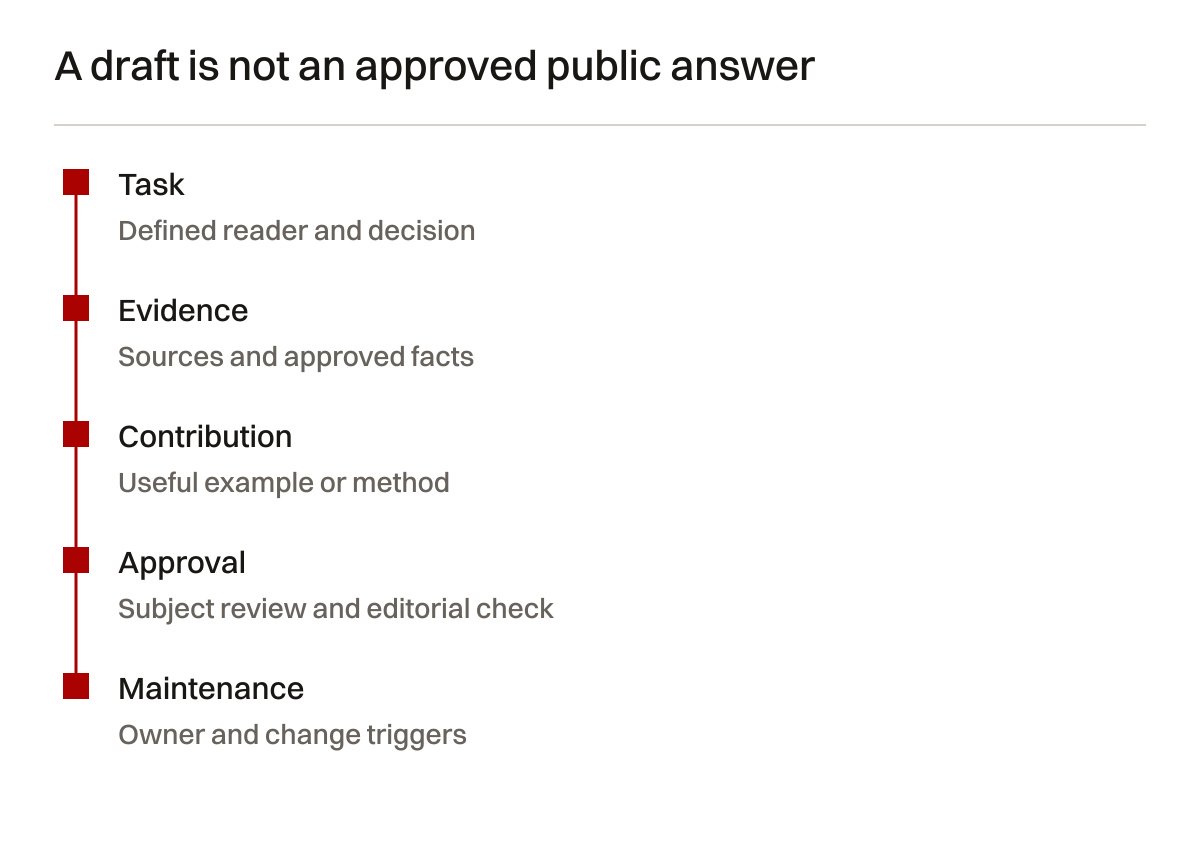
The content record should include factual approval, source review, image rights, descriptive alt text, mobile checks and maintenance ownership. Technical articles also need scope limits and subject review. A fluent draft is not an approved public answer.
Publication is a visitor-path check
Inspect the public page after release. Check charts and tables at small widths. Confirm that downloadable files open and related links lead to public destinations. Scheduled material should not create broken paths before its publication time.
Google's link guidance is relevant to implementation. The editorial check asks a further question: does the destination help the reader's next task? A technically crawlable link to an unrelated offer can still be poor navigation.
If the provider promises source-backed content, inspect a sample of claims and supporting pages. A citation beside a paragraph is not proof that every sentence is supported. Keep interpretation separate from the source's actual finding, especially when a study covers a different country or audience.
Ask what AI-assisted work was checked
AI can assist with drafting, sorting notes and proposing visual structures. The important question is not whether a tool was used. It is whether someone checked the evidence, calculations, implications and public output.
Google's generative-AI guidance calls for accuracy review. A provider selling analysis should apply that discipline to its own reports. An AI summary of a graph cannot identify an unrecorded release or establish why the graph changed.
Ask for the review method. Which calculations were reproduced? Which sources were opened? Who approved technical statements? Which private data was processed, under what authorisation? A generic “human reviewed” label does not answer those questions.
Separate efficiency from accountability
An assistant may reduce drafting time. That does not reduce responsibility for a misleading claim. The provider should retain the reasoned work record regardless of the production tool.
Do not require a transcript of every tool interaction unless that is genuinely needed and agreed. Require the evidence that supports the delivered conclusion. A calculation sheet, source register and inspected change can be more useful than hundreds of chat messages.
Reject invented results, synthetic client histories and unsupported market estimates. If an example is fictional, it should say so prominently. If a number is estimated, the method and uncertainty should be stated. Editing away the awkward caveat is not an improvement.
Treat AI-search reporting as a separate observation task
If the scope includes AI visibility, define the questions, services, context, dates and repeat process. Distinguish mention, citation, recommendation and referral. Do not call a handful of favourable screenshots an industry visibility score.
Google's AI-features guidance says there is no special schema or additional machine-readable file required for its AI features. A provider claiming a secret setup should explain the actual mechanism and evidence rather than relying on the label “GEO”.
Keep any sampled AI-answer study separate from website and commercial records. It can inform a content question. It cannot prove how many buyers saw the answer or which later sale it caused.
| Proposed measure | Record required | Valid use | Claim to avoid |
|---|---|---|---|
| Relevant Search clicks | Period, page group and filters | Review observed discovery | Every click is a buyer |
| Received requirements | Delivery evidence and classification | Assess enquiry fit | Every form event became a lead |
| AI-answer mention | Predefined question and dated sample | Observe a limited answer pattern | Representative market share |
| Citation | Exact answer and source destination | Inspect source inclusion | Guaranteed traffic or endorsement |
| Public repair | Changed URL and verification | Accept implementation | Guaranteed ranking improvement |
| Sales outcome | Defined source and attribution limits | Review commercial context | Sole-cause SEO revenue |
Require a monthly decision report
The summary should answer five questions: what was learned, what changed, what was verified, what remains uncertain and what the business needs to decide. Put important trade-offs near the top.
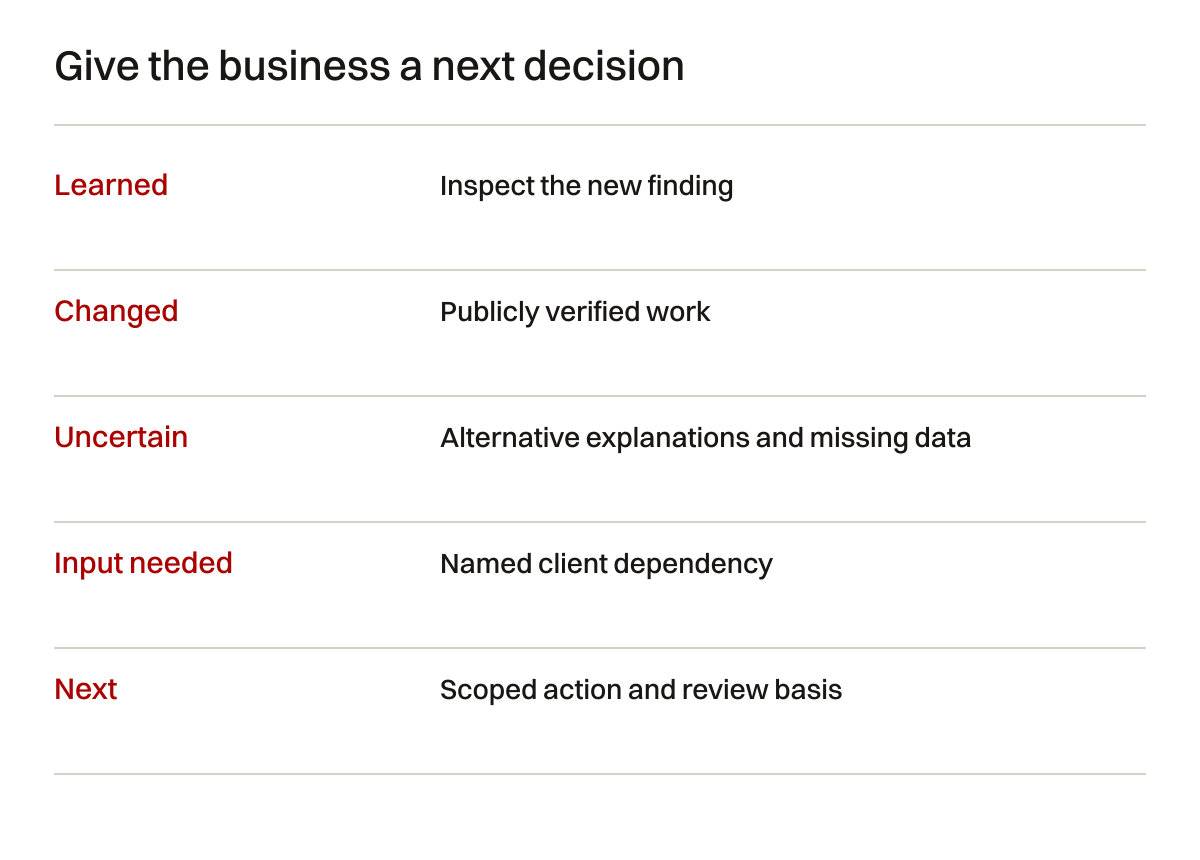
A useful sentence might be: “The capability page now contains approved appointment limits. We checked the public mobile page and enquiry route. We do not yet have enough classified requests to say whether unsuitable enquiries decreased.” That describes progress without pretending the outcome is settled.
The report should include work not done and why. If the provider rejected a proposed article because it repeated an existing answer, show the reason. If an urgent fault displaced a planned guide, show the revised plan. This makes editorial judgement visible.
Keep executive and technical views connected
The founder does not need every crawl row in a meeting. They do need a route from the summary to evidence. Put the exact URL, inspection or source record behind each important conclusion.
Use stable identifiers for internal work records where helpful. Those identifiers should refer to actual tasks, not decorative public numbering. If another team takes over, it should understand the unresolved item without recreating the entire audit.
Keep charts consistent. Changing the metric, scale or page group every month can make progress impossible to assess. When the basis changes, label it and explain the consequence for comparison. Do not disguise a new measurement definition as an improvement in performance.
Review a month with limited visible growth
A quiet month is not automatically failure. Useful maintenance, evidence corrections and implemented repairs can matter before a measurable search change. The provider should still explain what it did and why that work was the right use of the period.
Ask whether the hypothesis remains sensible. What new evidence was collected? Did dependencies move? Were planned checks completed? Does the next action depend on a result that has not appeared? Those questions make the review more useful than demanding a favourable chart at every meeting.
At the same time, lack of growth should not become an unlimited excuse. Define review points for the programme. If commercial relevance is weak, evidence remains unavailable or implementation never happens, revise the scope. Recurring payment is not a reason to keep the same untested plan indefinitely.
Handle scope changes transparently
A migration, new market or product launch may exceed the recurring agreement. Identify it early. State which existing tasks it would displace and what separate decisions are required. Do not quietly absorb a large project then claim the original monthly scope was completed.
The client also needs to flag planned releases. A provider cannot inspect a change it was never told about, although agreed monitoring may detect some public issues later. Define release communication and escalation instead of relying on informal memory.
If the programme includes structured data, use Google's structured-data introduction for implementation context. Valid markup is not a guarantee of a displayed feature. The public page and business facts must remain the basis of the claim.
Agree acceptance and escalation
Acceptance should concern work you can inspect: a reviewed brief, correct public page, reproducible observation or completed verification. Future rankings cannot be accepted on a publication date. Keep later performance review separate.
Define how mistakes are corrected. If a claim is inaccurate, who can pause publication or correct it? If an important technical change fails, who owns the repair and communication? Do not let a monthly reporting cycle delay an urgent public issue.
| Situation | Acceptance question | Escalation or decision | Record retained |
|---|---|---|---|
| Published content inaccurate | Does it match approved facts? | Correct or pause with responsible owner | Claim, approval and correction |
| Recommendation blocked | Is the dependency named? | Approve, reject or reduce scope | Reason and next date |
| Public fix unverified | Was the actual path checked? | Verify before marking complete | URL and observed state |
| Repeated weak results | Does the hypothesis still hold? | Change priorities or review engagement | Evidence and trade-off |
| Provider handover | Can another team continue? | Deliver controlled working records | Open issues, access and owners |
Plan the exit before it becomes urgent
A good handover includes current priorities, recent changes, source records, content review dates, measurement definitions and unresolved dependencies. It should state which observations cannot be reconstructed from the available data.
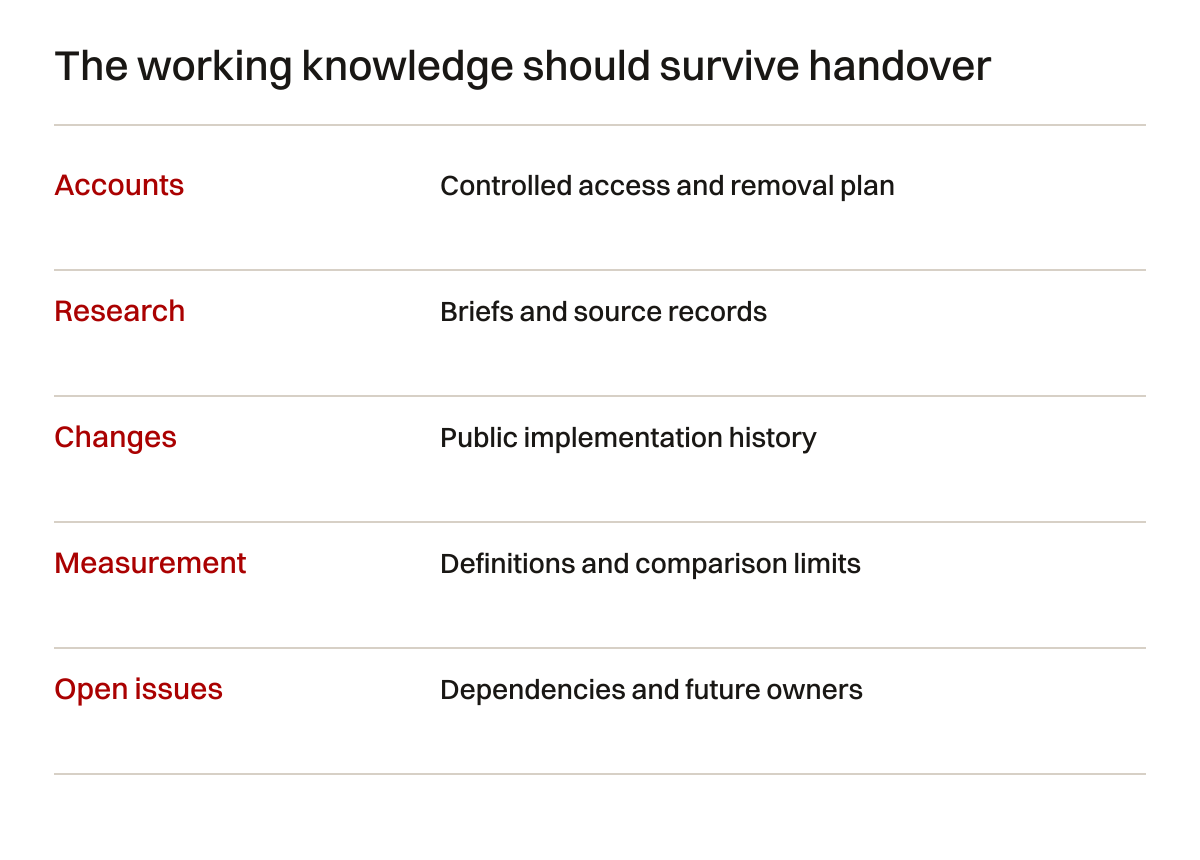
Agree how access is removed and how client data is handled. Preserve records needed for continuity under the relevant agreement. Do not leave the business dependent on a personal account or a dashboard it cannot inspect after the engagement ends.
An exit plan is not an accusation. It makes the programme easier to evaluate while it runs. The business can see what knowledge and implementation have accumulated, rather than judging value only by whether the provider remains available.
Walk through a fictional monthly review
Consider a fictional B2B equipment firm whose enquiries often omit application details. The first review finds that its capability page lists equipment names but not the information needed for assessment. The provider proposes a scope explanation and preparation checklist, not a generic content campaign.
The service owner supplies approved conditions. The writer drafts the page. A subject reviewer identifies an overbroad suitability statement and corrects it. The developer publishes the update. The verifier inspects the mobile page, links and form receipt. These steps belong to the same item, with distinct dates and statuses.
Meanwhile, the analytics event called “lead” is found to fire when the form opens. The measurement owner proposes a better event definition and keeps historical comparisons qualified. That correction does not prove past enquiries were higher or lower than reported. It prevents the same ambiguity continuing.
Show what changed in the next meeting
The next report states that the preparation information is public and checked. It shows the approved copy and actual destination. It also states that request classification has begun, but there are too few complete records to compare suitability reliably.
A second proposed article is held because it repeats the preparation answer. The team instead checks the supporting technical document and assigns a maintenance owner. This may reduce new-article volume. The report explains why that decision better serves the identified problem.
No client success claim is being made here. The fictional example demonstrates acceptance records. The provider can show inspected work even when commercial outcomes are still uncertain. That is the standard a founder should demand before accepting a broad claim of monthly progress.
Make the next plan conditional
If received requirements still lack essential details, the team will review the wording and form instructions with the receiving staff. If readers misunderstand service responsibility, the service page needs clarification. If the information is accurate and the real issue is response handling, content alone is not the next answer.
The planned review uses the same qualification definition and records unknowns. It does not switch to all form openings because that number looks better. It also does not claim that every suitable request came from the new page merely because the timing overlaps.
Adapt the records to the size of the business
A small site should not need a reporting system more complicated than its operations. Use a concise page map, a short prioritised backlog and a clear change log. The evidence standard remains the same, but the number of records should reflect actual work.
For example, a company with five stable service pages may need occasional factual updates and careful observation rather than an expanding article library. A large catalogue may need template checks and sampling coverage. A professional practice may need approval records for responsibility and exclusions. Do not impose the same production model on all three.
Keep representative checks honest. If a template change was tested on six pages, list the sampling rationale and remaining risk. “Site checked” should not imply every address was inspected. Where an automated check covers all known public URLs, state what that check does and does not inspect.
Explain sparse evidence without hiding it
Small B2B audiences can produce months with few suitable requests. That makes short-period rates unstable. Show the underlying counts and use qualitative requirement review alongside the available quantitative evidence. Do not expand the definition of a lead to make a percentage appear persuasive.
Missing evidence should generate a practical action. If enquiry sources are unknown, agree a proportionate collection method. If technical facts lack an approver, identify that person. If search observations are not informative for a narrow topic, use the buyer questions and page purpose as context without declaring measured demand.
The programme may discover that SEO is not the present bottleneck. Slow responses, unclear appointments or an unavailable service can limit commercial usefulness even when search discovery improves. The provider should say when another task needs attention rather than presenting publishing as the answer to every problem.
Keep technical and commercial review times different
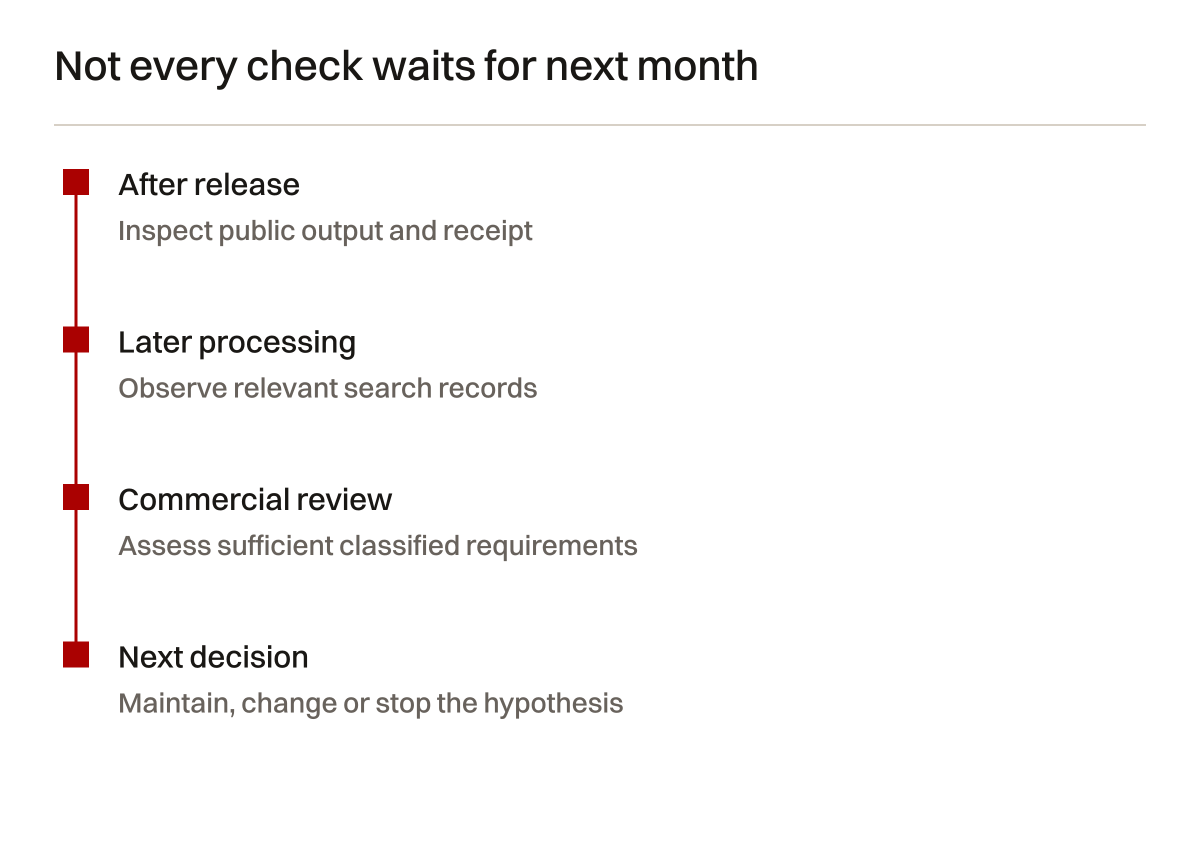
A response fault can be verified immediately after repair. An editorial correction can be checked against approved facts. Suitable enquiry patterns may require longer observation. Record those different review times instead of making every item wait for the monthly meeting.
This gives the founder a more useful picture of delivery. Some items are accepted and complete. Some are implemented but awaiting system processing. Some are hypotheses under observation. Some are blocked by a named dependency. The distinction prevents a red traffic arrow from erasing completed work or a green implementation check from concealing an unresolved commercial question.
Challenge a report that only celebrates movement
A rank increasing from one sampled position to another may be encouraging. Ask which question and market were sampled, which destination appeared and whether the observation repeats. A chart of average position should not be treated as a fixed position for every buyer.
Similarly, a new AI citation can justify inspecting the cited passage. It does not establish a sale. A higher article count can demonstrate output. It does not establish originality or usefulness. Keep each observation in the category it actually measures.
The provider does not need to be negative. It needs to be precise. Progress can be communicated clearly when the audience understands the measurement, completed action and uncertainty. That is a better renewal discussion than choosing whichever number rose most during the month.
Questions before you sign or renew
Ask who implements priority recommendations. Ask what counts as accepted delivery. Ask which dependencies you must supply and what happens when they are delayed. Ask how the report distinguishes completed changes from observed outcomes.
Ask whether AI-assisted work is checked against sources and calculations. Ask how content maintenance competes with new production. Ask which accounts, records and assets you can retain at handover.
Finally, ask what would make the provider recommend changing or stopping the present plan. A defensible programme has review criteria. It does not depend on an endless claim that results are just around the corner.
Start with the problem
If your monthly report shows activity but leaves you unable to explain what changed, bring the working records and unresolved questions to Creatif Work. Our SEO service can be scoped around the problem, required evidence and implementation responsibilities rather than an arbitrary publishing quota.
The discussion should establish what needs inspecting, who can approve changes and how delivery will be verified. We do not promise a ranking from a recurring invoice. Start with the problem.