

SEO and AI Search for B2B Companies: Building a Search Strategy

B2B SEO and AI-search work should begin with the questions suitable buyers need answered. Make those answers accurate, accessible and connected to relevant services and evidence. A website build can establish the foundation. Continued content review, technical upkeep and measurement are separate responsibilities. No schema, file or publishing quota guarantees rankings or inclusion in an AI answer.
A founder may be told to publish more articles when the service pages do not explain the business. Another may buy a technical audit while nobody maintains the product records. A third may be shown screenshots of AI mentions as if they prove enquiries. These activities can produce reports without resolving the information gap.
This guide connects search work to the actual buying decision. It covers page purpose, indexability, evidence, internal links, language versions and measurement. It also distinguishes an initial implementation from the work required after launch.
The diagrams and workbook rows are original planning examples. They are not screenshots of client rankings, Search Console trends or AI-market share. No private analytics, representative prompt study or ranking gain is claimed.
Download the B2B search strategy workbook, or use the CSV template pack. There is no registration requirement. The article explains the same records and review process.
Understand what search can and cannot do
Search can help people discover information, compare an approach and find a company. It cannot establish a capability the company does not possess. A search result is not an endorsement of commercial suitability. A visit is not a qualified enquiry.
AI-assisted discovery adds another observation problem. An answer can mention a company without recommending it. It can cite a page without producing a visit. Different questions, contexts and services can produce different answers. Keep those distinctions visible in the brief and report.
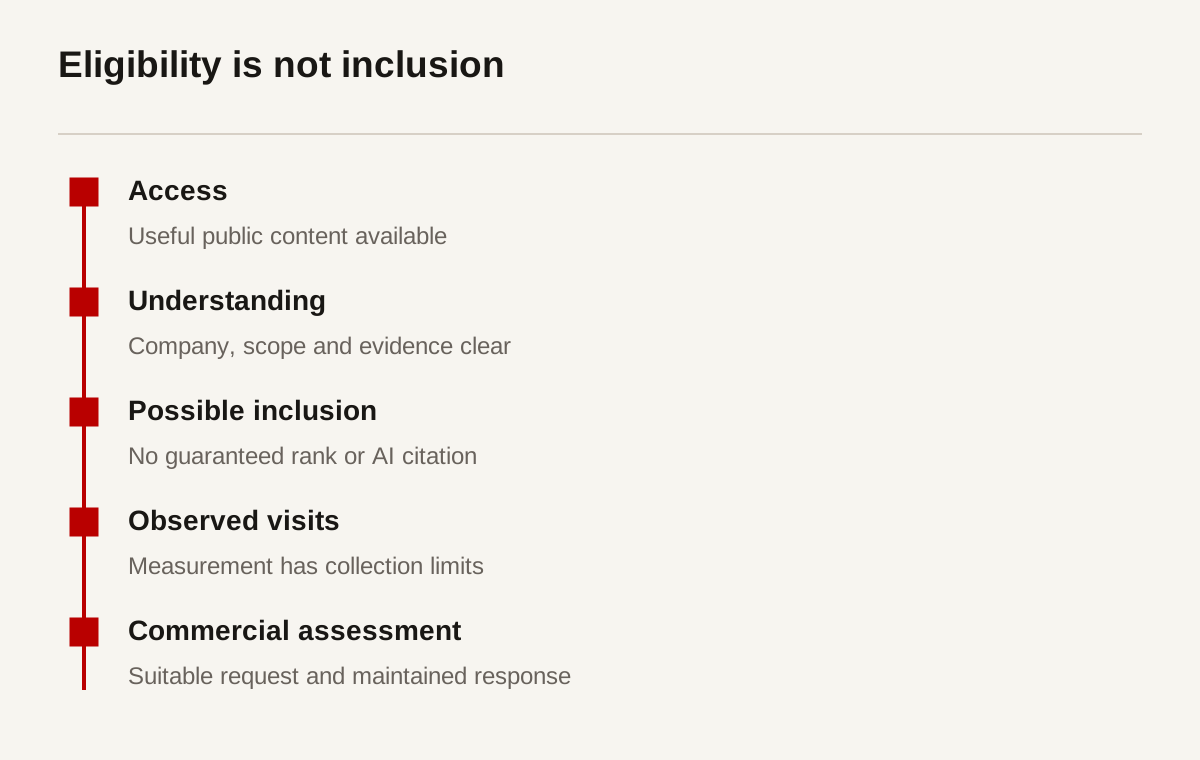
Google's AI-features guidance says established SEO practices remain relevant for its AI search features. It does not prescribe a special AI schema or file. Eligibility and useful content are not a guarantee that a page will appear for a particular question.
Separate the platform's requirements from your hypothesis
An official requirement needs an official source. A studio's proposed content structure is a recommendation. A pattern noticed in sampled answers is an observation. Presenting all three as established algorithm rules makes the programme difficult to evaluate.
Write them differently. “The page is accidentally marked noindex” is an inspectable fault. “This guide may answer a repeated buyer question” is a content hypothesis. “The page was cited in two recorded answers” is a dated sample observation. None automatically proves the others.
Keep the commercial aim specific. Better discovery may be useful, but the company also needs scope clarity, relevant evidence and a functioning enquiry route. Search work should connect to those tasks rather than stop at position or mention screenshots.
Define commercial questions before choosing keywords
Ask the people who assess real requirements which questions recur. A buyer may need to understand a process, verify compatibility, compare appointments or prepare a brief. These are more useful starting points than an undifferentiated list of popular terms.
Record the question, the reader and the decision. For a manufacturer, it might be whether a process accepts a particular material and what drawing information is needed. For a professional service, it might be which responsibilities the appointment covers and how the client team contributes.
Do not assume that a founder searches only broad terms. Founders and managers can use detailed language when the problem is specific. Equally, a technical term can attract researchers without a commercial requirement. Inspect the likely intent rather than treating every query as a buyer.
Use search-volume data as one input
Some relevant B2B questions may have low or uncertain measured volume. A small buying audience can still matter. Do not promise commercial value merely because a phrase is specific, and do not discard a useful buyer question solely because a tool reports little volume.
Separate measured tool data from manually chosen examples. If a report includes volume, record the tool, market, period and limits. If it contains a planning question from the team, label it accordingly. Avoid a diagram that makes an invented query look like researched demand.
The first output should be a prioritised question list. Assign a relevant service, evidence owner and next decision to each question. If the company cannot credibly answer it, reconsider the topic rather than generating a long article to fill the gap.
Inventory pages by purpose and gap
Inspect the pages already published. Record their purpose, relevant audience, content owner and current condition. A useful answer may exist but be difficult to find. Another page may attract visits while omitting the conditions that matter to assessment.
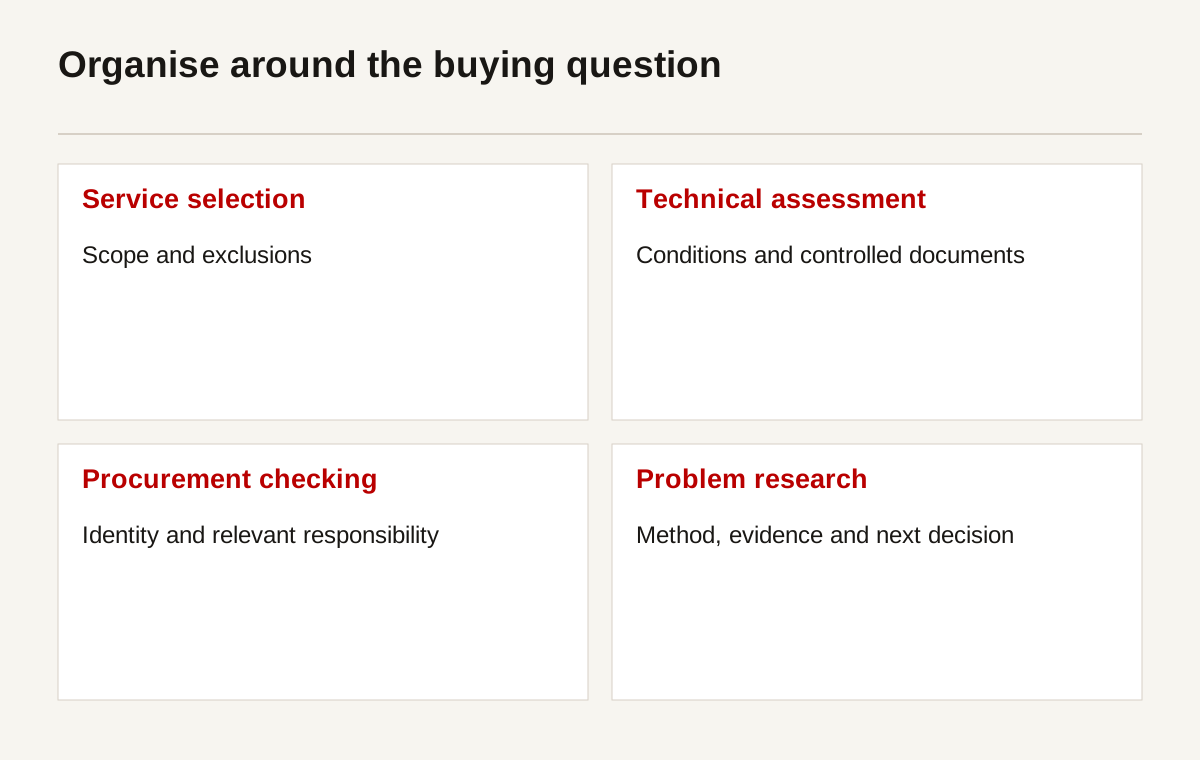
| Buyer intent | Existing page to inspect | Possible gap | Appropriate next action |
|---|---|---|---|
| Choose a service | Relevant service page | Scope or exclusions unclear | Repair the actual service explanation |
| Check technical fit | Product or capability page | Conditions and documents missing | Obtain approved technical records |
| Qualify a company | Company and project information | Identity or responsibility hard to assess | Clarify maintained evidence |
| Understand a problem | Useful guide | Answer too general for the decision | Add a specific method or worked example |
| Prepare an enquiry | Contact or assessment route | Information and receiving owner unclear | Fix instructions and delivery |
| Assess overseas support | Relevant market information | Local arrangement assumed | Verify actual delivery and language needs |
This table is an audit framework, not findings about a particular website. Inspect the actual pages before deciding which gaps apply. Record the evidence for each observation so the team can distinguish an inspected fault from a preference.
Decide what happens to an outdated service page
Suppose the company no longer offers a service described on a page that still receives relevant questions. This is a planning example, not a finding from an audited account. First confirm the business decision with the service owner. Search traffic is not a reason to keep an unavailable offer presented as current.
Inspect whether the page contains useful historical information, a maintained support route or a genuinely relevant successor service. Those possibilities require different treatment. Do not send every retired service to a general homepage merely to preserve a traffic count.
Record the proposed destination and the reason. If the service has changed rather than ended, rewrite the scope and limitations from approved facts. If an address changes, include it in the migration record and inspect links from documents and other pages.
Finally, review the receiving team's instructions. A buyer following an older reference should receive an accurate explanation. The decision belongs in the service inventory, not only in a developer's redirect file. That record makes later search reviews understandable when a page's traffic or purpose changes.
Do not create a second page without a second purpose
Two phrases can represent the same decision. If the existing page answers both, it may need clearer structure rather than a duplicate. Separate pages become useful when the scope, audience, evidence or next step genuinely differs.
Repeated country pages need the same test. A UK page with no UK-specific arrangement or useful difference may be a weak copy of a Singapore page. More addresses do not automatically create broader relevance.
Google's spam policies describe doorway abuse and scaled content created primarily to manipulate rankings without helping users. Publishing often is not the sole issue. The purpose, originality and usefulness of the pages matter.
Fix accessibility to crawlers without hiding content from people
For each important public page, check the actual URL response, rendered content and indexing controls. A page can exist in the editing system while returning the wrong status publicly. It can render for the author while a visitor encounters an access gate.
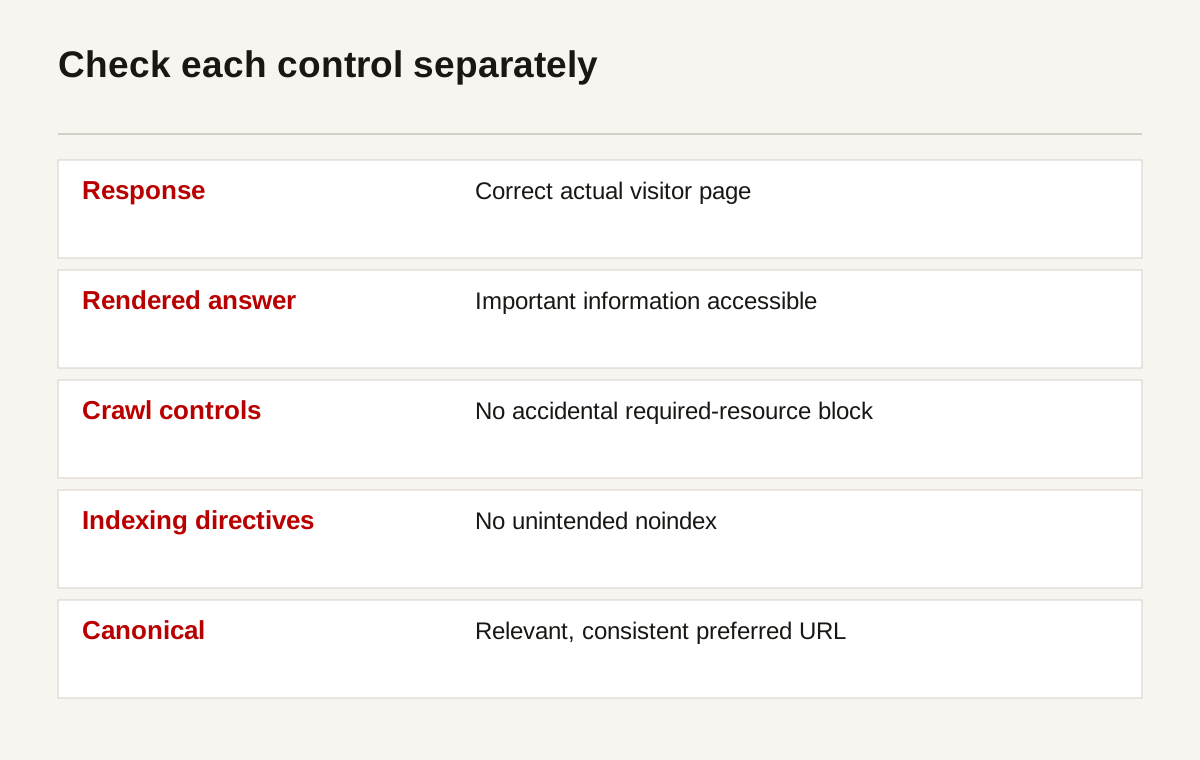
| Technical check | Why it matters | Inspection method | Pass condition for an intended public page |
|---|---|---|---|
| Public response | Establish whether the destination is available | Request and inspect the actual visitor URL | Expected successful response and correct page |
| Rendered content | Check whether the useful answer appears | Browser review and rendered inspection | Important information is accessible |
| Crawl controls | Identify unintended crawl restrictions | Inspect robots rules and applicable guidance | No accidental restriction on required resources |
| Indexing directive | Identify an accidental exclusion | Inspect meta and response headers | No unintended noindex directive |
| Canonical destination | Understand preferred duplicate handling | Inspect page and related URLs | Intended relevant destination, consistent signals |
| Sitemap | Check discoverable intended public URLs | Inspect generated sitemap | Correct public URLs rather than previews or drafts |
| Internal links | Find routes into important pages | Review real page links | Crawlable links and meaningful reader paths |
These are implementation checks, not a promise that Google will index or rank the page. Use Search Essentials as the general reference and the specific documentation for the control being inspected.
Google's robots.txt introduction and noindex guidance describe different mechanisms. Do not treat a crawl block as equivalent to an indexing directive. Have a developer verify the actual implementation and intended effect.
Keep staging and scheduled material out of the public path
A preview route may need restricted access or indexing control. An unpublished article should not appear in the public sitemap or related links before its release. Decide the intended state and test all those surfaces, not just the article page.
For duplicate handling, consult Google's canonical guidance. A canonical is not a substitute for a reader-friendly structure or a command that guarantees the search engine selects your preference.
For discovery, consult the sitemap overview. A submitted sitemap does not prove every entry is indexed. Keep the distinction between publishing, submitting, indexing and appearing in results in the status report.
Make the company and service unambiguous
Search-facing copy should still answer the buyer. Name the company accurately. Explain the service responsibility, relevant applications, coverage and limits. Keep contact and company records consistent across pages and maintained documents.
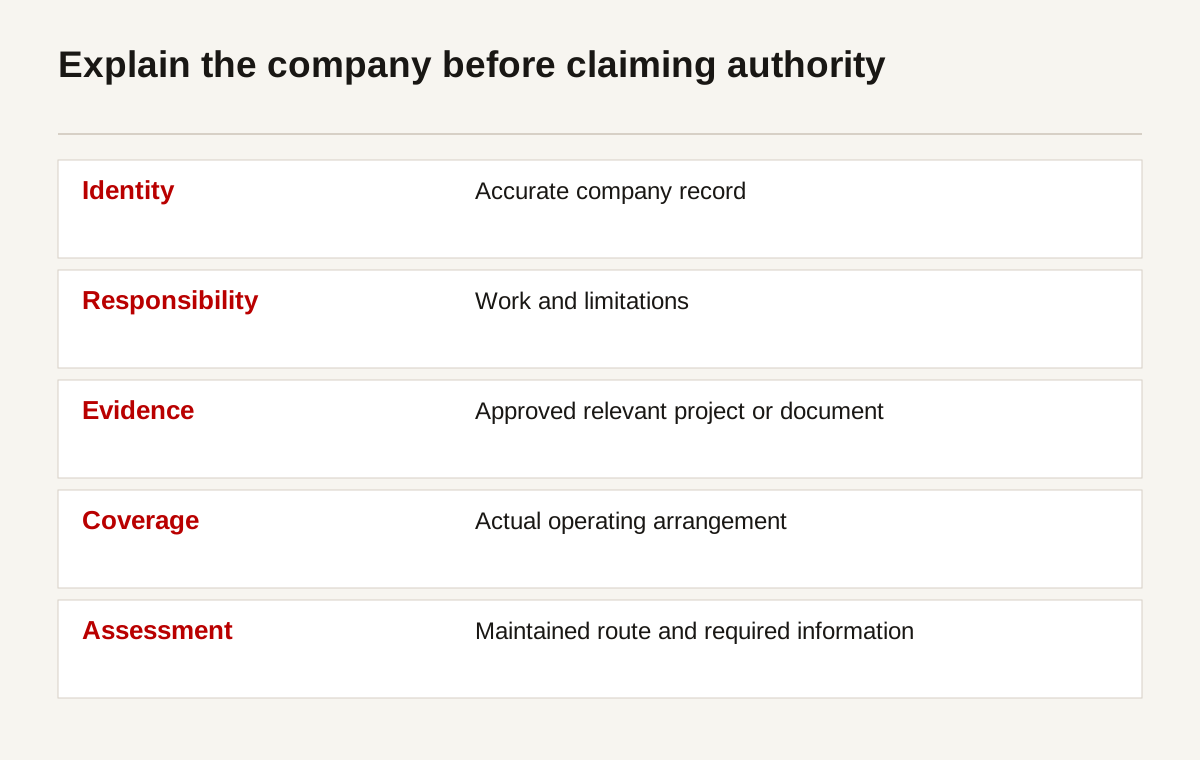
Avoid broad claims such as “trusted globally” when the page provides no relevant basis. An approved project showing a defined appointment is more useful than an unsupported superlative. Do not write “best” into every heading as a substitute for evidence.
Have a technical reviewer approve specifications and scope. Have a commercial owner approve responsibility and coverage. Have an editor make the explanation readable. Those tasks support each other, but none can replace the others.
Describe important conditions in normal page content
A buyer should not have to open a downloadable brochure to identify the main service or limitation. Put the useful summary on the page and connect it to controlled detail. Keep revisions consistent between the page and file.
Use descriptive titles and headings that match the answer. Do not insert a different claim into metadata to attract a click the page cannot satisfy. Google's title-link guidance is an implementation reference for concise, descriptive titles.
Check the public page on mobile. A large image may make the homepage impressive while pushing the scope out of view. A table may contain the answer but require an unusable interaction. Search visibility is only valuable when the destination remains useful.
Build a topic group around decisions, not word counts
A long guide can explain a complete decision. Supporting pages can answer narrower questions with more specific evidence. The relationship should make sense to the reader, not only to an SEO spreadsheet.
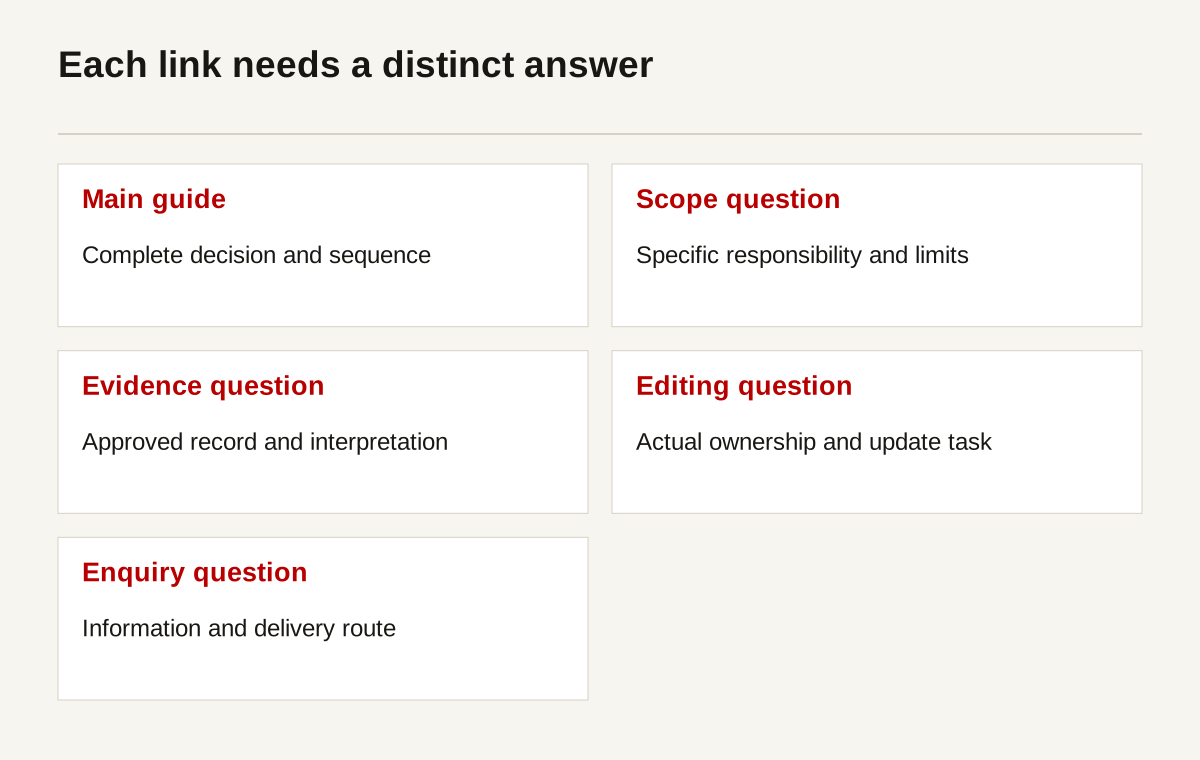
For example, an engineering website guide can explain planning from scope to launch. A supporting page might discuss specification revision or editing ownership. Another could explain a particular project responsibility. Each should contribute something the guide cannot fully cover without losing its focus.
Do not split a coherent answer into thin pages merely to create more links. Do not produce several lengthy guides that repeat the same method under different industry names. Decide which examples, evidence and questions make the page distinct.
Give each planned article an evidence requirement
Before scheduling, name the original contribution. It might be a useful worksheet, an approved project record, a method with explicit limitations or a carefully sourced comparison. If the contribution is only rephrased public information, improve the brief.
State who reviews the facts and who maintains the page. A publishing calendar with no review ownership is a production plan, not an editorial process. Keep enough capacity for correction and maintenance instead of treating every new page as finished forever.
A long article should remain navigable. Use descriptive headings, a contents route and readable examples. Length is a consequence of the questions covered. It is not a ranking requirement or proof that the page deserves to replace shorter, accurate answers.
Use evidence that survives inspection
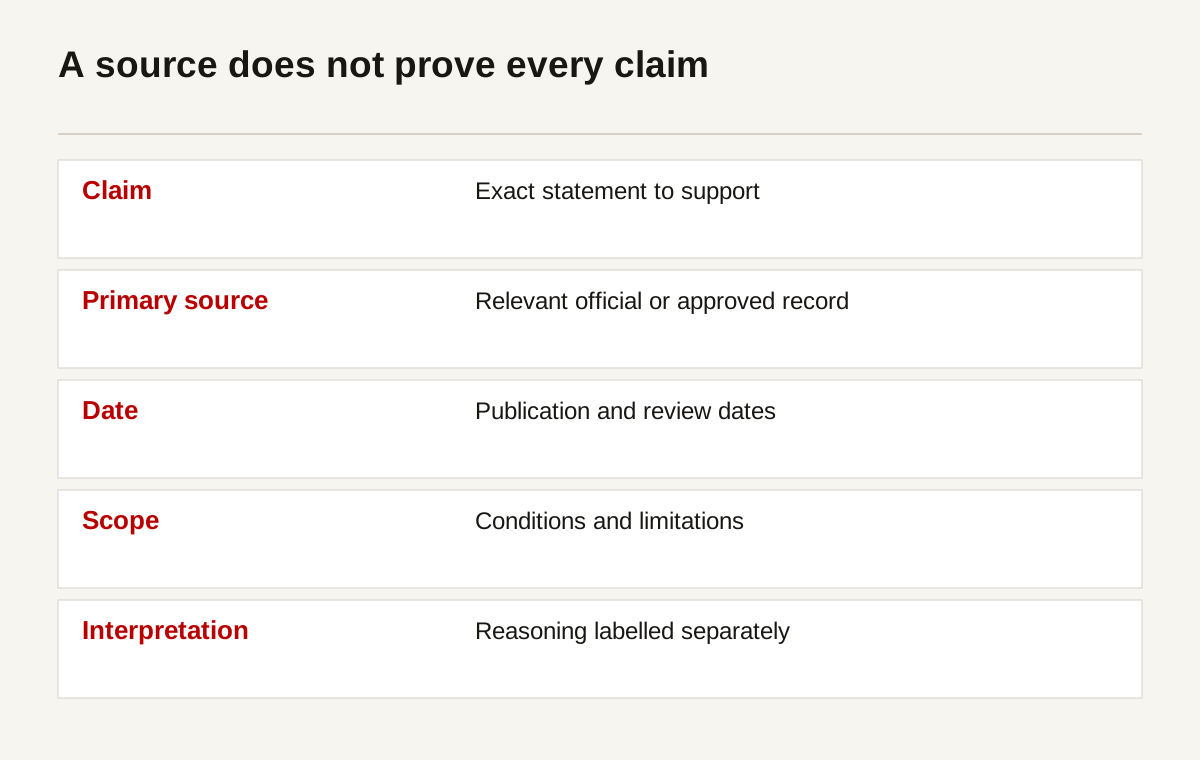
For each material claim, record its source, scope, date and approval owner. Distinguish public guidance, company facts, measured results and editorial recommendations. A footnote cannot turn an unrelated source into evidence for a specific claim.
| Content claim | Evidence needed | Responsible reviewer | Review trigger |
|---|---|---|---|
| Current service capability | Approved scope and operating record | Service owner | Capability or responsibility changes |
| Product condition | Controlled manufacturer or technical source | Technical owner | Model or revision changes |
| Project result | Defined measurement and publication permission | Data and client owners | New interpretation or correction |
| Regulatory statement | Applicable current primary material | Competent responsible reviewer | Rule or jurisdiction changes |
| Search requirement | Relevant official documentation | Search and development owner | Platform guidance changes |
| Planning recommendation | Explicit reasoning and limitations | Editorial owner | Feedback or contrary evidence |
Use primary sources for technical or regulatory claims. Check that the source says what the sentence needs. A page about vessel certification does not prove a supplier holds a specific approval. A search guidance page does not prove a design change increased revenue.
Do not manufacture original research. If you have no permission to inspect client analytics, use a clearly labelled method or example. If interviews were not conducted, do not imply that decision-makers told you something. Original usefulness can come from a careful working tool, not only a survey.
Give visuals a data and permission record
A chart needs defined units, periods and source. A photograph needs accurate context and rights. A diagram needs a label explaining whether it shows actual records or an illustrative process. A screenshot needs an inspected date and a clear boundary on what it proves.
Use Google's image guidance for discoverability and page context. Use the W3C image tutorial for the information purpose and text alternative. The caption should not claim a result the image cannot establish.
For data comparisons, preserve the original conditions. Do not combine forecast and actual values without labels. Do not turn separate units into one apparent trend. Include an accessible table or download where a reader needs the underlying values.
Connect pages and structured data to visible content
Internal links should help someone reach a useful next answer. Link a service to relevant work, a guide to a specific supporting record and a contact instruction to the assessment route. Use meaningful text instead of repeating a target phrase everywhere.
Google's crawlable-link guidance provides the technical context. The editorial question remains whether the destination is relevant and available. Do not link a scheduled article before it is public simply to make the group look complete.
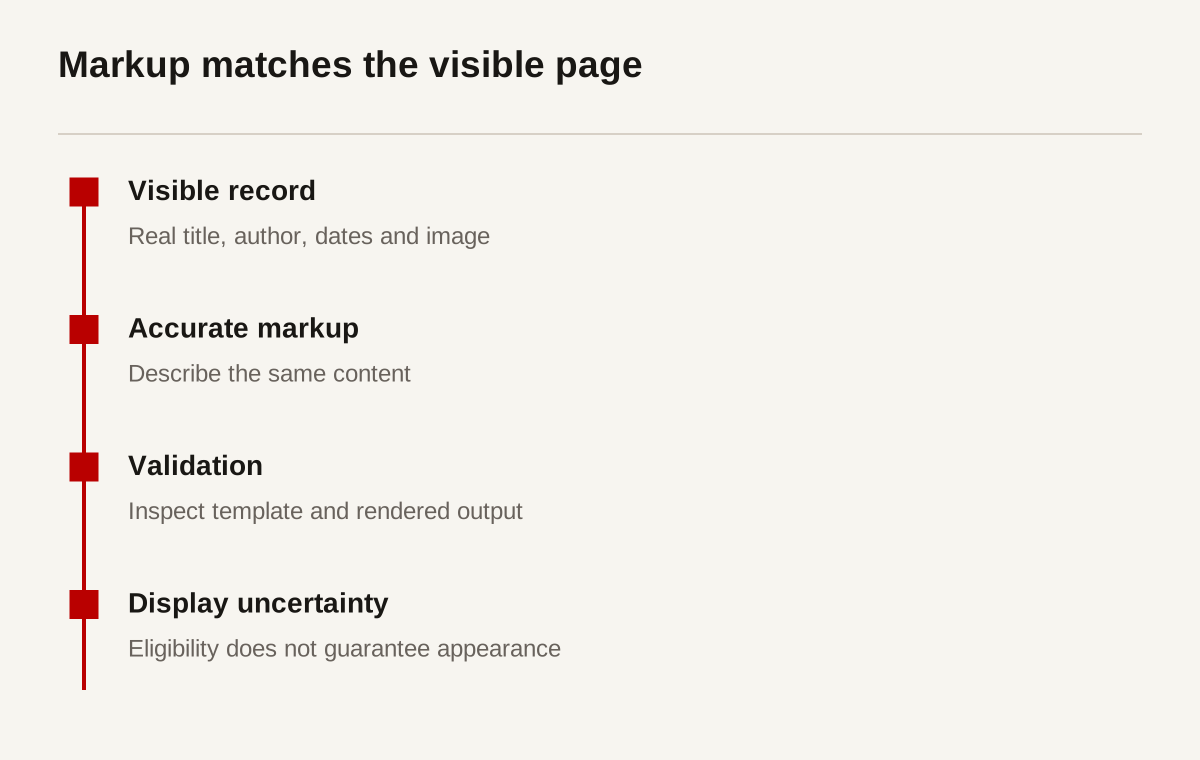
Use structured data only where it accurately describes the page. Google's structured-data introduction and Article documentation provide the implementation reference. Valid markup does not guarantee a rich result or an AI citation.
Do not use metadata to invent authority
The organisation or author should be real and accurately represented. The publication and modification dates should reflect the page record. Do not label routine publication as peer-reviewed research when no such review took place.
Keep schema, metadata and visible copy aligned. A review rating that does not exist on the page is not made legitimate by putting it in JSON. A publication date should not be repeatedly reset to make old material appear new.
Test the rendered page after deployment. A correct source file can still become wrong output through a template or caching issue. Inspect canonical, metadata, structured data, public links and images on the actual visitor route.
Handle languages and markets as real content responsibilities
Identify which overseas readers you can serve and what they need to know. A market page may explain a delivery arrangement or local assessment route. A language page may make technical information readable. These purposes should not be confused.
Use Google's multilingual and multi-regional guidance for the search implementation. Maintain the actual content, links and language relationships. Do not assume that selecting a region label establishes local presence or eligibility.
For Singapore and Malaysia, verify the service and contact arrangement rather than relying on proximity. For Australia, the UK, Germany and France, state relevant coverage and time-zone information accurately. Technical conditions and procurement requirements may need a competent local review.
Maintain translations when the source changes
Use reviewers who understand the service. Preserve product names, units, limitations and document revisions. A fluent sentence that changes the technical scope is not an acceptable translation.
Assign a source-change process. When a capability, contact or credential changes, identify the affected language pages and downloads. Do not keep distributing a translated version of a claim that the original page has corrected.
Avoid automatic redirection that makes the visitor's desired language or region difficult to access. Test actual navigation and links. The implementation should support the reader's task, not merely satisfy a country-page count.
Measure observed search and sampled AI answers separately
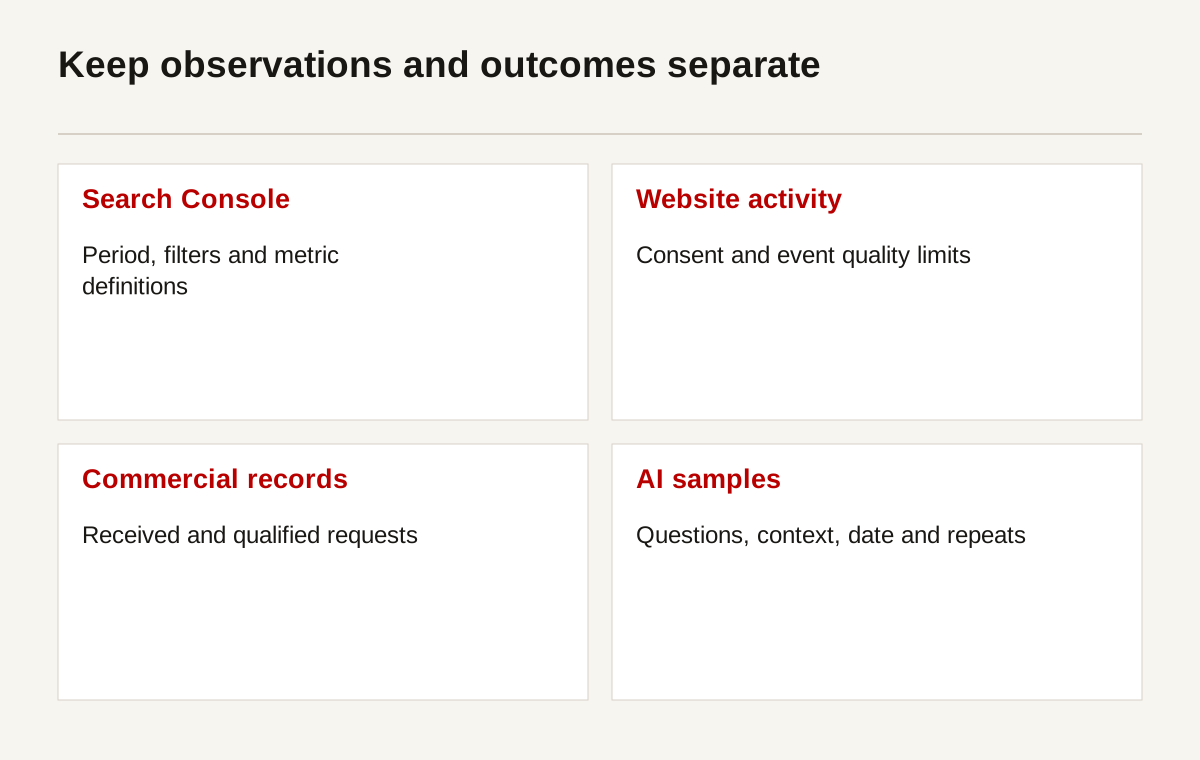
Use authorised Search Console access for actual search reports. Google's Search Console introduction explains the available starting tools. Do not create a chart resembling a client report when you have no permission or data.
| Measure | Collection method | Important uncertainty | Decision it can support |
|---|---|---|---|
| Search impressions and clicks | Authorised Search Console report | Report scope, filters and platform definitions | Which relevant pages or queries need inspection |
| Observed website activity | Properly implemented analytics | Consent, browser restrictions and event quality | Whether the task path appears usable |
| Received enquiries | Receiving-system records | Duplicates, spam and missing qualification | Whether requests reach the business |
| Qualified opportunities | Agreed commercial definitions | Long cycles and several contributing channels | Whether work matches the company's aims |
| Sampled AI mentions | Recorded questions, context, date and repeats | Non-representative answers and changing services | Which factual explanations need review |
| Cited destination accuracy | Inspect actual answer links | A citation does not establish recommendation | Whether the cited page answers the question |
Consult the Search Console performance overview and metric definitions before comparing impressions, clicks or positions. Keep the selected period and filters visible. Do not treat an average position as a fixed rank for every user.
Predefine an AI observation method
Write the questions before collecting answers. Record the service, available version information, date, language, location context and whether prior conversation influenced the response. Decide the repeats and classification rules. Keep the exact responses where permitted.
Separate mention, recommendation and citation. A company listed in a comparison is not necessarily endorsed. A source linked for one fact may not be recommended as a supplier. Count these separately and report the sample size and limitations.
Do not describe a hand-picked set of favourable screenshots as market share. A repeated observation can support investigation. It cannot establish complete visibility across all services, questions and users. This article contains a recording template, not fabricated observation results.
Separate launch work from continued improvement
The initial website project should have defined search deliverables. These may include appropriate page structure, metadata, public access checks, meaningful links, image handling and a migration plan. Agree which are in scope and how they will be verified.
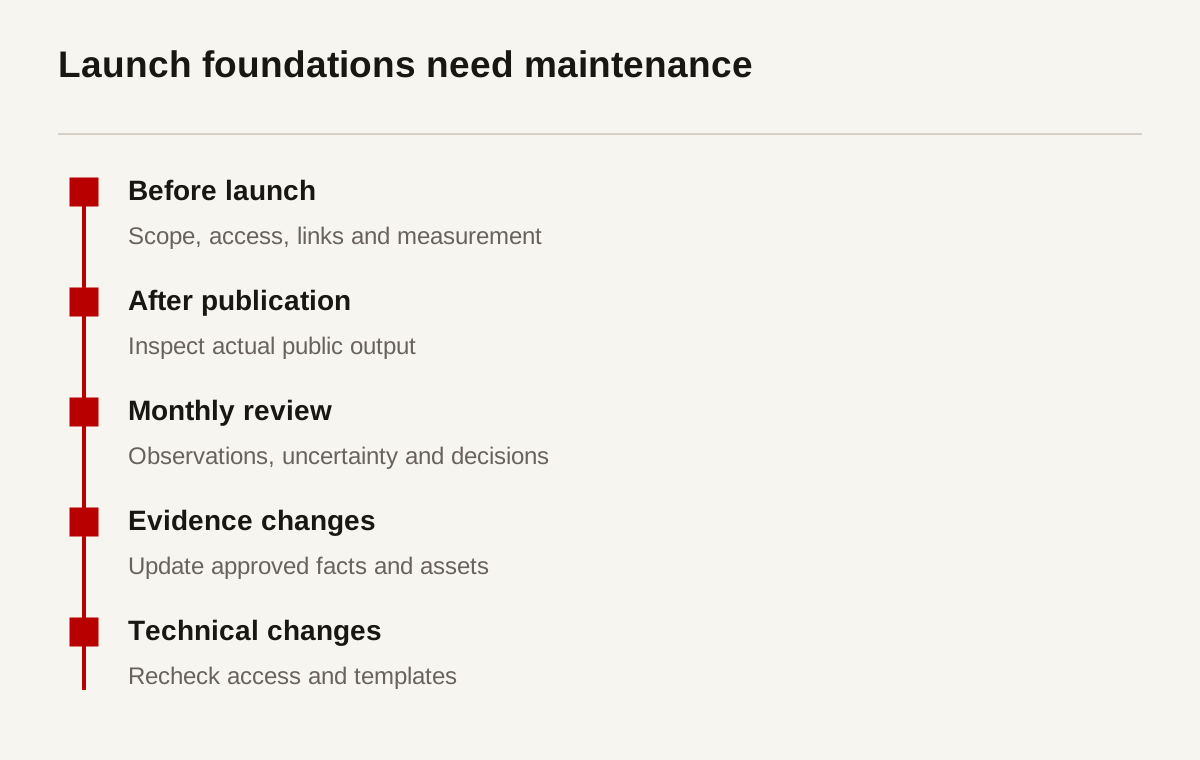
| Launch deliverable | Continued responsibility | Trigger | Responsible team |
|---|---|---|---|
| Approved service structure | Maintain scope and limitations | Business changes | Commercial and service owners |
| Search-facing metadata | Review accuracy and relevant purpose | Page changes or unclear observations | Editorial and search owners |
| Public access and index controls | Check deployment and template changes | Technical releases | Developer and search owner |
| Evidence and source records | Correct outdated facts and add useful proof | New approved evidence or source changes | Content and factual reviewers |
| Image and document handling | Maintain revisions, rights and readable exports | Asset or document changes | Editor and source owner |
| Measurement setup | Validate events and business definitions | System or consent changes | Analytics and commercial owners |
For a rebuild, use Google's URL-move guidance when addresses change. Map relevant destinations and review the transition. A website launch should not discard useful old addresses without a considered plan.
Define an ongoing engagement by work, not vague promises
Ask what is reviewed, what can be changed and who supplies the evidence. A monthly report without decisions is not the same as continued improvement. A fixed article quota without factual reviewers may create maintenance debt.
Set approval boundaries. The search team can propose a page; the company must verify its capabilities. The developer can repair an indexing fault; the commercial team must decide the correct scope. Useful ongoing work requires those handoffs.
No provider should promise automatic rankings or citations. Agree observable deliverables and a review method instead. Business outcomes still depend on relevance, competition, buying conditions and the company's ability to respond.
Build the first ninety-day review
In the first month, agree buyer questions and inspect existing pages. Repair material scope errors, public-access faults and broken enquiry delivery. Establish an authorised baseline. Record unknowns rather than producing charts from assumptions.
In the second month, improve a small group of relevant pages. Collect approved evidence, clarify structure and connect useful answers. Inspect metadata and public links after deployment. Use task checks to confirm that readers can identify the scope and next step.
In the third month, compare observations and enquiry quality within their limits. Review source changes and maintenance faults. Decide whether the next priority is a new answer, better evidence, technical repair or a different commercial route.
Use the workbook without turning it into a target factory
The workbook contains an intent map, technical checklist, source register, monthly review and AI observation log. Example rows are labelled. They contain no researched search volumes or client performance.
Complete the intent map with real buyer questions. Use the technical checklist on public pages you control. Give factual claims an owner in the source register. In the monthly review, record the observation, uncertainty and decision rather than only a metric.
The AI log records a method without inventing results. Use it only for observations you actually collect. Neither the workbook nor CSV pack contains macros, private analytics or a promise of visibility.
Questions to ask an SEO or AI-search provider
Is one-time SEO enough?
An initial implementation can establish foundations. It cannot keep a changing service, document library or website template accurate forever. The necessary continued work depends on actual changes and observations. Define the launch checks and later responsibilities separately.
Do we need a special AI file?
Do not accept that as a requirement without the relevant platform's official documentation. Google's published guidance does not prescribe a special AI file for its AI search features. A file alone is not a substitute for accessible, accurate answers.
Will longer articles rank better?
Length is not a guarantee. A guide should cover the decision with useful evidence and navigation. A shorter answer may be better for a narrow question. Do not add paragraphs solely to reach a word count or call repetition depth.
Can we promise a place in Google AI summaries?
No. You can improve the page foundations, relevance and evidence, then observe what happens. Eligibility is not inclusion, and an observed citation is not a permanent position or guaranteed source of enquiries.
Build the foundation, then maintain the answer
At Creatif Work, we connect search work to the information a buyer needs and the process that follows. A website build can establish readable structure, maintained content and an assessment route. It should not be sold as permanent search success.
Our SEO and AI-search work addresses continued content review, evidence, technical checks and measurement where those are needed. The work is human-led and tied to explicit decisions, not an algorithm shortcut.
Sources and scope
Sources were reviewed on 1 October 2026. Platform documentation and reports can change. Recheck the relevant official page before implementing a specific control.
- Google AI features and Search Essentials: established search foundations and AI-feature context.
- Google spam policies: content and manipulation-policy context.
- Google robots.txt, noindex, canonical guidance and sitemaps: distinct crawl, indexing and discovery controls.
- Google title links, image guidance and crawlable links: page presentation and connection.
- Google structured data and Article guidance: accurate markup, not guaranteed display.
- Google multilingual sites and URL moves: language and migration implementation.
- Search Console introduction, performance report and metric definitions: authorised observation and measurement limits.
- W3C image tutorial: accessible image purpose.
No client account was audited to produce this article. Its examples are working methods, not measured findings. Search and AI observations need their own authorised collection and clear limitations before any performance claim is made.